
Recent from talks
Tilottama
Knowledge base stats:
Talk channels stats:
Members stats:
Tilottama
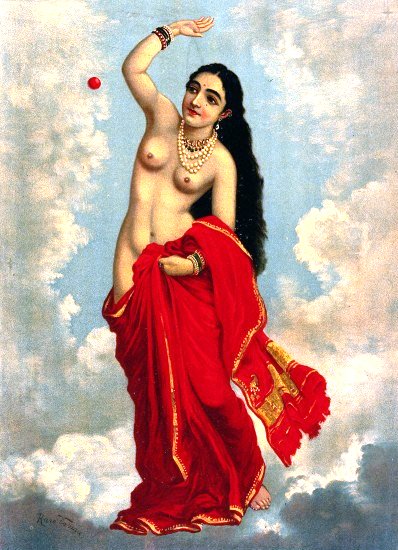
Tilottama (Sanskrit: तिलोत्तमा, romanized: Tilottamā), is an apsara (celestial nymph) described in Hindu mythology.
"Tila" is a Sanskrit word for a small particle and "uttama" means the ultimate. Tilottama, therefore, means the being whose smallest particle is the finest or one who is composed of the finest and highest qualities.
In the Hindu epic Mahabharata, Tilottama is described to have been created by the divine architect Vishvakarma, at Brahma's request, by taking the best quality of everything as the ingredients. She is responsible for bringing about the mutual destruction of the asuras (a class of malevolent beings), Sunda and Upasunda. Even devas (a class of benevolent beings) like Indra are described to be enamoured of Tilottama.
While a legend talks about a pre-birth as an ugly widow, another narrates how she was cursed to be born as a daitya princess Usha by sage Durvasa.
In the Adi Parva (Book 1) of the epic Mahabharata, the divine sage Narada tells the Pandava brothers the story of the destruction of asura brothers Sunda and Upasunda due to the apsara Tilottama and warns the Pandavas that their common wife Draupadi could be a reason of quarrel between them. The tale states Sunda and Upasunda were sons of the asura Nikumbha. They are described as inseparable siblings who shared everything: the kingdom, the bed, food, house, a seat. Once, the brothers practiced severe austerities on the Vindhya mountains, compelling the creator-god Brahma to grant them a boon. They asked for great power and immortality, but the latter was denied, instead, Brahma gave them the boon that nothing but they themselves can hurt each other. Soon, the asuras attacked Svarga and drove the devas out. Conquering the whole universe, the asuras started harassing sages and creating havoc in the universe.
The devas and seers sought refuge with Brahma. Brahma then ordered the divine architect Vishvakarma to create a beautiful woman. Vishvakarma collected all that was beautiful from the three worlds (Svarga, earth, Patala) and all the gems of the world and created an alluring woman - with unrivalled beauty - from them. As she was created bit by bit from the gems, Brahma named her Tilottama and directed her to seduce the asura brothers to the extent that she would become an issue of contention between them.
As Sunda and Upasunda were enjoying a dalliance with women and engrossed in drinking liquor along a riverbank in the Vindhya mountains, Tilottama appeared there plucking flowers. Bewitched by her voluptuous figure and drunk with power and liquor, Sunda and Upasunda took hold of Tilottama's right and left hands respectively. As both of the brothers argued that Tilottama should be his own wife, they grabbed their clubs and attacked each other, ultimately killing each other. The devas congratulated her and Brahma granted her the right to roam freely in the universe as a boon. Brahma also decreed that no one would be able to look at her for a long time due to her luster.
The Mahabharata (Book 1: Adi Parva) narrates: Though Brahma was unaffected by Tilottama's beauty, the other devas were spell-bound by her beauty. Initially, Shiva and Indra remain unperturbed, however, so great was the desire of the great god Shiva (referred to as "Sthanu" - the firm one) to see her, a head developed on both his sides and back of his head as she circumambulated him as a mark of reverence. The king of Svarga, Indra, however, developed thousand red eyes on his body to see her. Another legend describes sage Gautama cursing Indra for seducing his wife Ahalya. Gautama decreed that Indra would develop a thousand vaginas on his body, but they change to thousand eyes once Indra lays his eyes on Tiliottama.
Hub AI
Tilottama AI simulator
(@Tilottama_simulator)
Tilottama
Tilottama (Sanskrit: तिलोत्तमा, romanized: Tilottamā), is an apsara (celestial nymph) described in Hindu mythology.
"Tila" is a Sanskrit word for a small particle and "uttama" means the ultimate. Tilottama, therefore, means the being whose smallest particle is the finest or one who is composed of the finest and highest qualities.
In the Hindu epic Mahabharata, Tilottama is described to have been created by the divine architect Vishvakarma, at Brahma's request, by taking the best quality of everything as the ingredients. She is responsible for bringing about the mutual destruction of the asuras (a class of malevolent beings), Sunda and Upasunda. Even devas (a class of benevolent beings) like Indra are described to be enamoured of Tilottama.
While a legend talks about a pre-birth as an ugly widow, another narrates how she was cursed to be born as a daitya princess Usha by sage Durvasa.
In the Adi Parva (Book 1) of the epic Mahabharata, the divine sage Narada tells the Pandava brothers the story of the destruction of asura brothers Sunda and Upasunda due to the apsara Tilottama and warns the Pandavas that their common wife Draupadi could be a reason of quarrel between them. The tale states Sunda and Upasunda were sons of the asura Nikumbha. They are described as inseparable siblings who shared everything: the kingdom, the bed, food, house, a seat. Once, the brothers practiced severe austerities on the Vindhya mountains, compelling the creator-god Brahma to grant them a boon. They asked for great power and immortality, but the latter was denied, instead, Brahma gave them the boon that nothing but they themselves can hurt each other. Soon, the asuras attacked Svarga and drove the devas out. Conquering the whole universe, the asuras started harassing sages and creating havoc in the universe.
The devas and seers sought refuge with Brahma. Brahma then ordered the divine architect Vishvakarma to create a beautiful woman. Vishvakarma collected all that was beautiful from the three worlds (Svarga, earth, Patala) and all the gems of the world and created an alluring woman - with unrivalled beauty - from them. As she was created bit by bit from the gems, Brahma named her Tilottama and directed her to seduce the asura brothers to the extent that she would become an issue of contention between them.
As Sunda and Upasunda were enjoying a dalliance with women and engrossed in drinking liquor along a riverbank in the Vindhya mountains, Tilottama appeared there plucking flowers. Bewitched by her voluptuous figure and drunk with power and liquor, Sunda and Upasunda took hold of Tilottama's right and left hands respectively. As both of the brothers argued that Tilottama should be his own wife, they grabbed their clubs and attacked each other, ultimately killing each other. The devas congratulated her and Brahma granted her the right to roam freely in the universe as a boon. Brahma also decreed that no one would be able to look at her for a long time due to her luster.
The Mahabharata (Book 1: Adi Parva) narrates: Though Brahma was unaffected by Tilottama's beauty, the other devas were spell-bound by her beauty. Initially, Shiva and Indra remain unperturbed, however, so great was the desire of the great god Shiva (referred to as "Sthanu" - the firm one) to see her, a head developed on both his sides and back of his head as she circumambulated him as a mark of reverence. The king of Svarga, Indra, however, developed thousand red eyes on his body to see her. Another legend describes sage Gautama cursing Indra for seducing his wife Ahalya. Gautama decreed that Indra would develop a thousand vaginas on his body, but they change to thousand eyes once Indra lays his eyes on Tiliottama.
Recent media