



Community hub
Recent from talks
Knowledge base stats:
Talk channels stats:
Members stats:
Missions in Spanish Florida
Beginning in the second half of the 16th century, the Kingdom of Spain established missions in Spanish Florida (La Florida) in order to convert the indigenous tribes to Roman Catholicism, to facilitate control of the area, and to obstruct regional colonization by Protestants, particularly, those from England and France. Spanish Florida originally included much of what is now the Southeastern United States, although Spain never exercised long-term effective control over more than the northern part of what is now the State of Florida from present-day St. Augustine to the area around Tallahassee, southeastern Georgia, and some coastal settlements, such as Pensacola, Florida. A few short-lived missions were established in other locations, including Mission Santa Elena in present-day South Carolina, around the Florida peninsula, and in the interior of Georgia and Alabama.
The missions of what are now northern Florida and southeastern Georgia were divided into four main provinces where the bulk of missionary effort took place. These were Apalachee, comprising the eastern part of what is now the Florida Panhandle; Timucua, ranging from the St. Johns River west to the Suwanee; Mocama, the coastal areas east of the St. Johns running north to the Altamaha River; and Guale, north of the Altamaha River along the coast to the present-day Georgia Sea Islands. These provinces roughly corresponded to the areas where those dialects were spoken among the varying Native American peoples, thus, they reflected the territories of the peoples. Missionary provinces were relatively fluid and evolved over the years according to demographic and political trends, and at various times smaller provinces were established, abandoned, or merged with larger ones. There were also ephemeral attempts to establish missions elsewhere, particularly further south into Florida.
Although priests and religious (monks) had traveled with the early conquistadors, the 1549 expedition of Father Luis de Cancer and three other Dominicans to Tampa Bay was the first solely missionary effort attempted in La Florida. It ended in failure with de Cancer being clubbed to death by the Tocobaga natives soon after landing, which diminished Catholic interest in La Florida for sixteen years.
The first Spanish missions to La Florida, starting with the foundation of St. Augustine in 1565, were attached to presidios, or fortified bases. Between 1559 and 1567, ten presidios were established at major harbors from Port Royal Sound in modern South Carolina to Pensacola Bay on the northern Gulf of Mexico in an attempt to prevent other European powers from establishing bases on land claimed by Spain. Most of the presidios were unsustainable; San Mateo (near modern-day Jacksonville, Florida) was destroyed by the French, the entire garrison at Tocobago was wiped out, and most of the other presidios were abandoned due to a combination of hostility from the native inhabitants, difficulty in providing supplies, and damage from hurricanes.
By 1573, the only remaining presidios in La Florida were at St. Augustine and Santa Elena on Paris Island, South Carolina. Santa Elena was abandoned in 1587, leaving St. Augustine as the only sizeable Spanish settlement in La Florida. The mission system functioned for decades, as the Spanish convinced most village leaders to provide food and labor in exchange for tools and protection. Regular waves of European-borne disease along with conflict with Carolina colonists to the north weakened the system as the 1600s progressed. It collapsed in the aftermath of Queen Anne's War, when colonists from the Province of Carolina, along with their Creek allies, killed or kidnapped much of the remaining native population of Spanish Florida except in areas near St. Augustine and Pensacola. The network of missions was virtually destroyed by Carolina Governor James Moore's incursions into northern Florida between 1702 and 1709, a series of attacks that were later called the Apalachee massacre. Dozens of missions and surrounding villages were abandoned by the early 1700s and their locations lost, as was much of the former route of El Camino Real. As a result, only a few mission sites in Florida have been found and positively identified.
After French Huguenots under René Goulaine de Laudonnière established Fort Caroline on the St. Johns River in 1564, Phillip II, King of Spain, commissioned Pedro Menéndez de Avilés to drive the French out of Spanish Florida and to provide missionaries to the native inhabitants. In 1565, de Avilés founded St. Augustine and defeated the French. He quickly established a number of strong points, or presidios along the coast from Santa Elena in South Carolina down the length of the Florida peninsula and up the Gulf coast of Florida to Tampa Bay. Two of the presidios were in what is now the state of Georgia, on Guale (St. Catherines) Island (abandoned after three months) and at the Tacatacuru chiefdom on Cumberland (San Pedro) Island (abandoned in 1573). De Avilés had only four priests in his initial company, and three of those ministered to the garrisons at St. Augustine, Santa Elena, and San Mateo (on the site of the captured Fort Caroline). De Avilés asked the Society of Jesus to send missionaries to convert the natives. In the meantime, he appointed particularly pious lay persons at each presidio to instruct the natives on Christianity. De Aviles sent a secular priest to the town of Guale in 1566 to preach to the natives, but that priest was soon recalled and sent to Santa Elena. All of the presidios, except for St. Augustine and Santa Elena, were abandoned within four years. The first Jesuit missionaries arrived in Florida in 1566, soon followed by others. Jesuits started missions at the towns of Guale (on St. Catherines Island) and Tupiqui. Jesuit missionaries to the Guale complained that it was difficult to convert the natives to Christianity because they did not remain resident in one place, but moved to be near food resources as they became seasonally available. A Jesuit missionary, Father Pedro Martinez, and three companions attempted to establish a mission at Tacatacuru that year, but all four were killed by the Tacatacuru. Discouraged by the killings at Tacatacuru and a lack of progress in converting the Guale, the Jesuits withdrew from the Georgia coast and, in 1570, established the Ajacán Mission in what is now the state of Virginia. All of those missionaries were killed a few months later. The surviving Jesuit missionaries were withdrawn from Spanish Florida in 1572. There are indications that a Franciscan friar was resident in Tupiqui on the Sapelo River in 1569–1570, and that in the 1570s Theatine friars established a mission in the town of Guale, but little has been found about those missions in Spanish records.
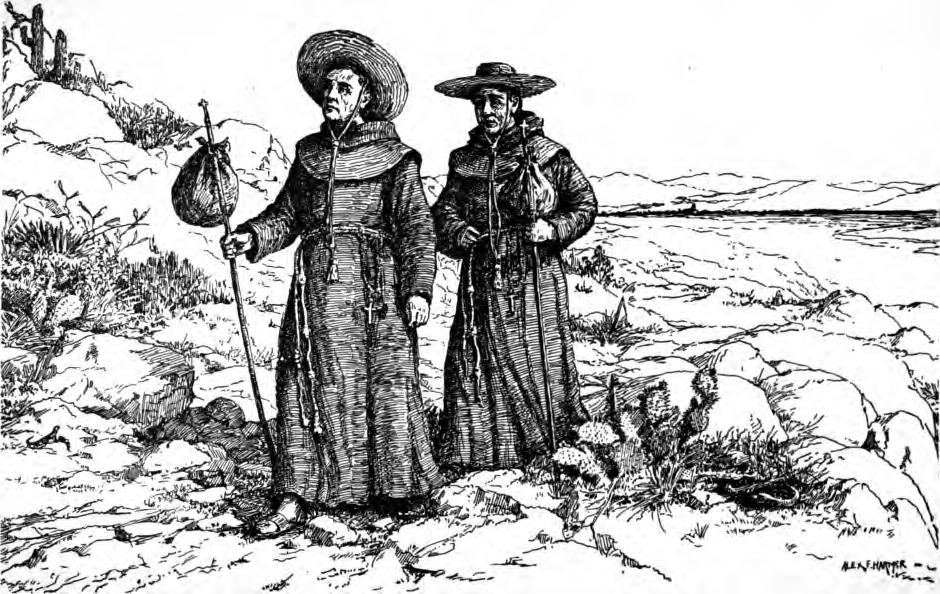
The missions at the presidios were staffed by the Jesuits. Due to the hostility of the Native Americans, which resulted in the killing of several of the missionaries, the Jesuits withdrew from the mission field in La Florida in 1572. Franciscan friars entered into La Florida in 1573, but at first confined their activities to the immediate vicinity of St. Augustine. The Franciscans began taking their mission to the Guale and Timucua along the Atlantic coast in 1587. Starting in 1606 the Franciscans expanded their mission efforts westward across northern Florida along a primitive but lengthy road known as El Camino Real. The road and the network of missions stretched across the Florida panhandle through the territory of the Timucua and reached the Apalachees in the vicinity of modern Tallahassee by 1633.
Before de Avilés left Florida for the final time in 1572, he requested missionaries be sent by the Franciscans. The first Franciscan friars arrived at Santa Elena in 1573, and over the next few years a few Franciscans served in Spanish Florida, primarily in the garrison towns of St. Augustine and Santa Elena. Four Franciscan priests arrived in Florida in 1584, and another twelve arrived in Spanish Florida in 1587, one year after the presidio and town at Santa Elena had been abandoned. The Franciscan missionaries were assigned to native towns, primarily near St. Augustine, but including a mission on Cumberland Island, San Pedro de Mocama, established in 1587. Few of those Fransciscans remained in Spanish Florida for very long, with only five left in 1592. More Franciscans arrived in 1595, and six more missions were established that year along the Georgia coast, including at Puturiba near the northern end of Cumberland Island (in Mocama Province), and five in Guale Province, at Tupiqui on the Sapelo River, Asao at the mouth of the Altamaha River, Talapo (or Ospo) on the mainland near Sapelo Island, Tolomato on the mainland near St. Catherines Island, and on Guale (St. Catherines) Island. Another mission was established in Ibi (Yui) Province the following year. In 1597, the Spanish visited Tama, their name for the area west of Guale Province. Gonzalo Méndez de Canço, governor of Florida, proposed establishing a mission in Tama, but was refused permission to do so because the area was considered to be too far from St. Augustine.
Hub AI
Missions in Spanish Florida AI simulator
(@Missions in Spanish Florida_simulator)
Missions in Spanish Florida
Beginning in the second half of the 16th century, the Kingdom of Spain established missions in Spanish Florida (La Florida) in order to convert the indigenous tribes to Roman Catholicism, to facilitate control of the area, and to obstruct regional colonization by Protestants, particularly, those from England and France. Spanish Florida originally included much of what is now the Southeastern United States, although Spain never exercised long-term effective control over more than the northern part of what is now the State of Florida from present-day St. Augustine to the area around Tallahassee, southeastern Georgia, and some coastal settlements, such as Pensacola, Florida. A few short-lived missions were established in other locations, including Mission Santa Elena in present-day South Carolina, around the Florida peninsula, and in the interior of Georgia and Alabama.
The missions of what are now northern Florida and southeastern Georgia were divided into four main provinces where the bulk of missionary effort took place. These were Apalachee, comprising the eastern part of what is now the Florida Panhandle; Timucua, ranging from the St. Johns River west to the Suwanee; Mocama, the coastal areas east of the St. Johns running north to the Altamaha River; and Guale, north of the Altamaha River along the coast to the present-day Georgia Sea Islands. These provinces roughly corresponded to the areas where those dialects were spoken among the varying Native American peoples, thus, they reflected the territories of the peoples. Missionary provinces were relatively fluid and evolved over the years according to demographic and political trends, and at various times smaller provinces were established, abandoned, or merged with larger ones. There were also ephemeral attempts to establish missions elsewhere, particularly further south into Florida.
Although priests and religious (monks) had traveled with the early conquistadors, the 1549 expedition of Father Luis de Cancer and three other Dominicans to Tampa Bay was the first solely missionary effort attempted in La Florida. It ended in failure with de Cancer being clubbed to death by the Tocobaga natives soon after landing, which diminished Catholic interest in La Florida for sixteen years.
The first Spanish missions to La Florida, starting with the foundation of St. Augustine in 1565, were attached to presidios, or fortified bases. Between 1559 and 1567, ten presidios were established at major harbors from Port Royal Sound in modern South Carolina to Pensacola Bay on the northern Gulf of Mexico in an attempt to prevent other European powers from establishing bases on land claimed by Spain. Most of the presidios were unsustainable; San Mateo (near modern-day Jacksonville, Florida) was destroyed by the French, the entire garrison at Tocobago was wiped out, and most of the other presidios were abandoned due to a combination of hostility from the native inhabitants, difficulty in providing supplies, and damage from hurricanes.
By 1573, the only remaining presidios in La Florida were at St. Augustine and Santa Elena on Paris Island, South Carolina. Santa Elena was abandoned in 1587, leaving St. Augustine as the only sizeable Spanish settlement in La Florida. The mission system functioned for decades, as the Spanish convinced most village leaders to provide food and labor in exchange for tools and protection. Regular waves of European-borne disease along with conflict with Carolina colonists to the north weakened the system as the 1600s progressed. It collapsed in the aftermath of Queen Anne's War, when colonists from the Province of Carolina, along with their Creek allies, killed or kidnapped much of the remaining native population of Spanish Florida except in areas near St. Augustine and Pensacola. The network of missions was virtually destroyed by Carolina Governor James Moore's incursions into northern Florida between 1702 and 1709, a series of attacks that were later called the Apalachee massacre. Dozens of missions and surrounding villages were abandoned by the early 1700s and their locations lost, as was much of the former route of El Camino Real. As a result, only a few mission sites in Florida have been found and positively identified.
After French Huguenots under René Goulaine de Laudonnière established Fort Caroline on the St. Johns River in 1564, Phillip II, King of Spain, commissioned Pedro Menéndez de Avilés to drive the French out of Spanish Florida and to provide missionaries to the native inhabitants. In 1565, de Avilés founded St. Augustine and defeated the French. He quickly established a number of strong points, or presidios along the coast from Santa Elena in South Carolina down the length of the Florida peninsula and up the Gulf coast of Florida to Tampa Bay. Two of the presidios were in what is now the state of Georgia, on Guale (St. Catherines) Island (abandoned after three months) and at the Tacatacuru chiefdom on Cumberland (San Pedro) Island (abandoned in 1573). De Avilés had only four priests in his initial company, and three of those ministered to the garrisons at St. Augustine, Santa Elena, and San Mateo (on the site of the captured Fort Caroline). De Avilés asked the Society of Jesus to send missionaries to convert the natives. In the meantime, he appointed particularly pious lay persons at each presidio to instruct the natives on Christianity. De Aviles sent a secular priest to the town of Guale in 1566 to preach to the natives, but that priest was soon recalled and sent to Santa Elena. All of the presidios, except for St. Augustine and Santa Elena, were abandoned within four years. The first Jesuit missionaries arrived in Florida in 1566, soon followed by others. Jesuits started missions at the towns of Guale (on St. Catherines Island) and Tupiqui. Jesuit missionaries to the Guale complained that it was difficult to convert the natives to Christianity because they did not remain resident in one place, but moved to be near food resources as they became seasonally available. A Jesuit missionary, Father Pedro Martinez, and three companions attempted to establish a mission at Tacatacuru that year, but all four were killed by the Tacatacuru. Discouraged by the killings at Tacatacuru and a lack of progress in converting the Guale, the Jesuits withdrew from the Georgia coast and, in 1570, established the Ajacán Mission in what is now the state of Virginia. All of those missionaries were killed a few months later. The surviving Jesuit missionaries were withdrawn from Spanish Florida in 1572. There are indications that a Franciscan friar was resident in Tupiqui on the Sapelo River in 1569–1570, and that in the 1570s Theatine friars established a mission in the town of Guale, but little has been found about those missions in Spanish records.
The missions at the presidios were staffed by the Jesuits. Due to the hostility of the Native Americans, which resulted in the killing of several of the missionaries, the Jesuits withdrew from the mission field in La Florida in 1572. Franciscan friars entered into La Florida in 1573, but at first confined their activities to the immediate vicinity of St. Augustine. The Franciscans began taking their mission to the Guale and Timucua along the Atlantic coast in 1587. Starting in 1606 the Franciscans expanded their mission efforts westward across northern Florida along a primitive but lengthy road known as El Camino Real. The road and the network of missions stretched across the Florida panhandle through the territory of the Timucua and reached the Apalachees in the vicinity of modern Tallahassee by 1633.
Before de Avilés left Florida for the final time in 1572, he requested missionaries be sent by the Franciscans. The first Franciscan friars arrived at Santa Elena in 1573, and over the next few years a few Franciscans served in Spanish Florida, primarily in the garrison towns of St. Augustine and Santa Elena. Four Franciscan priests arrived in Florida in 1584, and another twelve arrived in Spanish Florida in 1587, one year after the presidio and town at Santa Elena had been abandoned. The Franciscan missionaries were assigned to native towns, primarily near St. Augustine, but including a mission on Cumberland Island, San Pedro de Mocama, established in 1587. Few of those Fransciscans remained in Spanish Florida for very long, with only five left in 1592. More Franciscans arrived in 1595, and six more missions were established that year along the Georgia coast, including at Puturiba near the northern end of Cumberland Island (in Mocama Province), and five in Guale Province, at Tupiqui on the Sapelo River, Asao at the mouth of the Altamaha River, Talapo (or Ospo) on the mainland near Sapelo Island, Tolomato on the mainland near St. Catherines Island, and on Guale (St. Catherines) Island. Another mission was established in Ibi (Yui) Province the following year. In 1597, the Spanish visited Tama, their name for the area west of Guale Province. Gonzalo Méndez de Canço, governor of Florida, proposed establishing a mission in Tama, but was refused permission to do so because the area was considered to be too far from St. Augustine.