Hubbry Logo
TimucuaTimucuaMain
Open search
Timucua
Community hub
Timucua
logo
8 pages, 0 posts
0 subscribers
Be the first to start a discussion here.
Timucua
Timucua
from Wikipedia

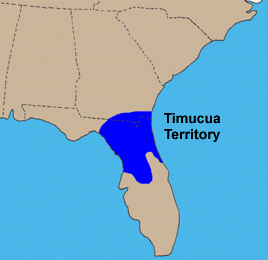
The Timucua were a Native American people who lived in Northeast and North Central Florida and southeast Georgia. They were the largest indigenous group in that area and consisted of about 35 chiefdoms, many leading thousands of people. The various groups of Timucua spoke several dialects of the Timucua language. At the time of European contact, Timucuan speakers occupied about 19,200 square miles (50,000 km2) in the present-day states of Florida and Georgia, with an estimated population of 200,000. Milanich notes that the population density calculated from those figures, 10.4 per square mile (4.0/km2) is close to the population densities calculated by other authors for the Bahamas and for Hispaniola at the time of first European contact.[1][2][page needed] The territory occupied by Timucua speakers stretched from the Altamaha River and Cumberland Island in present-day Georgia as far south as Lake George in central Florida, and from the Atlantic Ocean west to the Aucilla River in the Florida Panhandle, though it reached the Gulf of Mexico at no more than a couple of points.

Key Information

The name "Timucua" (recorded by the French as Thimogona but this is likely a misprint for Thimogoua) came from the exonym used by the Saturiwa (of what is now Jacksonville) to refer to the Utina, another group to the west of the St. Johns River. The Spanish came to use the term more broadly for other peoples in the area.[3] Eventually it became the common term for all peoples who spoke what is known as Timucuan.

While alliances and confederacies arose between the chiefdoms from time to time, the Timucua were never organized into a single political unit.[2][page needed] The various groups of Timucua speakers practiced several different cultural traditions.[4] The people suffered severely from the introduction of Eurasian infectious diseases. By 1595, their population was estimated to have been reduced from 200,000 to 50,000 and thirteen chiefdoms remained. By 1700, the population of the tribe had been reduced to an estimated 1,000 due to slave raids from Carolinian settlers and their Indian allies. The local slave trade completed their extinction as a tribe soon after the turn of the 18th century.

Meaning

[edit]

The word "Timucuan" may derive from "Thimogona" or "Tymangoua", an exonym used by the Saturiwa chiefdom of present-day Jacksonville for their enemies, the Utina, who lived inland along the St. Johns River. Both groups spoke dialects of the Timucua language. The French followed the Saturiwa in this usage, but the Spanish applied the term "Timucua" much more widely to groups within a wide section of interior North Florida.[3][5] In the 16th century they designated the area north of the Santa Fe River between the St. Johns and Suwannee Rivers (roughly the area of the group known as the Northern Utina) as the Timucua Province, which they incorporated into the mission system. The dialect spoken in that province became known as "Timucua" (now usually known as "Timucua proper").[6] During the 17th century, the Province of Timucua was extended to include the area between the Suwannee River and the Aucilla River, thus extending its scope.[7] Eventually, "Timucua" was applied to all speakers of the various dialects of the Timucua language.

History

[edit]
One of the engravings based on Jacques le Moyne's drawings, depicting Athore, son of the Timucuan chief Saturiwa, showing René Laudonnière a monument placed by Jean Ribault

The Timucua were organized into as many as 35 chiefdoms, each of which had hundreds of people in assorted villages within its purview. They sometimes formed loose political alliances, but did not operate as a single political unit.

Timucua tribes, in common with other peoples in Florida, engaged in limited warfare with each other. The standard pattern was to raid a town by surprise, kill and scalp as many men of the town as possible during the battle, and carry away any women and children that could be captured. The victors in such battles did not try to pursue their defeated enemies, and there were no prolonged campaigns. Laudonnière reported that after a successful raid a tribe would celebrate its victory for three days and nights.[8]

The Timucua may have been the first American natives to see the landing of Juan Ponce de León, if that landing was near St. Augustine in 1513. However, claims have also been made for Ponce de Leon Inlet, the portion of an unnamed barrier island in Melbourne Beach, and Jupiter Inlet as the site of the landing.[9]

Later, in 1528, Pánfilo de Narváez's expedition passed along the western fringes of the Timucua territory.[10]

A proposed route for the first leg of the de Soto Expedition, based on Charles M. Hudson map of 1997

In 1539, Hernando de Soto led an army of more than 500 men through the western parts of Timucua territory, stopping in a series of villages of the Ocale, Potano, Northern Utina, and Yustaga branches of the Timucua on his way to the Apalachee domain (see list of sites and peoples visited by the Hernando de Soto Expedition for other sites visited by de Soto). His army seized the food stored in the villages, forced women into concubinage, and forced men and boys to serve as guides and bearers. The army fought two battles with Timucua groups, resulting in heavy Timucua casualties. After defeating the resisting Timucuan warriors, Hernando de Soto had 200 executed, in what was to be called the Napituca Massacre, the first large-scale massacre by Europeans on what later became U.S. soil (Florida).[11] De Soto was in a hurry to reach the Apalachee domain, where he expected to find gold and sufficient food to support his army through the winter, so he did not linger in Timucua territory.[12][13][page needed] The Acuera resisted the Spaniards de Soto's forces when de Soto's forces tried to seize stored food from Acuera towns, killing several of the Spaniards.[14][15]

In 1564, French Huguenots led by René Goulaine de Laudonnière founded Fort Caroline in present-day Jacksonville and attempted to establish further settlements along the St. Johns River. After initial conflict, the Huguenots established friendly relations with the local natives in the area, primarily the Timucua under the cacique Saturiwa. Sketches of the Timucua drawn by Jacques le Moyne de Morgues, one of the French settlers, have proven valuable resources for modern ethnographers in understanding the people. The next year the Spanish under Pedro Menéndez de Avilés surprised the Huguenots and ransacked Fort Caroline, killing everyone but 50 women and children and 26 escapees. The rest of the French had been shipwrecked off the coast and picked up by the Spanish, who executed all but 20 of them; this brought French settlement in Florida to an end. These events caused a rift between the natives and Spanish, though Spanish missionaries were soon out in force.

The Timucua history changed after the Spanish established St. Augustine in 1565 as the capital of their province of Florida. From here, Spanish missionaries established missions in each main town of the Timucuan chiefdoms, including the Santa Isabel de Utinahica mission in what is now southern Georgia, for the Utinahica. By 1595, the Timucuan population had shrunk by 75%, primarily from epidemics of new infectious diseases introduced by contact with Europeans, and war.

By 1700, the Timucuan population had been reduced to just 1,000. In 1703, Governor James Moore led a force of colonists from Carolina with allied Creek, Catawba, and Yuchi and launched slave raids against the Timucua, killing and enslaving hundreds of them.

A census in 1711 found 142 Timucua-speakers living in four villages under Spanish protection.[16] Another census in 1717 found 256 people in three villages where Timucua was the language of the majority, although there were a few inhabitants with a different native language.[17] The population of the Timucua villages was 167 in 1726.[18] By 1759 the Timucua under Spanish protection and control numbered just six adults and five half-Timucua children.[19]

In 1763, when Spain ceded Florida to Great Britain, the Spanish took the less than 100 Timucua and other natives to Cuba. Research is underway in Cuba to discover if any Timucua descendants exist there. Some historians believe a small group of Timucua may have stayed behind in Florida or Georgia and possibly assimilated into other groups such as the Seminoles. Many Timucua artifacts are stored at the Florida Museum of Natural History, the University of Florida and in other museums.[20]

Tribes

[edit]
A map of the definite and possible extent of the Timucua peoples.

The Timucua were divided into a number of different tribes or chiefdoms, each of which spoke one of the nine or ten dialects of the Timucua language. The tribes can be placed into eastern and western groups. The Eastern Timucua were located along the Atlantic coast and on the Sea Islands of northern Florida and southeastern Georgia; along the St. Johns River and its tributaries; and among the rivers, swamps and associated inland forests in southeastern Georgia, possibly including the Okefenokee Swamp. They usually lived in villages close to waterways, participated in the St. Johns culture or in unnamed cultures related to the Wilmington-Savannah culture, and were more focused on exploiting the resources of marine and wetland environments.[21][22][23][24] All of the known Eastern Timucua tribes were incorporated into the Spanish mission system starting in the late 16th century.[25]

The Western Timucua lived in the interior of the upper Florida peninsula, extending to the Aucilla River on the west and into Georgia to the north. They usually lived in villages in hammocks, and participated in the Alachua, Suwannee Valley or other unknown cultures. Because of their environment, they were more oriented to exploiting the resources of the hammocks.[21]

Early 20th-century scholars such as John Swanton and John Goggin identified tribes and chiefdoms around Tampa Bay (in the Safety Harbor culture area) – including Tocobaga, Uzita, Pohoy, and Mocoso – as Timucua speakers, classified by Goggin as Southern Timucua.[26] Hann has argued that there is evidence that the Mocoso spoke a dialect of Timucua, while the other chiefdoms of the Tampa Bay area spoke a different, unknown language.[27]

A chiefdom in central Florida (in southeastern Lake or southwestern Orange counties) led by Urriparacoxi may have spoken Timucua. "Urriparacoxi" was a Timucuan term for "war-prince".[28] While leadership titles were borrowed between different languages in what is now the southeastern United States, "Urriparacoxi" is not known to have been used by any group that did not speak Timucuan.[29]

Based on a vocabulary list collected from a man named Lamhatty in 1708, Swanton classified the Tawasa language as a dialect of Timucuan. Later scholars have noted that while the vocabulary items appear to be mostly related to Timucuan, Lamhatty's tribal identity remains uncertain.[30]

Timucuan Ecological and Historic Preserve and Fort Caroline National Memorial

List of associated tribes

[edit]

Eastern Timucua

[edit]

The largest and best known of the eastern Timucua groups were the Mocama, who lived in the coastal areas of what are now Florida and southeastern Georgia, from St. Simons Island to south of the mouth of the St. Johns River.[32] They gave their name to the Mocama Province, which became one of the major divisions of the Spanish mission system. They spoke a dialect also known as Mocama (Timucua for "Ocean"), which is the best attested of the Timucua dialects. At the time of European contact, there were two major chiefdoms among the Mocama, the Saturiwa and the Tacatacuru, each of which had a number of smaller villages subject to them.[33]

The Saturiwa were concentrated around the mouth of the St. Johns in what is now Jacksonville, and had their main village on the river's south bank.[34] European contact with the Eastern Timucua began in 1564 when the French Huguenots under René Goulaine de Laudonnière established Fort Caroline in Saturiwa territory. The Saturiwa forged an alliance with the French, and at first opposed the Spanish when they arrived. Over time, however, they submitted to the Spanish and were incorporated into their mission system. The important Mission San Juan del Puerto was established at their main village; it was here that Francisco Pareja undertook his studies of the Timucua language. The Tacatacuru lived on Cumberland Island in present-day Georgia, and controlled villages on the coast. They too were incorporated into the Spanish mission system, with Mission San Pedro de Mocama being established in 1587.

Other Eastern Timucua groups lived in southeastern Georgia. The Icafui and Cascangue tribes occupied the Georgia mainland north of the Satilla River, adjacent to the Guale. They spoke the Itafi dialect of Timucua. The Yufera tribe lived on the coast opposite to Cumberland Island and spoke the Yufera dialect. The Ibi tribe lived inland from the Yufera, and had 5 towns located 14 leagues (about 50 miles) from Cumberland Island; like the Icafui and Cascangue they spoke the Itafi dialect. All these groups participated in a culture that was intermediate between the St. Johns and Wilmington-Savannah cultures. The Oconi lived further west, perhaps on the east side of the Okefenokee Swamp. Both the Ibi and Oconi eventually received their own missions, while the coastal tribes were subject to San Pedro on Cumberland Island.

Up the St. Johns River to the south of the Saturiwa were the Utina, later known as the Agua Dulce or Agua Fresca (Freshwater) tribe. They lived along the river from roughly the Palatka area south to Lake George. They participated in the St. Johns culture and spoke the Agua Dulce dialect. The area between Palatka and downtown Jacksonville was relatively less populated, and may have served as a barrier between the Utina and Saturiwa, who were frequently at war. In the 1560s the Utina were a powerful chiefdom of over 40 villages. However, by the end of the century the confederacy had crumbled, with most of the diminished population withdrawing to six towns further south on the St. Johns.

The Acuera lived along the Ocklawaha River, and spoke the Acuera dialect. Unlike most of the other Timucuan chiefdoms, they maintained much of their traditional social structure during the mission period and are the only known Timucuan chiefdom to have missions in their territory for several decades, to have left the mission system, and to have remained in their original territory with much of their traditional culture and religious practices intact despite missionization.[35]

Western Timucua

[edit]

Three major Western Timucua groups, the Potano, Northern Utina, and Yustaga, were incorporated into the Spanish mission system in the late 16th and 17th centuries.[36][6][24]

The Potano lived in north central Florida, in an area covering Alachua County and possibly extending west to Cofa at the mouth of the Suwannee River. They participated in the Alachua culture and spoke the Potano dialect. They were among the first Timucua peoples to encounter Europeans. They were frequently at war with the Utina tribe, who managed to convince first the French and later the Spanish to join them in combined assaults against the Potano. They received missionaries in the 1590s and five missions were built in their territory by 1633. Like other Western Timucua groups they participated in the Timucua Rebellion of 1656.[37]

North of the Potano, living in a wide area between the Suwannee and St. Johns Rivers, were the Northern Utina. This name is purely a convention; they were known as the "Timucua" to their contemporaries. They participated in the Suwannee Valley culture and spoke the "Timucua proper" dialect. The Northern Utina appear to have been less integrated than other Timucua tribes, and seem to have been organized into several small local chiefdoms, with the leader of one being recognized as paramount chief. They were missionized beginning in 1597 and their territory was organized by the Spanish as the Timucua Province. Over time smaller provinces were merged into the Timucua Province, thereby increasing the profile of the Northern Utina substantially. They took the forefront in the Timucua Rebellion of 1656, and their society declined severely when it was put down.

On the other side of the Suwannee River from the Northern Utina were the two westernmost Timucuan groups, the Yustaga and the Asile.[38] They lived between the Suwannee and the Aucilla River, which served as a boundary with the Apalachee. The Yustaga participated in the same Suwanee Valley culture as the Northern Utina, but appear to have spoken a different dialect, perhaps Potano. Unlike other Timucua groups, the Yustaga resisted Spanish missionary efforts until well into the 17th century. They maintained higher population levels significantly later than other Timucua groups, as their less frequent contact with Europeans kept them freer of introduced diseases. Like other Western Timucua groups, they participated in the Timucua Rebellion. The Asile, living immediately east of the Aucilla River, were described in early contact accounts as "a subject of Apalachee", and held some land on the western side of the Aucilla in the territory of the Apalachee chief of Ivitachuco.[38]

Other Western Timucua tribes are known from the earliest Spanish records, but later disappeared. The most significant of these are the Ocale, who lived in Marion County, near the modern city of Ocala, which takes its name from them. Ocale was conquered by De Soto in 1538 and the people dispersed; the town is unknown from later sources. However, both French and Spanish sources note a town named Eloquale or Etoquale in the Acuera chiefdom, suggesting that the Ocale may have migrated east and joined the Acuera. Hann has argued that the chiefdom of Mocoso, located near the mouth of the Alafia River on the eastern shore of Tampa Bay in the 16th century, was Timucuan. He suggests that the people of that chiefdom may have relocated to the village of Mocoso in Acuera province in the 17th century.[39]

Some scholars such as Julian Granberry, have suggested that the Tawasa people of Alabama spoke a language related to Timucua based on lexical similarities. The only surviving written Tawasa text is an account from an Indigenous man named Lamhatty. Others like Hann have cast doubt on this theory on the basis that only some words appear to be cognates, and that the Tawasa are never described as Timucua in the historical record despite frequent European encounters with them. Swanton suggests based on village placenames that the Tawasa were a confederacy of peoples with "Muskhogean, Timucua, and Yuchi affiliations."[30]

Organization and classes

[edit]

The Timucua were not a unified political unit. Rather, they were made up of at least 35 chiefdoms, each consisting of about two to ten villages, with one being primary.[2][page needed] In 1601 the Spanish noted more than 50 caciques (chiefs) subject to the head caciques of Santa Elena (Yustaga), San Pedro (Tacatacuru, on Cumberland Island), Timucua (Northern Utina) and Potano. The Tacatacuru, Saturiwa and Cascangue were subject to San Pedro, while the Yufera and Ibi, neighbors of the Tacatacuru and Cascangue, were independent.[40]

Villages were divided into family clans, usually bearing animal names. Other villages bore the name of the residing chieftain.[41] Children always belonged to their mother's clan.

Customs

[edit]

The Timucua played two related but distinct ball games. Western Timucua played a game known as the "Apalachee ball game". Despite the name, it was as closely associated with the western Timucua as it was with the Apalachee. It involved two teams of around 40 or 50 players kicking a ball at a goal post. Hitting the post was worth one point, while landing it in an eagle's nest at the top of the post was worth two; the first team to score eleven points was the victor. The western Timucua game was evidently less associated with religious significance, violence, and fraud than the Apalachee version, and as such missionaries had a much more difficult time convincing them to give it up.[42][43]

The eastern Timucua played a similar game in which balls were thrown, rather than kicked, at a goal post. The Timucua probably also played chunkey, as did the neighboring Apalachee and Guale peoples, but there is no firm evidence of this. Archery, running, and dancing were other popular pastimes.[42]

The chief had a council that met every morning when they would discuss the problems of the chiefdom and smoke. To initiate the meeting, the White Drink ceremony would be carried out (see "Diet" below). The council members were among the more highly respected members of the tribe. They made decisions for the tribe.

Settlements

[edit]
One of the sketches by Jacques le Moyne showing a Timucua village

The Timucua of northeast Florida (the Saturiwa and Agua Dulce tribes) at the time of first contact with Europeans lived in villages that typically contained about 30 houses, and 200 to 300 people. The houses were small, made of upright poles and circular in shape. Palm leaf thatching covered the pole frame, with a hole at the top for ventilation and smoke escape. The houses were 15 to 20 feet (4.5 to 6 m) across and were used primarily for sleeping. A village would also have a council house which would usually hold all of the villagers. Europeans described some council houses as being large enough to hold 3,000 people. If a village grew too large, some of the families would start a new village nearby, so that clusters of related villages formed. Each village or small cluster of related villages had its own chief. Temporary alliances between villages for warfare were also formed. Ceremonial mounds might be in or associated with a village, but the mounds belonged to clans rather than villages.[44]

Diet

[edit]

The Timucua were a semi-agricultural people and ate foods native to North Central Florida. They planted food crops such as maize (corn), beans, squash and other vegetables. Archaeologists' findings suggest that they may have employed crop rotation. In order to plant, they used fire to clear the fields of weeds and brush. They prepared the soil with various tools, such as the hoe. Later the women would plant the seeds using two sticks known as coa. They also cultivated tobacco. Their crops were stored in granaries to protect them from vermin and the elements. Corn was ground into flour and used to make corn fritters.

In addition to agriculture, the Timucua men would hunt game (including alligators, manatees, and maybe even whales); fish in the many streams and lakes in the area; and collect freshwater and marine shellfish. The women gathered wild fruits, palm berries, acorns, and nuts; and baked bread made from the root koonti. Meat was cooked by boiling or over an open fire known as the barbacoa, the origin of the word barbecue. Fish were filleted and dried or boiled. Broths were made from meat and nuts.

After the establishment of Spanish missions between 1595–1620, the Timucua were introduced to European foods, including barley, cabbage, chickens, cucumbers, figs, garbanzo beans, garlic, European grapes, European greens, hazelnuts, various herbs, lettuce, melons, oranges, peas, peaches, pigs, pomegranates, sugar cane, sweet potatoes, watermelons, and wheat. The native corn became a traded item and was exported to other Spanish colonies.

A black tea called "black drink" (or "white drink" because of its purifying effects) served a ceremonial purpose, and was a highly caffeinated Cassina tea, brewed from the leaves of the yaupon holly tree. The tea was consumed only by males in good status with the tribe. The drink was posited to have an effect of purification, and those who consumed it often vomited immediately. This drink was integral to most Timucua rituals and hunts.[45][page needed]

Physical appearance

[edit]
Timucuan village and inhabitants depicted on a painting in the United States Capitol

Spanish explorers were shocked at the height of the Timucua, who averaged four inches or more above them.[citation needed] Timucuan men wore their hair in a bun on top of their heads, adding to the perception of height. Measurement of skeletons exhumed from beneath the floor of a presumed Northern Utina mission church (tentatively identified as San Martín de Timucua) at the Fig Springs mission site yielded a mean height of 64 inches (163 cm) for nine adult males and 62 inches (158 cm) for five adult women. The conditions of the bones and teeth indicated that the population of the mission had been chronically stressed.[46] Each person was extensively tattooed. The tattoos were gained by deeds. Children began to acquire tattoos as they took on more responsibility. The people of higher social class had more elaborate decorations. The tattoos were made by poking holes in the skin and rubbing ashes into the holes. The Timucua had dark skin, usually brown, and black hair. They wore clothes made from moss, and cloth created from various animal skins.

Language

[edit]

The Timucua groups, never unified culturally or politically, are defined by their shared use of the Timucua language.[47] The language is relatively well attested compared to other Native American languages of the period. This is largely due to the work of Francisco Pareja, a Franciscan missionary at San Juan del Puerto, who in the 17th century produced a grammar of the language, a confessional, three catechisms in parallel Timucua and Spanish, as well as a newly-discovered Doctrina. The Doctrina, a guide for Catholics attending Mass, written in Latin with Spanish and Timucua commentary, was discovered at All Souls College Library in Oxford in 2019 by Dr. Timothy Johnson of Flagler College in St. Augustine, Florida. The last previous discovery of a lost text by Friar Pareja was in 1886.[48] The other sources for the language are two catechisms by another Franciscan, Gregorio de Movilla, two letters from Timucua chiefs, and scattered references in other European sources.[49]

Pareja noted that there were ten dialects of Timucua, which were usually divided along tribal lines. These were Timucua proper, Potano, Itafi, Yufera, Mocama, Agua Salada, Tucururu, Agua Fresca, Acuera, and Oconi.[50]

In December 2024, linguistic anthropologist George Aaron Broadwell published a comprehensive reference grammar for the Timucua language, "Timucua: A Text-Based Reference Grammar."[51]

Notes

[edit]

References

[edit]

Further reading

[edit]
[edit]
Revisions and contributorsEdit on WikipediaRead on Wikipedia
from Grokipedia
The Timucua were Native American peoples who inhabited an area encompassing northern and southern Georgia, spanning approximately 19,200 square miles, prior to and during initial European contact in the . Speaking mutually intelligible dialects of the —a linguistic isolate documented mainly through 17th-century Spanish missionary grammars and catechisms—they organized into semi-sedentary chiefdoms with complex political hierarchies led by hereditary chiefs. These societies sustained themselves via maize-based agriculture, supplemented by hunting, fishing, and gathering, while residing in permanent villages featuring circular palm-thatched houses and communal structures like council houses. Encounters with explorers such as in 1539 and subsequent Spanish missions introduced diseases to which they lacked immunity, triggering epidemics that decimated their population—estimated in the tens of thousands at contact—from which they never recovered, leading to and extinction by around 1750. Defining elements of Timucua culture included animistic beliefs centered on sun and moon worship, shaman-mediated rituals, and practical adaptations to coastal and inland ecosystems, evidenced archaeologically through midden mounds and artifact assemblages.

Name and Identity

Etymology and Meaning

The designation "Timucua" derives from native terms in the Timucua language family, most plausibly from atimuca or atimoqua, interpreted as "lord," "chief," or "one waited upon by servants" (ati denoting servants and muca implying attendance or service). This etymology aligns with early European transcriptions linking the name to titles of authority among chiefdom leaders, as documented in Spanish colonial records from the 16th century onward. European chroniclers rendered the term phonetically with variations including Timagoa, Timuca, Timuaca, and Timucoa in Spanish sources, Thimogona or Thimogoua in French accounts from the 1560s expeditions, and Tomoco in English records. These discrepancies arose from inconsistent orthographic practices and limited familiarity with Timucua , rather than deliberate alterations, as explorers like Hernando de Escalante Fontaneda and de Laudonnière adapted sounds to Latin alphabets. The label "Timucua" functioned primarily as a linguistic classifier applied retroactively by colonizers to encompass diverse chiefdoms sharing dialects, not as a unified self-designation by the groups themselves. One posits it as an exonym originating from Thimogona or Tymangoua, a Saturiwa term for their Utina adversaries—both Timucua-speaking polities—indicating inter-chiefdom rivalry rather than collective identity. This usage solidified in Spanish mission documentation by the late 1500s, grouping autonomous entities like the Saturiwa, Mocama, and under a single nomenclature for administrative purposes.

Linguistic Affiliation and Classification

The , spoken by indigenous groups in northern and southern Georgia until the early 18th century, is classified as a linguistic isolate, exhibiting no demonstrable genetic affiliation with other Native American language families despite sporadic proposals for connections. Early 20th-century linguists occasionally hypothesized ties to Algonquian or Siouan-Catawba families based on superficial lexical resemblances, but these lack substantiation from systematic comparative reconstruction, as Timucua's core vocabulary and phonological inventory diverge markedly. Similarly, limited vocabulary overlaps with —such as shared terms for numerals or body parts noted in 17th-century glosses—have prompted weak affiliation claims, yet fundamental grammatical mismatches, including Timucua's distinct pronominal prefixes and verb serialization, undermine any family relationship. Primary documentation derives from Franciscan missionary texts, including grammars and dictionaries compiled between 1612 and 1635 by figures like Fray Francisco Pareja and Fray Gregorio de Movilla, which reveal Timucua's agglutinative structure. The language employs polysynthetic verbs that fuse subject, object, tense, and aspect markers into single words, alongside incorporation and a head-initial atypical of neighboring Muskogean tongues. Phonologically, it features a six-vowel with contrastive length and glottal stops, but without the tone or ablaut patterns common in Muskogean. These traits, preserved in over 20 extant manuscripts totaling around 100,000 words, confirm Timucua's structural , as no regular sound correspondences link it to proposed kin. Timucua encompassed multiple dialects correlating with geographic s, broadly divided into Eastern (coastal and variants, including Satsuma and Mayaca speech) and Western (inland Potano and Utina forms) clusters, with further subdivisions like the Northern Timucua of the Acuera and Timucua proper. These variants showed but diverged in —e.g., Eastern dialects retained archaic terms for maritime absent westward—and , such as variable realizations. Missionary records indicate at least seven named dialects by the 1620s, reflecting the language's adaptation across chiefdom boundaries from the to the Atlantic coast, though post-1700 population disruptions homogenized surviving speech before total by circa 1760.

Pre-Columbian Society

Geographic Extent and Settlements

The Timucua territory extended across northeastern Florida and southeastern Georgia, encompassing roughly 19,000 square miles from the Atlantic coast westward to the Suwannee River, with northern boundaries near the Altamaha River and southern limits into north-central Florida. This landscape, featuring coastal estuaries, river valleys, and upland forests, supported between 30 and 35 chiefdoms, each overseeing multiple villages attuned to local resources for subsistence. Archaeological sites document village layouts with clusters of circular houses—typically 8-9 meters in diameter, framed by posts sunk into the ground—arranged around central open plazas that facilitated communal activities. Prominent settlements included pyramidal platform mounds up to 5 meters high, often with associated charnel structures for processing of the dead, and sand-based burial mounds yielding artifacts like copper plates and shell tools. European accounts from the describe palisaded enclosures around some villages, implying defensive postures amid intergroup rivalries, although posthole evidence for such fortifications has not been conclusively identified in pre-contact excavations. Distributions of shell middens, temporary camps, and resource-specific sites across the territory reveal patterns of seasonal mobility, with groups shifting to coastal and riverine locations for intensive and hunting during peak seasons, complementing fixed villages reliant on cultivation and in varied habitats. This adaptive strategy enabled exploitation of transient abundances, such as migratory runs and migrations, underscoring practical territorial management over sedentary uniformity.

Social Structure and Hierarchy

The Timucua were organized into as many as 35 chiefdoms, each comprising multiple villages under the authority of a hereditary (chief) who exercised centralized political control. These chiefdoms featured hierarchical structures with elites, including councillors such as the inihama who advised and accompanied the , and subordinate classes like the anacotima who performed tasks at the chief's command. Commoners formed the bulk of the population, while evidence from ethnohistoric accounts indicates the presence of lower-status individuals, possibly including slaves acquired through raids and conflicts over status, wives, or captives. Timucua was matrilineal, with descent, , and succession traced through the female line; a cacique's primary heirs were typically his sister's sons rather than his own children. Leadership remained male-dominated, as caciques directed warfare, diplomacy, and major decisions, with elites often polygynous—caciques sometimes having two or three wives—while most commoners practiced . Women held influence in domestic spheres, including agricultural planning, marriage arrangements, and , underscoring a division of labor where men focused on large game, crafting weapons, and engaging in intergroup conflicts. Archaeological and ethnohistoric evidence reveals , such as differential treatment in burials: elite interments included prestige items like elaborate shell gorgets and other indicative of status, contrasting with simpler mass or burials lacking such artifacts. These patterns, drawn from Mississippian-influenced sites in northern , align with hierarchical models observed in Timucua , where access to resources and authority stratified communities beyond mere kinship ties.

Economy, Diet, and Technology

The Timucua maintained a centered on , , and , supplemented by limited . Archaeological evidence from shell middens indicates that marine and estuarine resources formed the primary dietary foundation, with faunal remains dominated by , such as oysters and clams, and occasional or alligators. These coastal adaptations reflected the Timucua's settlement patterns along rivers and shorelines, where dugout canoes—hollowed from single logs up to 21 feet long—facilitated access to aquatic prey and travel. While , beans, squash, and sunflowers were cultivated in small garden plots, particularly inland, these crops played a secondary role compared to wild resources, as evidenced by sparse carbonized plant remains in middens and the absence of large-scale field systems. Hunting supplemented the diet with deer, turkey, and small game, pursued using , spears, and atlatls for propulsion. Gathering included nuts, berries, and palmetto fruits, processed with stone mortars and shell scrapers. Tools were predominantly perishable or locally sourced: shell adzes and axes for , bone awls for nets and mats, and chert points traded from distant quarries due to local scarcity. Pre-contact lacked , relying instead on fire-hardened wood, cordage from plant fibers, and thatched structures built via "burn and chip" techniques to shape canoes and houses. Intergroup trade networks extended the Timucua's access to prestige goods like ornaments from the and sheets from the Appalachians, exchanged alongside flint, shells, and . These exchanges, often mediated through riverine routes, underscore competitive dynamics among chiefdoms rather than broad cooperation, as exotic items served chiefly status displays amid territorial rivalries. Canoes not only enabled subsistence but also warfare and raids, amplifying the strategic value of maritime prowess in economic interactions.

Religion, Customs, and Warfare

The Timucua maintained a polytheistic belief system centered on celestial bodies, with the sun, known as Ela, and the moon, Acu, as primary objects of , as reported by early French observers. Chiefs held significant religious , overseeing ceremonies, while shamans wielded powers to predict events, control , cure illnesses with remedies, and interpret omens such as owl calls or snake sightings, which signaled misfortune or protection. Rituals included annual spring offerings of deer skins stuffed with roots and fruits to the sun, conducted atop trees or mounds serving as temples, alongside shaman-led prayers over crops, hunts, and the sick. Ancestor worship manifested in the construction and use of burial mounds for ceremonial purposes and of the deceased elite. Human sacrifice occurred rarely, primarily involving the offering of firstborn children to chiefs in solemn ceremonies witnessed by French artist Jacques Le Moyne, who documented the ritual entailing decapitation on a wooden stump. Such practices, also noted in de Soto expedition accounts as blood offerings to malevolent spirits, underscore a cosmology blending reverence for natural forces with appeasement of darker entities, though these reports derive from European eyewitnesses potentially influenced by cultural unfamiliarity. Customs emphasized bodily adornment for status: tattoos, acquired from childhood through deeds and applied by puncturing skin with dyes, signified prestige, with denser markings denoting higher rank among men and women. Men applied daily black face paint, while chiefs and their wives used distinctive blue designs around the mouth; extended this to elaborate tattoos covering much of the body. practices varied by : commoners received simple interments, but chiefs were laid in mounds with like shell drinking cups encircled by arrows planted in the earth, following defleshing in charnel houses for prominent individuals to prepare remains for the . Warfare among the Timucua involved frequent intertribal raids predating European contact, driven by territorial disputes and captive-taking for labor or , with chiefs like Saturioua leading pre-battle ceremonies to invoke success against rivals. Combatants employed cane knives capable of or dismembering foes, a practice of universal in their military tradition, which emphasized superiority over neighboring groups through organized tactics rather than individual heroism. Raids yielded slaves and trophies, reflecting a martial culture where victory reinforced chiefly authority and communal status.

European Encounters

Initial Contacts with Explorers

The first documented European contact with the Timucua occurred in April 1513, when Spanish explorer landed near the site of present-day St. Augustine during his expedition to explore and claim new territories for . The Timucua, inhabiting the northeastern coast, approached the Spanish vessels in canoes, initiating cautious exchanges that included trade of goods such as fish and objects found on the shore; however, mutual suspicion was evident, as the natives maintained distance and the explorers noted their proficiency with bows and arrows, prompting Ponce de León to limit prolonged interaction before sailing southward without establishing a settlement. This brief encounter set a precedent of wariness, with Ponce de León's journal describing the Timucua as numerous and well-armed, though no open conflict erupted at the landing site. Subsequent contacts intensified in 1562, when French Huguenot captain explored the (then called the River of May) and encountered the Saturiwa, a prominent Timucua controlling the river's mouth and surrounding villages. Chief Saturiwa received Ribault's party with displays of , including feasts and demonstrations of prowess, leading to a short-lived alliance against Saturiwa's rivals, such as the Tacatacuru; French accounts, including those illustrated by artist Jacques Le Moyne de Morgues, portray the Timucua as strategic allies wary of European intentions, while Ribault viewed them as potential subjects for conversion and trade but exploited their rivalries for intelligence. This rapport frayed as French demands for food escalated, fostering resentment among the Timucua, who saw the visitors as transient opportunists rather than permanent partners. In response to French encroachments, Spanish admiral arrived in 1565 to expel the and secure Spanish claims, landing on September 8 at the Timucua village of Seloy near the Matanzas River and founding St. Augustine there. Cacique Seloy initially offered provisions and labor for fort construction, enabling rapid establishment amid the site's strategic defensibility, but Menéndez simultaneously cultivated alliances with anti-French Timucua factions while viewing Saturiwa—recent French allies—as threats, leading to betrayals such as intelligence-sharing and preemptive strikes that underscored the Timucua's divided loyalties and the Europeans' willingness to exploit intertribal conflicts. Primary Spanish dispatches reveal Menéndez's calculations of native military strength, estimating thousands of Timucua warriors, and his use of divide-and-conquer tactics, which heightened suspicions and sporadic violence, including ambushes on Spanish foraging parties. These interactions, far from peaceful, reflected causal drivers of rivalry: European imperial competition intersecting with Timucua geopolitical tensions, resulting in opportunistic pacts marred by distrust and the prelude to broader subjugation.

Spanish Missions and Colonization

The Franciscan order initiated missionary efforts among the Timucua in the late , establishing the first permanent missions in their territories around 1587, following initial conversions near St. Augustine after 1577. By the early , over 30 missions dotted the Timucua landscape from the Atlantic coast to the interior, integrating indigenous villages into self-sufficient agricultural communities focused on cultivation, herding, and craft production to support Spanish colonial needs. These missions emphasized rapid , with like Francisco Pareja producing bilingual catechisms and doctrinal texts in Timucua and Spanish starting in 1595, fostering in the native language among converts and enabling doctrinal instruction without full linguistic assimilation. Mission life imposed on semi-nomadic Timucua groups, channeling labor into communal fields, ranches, and transport drafts for St. Augustine, where indigenous workers hauled goods, piloted rivers, and tended herds under obligations rather than the system prevalent elsewhere in . This economic incorporation, while providing access to European tools and crops, strained traditional social structures by prioritizing Spanish directives over chiefly authority, exacerbating vulnerabilities from recurrent epidemics that halved Timucua populations in episodes like 1614–1617. Tensions culminated in the 1656 Timucua rebellion, orchestrated by chief Lucas Menéndez, who ordered the killing of five Franciscan priests and several soldiers across missions in the interior province. The uprising stemmed from grievances over excessive labor drafts for ranching and fortifications, perceived favoritism toward rival groups, and fears of disease transmission from Spanish overseers, reflecting broader disruptions where mission demands undermined indigenous resilience without equivalent protections. Spanish reprisals quelled the by late 1656, but it highlighted causal links between coerced integration and resistance, as overreliance on Timucua labor for colonial sustenance eroded chiefly legitimacy and accelerated cultural shifts toward dependency.

Interactions with French and English

In 1564, Timucua groups, particularly the Saturiwa near the mouth of the , provided labor and resources to French colonists under de Laudonnière in establishing , viewing the newcomers as potential allies against rival indigenous groups and facilitating trade in exchange for metal tools. This cooperation included treaties formalized between French leaders and Timucua caciques, enabling the French to secure supplies and build defensive structures amid initial hostilities from inland Timucua chiefdoms like the Thamahakki. However, relations soured by early 1565 due to French overexploitation of Timucua corn stores and broken promises of , prompting some groups to withhold support. During the Spanish siege of in September 1565, led by , coastal Timucua such as the Saturiwa maintained neutrality, neither aiding the French defenders nor actively assisting the attackers, which contributed to the fort's fall and of most French survivors. Three years later, in 1568, Timucua warriors allied opportunistically with French forces under Dominique de Gourgues, joining raids that recaptured and destroyed a Spanish outpost near the Matanzas Inlet, an act of vengeance against the 1565 slaughter but ultimately abandoned as the French withdrew from permanently. These brief engagements highlighted Timucua strategic pragmatism in leveraging European rivalries to counter Spanish expansion, though they yielded no lasting territorial gains. By the late 17th century, English colonists from the , operating from Charles Town, initiated systematic slave raids into northern targeting Timucua mission communities, often allying with , Creek, and remnant groups equipped with English firearms to capture hundreds for export to plantations. These incursions, peaking between 1702 and 1706, devastated Timucua villages east of the , with raiders exploiting Spanish-Timucua alliances by portraying missions as vulnerable prizes, reducing free Timucua populations by an estimated 50-70% in affected provinces through enslavement and flight. The of 1715, erupting in Carolina over English debts and slave trading abuses, spilled southward as defeated and allied forces sought refuge in while continuing retaliatory strikes on Timucua settlements acting as frontline buffers for St. Augustine. Timucua caciques, bound by prior Spanish pacts, mobilized defenses but suffered disproportionate losses in ambushes and village burnings, with raids capturing or killing dozens in provinces like the Guale-Timucua borderlands, exacerbating fragmentation without direct Timucua involvement in the Carolina theater. This pattern of English-backed predation intensified inter-tribal animosities, positioning Timucua as collateral targets in broader Anglo-Spanish proxy conflicts.

Population Decline and Extinction

Demographic Evidence from Records and Archaeology

Historical records from Spanish explorers and early missionaries provide the earliest quantitative insights into Timucua demographics, estimating a pre-contact population of approximately individuals across dialects in northern and southern Georgia as of the mid-16th century. By the late 1500s, following initial European contacts, mission accounts and explorer reports indicated a decline to around 50,000, reflecting early disruptions documented in Franciscan friar correspondences. Mid-17th-century Spanish administrative records, including Governor Diego de Rebolledo's 1657 visitation of Timucua missions, cataloged 29 western Timucua villages amid reports of severe depopulation, with epidemics such as the 1659 outbreak alone claiming an estimated 10,000 lives according to gubernatorial dispatches. These censuses highlighted shrinking mission rosters and failed repopulation efforts in sites like and Santa Fé, underscoring a trajectory of contraction from prior benchmarks. By the early 18th century, colonial tallies reported Timucua numbers below 1,000, concentrated in remnant missions near St. Augustine. Linguistic records trace fluent speakers persisting into the mid-1700s, with the final native speakers documented among evacuees relocated to after 1732, the last known individual dying around 1767. Archaeological surveys reveal corroborating patterns of decline through site abandonments post-1600, including the early 1660s desertion of the missionized Timucua village at San Pedro on , evidenced by discontinuous occupation layers and artifact distributions. Broader excavation data from western Timucua territories show disrupted settlement hierarchies and village relocations by the late , with fewer intact domestic structures and reduced refuse accumulation in middens signaling lowered occupancy densities.

Primary Causes: Disease, Conflict, and Enslavement

The introduction of Eurasian to Timucua populations, which lacked acquired immunity, triggered virgin epidemics with exceptionally high mortality due to the absence of prior exposure and limited medical knowledge. and outbreaks, among others, ravaged communities starting from early Spanish contacts in the , with cumulative effects persisting into the 17th. Between 1614 and 1617, Franciscan friars documented nearly half of the Timucua dying from unidentified epidemics, reflecting the acute vulnerability of dense, interconnected settlements to pathogens like those. A epidemic in 1659 struck further, exacerbating demographic collapse already underway from recurrent waves. By 1595, these , compounded by initial warfare, had reduced Timucua numbers by about 75 percent from pre-contact estimates. Direct conflicts, including internal revolts against Spanish mission policies and external invasions, inflicted additional casualties through combat and societal disruption. The 1656 Timucua rebellion, provoked by Spanish demands for labor and tribute, led to the killing of missionaries and subsequent Spanish reprisals that executed chiefs and integrated rebel groups into loyalist villages, weakening overall cohesion. In the early 1700s, English colonists from Carolina, allied with Creek warriors, launched incursions into Timucua territory, destroying missions like Santa Fe in 1702 and killing or displacing hundreds in battles that targeted mission villages as soft points of Spanish influence. These raids exploited disease-weakened defenses, turning sporadic violence into systematic attrition rather than standalone conquest. Enslavement via the Anglo-Carolina Indian slave trade accelerated extinction by removing reproductive-age individuals en masse, often in tandem with lethal raids. From the late 1600s, and Lower Creek groups, incentivized by English traders offering guns and goods, conducted slave-hunting expeditions into , capturing thousands of Timucua for export to colonial plantations. By 1707, such operations had devastated mission systems, enslaving or dispersing most surviving Timucua, with raids peaking around 1700–1710. -led assaults alone reduced Spanish 's indigenous populations, including Timucua, to mere hundreds by 1710, as captives faced high mortality during marches and labor, preventing recovery. This trade's profitability drove relentless pressure, but Timucua pre-contact social structures—lacking immunity or centralized militaries—amplified enslavement's impact beyond mere numbers, as communities fragmented without captives to sustain them.

Assimilation and Final Disappearance

Following the raids by English colonists from and their allies, which destroyed the remaining Timucua missions between 1702 and 1705, survivors fled to St. Augustine for Spanish protection. There, these remnant groups—numbering in the low hundreds—adapted pragmatically by serving as laborers in construction, agriculture, and domestic roles within the colonial economy, intermarrying with Spanish settlers and other indigenous refugees to sustain their communities amid ongoing threats. As British control over loomed in 1763, a portion of the St. Augustine Timucua evacuated to with departing Spanish officials and civilians, preserving a fragile continuity but accelerating cultural dilution through relocation and exposure to broader influences. The death of Juan Alonso Cabale—born circa 1709 at the Nombre de Dios Mission near St. Augustine and identified in colonial records as the last known unmixed Timucua speaker—occurred in Guanabacoa, , on November 14, 1767, signaling the effective end of unadulterated Timucua patrilines in that . Concurrently, other Timucua escapees relocated northward into areas of Creek and emerging influence, where alliances against common foes and intermarriage led to their absorption into Muskogean-speaking societies by the late . This process entailed a gradual linguistic transition, with Timucua dialects supplanted by Spanish in mission holdouts and by Creek-derived languages among northern groups, eroding distinct ethnic markers as offspring prioritized adaptive survival strategies over ancestral isolation.

Language and Documentation

Structure and Dialects

The displayed agglutinative and polysynthetic traits, with verbs incorporating multiple affixes to mark subjects, objects, tense, and relational nuances, enabling concise expression of complex ideas in single words. Its canonical followed a subject-object-verb (SOV) , diverging from Indo-European norms and aligning with morphological to prioritize relational encoding over linear sequencing. No indigenous script existed; all stems from Franciscan efforts in the 1610s to 1630s, particularly Francisco Pareja's Arte y gramática general de la lengua que corre por estas provincias (1614), which analyzed morphology through a Latinate lens while noting Timucua's deviations. Pareja identified at least nine dialects, each tied to tribal territories across northern and southern Georgia, with mutual intelligibility among speakers despite variations in , lexicon, and some grammatical forms. Documented variants included Timucua proper (northern Utina groups), Potano (central interior), Mocama (coastal eastern), Itafi, Yufera, Tucururu, and others like Acuera and Oconi, reflecting geographic divergence without sharp mutual unintelligibility. Eastern dialects, such as Mocama, exhibited subtle influences from adjacent groups, but core structure remained consistent across records. Lexicographical evidence from Pareja's texts reveals vocabulary attuned to subsistence patterns, with terms for emphasizing hierarchical pedigrees (e.g., noble lineages distinguished from commoners) and natural resources like waterways and crops central to , , and cultivation. Examples include relational words for familial roles and environmental features, underscoring a shaped by matrilineal and riverine , preserved solely through bilingual confessionals and catechisms produced circa 1612–1627. These sources, limited to religious contexts, provide no of broader secular corpora, constraining analysis to missionary-filtered samples.

Extinction and Revival Efforts

The Timucua language ceased to be transmitted as a native tongue by the mid-18th century, coinciding with the abandonment of Spanish missions in northern and the evacuation of surviving Timucua communities to in 1763–1764. These evacuations involved fewer than 100 Timucua individuals, whose small numbers and rapid assimilation into Spanish-speaking exile populations precluded sustained oral use. By 1800, no verifiable records of fluent speakers or independent oral traditions existed, as demographic collapse from epidemics and warfare had reduced potential transmitters to critically low levels, hindering maintenance independent of missionary Spanish influence. 21st-century efforts to address the language's loss have centered on academic reconstruction from 17th-century texts, including s, catechisms, and bilingual manuscripts compiled by like Francisco Pareja. George Aaron Broadwell, working since the early , has produced an online dictionary and reference drawing on these sources, enabling partial decipherment of Timucua and . Collaborations, such as with Alejandra Dubcovsky, have identified Timucua-authored elements in colonial documents, revealing nuances like marking absent in purely Spanish records. However, emphasize that Timucua's status as an isolate—with no related languages for comparative reconstruction—limits these initiatives to scholarly tools, not communal revival. True revival remains infeasible absent any first-language speakers or unbroken transmission chains, as reconstructed forms lack the idiomatic depth, phonetic subtleties, and cultural embedding acquired through childhood immersion. The extinction stemmed fundamentally from population bottlenecks—estimated Timucua speakers numbering around 13,000 in 1650 but plummeting thereafter—disrupting the needed for persistence, beyond mission-era linguistic shifts. These factors underscore that while documentation preserves fragments, endogenous demographic erosion, not isolated suppression, sealed the 's fate.

Sources of Knowledge: Missionary Works and Artifacts

The principal documentary sources on and customs emanate from Spanish Franciscan missionary efforts, with Francisco Pareja's 1613 Confessionario en lengua timuquana forming the foundational corpus. This bilingual text, comprising a (Arte y gramatica) and confessional guide (), translates Catholic tenets into Timucua, yielding over 400 lexical entries and derived from interactions with converts in northern missions. As a conversion manual printed in , it prioritizes religious adaptation over neutral , embedding European theological frameworks that likely refract indigenous concepts—such as sin or cosmology—through a lens of doctrinal conformity, thereby introducing interpretive distortions absent in secular records. Subsequent Pareja publications, including the 1612 Doctrina christiana and 1627 catechism, extend this corpus with ritual dialogues and creation narratives rendered in Timucua, offering glimpses into native and oral traditions co-opted for evangelization. French accounts from the 1560s, such as those by Jacques Le Moyne, provide sparse missionary parallels but are skewed by Protestant antagonism toward Spanish Catholicism and brief colonial foothold, emphasizing alliances over systematic documentation and thus underrepresenting Timucua internal dynamics. Both corpora warrant scrutiny for observer biases: Spanish friars, embedded in mission hierarchies, incentivized portrayals of docility to sustain royal funding, while French narrators amplified native cooperation to legitimize their incursions, potentially exaggerating fidelity to European observers at the expense of autonomous practices. Material artifacts furnish a complementary, less ideologically laden evidentiary base, with pottery vessels stamped using shell tools revealing recurrent motifs like curvilinear scrolls and crosshatched designs prevalent in Timucua sites from circa 1000–1600 CE. These incised patterns, recovered from middens in the St. Johns River watershed, encode symbolic elements—potentially totemic or ceremonial—that align with missionary allusions to native iconography but evade textual mediation, enabling empirical reconstruction of aesthetic continuity predating contact. Etched marine shells, including bushels from workshop contexts, bear analogous engravings of fauna and geometrics, cross-verified against stratigraphic data to amend missionary overgeneralizations, such as conflating dialectal variations in ritual motifs with uniform paganism. Archaeological integration thus mitigates source-specific errors, grounding textual claims in durable residues that reflect pre-colonial material culture without conversionary overlay.

Archaeological and Genetic Insights

Key Excavation Sites and Findings

Excavations at the Richardson Village site (8AL100) in Alachua County, associated with the Potano chiefdom of the Timucua, have revealed stratified deposits spanning pre-contact and early mission periods, including postmolds from rectangular structures measuring approximately 25 cm in diameter and San Marcos pottery indicative of post-1580s Spanish influence overlaid on indigenous Northern Florida pottery traditions. Shovel testing from 2012–2013 expanded the known site area, uncovering features like fire pits and domestic artifacts that demonstrate occupational continuity disrupted by mission-era enclosures around 1608. At in St. Augustine, archaeological work from 1934 through 2011 exposed 16th–18th-century Franciscan mission features, including foundations and tabby structures, alongside Timucua-associated midden layers with St. Johns and European trade goods marking the transition from indigenous village layouts to mission compounds established in 1587. The Sarabay village site, excavated by the Archaeology Lab since 2021, has yielded large blocks of artifacts such as shards, lithic tools, and structural post evidence, confirming a 16th-century Timucua settlement with pre-contact bases showing resource processing continuity before European-induced shifts. analyses from Timucua sites, including those in the Timucuan Ecological and Historic Preserve, indicate pre-1600 dietary stability reliant on , , and riverine , with post-contact layers exhibiting reduced faunal diversity and incorporation of remnants, reflecting subsistence disruptions from disease and labor demands rather than cultural preference changes.

Bioarchaeological Data on Health and Appearance

Skeletal analyses from Timucua mission cemeteries and pre-contact sites in northern reveal adult male stature averaging approximately 170 cm (5 feet 7 inches), with females shorter by about 10-15 cm, based on measurements such as femora and humeri. These remains exhibit robust cortical thickness and muscle attachment sites, indicative of physically demanding subsistence activities including , , and cultivation. Such builds contrast with European accounts that exaggerated Timucua height to near-giant proportions, but align with regional Southeastern patterns without supporting uniform exceptional stature. Pathological indicators include widespread , especially in vertebral and lower limb joints, linked to repetitive strain from load-carrying and postural stress in daily labor. Dental enamel shows severe wear and abscesses from a gritty, abrasive diet heavy in , roots, and , with carious lesions less common pre-contact than in later mission contexts. Healed fractures, fractures on ulnae, and cranial trauma in 10-20% of adults suggest interpersonal or accidental injury prior to European arrival, though without epidemic infectious disease markers like treponemal in early samples. Trace element profiles from chemistry, including elevated and relative to calcium, point to a plant-dominant with modest consumption, as these ratios reflect terrestrial intake over marine or large-game proteins. No skeletal evidence corroborates myths of "giant" Timucua populations exceeding 2 meters routinely; maximum individual heights approach 6.5 feet in outliers, but averages refute such generalizations derived from artistic or anecdotal sources.

Debates on Origins and Affiliations

Archaeological investigations in Timucua territories reveal a pattern of cultural continuity from the Archaic period onward, spanning over 10,000 years of indigenous occupation without evidence of large-scale migrations disrupting local sequences. Early 20th-century diffusionist theories proposed origins tied to South American or Antillean influences, based on superficial similarities in mound construction or subsistence practices, but empirical data from stratified sites emphasize evolution from pre-ceramic Archaic adaptations to Woodland-period innovations. Pottery assemblages provide key evidence against Mesoamerican diffusion, as Timucua-associated ceramics derive from the Deptford culture's sand-tempered, linear-punctated styles emerging around 500 BCE in the southeastern U.S., including northern . These local traditions transitioned gradually into St. Johns and Weedon Island types without abrupt stylistic imports, indicating endogenous technological development rather than external imposition. Bioarchaeological and genetic analyses of pre-1650 remains from and western sites show high regional and limited extralocal , consistent with Archaic-period population continuity rather than recent South American admixture. Attributed Muskogean affinities in or loanwords, once interpreted as ancient affiliations, are now viewed as products of post-contact interactions with neighbors like the , whose Muskogean language facilitated trade and mission-era exchanges after 1528.

Controversies and Historical Revisions

Accuracy of European Artistic Depictions

![Le Moyne de Morgues depiction engraved by de Bry][float-right] The engravings of Timucua life created by Theodor de Bry in 1591, based on sketches by Jacques Le Moyne de Morgues from the French Huguenot colony at Fort Caroline in 1564–1565, have long influenced perceptions of the Timucua but contain significant inaccuracies introduced during the engraving process. De Bry, working from Le Moyne's lost originals in Europe over two decades later, incorporated elements from other sources and artistic embellishments to appeal to European audiences, resulting in depictions that prioritize dramatic narrative over ethnographic fidelity. Scholars such as archaeologist Jerald T. Milanich have identified these as composite inventions rather than direct records, with up to 45% of de Bry's broader oeuvre involving fabrication. Depictions of Timucua physiques often feature exaggerated muscular builds and Europeanized facial features, diverging from bioarchaeological of average statures around 5 feet 4 inches for males based on skeletal remains from northeast sites. These alterations served to portray the Timucua as noble yet primitive figures, aligning with European "" tropes rather than reflecting observed proportions. Village scenes in the engravings show fortified settlements with walls, closely spaced rectangular huts, and non-native vegetation such as weeping willows, contrasting archaeological excavations at Timucua sites like the Richardson site near Tallahassee, which reveal open, dispersed circular structures without defensive walls and using local like oaks and pines. Council houses appear square in the art but were circular in reality, as evidenced by posthole patterns in the soil. Adornments and tattoos are rendered with improbable intricacy and detail, including elaborate patterns unsupported by artifactual evidence; figurines and shell gorgets from Timucua contexts display simpler motifs and body paints rather than the dense, symmetrical tattoos shown. Elements like Brazilian-style war clubs and Pacific shells in ritual scenes further indicate borrowing from unrelated cultures, undermining claims of accurate representation. These discrepancies highlight the engravings' role as illustrative to promote narratives, rather than reliable visual .

Critiques of Romanticized Narratives

Modern interpretations frequently romanticize pre-contact Timucua as living in seamless ecological balance, with minimal human intervention in natural systems. Archaeological , however, reveals intensive exploitation that significantly modified local environments. Extensive shell middens, formed from millennia of heavy harvesting of oysters, clams, and other estuarine species, attest to concentrated depletion of in coastal zones, while the cultivation of , beans, and squash in communal fields required systematic clearing of upland forests, leading to localized and alteration around villages. These practices, sustained over centuries, demonstrate adaptive but resource-intensive strategies that prioritized population support over pristine preservation, challenging notions of inherent . The narrative of Timucua as passive victims of European incursion ignores their proactive role in conflicts that hastened their decline. In 1656, Chief Lucas Menéndez orchestrated attacks killing several in response to exploitative labor demands and religious impositions, sparking the Timucua Rebellion. Spanish retaliation involved executing rebel leaders, relocating missions, and restructuring Timucua governance, which deepened internal fractures and severed alliances with neighboring groups like the , thereby accelerating political isolation and vulnerability to raids from and other foes. This agency in resistance, rooted in defense of autonomy, contributed causally to their fragmentation, rather than decline being attributable solely to exogenous factors like epidemics. Assertions of Timucua society as a matriarchal free from violence, often amplified in progressive scholarship, overlook documented patriarchal hierarchies and martial traditions. While descent was matrilineal—tracing lineage through mothers—political and rested primarily with male chiefs (caciques), who led raids, warfare, and ; women managed and households but rarely held chieftainships. Endemic inter-village conflicts over territory and resources involved captive-taking and displays of enemy trophies, as observed in European records of sieges, evidencing a stratified, agonistic order incompatible with ideals of or .

Empirical Reassessments of Cultural Practices

Archaeological and ethnohistoric evidence indicates that Timucua warfare prior to European contact primarily involved small-scale raids aimed at capturing enemies or taking trophies such as scalps, which served to regulate population pressures and affirm status within hierarchies without risking . These tactics were sustainable given the patterns and limited population densities of Timucua groups, estimated at several thousand across multiple in northern by the early . However, the introduction of firearms through alliances with Spanish and French forces escalated conflicts, as seen in Timucua-Utina wars where European-supplied guns amplified lethality, while concurrent epidemics reduced warrior numbers by up to 90% in some missions by the , rendering traditional raiding strategies demographically untenable and contributing to disintegration. Shamanic healing practices among the Timucua emphasized extraction of illness, including sucking purported objects from the body and , often attributed to spiritual causes rather than transmissible pathogens. These methods, documented in 17th-century accounts and corroborated by bioarchaeological evidence of persistent trauma patterns, failed to mitigate epidemics like and , as shamans lacked empirical frameworks for isolation or , instead invoking threats to enforce compliance with rituals. This causal disconnect—prioritizing animistic explanations over observable contagion patterns—impeded adaptive responses, paralleling vulnerabilities in other shaman-dominated societies where rigidity exacerbated mortality during novel exposures. Reassessments in archaeological syntheses from the onward, including analyses of Timucua mission sites, reveal inherent fragilities in structures predating intensive European contact, driven by overreach through demands for tribute labor and feasting that strained subsistence bases in marginal environments. John Worth's examinations of Timucuan highlight how graded noble hierarchies, with multiple status levels conferring hereditary privileges, fostered internal competition and resource extraction that destabilized alliances, as evidenced by pre-mission distributions indicating uneven accumulation. These dynamics mirror cyclic collapses in contemporaneous Southeastern s, such as Coosa, where -driven hierarchies amplified environmental stresses like shortfalls, underscoring that external shocks alone cannot explain Timucua decline without accounting for pre-existing institutional brittleness.

References

Add your contribution
Related Hubs
User Avatar
No comments yet.