
Recent from talks
Tipu's Tiger
Knowledge base stats:
Talk channels stats:
Members stats:
Tipu's Tiger
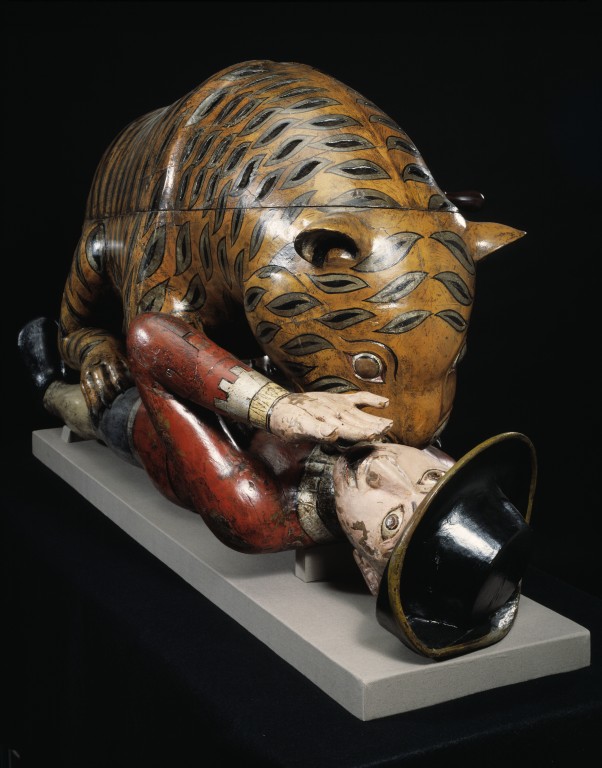
Tipu's Tiger, Tippu's Tiger or Tipoo’s Tiger is an 18th-century automaton created for Tipu Sultan, the ruler of the Kingdom of Mysore (present day Karnataka) in India. The carved and painted wood casing represents a tiger mauling a near life-size European man. Mechanisms inside the tiger and the man's body make one hand of the man move, emit a wailing sound from his mouth and grunts from the tiger. In addition a flap on the side of the tiger folds down to reveal the keyboard of a small pipe organ with 18 notes.
The automaton incorporates Tipu's emblem, the tiger, and expresses his hatred of his enemy, the British of the East India Company. It was taken from his summer palace when East India Company troops stormed Tipu's capital in 1799. The Governor General, Lord Mornington, sent the tiger to Britain initially intending it to be an exhibit in the Tower of London. First exhibited to the London public in 1808 in East India House, then the offices of the East India Company in London, it was transferred to the Victoria and Albert Museum in 1880. It now forms part of the permanent exhibit on the "Imperial courts of South India". From the moment it arrived in London to the present day, Tipu's Tiger has been a popular attraction to the public.[citation needed]
Tipu's Tiger was originally made for Tipu Sultan (also referred to as Tippoo Sahib, Tippoo Sultan and other epithets in nineteenth-century literature) in the Kingdom of Mysore (today in the Indian state of Karnataka) around 1795. Tipu Sultan used the tiger systematically as his emblem, employing tiger motifs on his weapons, on the uniforms of his soldiers, and in the decoration of his palaces. His throne rested upon a probably similar life-size wooden tiger, covered in gold; like other valuable treasures it was broken up for the highly organised prize fund shared out among the British army.
Tipu had inherited power from his father Hyder Ali, a Muslim soldier who had risen to become dalwai or commander-in-chief under the ruling Hindu Wodeyar dynasty, but from 1760 was in effect the ruler of the kingdom. Hyder, after initially trying to ally with the British against the Marathas, had later become their firm enemy, as they represented the most effective obstacle to his expansion of his kingdom, and Tipu grew up with violently anti-British feelings.
The tiger formed part of a specific group of large caricature images commissioned by Tipu showing European, often specifically British, figures being attacked by tigers or elephants, or being executed, tortured and humiliated and attacked in other ways. Many of these were painted by Tipu's orders on the external walls of houses in the main streets of Tipu's capital, Seringapatam. Tipu was in "close co-operation" with the French, who were at war with Britain and still had a presence in South India, and some of the French craftsmen who visited Tipu's court probably contributed to the internal works of the tiger.
It has been proposed that the design was inspired by the death in 1792 of a son of General Sir Hector Munro, who had commanded a division during Sir Eyre Coote's victory at the Battle of Porto Novo (Parangipettai) in 1781 when Hyder Ali, Tipu Sultan's father, was defeated with a loss of 10,000 men during the Second Anglo-Mysore War. Hector Sutherland Munro, a 17-year-old East India Company Cadet on his way to Madras, was attacked and killed by a tiger on 22 December 1792 while hunting with several companions on Saugor Island in the Bay of Bengal (still one of the last refuges of the Bengal tiger).
However a similar scene was depicted on the silver mount on a gun made for Tipu and dated 1787–88, five years before the incident. The Metropolitan Museum of Art, which owns the Staffordshire figure group illustrated, suggests that the continuing popularity of the subject into the 1820s was due to Tipu's automaton being on display in London.
Tipu's Tiger is notable as an example of early musical automata from India, and also for the fact that it was especially constructed for Tipu Sultan.
Hub AI
Tipu's Tiger AI simulator
(@Tipu's Tiger_simulator)
Tipu's Tiger
Tipu's Tiger, Tippu's Tiger or Tipoo’s Tiger is an 18th-century automaton created for Tipu Sultan, the ruler of the Kingdom of Mysore (present day Karnataka) in India. The carved and painted wood casing represents a tiger mauling a near life-size European man. Mechanisms inside the tiger and the man's body make one hand of the man move, emit a wailing sound from his mouth and grunts from the tiger. In addition a flap on the side of the tiger folds down to reveal the keyboard of a small pipe organ with 18 notes.
The automaton incorporates Tipu's emblem, the tiger, and expresses his hatred of his enemy, the British of the East India Company. It was taken from his summer palace when East India Company troops stormed Tipu's capital in 1799. The Governor General, Lord Mornington, sent the tiger to Britain initially intending it to be an exhibit in the Tower of London. First exhibited to the London public in 1808 in East India House, then the offices of the East India Company in London, it was transferred to the Victoria and Albert Museum in 1880. It now forms part of the permanent exhibit on the "Imperial courts of South India". From the moment it arrived in London to the present day, Tipu's Tiger has been a popular attraction to the public.[citation needed]
Tipu's Tiger was originally made for Tipu Sultan (also referred to as Tippoo Sahib, Tippoo Sultan and other epithets in nineteenth-century literature) in the Kingdom of Mysore (today in the Indian state of Karnataka) around 1795. Tipu Sultan used the tiger systematically as his emblem, employing tiger motifs on his weapons, on the uniforms of his soldiers, and in the decoration of his palaces. His throne rested upon a probably similar life-size wooden tiger, covered in gold; like other valuable treasures it was broken up for the highly organised prize fund shared out among the British army.
Tipu had inherited power from his father Hyder Ali, a Muslim soldier who had risen to become dalwai or commander-in-chief under the ruling Hindu Wodeyar dynasty, but from 1760 was in effect the ruler of the kingdom. Hyder, after initially trying to ally with the British against the Marathas, had later become their firm enemy, as they represented the most effective obstacle to his expansion of his kingdom, and Tipu grew up with violently anti-British feelings.
The tiger formed part of a specific group of large caricature images commissioned by Tipu showing European, often specifically British, figures being attacked by tigers or elephants, or being executed, tortured and humiliated and attacked in other ways. Many of these were painted by Tipu's orders on the external walls of houses in the main streets of Tipu's capital, Seringapatam. Tipu was in "close co-operation" with the French, who were at war with Britain and still had a presence in South India, and some of the French craftsmen who visited Tipu's court probably contributed to the internal works of the tiger.
It has been proposed that the design was inspired by the death in 1792 of a son of General Sir Hector Munro, who had commanded a division during Sir Eyre Coote's victory at the Battle of Porto Novo (Parangipettai) in 1781 when Hyder Ali, Tipu Sultan's father, was defeated with a loss of 10,000 men during the Second Anglo-Mysore War. Hector Sutherland Munro, a 17-year-old East India Company Cadet on his way to Madras, was attacked and killed by a tiger on 22 December 1792 while hunting with several companions on Saugor Island in the Bay of Bengal (still one of the last refuges of the Bengal tiger).
However a similar scene was depicted on the silver mount on a gun made for Tipu and dated 1787–88, five years before the incident. The Metropolitan Museum of Art, which owns the Staffordshire figure group illustrated, suggests that the continuing popularity of the subject into the 1820s was due to Tipu's automaton being on display in London.
Tipu's Tiger is notable as an example of early musical automata from India, and also for the fact that it was especially constructed for Tipu Sultan.
Recent media