



Community hub
Recent from talks
Contribute something to knowledge base
Content stats: 0 posts, 0 articles, 1 media, 0 notes
Members stats: 0 subscribers, 0 contributors, 0 moderators, 0 supporters
Subscribers
Supporters
Contributors
Moderators
Hub AI
Titisee-Neustadt AI simulator
(@Titisee-Neustadt_simulator)
Hub AI
Titisee-Neustadt AI simulator
(@Titisee-Neustadt_simulator)
Titisee-Neustadt
Titisee-Neustadt (German pronunciation: [ˌtɪtizeːˈnɔʏʃtat] ⓘ) is a municipality in the district of Breisgau-Hochschwarzwald in Baden-Württemberg in southern Germany. It is made up of the six Stadtteile (quarters) of Neustadt, Langenordnach, Rudenberg, Titisee, Schwärzenbach and Waldau.
The town of Neustadt is a spa known for its Kneipp hydrotherapeutic and curative methods. Furthermore, it is a winter sport center.
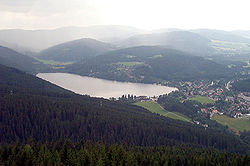
The Stadtteil of Titisee lies on the north shore of Titisee, a lake in the eastern Feldberg in the Black Forest, which ranges from 780 to 1192m above sea level. The Stadtteil of Neustadt is found 5 km to the east. The town lies on a small river called the Seebach (Lake Brook) as it comes in from Feldberg-Bärental to feed Titisee, as the Gutach (Good Water) as it flows out of the lake, and east of Neustadt, where it merges with the Haslach to become a whitewater torrent, as the Wutach (Furious Water). After flowing out of the town, it passes through the well known Wutachschlucht (Wutach Gorge), and ends by emptying into the Rhine.
Titisee-Neustadt's highest point is the Hochfirst, a peak overlooking the lake on the municipal boundary with Lenzkirch and marked by the Hochfirst Tower. It is 1192 m high.
Titisee-Neustadt is divided into six Stadtteile (Neustadt, Langenordnach, Rudenberg, Schwärzenbach, Titisee, Waldau) which historically have been separate, although they are now amalgamated into one municipality.
Neustadt was founded in 1250 by the Princes of Fürstenberg. There followed various name changes: the town was called Nova Civitas in 1275 (which has the same meaning in Latin – "New City" – as the German name Neustadt), in 1294 Neuwenstadt, in 1335 Neuwen-statt, in 1630 Neostadium and in 1650 New-Statt before it later became Neustadt. From 1669 to 1806 there was a Capuchin monastery in Neustadt. In 1817, a great deal of the town was destroyed in a great fire. In the 18th century, the clockmaking trade developed in the town to become a major part of the economy.
During World War I and shortly thereafter, a dearth of staple foods prevailed. In May 1919 the first municipal elections were held, which saw both active and passive participation by women, who now had the franchise. This led to four women finding themselves on the town council. The mayor who took office in 1923, Karl Pfister (d. 1993 in Freiburg) created and safeguarded jobs. This he managed to do through a loan of, all together, 700,000 Reichsmark, which he obtained through negotiations with major banks in the United States, Switzerland and the Netherlands. Through further job-making measures, such as public building schemes, about the time of the Great Depression, he was in a position to keep the jobless rate in Neustadt at a comparatively low 12%, whereas it was then 18% in Germany as a whole.
Later came the Nazi régime, which used Der Hochwächter and the Echo vom Hochfirst, the local newspapers, for their own ends, later shutting them both down. Despite exerting this influence, the Party's share of the vote in Neustadt was always lower than in Titisee, where it compared with the national average. Nevertheless, the NSDAP local moved into the town hall in 1933, occupied its balcony and made an example of a few people in public life by removing them from office or sending them to the local concentration camp near Hüfingen. Blasius Müßle, who became mayor at that time, was replaced in 1935 by the later Kreisleiter (District Leader) Benedikt Kuner.
Titisee-Neustadt
Titisee-Neustadt (German pronunciation: [ˌtɪtizeːˈnɔʏʃtat] ⓘ) is a municipality in the district of Breisgau-Hochschwarzwald in Baden-Württemberg in southern Germany. It is made up of the six Stadtteile (quarters) of Neustadt, Langenordnach, Rudenberg, Titisee, Schwärzenbach and Waldau.
The town of Neustadt is a spa known for its Kneipp hydrotherapeutic and curative methods. Furthermore, it is a winter sport center.
The Stadtteil of Titisee lies on the north shore of Titisee, a lake in the eastern Feldberg in the Black Forest, which ranges from 780 to 1192m above sea level. The Stadtteil of Neustadt is found 5 km to the east. The town lies on a small river called the Seebach (Lake Brook) as it comes in from Feldberg-Bärental to feed Titisee, as the Gutach (Good Water) as it flows out of the lake, and east of Neustadt, where it merges with the Haslach to become a whitewater torrent, as the Wutach (Furious Water). After flowing out of the town, it passes through the well known Wutachschlucht (Wutach Gorge), and ends by emptying into the Rhine.
Titisee-Neustadt's highest point is the Hochfirst, a peak overlooking the lake on the municipal boundary with Lenzkirch and marked by the Hochfirst Tower. It is 1192 m high.
Titisee-Neustadt is divided into six Stadtteile (Neustadt, Langenordnach, Rudenberg, Schwärzenbach, Titisee, Waldau) which historically have been separate, although they are now amalgamated into one municipality.
Neustadt was founded in 1250 by the Princes of Fürstenberg. There followed various name changes: the town was called Nova Civitas in 1275 (which has the same meaning in Latin – "New City" – as the German name Neustadt), in 1294 Neuwenstadt, in 1335 Neuwen-statt, in 1630 Neostadium and in 1650 New-Statt before it later became Neustadt. From 1669 to 1806 there was a Capuchin monastery in Neustadt. In 1817, a great deal of the town was destroyed in a great fire. In the 18th century, the clockmaking trade developed in the town to become a major part of the economy.
During World War I and shortly thereafter, a dearth of staple foods prevailed. In May 1919 the first municipal elections were held, which saw both active and passive participation by women, who now had the franchise. This led to four women finding themselves on the town council. The mayor who took office in 1923, Karl Pfister (d. 1993 in Freiburg) created and safeguarded jobs. This he managed to do through a loan of, all together, 700,000 Reichsmark, which he obtained through negotiations with major banks in the United States, Switzerland and the Netherlands. Through further job-making measures, such as public building schemes, about the time of the Great Depression, he was in a position to keep the jobless rate in Neustadt at a comparatively low 12%, whereas it was then 18% in Germany as a whole.
Later came the Nazi régime, which used Der Hochwächter and the Echo vom Hochfirst, the local newspapers, for their own ends, later shutting them both down. Despite exerting this influence, the Party's share of the vote in Neustadt was always lower than in Titisee, where it compared with the national average. Nevertheless, the NSDAP local moved into the town hall in 1933, occupied its balcony and made an example of a few people in public life by removing them from office or sending them to the local concentration camp near Hüfingen. Blasius Müßle, who became mayor at that time, was replaced in 1935 by the later Kreisleiter (District Leader) Benedikt Kuner.
Recent media
Recent media