
Recent from talks
Toba Batak language
Knowledge base stats:
Talk channels stats:
Members stats:
Toba Batak language
Toba Batak (/ˈtoʊbə ˈbætək/) is an Austronesian language spoken in North Sumatra province in Indonesia. It is part of a group of languages called Batak. There are approximately 1,610,000 Toba Batak speakers, living to the east, west and south of Lake Toba. Historically it was written using the Batak script, but the Latin script is now used for most writing.
The name of this language arises from a rich and complex history of ethnic identity in colonial and post-colonial Indonesia. It is a generic name for the common language used by the people of the districts of Toba, Uluan, Humbang, Habinsaran, Samosir, and Silindung, centered upon the Island of Sumatra; more particularly, at Lake Toba. Linguistically and culturally these tribes of people are closely related. Other nearby communities such as Silalahi and Tongging may also be classified as speakers of Toba Batak.
The term Toba Batak is, itself, a derivation of the Toba Batak language. As such, it is used both as a noun and an adjective, both to describe a language, and also to describe the people who speak the language.
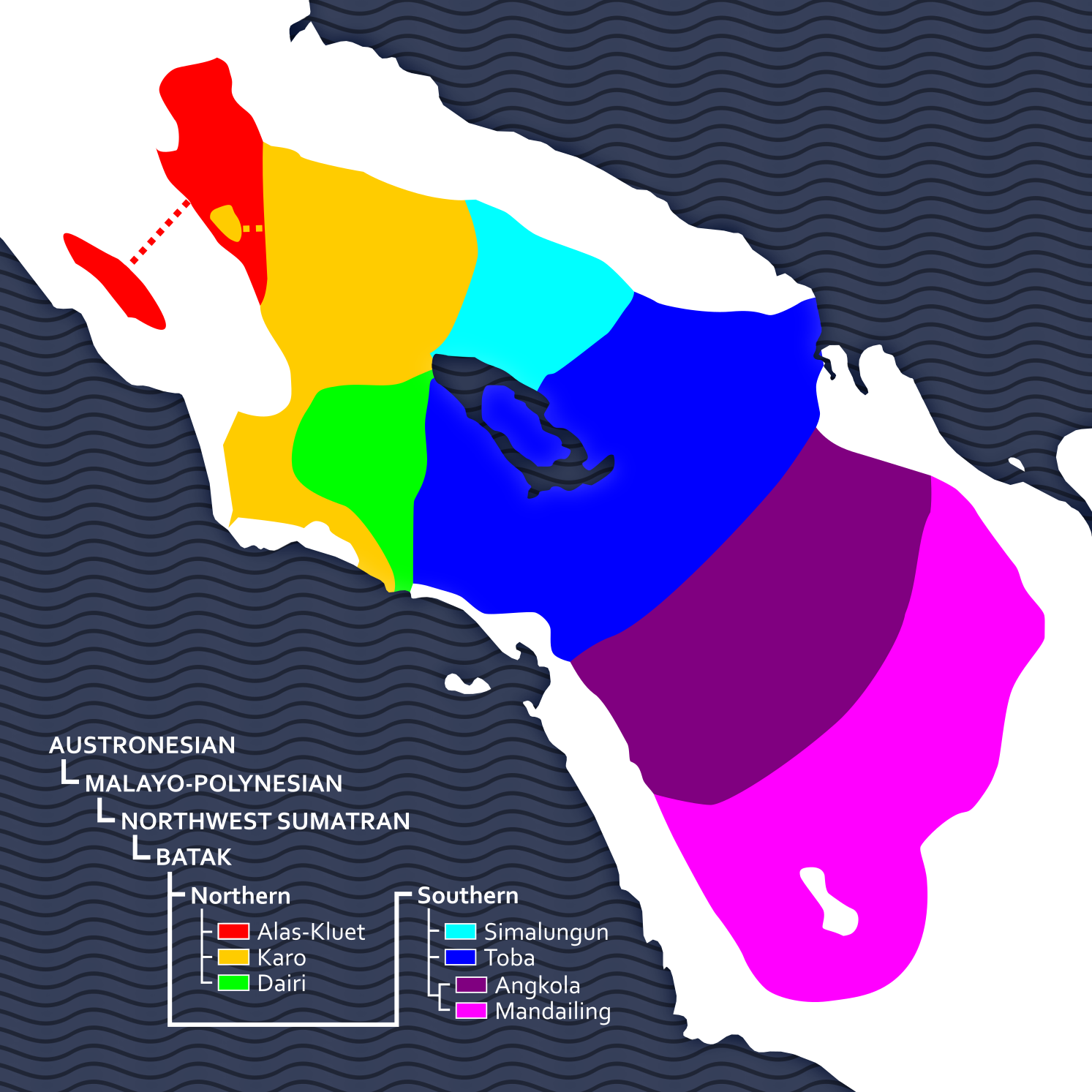
Among the aforementioned districts, Toba is the most densely populated and politically the most prominent district so that Toba Batak became a label for all communities speaking a dialect closely akin to the dialect spoken in Toba. In contemporary Indonesia the language is seldom referred to as Toba Batak (bahasa Batak Toba), but more commonly and simply as Batak (bahasa Batak). The (Toba)-Batak refer to it in their own language as Hata Batak. This "Batak" language is different from the languages of other Batak people that can be divided into speaking a northern Batak dialect (Karo Batak, and Pakpak-Dairi Batak – linguistically this dialect group also includes the culturally very different Alas people), a central Batak dialect (Simalungun) and closely related other southern Batak dialects such as Angkola and Mandailing.
There are several dictionaries and grammars for each of the five major dialects of Batak (Angkola-Mandailing, Toba, Simalungun, Pakpak-Dairi, and Karo). Specifically for Toba Batak the most important dictionaries are that of Johannes Warneck (Toba-German) and Herman Neubronner van der Tuuk (Toba-Dutch). The latter was also involved in translating the Christian Bible into Toba Batak.
This description follows Nababan (1981).
In native words, /k/ and /h/ are in complementary distribution, where the latter only occurs when followed by vowels and not doubled, and the former elsewhere. Thus, hódok "perspiration" → hodohí "the perspiration", but dɔkkɔ́nɔn "will be invited". /k/ in other positions, are only recent developments from loanwords.
Note:
Hub AI
Toba Batak language AI simulator
(@Toba Batak language_simulator)
Toba Batak language
Toba Batak (/ˈtoʊbə ˈbætək/) is an Austronesian language spoken in North Sumatra province in Indonesia. It is part of a group of languages called Batak. There are approximately 1,610,000 Toba Batak speakers, living to the east, west and south of Lake Toba. Historically it was written using the Batak script, but the Latin script is now used for most writing.
The name of this language arises from a rich and complex history of ethnic identity in colonial and post-colonial Indonesia. It is a generic name for the common language used by the people of the districts of Toba, Uluan, Humbang, Habinsaran, Samosir, and Silindung, centered upon the Island of Sumatra; more particularly, at Lake Toba. Linguistically and culturally these tribes of people are closely related. Other nearby communities such as Silalahi and Tongging may also be classified as speakers of Toba Batak.
The term Toba Batak is, itself, a derivation of the Toba Batak language. As such, it is used both as a noun and an adjective, both to describe a language, and also to describe the people who speak the language.
Among the aforementioned districts, Toba is the most densely populated and politically the most prominent district so that Toba Batak became a label for all communities speaking a dialect closely akin to the dialect spoken in Toba. In contemporary Indonesia the language is seldom referred to as Toba Batak (bahasa Batak Toba), but more commonly and simply as Batak (bahasa Batak). The (Toba)-Batak refer to it in their own language as Hata Batak. This "Batak" language is different from the languages of other Batak people that can be divided into speaking a northern Batak dialect (Karo Batak, and Pakpak-Dairi Batak – linguistically this dialect group also includes the culturally very different Alas people), a central Batak dialect (Simalungun) and closely related other southern Batak dialects such as Angkola and Mandailing.
There are several dictionaries and grammars for each of the five major dialects of Batak (Angkola-Mandailing, Toba, Simalungun, Pakpak-Dairi, and Karo). Specifically for Toba Batak the most important dictionaries are that of Johannes Warneck (Toba-German) and Herman Neubronner van der Tuuk (Toba-Dutch). The latter was also involved in translating the Christian Bible into Toba Batak.
This description follows Nababan (1981).
In native words, /k/ and /h/ are in complementary distribution, where the latter only occurs when followed by vowels and not doubled, and the former elsewhere. Thus, hódok "perspiration" → hodohí "the perspiration", but dɔkkɔ́nɔn "will be invited". /k/ in other positions, are only recent developments from loanwords.
Note:
Recent media