



Community hub
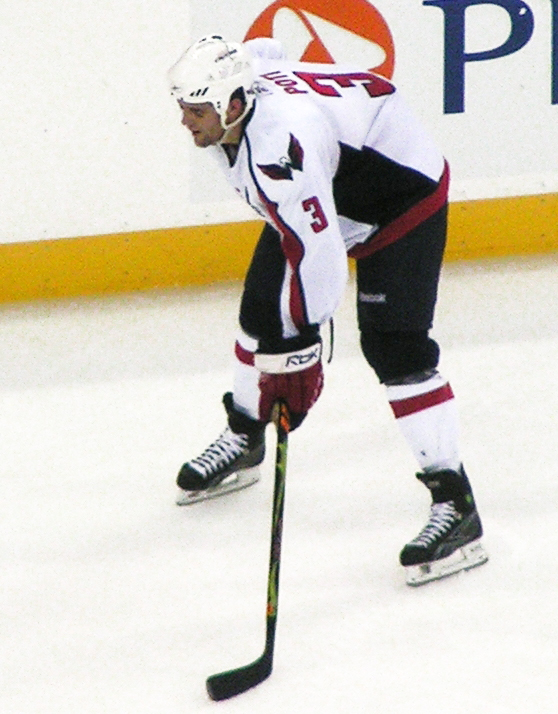
Tom Poti
View on Wikipedia
Thomas Emilio Poti (born March 22, 1977) is an American former professional ice hockey player. He played 14 seasons in the National Hockey League (NHL).
Key Information


Playing career
[edit]As a youth, Poti played in the 1991 Quebec International Pee-Wee Hockey Tournament with a minor ice hockey team from Hartford, Connecticut.[1]
He attended Saint Peter-Marian High School for two years. A graduate of the Cushing Academy, Poti moved on to play for Boston University of Hockey East. At BU in 1998, Poti became the first defenseman since Dave Archambault to win the Beanpot MVP.[2] Poti was drafted in the third round of the 1996 NHL entry draft, 59th overall, by the Edmonton Oilers.[3]
On March 19, 2002, the Rangers acquired Poti and Rem Murray in exchange for Mike York and a fourth round selection in the 2002 NHL entry draft. Poti was the point man on New York's top power-play unit until Fedor Tyutin took over. During his time with the Rangers, Poti became unpopular with his team's fans, to the point that he was booed at home whenever he touched the puck and cheered when he left the ice for a player change.[4]
In the summer of 2006, Poti signed as a free agent with the Rangers' crosstown rival New York Islanders. For the rest of his career, he continued to hear choruses of boos when he touched the puck at Madison Square Garden.[5][6]
On July 1, 2007, Poti signed a four-year deal with the Washington Capitals worth $3.5 million per year. Poti won his first playoff series with the Capitals when they eliminated the Rangers in seven games on April 28, 2009.[7]
He signed a three-year contract extension with the Capitals in 2010. However, a recurring groin injury held him to only 21 games in 2010–11, and he did not play at all the following season. In September 2011, Washington General Manager George McPhee said that the injury has not improved and Poti's NHL career may be finished.[8] However, after missing the entire 2011-12 season due to the groin issue, Poti was cleared to return upon the start of the lockout-shortened 2012–13 season. He was assigned to the Hershey Bears of the AHL on January 13, 2013 for a conditioning assignment, but was eventually called up to Washington, playing in 16 games. He became a free agent at the end of the season, and he announced his retirement on May 1, 2014,[9] later becoming a part-owner of the Boston Bandits junior ice hockey organization.[10][11]
Personal life
[edit]Poti resides in Sandwich, Massachusetts, with his wife Jessica and their two children.[9] He suffers from severe food allergies. Contact with such foods as chocolate, peanuts, fish, Monosodium glutamate (MSG), and most spices and sauces can be potentially lethal. Poti carries an EpiPen epinephrine auto-injector at all times.[12][13]
Despite growing up in Massachusetts, home of the Boston Red Sox, Poti is a fan of the New York Yankees.[14]
Career statistics
[edit]Regular season and playoffs
[edit]| Regular season | Playoffs | |||||||||||||
|---|---|---|---|---|---|---|---|---|---|---|---|---|---|---|
| Season | Team | League | GP | G | A | Pts | PIM | GP | G | A | Pts | PIM | ||
| 1993–94 | Cushing Academy | HS-Prep | 30 | 10 | 35 | 45 | — | — | — | — | — | — | ||
| 1994–95 | Cushing Academy | HS-Prep | 36 | 17 | 54 | 71 | 35 | — | — | — | — | — | ||
| 1994–95 | Central Mass Outlaws | MBHL | 8 | 8 | 10 | 18 | — | — | — | — | — | — | ||
| 1995–96 | Cushing Academy | HS-Prep | 29 | 14 | 59 | 73 | 18 | — | — | — | — | — | ||
| 1996–97 | Boston University | HE | 38 | 4 | 17 | 21 | 54 | — | — | — | — | — | ||
| 1997–98 | Boston University | HE | 38 | 13 | 29 | 42 | 60 | — | — | — | — | — | ||
| 1998–99 | Edmonton Oilers | NHL | 73 | 5 | 16 | 21 | 42 | 4 | 0 | 1 | 1 | 2 | ||
| 1999–2000 | Edmonton Oilers | NHL | 76 | 9 | 26 | 35 | 65 | 5 | 0 | 1 | 1 | 0 | ||
| 2000–01 | Edmonton Oilers | NHL | 81 | 12 | 20 | 32 | 60 | 6 | 0 | 2 | 2 | 2 | ||
| 2001–02 | Edmonton Oilers | NHL | 55 | 1 | 16 | 17 | 32 | — | — | — | — | — | ||
| 2001–02 | New York Rangers | NHL | 11 | 1 | 7 | 8 | 2 | — | — | — | — | — | ||
| 2002–03 | New York Rangers | NHL | 80 | 11 | 37 | 48 | 58 | — | — | — | — | — | ||
| 2003–04 | New York Rangers | NHL | 67 | 10 | 14 | 24 | 47 | — | — | — | — | — | ||
| 2005–06 | New York Rangers | NHL | 73 | 3 | 20 | 23 | 70 | 4 | 0 | 0 | 0 | 2 | ||
| 2006–07 | New York Islanders | NHL | 78 | 6 | 38 | 44 | 74 | 5 | 0 | 3 | 3 | 6 | ||
| 2007–08 | Washington Capitals | NHL | 71 | 2 | 27 | 29 | 46 | 7 | 0 | 1 | 1 | 8 | ||
| 2008–09 | Washington Capitals | NHL | 52 | 3 | 10 | 13 | 28 | 14 | 2 | 5 | 7 | 4 | ||
| 2009–10 | Washington Capitals | NHL | 70 | 4 | 20 | 24 | 42 | 6 | 0 | 4 | 4 | 5 | ||
| 2010–11 | Washington Capitals | NHL | 21 | 2 | 5 | 7 | 8 | — | — | — | — | — | ||
| 2012–13 | Hershey Bears | AHL | 2 | 1 | 0 | 1 | 0 | — | — | — | — | — | ||
| 2012–13 | Washington Capitals | NHL | 16 | 0 | 2 | 2 | 2 | — | — | — | — | — | ||
| NHL totals | 824 | 69 | 258 | 327 | 588 | 51 | 2 | 17 | 19 | 29 | ||||
| Medal record | ||
|---|---|---|
| Ice hockey | ||
Representing  United States United States
| ||
| Olympic Games | ||
 |
2002 Salt Lake City | |
International
[edit]| Year | Team | Event | Result | GP | G | A | Pts | PIM | |
|---|---|---|---|---|---|---|---|---|---|
| 1996 | United States | WJC | 5th | 6 | 0 | 3 | 3 | 0 | |
| 1997 | United States | WJC | 
|
6 | 1 | 2 | 3 | 4 | |
| 2002 | United States | OG |
|
6 | 0 | 1 | 1 | 4 | |
| Junior totals | 12 | 1 | 5 | 6 | 4 | ||||
| Senior totals | 6 | 0 | 1 | 1 | 4 | ||||
Awards and honors
[edit]| Award | Year | |
|---|---|---|
| NCAA | ||
| All-Hockey East Rookie Team | 1996–97 | |
| All-NCAA All-Tournament Team | 1997 | [15] |
| All-Hockey East First Team | 1997–98 | |
| AHCA East First-Team All-American | 1997–98 | |
| NHL | ||
| All-Rookie Team | 1998–99 | |
References
[edit]- ^ "Pee-Wee players who have reached NHL or WHA" (PDF). Quebec International Pee-Wee Hockey Tournament. 2018. Archived from the original (PDF) on March 6, 2019. Retrieved February 1, 2019.
- ^ Corbett, Bernard (November 14, 2002). The Beanpot: Fifty Years of Thrills, Spills, and Chills. Boston, MA: Northeastern University Press. pp. 174–176. ISBN 978-1555535315.
- ^ "Tom Poti". HockeysFuture.com. December 20, 1997. Retrieved March 26, 2019.
- ^ "Run of the Mill". Archived from the original on November 19, 2006. Retrieved February 14, 2007.
{{cite web}}: CS1 maint: bot: original URL status unknown (link) - ^ "Islanders lure Poti". CBC Sports. July 8, 2006. Retrieved July 8, 2006.
- ^ Masisak, Corey (April 27, 2009). "Poti scores, draws boos". The Washington Times. Retrieved March 26, 2019.
- ^ "2009 NHL Stanley Cup Eastern Conference Quarter-Finals; Washington Capitals defeat New York Rangers 4-3". Hockey Reference. Retrieved March 26, 2019.
- ^ El-Bashir, Tarik (September 17, 2011). "Tom Poti fails medical exam, is placed on long term IR". Washington Post. Retrieved September 17, 2011.
- ^ a b "TOM POTI ANNOUNCES RETIREMENT AFTER 14 NHL SEASONS". NHLPA. May 1, 2014. Retrieved May 1, 2014.
- ^ "Tom Poti Signs as Part Owner of the Boston Bandits". Boston Bandits. Boston Bandits. December 20, 2017. Retrieved March 26, 2019.
- ^ Ballou, Bill (January 27, 2018). "CMass. Winter Olympians - Where are they now?: Tom Poti, Worcester". Telegram & Gazette. Retrieved March 26, 2019.
- ^ "Allergies drove Poti into hockey". Canoe.ca. September 6, 2006. Archived from the original on March 10, 2016. Retrieved September 5, 2008.
- ^ Yerdon, Joe (January 11, 2011). "Hold everything for Tom Poti; Severe allergies haven't hurt his career". NBC Sports. Retrieved March 26, 2019.
- ^ Hall, Brendan (October 25, 2010). "New England Roots: Tom Poti". ESPN. Retrieved March 26, 2019.
- ^ "NCAA Frozen Four Records" (PDF). NCAA.org. Retrieved June 19, 2013.
External links
[edit]- Biographical information and career statistics from NHL.com, or Eliteprospects.com, or Hockey-Reference.com, or The Internet Hockey Database
- Official Website
Tom Poti
View on GrokipediaEarly Life and Amateur Career
Youth and High School Hockey
Tom Poti was born on March 22, 1977, in Worcester, Massachusetts.[5] Poti began skating at age seven in a local learn-to-skate program in Worcester before joining the Mid-State Hockey youth team, where he played until age ten.[6] He then advanced to the Worcester Junior Monarchs until age twelve and the Boston Junior Terriers until age fourteen, honing his skills in competitive youth leagues in the region.[6] Poti attended Saint Peter-Marian High School in Worcester, starting varsity hockey as a seventh-grader and playing there for two years.[7] He transferred to Cushing Academy, a preparatory school in Ashburnham, Massachusetts, for his junior and senior years, competing in an independent schedule against top Northeast teams.[6] At Cushing, Poti emerged as a standout defenseman, recording 45 points (10 goals, 35 assists) in 30 games as a sophomore in 1993–94, 71 points (17 goals, 54 assists) in 36 games as a junior in 1994–95, and 73 points (14 goals, 59 assists) in 29 games as a senior in 1995–96.[5] These achievements highlighted his reputation as one of Massachusetts' premier young defensemen, blending strong defensive play with offensive contributions.[7] Poti's high school development at Cushing Academy positioned him for success in college hockey at Boston University.[8]College Career at Boston University
Tom Poti enrolled at Boston University in 1996, joining the BU Terriers men's ice hockey team in the Hockey East conference, where he played as a defenseman for two seasons from 1996 to 1998.[5] During his freshman year in 1996–97, Poti recorded 4 goals and 17 assists for 21 points in 38 games, contributing offensively from the blue line while helping the Terriers advance to the NCAA tournament, where BU reached the championship game.[9] He earned selection to the Hockey East All-Rookie Team as the conference's top rookie defenseman.[10] Additionally, Poti was named to the NCAA All-Tournament Team following BU's strong postseason performance.[5] In his sophomore season of 1997–98, Poti elevated his game, leading all BU defensemen in scoring with 13 goals and 29 assists for 42 points in 38 games, while also anchoring the team's defense en route to the Hockey East regular season title.[9][5] His standout play earned him spots on the Hockey East First Team, the AHCA East First-Team All-American, and the Beanpot All-Tournament Team; he was also voted Beanpot MVP after assisting on the game-winning goal in overtime (his shot tipped in by Nick Gillis) to secure BU's fourth consecutive tournament championship.[5][11] Over his two-year college career, Poti amassed 17 goals and 46 assists for 63 points in 76 games, establishing himself as a key contributor to BU's success, including two Hockey East titles and a Frozen Four appearance that bolstered the program's reputation in the late 1990s.[9] Following the 1997–98 season, Poti opted to forgo his junior year and turn professional, signing an entry-level contract with the Edmonton Oilers.[12]NHL Draft
Poti emerged as a promising prospect during his time at Boston University, where scouts highlighted his mobility, strong puck-handling skills, and offensive instincts as a defenseman capable of contributing on the power play with a heavy point shot.[13] His profile emphasized excellent lateral movement and the ability to log heavy minutes while transitioning effectively from offense to defense.[13] The Edmonton Oilers selected Poti in the third round, 59th overall, of the 1996 NHL Entry Draft, valuing his potential as a two-way blueliner from the collegiate ranks.[5] Poti's standout sophomore season at BU, where he recorded 42 points and earned NCAA East First All-American honors, significantly elevated his draft position among defensemen.[5] In the 1998 preseason, he impressed Oilers coaches with a strong training camp performance, earning a spot as the projected fourth defenseman alongside veteran Roman Hamrlík for opening night.[14] Poti's transition from college hockey to the NHL was anticipated to involve key physical adjustments, including adapting to the faster pace, increased physicality, and defensive demands of professional play, though his summer preparation and camp showing suggested he was well-positioned for the leap.[14]Professional NHL Career
Edmonton Oilers Era (1998–2002)
Tom Poti made his NHL debut on October 10, 1998, against the Los Angeles Kings, logging 20:38 of ice time in a 2-1 loss for the Edmonton Oilers.[15] Just over a month later, on November 18, 1998, he scored his first NHL goal—a power-play tally—against the Detroit Red Wings in a 6-2 defeat.[15] In his rookie 1998–99 season, Poti established himself as a reliable top-four defenseman, appearing in 73 games and recording 5 goals and 16 assists for 21 points while posting a +10 plus-minus rating.[3] His strong performance earned him a spot on the NHL All-Rookie Team, as selected by the Professional Hockey Writers' Association.[16] Over the following seasons, Poti solidified his role as a key offensive contributor on Edmonton's blue line, often paired with fellow defenseman Janne Niinimaa to form a dynamic duo that facilitated transitions from the back end.[17] In 1999–00, he played all 76 regular-season games, tallying 9 goals and 26 assists for 35 points and a +8 rating, helping the Oilers reach the playoffs where they lost in five games to the Dallas Stars.[3] The 2000–01 campaign marked a career high for Poti with 12 goals and 20 assists in 81 games, leading Oilers defensemen in assists and contributing to the team's second-place finish in the Northwest Division.[18] Edmonton advanced to the Western Conference Finals that postseason, defeating the Stars in six games before falling to the Colorado Avalanche in seven; Poti recorded 2 assists in 12 playoff games with a +2 rating.[1] In 2001–02, limited by injury to 55 games, he added 1 goal and 16 assists for 17 points.[3] Poti's consistent play during this era supported Edmonton's push for Western Conference contention, averaging over 22 minutes of ice time per game across 285 regular-season appearances with the club.[19] On March 19, 2002, amid a contract dispute and with the Oilers out of playoff contention, Poti was traded to the New York Rangers along with forward Rem Murray in exchange for center Mike York and a fourth-round draft pick (later used to select Ivan Koltsov).[20]New York Teams (2002–2007)
On March 19, 2002, the New York Rangers acquired defenseman Tom Poti and forward Rem Murray from the Edmonton Oilers in exchange for forward Mike York and a fourth-round pick in the 2002 NHL Entry Draft.[21] Poti made an immediate contribution after the trade, recording 1 goal and 7 assists in the remaining 11 games of the 2001–02 season.[3] In his first full season with the Rangers during 2002–03, Poti achieved a career-high 48 points (11 goals and 37 assists) in 80 games, showcasing his offensive capabilities from the blue line while logging significant ice time.[3] However, the Rangers finished last in the Atlantic Division and missed the playoffs, marking the beginning of Poti's tenure amid the team's ongoing rebuild efforts under general manager Glen Sather.[1] Poti's time with the Rangers from 2002 to 2006 was marked by consistent production but frustration due to the team's inconsistencies and lack of postseason success. In 2003–04, he posted 24 points (10 goals and 14 assists) in 67 games.[3] Returning for the 2005–06 post-lockout campaign, Poti contributed 23 points (3 goals and 20 assists) in 73 games, helping the Rangers secure a playoff spot for the first time since 1997, though they were eliminated in the first round by the New Jersey Devils.[1] Despite these contributions, Poti faced challenges, including minor injuries that occasionally sidelined him, and he became a frequent target of fan boos at Madison Square Garden, often scapegoated for defensive lapses in a rebuilding roster that struggled to contend in the competitive Atlantic Division.[22] Media coverage highlighted the disconnect, portraying Poti as underperforming relative to expectations set by the trade, even as analytics later suggested his underlying play was more effective than perceived.[23] As an unrestricted free agent in the 2006 offseason, Poti signed a one-year, $2.75 million contract with the New York Islanders on July 8, 2006, staying within the metropolitan area but switching to the Rangers' crosstown rivals. In the 2006–07 season, Poti delivered solid defensive play for the Islanders, appearing in 78 games and tallying 44 points (6 goals and 38 assists), which led the team in assists and helped them clinch a playoff berth as the eighth seed in the Eastern Conference.[3] His performance provided stability on the blue line during a transitional year for the franchise, though the Islanders fell in the first round to the Buffalo Sabres.[24] Poti's New York chapter concluded in free agency, as he signed a four-year, $14 million contract with the Washington Capitals on July 1, 2007, seeking a fresh start after four seasons marked by team struggles and public scrutiny.[25]Washington Capitals Tenure (2007–2013)
On July 1, 2007, Poti signed a four-year contract with the Washington Capitals worth $14 million, carrying an average annual value of $3.5 million.[26] This deal marked his transition to the Capitals as an unrestricted free agent, providing defensive stability on the blue line during a period of team rebuilding around young talent.[27] Poti's tenure peaked in the 2008–09 and 2009–10 seasons, where he contributed significantly to the Capitals' playoff pushes. In 2008–09, he posted 3 goals and 10 assists in 52 regular-season games, then added 2 goals and 5 assists in 14 playoff contests, helping the team defeat the New York Rangers in seven games on April 28, 2009—Poti's first career playoff series victory.[3] The Capitals advanced to the Eastern Conference Finals that year, losing to the Pittsburgh Penguins in seven games. The following season, 2009–10, Poti achieved one of his strongest statistical outputs with 4 goals and 20 assists for 24 points in 70 games, while logging extensive penalty-kill minutes as a key shutdown defender.[3] His plus-26 rating ranked second among Capitals defensemen, underscoring his role in the team's league-leading 121-point regular season. Injuries began to derail Poti's consistency starting in 2010–11, when recurring groin issues limited him to 21 games (2 goals, 5 assists).[3] These problems stemmed from a fractured pelvis sustained on December 21, 2010, during a game against the New Jersey Devils, compounded by chronic groin strain that forced him out after January 12, 2011.[28] He missed the entire 2011–12 season due to ongoing recovery from these ailments, despite signing a two-year, $5.75 million extension in September 2010 that carried through 2012–13. Poti attempted a return in the lockout-shortened 2012–13 campaign, playing 16 games (0 goals, 2 assists) in a diminished depth role before a back injury sidelined him for the final 20 regular-season games and playoffs; his last NHL appearance was on March 17, 2013, against the Buffalo Sabres.[3][29] Following the expiration of his contract after the 2012–13 season, the Capitals did not re-sign Poti, effectively ending his NHL tenure with the club.[30] He joined the Hershey Bears of the American Hockey League (Washington's affiliate) on a conditioning assignment in January 2013, scoring once in two games, but no further professional play occurred in 2013–14.[31] Poti announced his retirement on May 1, 2014, after 14 NHL seasons, citing persistent health challenges.[32]International Representation
World Junior Championships
1996 IIHF World U20 Championship
Tom Poti represented the United States as a defenseman at the 1996 IIHF World U20 Championship, held in Boston, Massachusetts, from December 26, 1995, to January 5, 1996. At age 18 and in his senior year of high school at Cushing Academy, Poti earned a spot on Team USA's roster, marking his international debut.[33][9] In six games, Poti contributed 3 assists while accumulating no penalty minutes. Team USA finished fifth overall after a 3–2–1 record in the round-robin stage but losses in placement games.[9] Poti's performance highlighted his emerging defensive and puck-moving abilities against international junior competition.1997 IIHF World U20 Championship
Tom Poti represented the United States as a defenseman at the 1997 IIHF World U20 Championship, held in Geneva and Morges, Switzerland, from December 26, 1996, to January 4, 1997. At 19 years old and in his freshman season at Boston University, Poti earned a spot on Team USA's roster for the tournament, marking his second major international competition.[34][9] In six games, Poti contributed offensively with 1 goal and 2 assists for 3 points, while accumulating 4 penalty minutes. His standout moment came in the semifinal against the Czech Republic, where he scored the game-winning goal at 12:41 of the second period with a slap shot from the top of the left faceoff circle, helping secure a 5-2 victory that advanced Team USA to the gold medal game.[35][36] Team USA finished with a silver medal, their best result at the time, after defeating the Czech Republic in the semifinals but falling 2-0 to Canada in the final on January 4, 1997.[37] Poti's tournament performance showcased his puck-moving and offensive skills from the blue line, providing valuable experience against top junior talent ahead of his NHL debut with the Edmonton Oilers the following fall.[38]Olympic Participation
Tom Poti was selected to the United States men's ice hockey team for the 2002 Winter Olympics in Salt Lake City, Utah, as the youngest defenseman on the roster at age 24 while playing for the Edmonton Oilers.[39] His inclusion highlighted his emerging NHL presence following a strong season, where he served as a mobile, two-way blueliner capable of handling top competition.[32] In the tournament, Poti played all six games, primarily paired with Brian Rafalski on the third defensive unit, focusing on shutdown responsibilities against skilled opponents.[40] He contributed offensively with one assist and posted a +2 plus-minus rating, while accumulating four penalty minutes, aiding Team USA's run through the preliminary rounds and quarterfinal victory over host nation Belarus.[41] He recorded the primary assist on Tony Amonte's opening goal for the U.S. at 8:49 of the first period in the gold medal game against Canada on February 24, 2002.[42] Team USA secured the silver medal after falling 5–2 to Canada in the final, marking the program's first Olympic medal since 1980.[4] This debut Olympic appearance built on Poti's prior international experience at the World Junior Championships and showcased his composure in high-stakes play, as he helped stabilize the defense during a grueling schedule against powerhouse teams.[32]Personal Life and Legacy
Family and Health Challenges
Tom Poti married Jessica in 2009, and the couple resides in Sandwich, Massachusetts, with their two children, son Tyler (born 2010) and daughter Dylan (born 2012).[43][2] Poti has lived with severe food allergies since childhood, reacting anaphylactically to peanuts, tree nuts, chocolate, fish, MSG, and certain herbs and spices.[44][45] He also manages asthma as part of his health challenges.[44] To mitigate risks, Poti carries an EpiPen at all times and relies on his wife Jessica to scrutinize food labels and ingredients at home.[46] During his career, teams accommodated his needs, such as avoiding nuts on flights, allowing him to manage the condition without major disruptions.[46] Despite his Massachusetts upbringing in Worcester, Poti has long been a devoted fan of the New York Yankees, drawing occasional teasing from locals loyal to the Boston Red Sox.[7] Throughout his professional career, Poti's family provided unwavering support amid frequent travels and health management, with Jessica and their children offering emotional stability during his NHL tenure.[2] This familial backing extended to everyday adjustments for his allergies, helping him navigate the demands of life on the road.[46]Post-Retirement Activities
Tom Poti officially announced his retirement from professional hockey on May 1, 2014, after 14 seasons in the National Hockey League, citing a statement released through the NHL Players' Association.[2] Following his retirement, Poti transitioned into youth hockey development in Massachusetts, initially serving as head coach for the Cape Cod Penguins, a youth team based in Hyannis, where he led drills and training sessions to foster young players' skills.[43] In 2017, he partnered with Total Athletics of Cape Cod to expand youth hockey programs, emphasizing skill-building and player growth in the region.[47] By late 2017, Poti acquired part-ownership of the Boston Bandits Hockey Organization, a junior ice hockey program with teams competing in various youth leagues, where he took an active role in operations and youth development initiatives.[48] He also continued coaching duties with the Bandits and other local teams, focusing on defensive techniques drawn from his NHL experience to mentor emerging talent. Poti remains involved in youth hockey through programs like TP3 Hockey, which offers skills sessions and summer camps on Cape Cod as of 2025.[49] Poti's community efforts center on promoting hockey accessibility in Massachusetts, particularly in central and southeastern areas, by supporting local leagues and encouraging participation among youth to build the sport's grassroots foundation. In a 2018 interview reflecting on his Olympic and NHL career, he expressed satisfaction with giving back to the game that shaped his life, highlighting the rewards of coaching the next generation.[48] Additionally, since 2013, Poti has owned and operated Mayflower Beach Rental in Sandwich, Massachusetts.[50]Career Statistics and Honors
NHL and Playoff Statistics
Tom Poti played 824 regular season games in the National Hockey League (NHL) over 14 seasons from 1998 to 2013, accumulating 69 goals, 258 assists, 327 points, and 586 penalty minutes.[1] His career plus-minus rating stood at +44, reflecting a defensive-minded approach with consistent point production as a defenseman.[1] Poti's scoring peaked in the 2002–03 season with the New York Rangers, where he recorded 48 points (11 goals and 37 assists) in 80 games, marking his most productive offensive year.[1] Injuries limited his play in certain seasons, notably 2010–11 with the Washington Capitals, where he appeared in only 21 games due to health issues, tallying just 7 points.[1] Across teams, Poti's contributions varied by tenure. With the Edmonton Oilers from 1998 to 2002, he played 285 games, scoring 27 goals and 78 assists for 105 points and 209 penalty minutes.[1] In seasons split between the New York Rangers (2002–2006) and a brief 2001–02 stint, he logged 231 games, with 25 goals, 78 assists, 103 points, and 177 penalty minutes.[1] His single season with the New York Islanders in 2006–07 yielded 78 games, 6 goals, 38 assists, 44 points, and 74 penalty minutes.[1] Finally, during his six-year run with the Washington Capitals from 2007 to 2013, Poti suited up for 230 games, notching 11 goals, 64 assists, 75 points, and 126 penalty minutes, often serving as a steady top-four defender.[1] In the playoffs, Poti appeared in 51 games across eight postseasons, recording 2 goals, 17 assists, 19 points, and 29 penalty minutes.[1] His most notable playoff contribution came in 2008–09 with the Capitals, where he posted 7 points (2 goals and 5 assists) in 14 games en route to the Eastern Conference Finals, including key defensive play in the series against the Pittsburgh Penguins.[51] Overall, Poti's postseason output emphasized reliability over flash, with a career playoff plus-minus of +10.[1] Poti earned several honors during his NHL career, including selection to the NHL All-Rookie Team in 1998–99 and participation in the 2003 NHL All-Star Game.[2]Regular Season Statistics
| Season | Team | GP | G | A | PTS | PIM | +/- |
|---|---|---|---|---|---|---|---|
| 1998–99 | EDM | 73 | 5 | 16 | 21 | 42 | +10 |
| 1999–00 | EDM | 76 | 9 | 26 | 35 | 65 | +8 |
| 2000–01 | EDM | 81 | 12 | 20 | 32 | 60 | –4 |
| 2001–02 | 2TM | 66 | 2 | 23 | 25 | 44 | –10 |
| 2002–03 | NYR | 80 | 11 | 37 | 48 | 58 | –6 |
| 2003–04 | NYR | 67 | 10 | 14 | 24 | 47 | –1 |
| 2005–06 | NYR | 73 | 3 | 20 | 23 | 70 | +16 |
| 2006–07 | NYI | 78 | 6 | 38 | 44 | 74 | –1 |
| 2007–08 | WSH | 71 | 2 | 27 | 29 | 46 | +9 |
| 2008–09 | WSH | 52 | 3 | 10 | 13 | 28 | +3 |
| 2009–10 | WSH | 70 | 4 | 20 | 24 | 42 | +26 |
| 2010–11 | WSH | 21 | 2 | 5 | 7 | 8 | –4 |
| 2012–13 | WSH | 16 | 0 | 2 | 2 | 2 | –2 |
| Career | 824 | 69 | 258 | 327 | 586 | +44 |
Playoff Statistics
| Season | Team | GP | G | A | PTS | PIM |
|---|---|---|---|---|---|---|
| 1998–99 | EDM | 4 | 0 | 1 | 1 | 2 |
| 1999–00 | EDM | 5 | 0 | 1 | 1 | 0 |
| 2000–01 | EDM | 6 | 0 | 2 | 2 | 2 |
| 2005–06 | NYR | 4 | 0 | 0 | 0 | 2 |
| 2006–07 | NYI | 5 | 0 | 3 | 3 | 6 |
| 2007–08 | WSH | 7 | 0 | 1 | 1 | 8 |
| 2008–09 | WSH | 14 | 2 | 5 | 7 | 4 |
| 2009–10 | WSH | 6 | 0 | 4 | 4 | 5 |
| Career | 51 | 2 | 17 | 19 | 29 |
International Statistics and Awards
Tom Poti represented the United States in international competition primarily during his junior and Olympic career, accumulating a total of 18 games played, 1 goal, 6 assists, and 7 points across these events.[5] His international appearances were limited due to his commitments in the National Hockey League (NHL), where he played professionally from 1998 onward.[9] Poti first competed internationally at the World Junior Championships (WJC), participating in both the 1996 and 1997 tournaments. In the 1996 WJC held in Switzerland, he recorded 6 games played, 0 goals, 3 assists, and 3 points while helping the U.S. team finish fifth.[52] The following year, at the 1997 WJC in the same country, Poti contributed 6 games played, 1 goal, 2 assists, and 3 points, earning a silver medal as the U.S. team fell to Canada in the gold-medal game.[35][53] Poti's senior international debut came at the 2002 Winter Olympics in Salt Lake City, where he played all 6 games for the U.S. team as a defenseman, registering 0 goals, 1 assist, and 1 point with a +2 plus-minus rating.[54] The team secured a silver medal, losing 5-2 to Canada in the final.[55] Poti did not participate in any other senior international tournaments, such as the IIHF World Championships.[5] His international honors include silver medals from both the 1997 WJC and the 2002 Olympics, marking the extent of his accolades on the global stage.[5][55]| Tournament | Year | GP | G | A | Pts | PIM | Result |
|---|---|---|---|---|---|---|---|
| World Junior Championships | 1996 | 6 | 0 | 3 | 3 | 0 | 5th place[52] |
| World Junior Championships | 1997 | 6 | 1 | 2 | 3 | 4 | Silver[35] |
| Winter Olympics | 2002 | 6 | 0 | 1 | 1 | 4 | Silver[54] |
| Total | - | 18 | 1 | 6 | 7 | 8 | -[5] |