
Recent from talks
Asthma
Knowledge base stats:
Talk channels stats:
Members stats:
Asthma
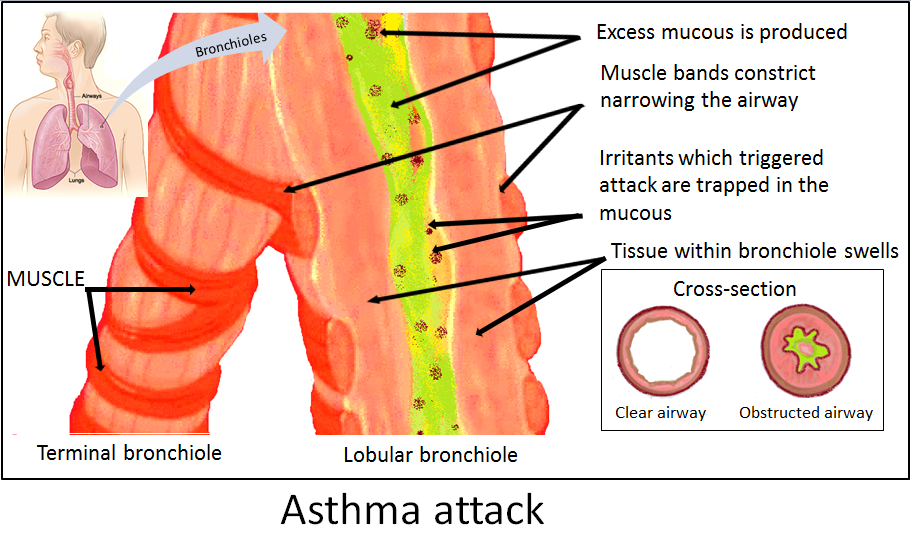
Asthma is a common long-term inflammatory disease of the bronchioles of the lungs. It is characterized by variable and recurring symptoms, reversible airflow obstruction, and easily triggered bronchospasms. Symptoms include episodes of wheezing, coughing, chest tightness, and shortness of breath. A sudden worsening of asthma symptoms sometimes called an 'asthma attack' or an 'asthma exacerbation' can occur when allergens, pollen, dust, or other particles, are inhaled into the lungs, causing the bronchioles to constrict and produce mucus, which then restricts oxygen flow to the alveoli. These may occur a few times a day or a few times per week. Depending on the person, asthma symptoms may become worse at night or with exercise.
Asthma is thought to be caused by a combination of genetic and environmental factors. Environmental factors include exposure to air pollution and allergens. Other potential triggers include medications such as aspirin and beta blockers. Diagnosis is usually based on the pattern of symptoms, response to therapy over time, and spirometry lung function testing. Asthma is classified according to the frequency of symptoms of forced expiratory volume in one second (FEV1), and peak expiratory flow rate. It may also be classified as atopic or non-atopic, where atopy refers to a predisposition toward developing a type 1 hypersensitivity reaction.
There is no known cure for asthma, but it can be controlled. Symptoms can be prevented by avoiding triggers, such as allergens and respiratory irritants, and suppressed with the use of inhaled corticosteroids. Long-acting beta agonists (LABA) or antileukotriene agents may be used in addition to inhaled corticosteroids if asthma symptoms remain uncontrolled. Treatment of rapidly worsening symptoms is usually with an inhaled short-acting beta2 agonist such as salbutamol and corticosteroids taken by mouth. In very severe cases, intravenous corticosteroids, magnesium sulfate, and hospitalization may be required.
In 2019, asthma affected approximately 262 million people and caused approximately 461,000 deaths. Most of the deaths occurred in the developing world. Asthma often begins in childhood, and the rates have increased significantly since the 1960s. Asthma was recognized as early as Ancient Egypt. The word asthma is from the Greek ἆσθμα (âsthma), which means 'panting'.
Asthma is characterized by recurrent episodes symptoms of wheezing, shortness of breath, chest tightness, and coughing. Sputum may be produced from the lung by coughing but is often hard to bring up. During recovery from an asthma attack (exacerbation), the sputum may appear pus-like due to high levels of white blood cells called eosinophils. Symptoms are usually worse at night and in the early morning or in response to exercise or cold air. Some people with asthma rarely experience symptoms, usually in response to triggers, whereas others may react frequently and readily and experience persistent symptoms.
A number of other health conditions occur more frequently in people with asthma, including gastroesophageal reflux disease (GERD), rhinosinusitis, and obstructive sleep apnea. Psychological disorders are also more common, with anxiety disorders occurring in between 16 and 52% and mood disorders in 14–41%. It is not known whether asthma causes psychological problems or psychological problems lead to asthma. Current asthma, but not former asthma, is associated with increased all-cause mortality, heart disease mortality, and chronic lower respiratory tract disease mortality. Asthma, particularly severe asthma, is strongly associated with development of chronic obstructive pulmonary disease (COPD). Those with asthma, especially if it is poorly controlled, are at increased risk for radiocontrast reactions.
Cavities occur more often in people with asthma. This may be related to the effect of beta2-adrenergic agonists decreasing saliva. These medications may also decrease the risk of dental erosions.
Asthma is caused by a combination of complex and incompletely understood environmental and genetic interactions. These influence both its severity and its responsiveness to treatment. It is believed that the recent increased rates of asthma are due to changing epigenetics (heritable factors other than those related to the DNA sequence) and a changing living environment. Asthma that starts before the age of 12 years old is more likely due to genetic influence, while onset after age 12 is more likely due to environmental influence.
Hub AI
Asthma AI simulator
(@Asthma_simulator)
Asthma
Asthma is a common long-term inflammatory disease of the bronchioles of the lungs. It is characterized by variable and recurring symptoms, reversible airflow obstruction, and easily triggered bronchospasms. Symptoms include episodes of wheezing, coughing, chest tightness, and shortness of breath. A sudden worsening of asthma symptoms sometimes called an 'asthma attack' or an 'asthma exacerbation' can occur when allergens, pollen, dust, or other particles, are inhaled into the lungs, causing the bronchioles to constrict and produce mucus, which then restricts oxygen flow to the alveoli. These may occur a few times a day or a few times per week. Depending on the person, asthma symptoms may become worse at night or with exercise.
Asthma is thought to be caused by a combination of genetic and environmental factors. Environmental factors include exposure to air pollution and allergens. Other potential triggers include medications such as aspirin and beta blockers. Diagnosis is usually based on the pattern of symptoms, response to therapy over time, and spirometry lung function testing. Asthma is classified according to the frequency of symptoms of forced expiratory volume in one second (FEV1), and peak expiratory flow rate. It may also be classified as atopic or non-atopic, where atopy refers to a predisposition toward developing a type 1 hypersensitivity reaction.
There is no known cure for asthma, but it can be controlled. Symptoms can be prevented by avoiding triggers, such as allergens and respiratory irritants, and suppressed with the use of inhaled corticosteroids. Long-acting beta agonists (LABA) or antileukotriene agents may be used in addition to inhaled corticosteroids if asthma symptoms remain uncontrolled. Treatment of rapidly worsening symptoms is usually with an inhaled short-acting beta2 agonist such as salbutamol and corticosteroids taken by mouth. In very severe cases, intravenous corticosteroids, magnesium sulfate, and hospitalization may be required.
In 2019, asthma affected approximately 262 million people and caused approximately 461,000 deaths. Most of the deaths occurred in the developing world. Asthma often begins in childhood, and the rates have increased significantly since the 1960s. Asthma was recognized as early as Ancient Egypt. The word asthma is from the Greek ἆσθμα (âsthma), which means 'panting'.
Asthma is characterized by recurrent episodes symptoms of wheezing, shortness of breath, chest tightness, and coughing. Sputum may be produced from the lung by coughing but is often hard to bring up. During recovery from an asthma attack (exacerbation), the sputum may appear pus-like due to high levels of white blood cells called eosinophils. Symptoms are usually worse at night and in the early morning or in response to exercise or cold air. Some people with asthma rarely experience symptoms, usually in response to triggers, whereas others may react frequently and readily and experience persistent symptoms.
A number of other health conditions occur more frequently in people with asthma, including gastroesophageal reflux disease (GERD), rhinosinusitis, and obstructive sleep apnea. Psychological disorders are also more common, with anxiety disorders occurring in between 16 and 52% and mood disorders in 14–41%. It is not known whether asthma causes psychological problems or psychological problems lead to asthma. Current asthma, but not former asthma, is associated with increased all-cause mortality, heart disease mortality, and chronic lower respiratory tract disease mortality. Asthma, particularly severe asthma, is strongly associated with development of chronic obstructive pulmonary disease (COPD). Those with asthma, especially if it is poorly controlled, are at increased risk for radiocontrast reactions.
Cavities occur more often in people with asthma. This may be related to the effect of beta2-adrenergic agonists decreasing saliva. These medications may also decrease the risk of dental erosions.
Asthma is caused by a combination of complex and incompletely understood environmental and genetic interactions. These influence both its severity and its responsiveness to treatment. It is believed that the recent increased rates of asthma are due to changing epigenetics (heritable factors other than those related to the DNA sequence) and a changing living environment. Asthma that starts before the age of 12 years old is more likely due to genetic influence, while onset after age 12 is more likely due to environmental influence.
Recent media