



Community hub
Recent from talks
Knowledge base stats:
Talk channels stats:
Members stats:
Etlingera elatior
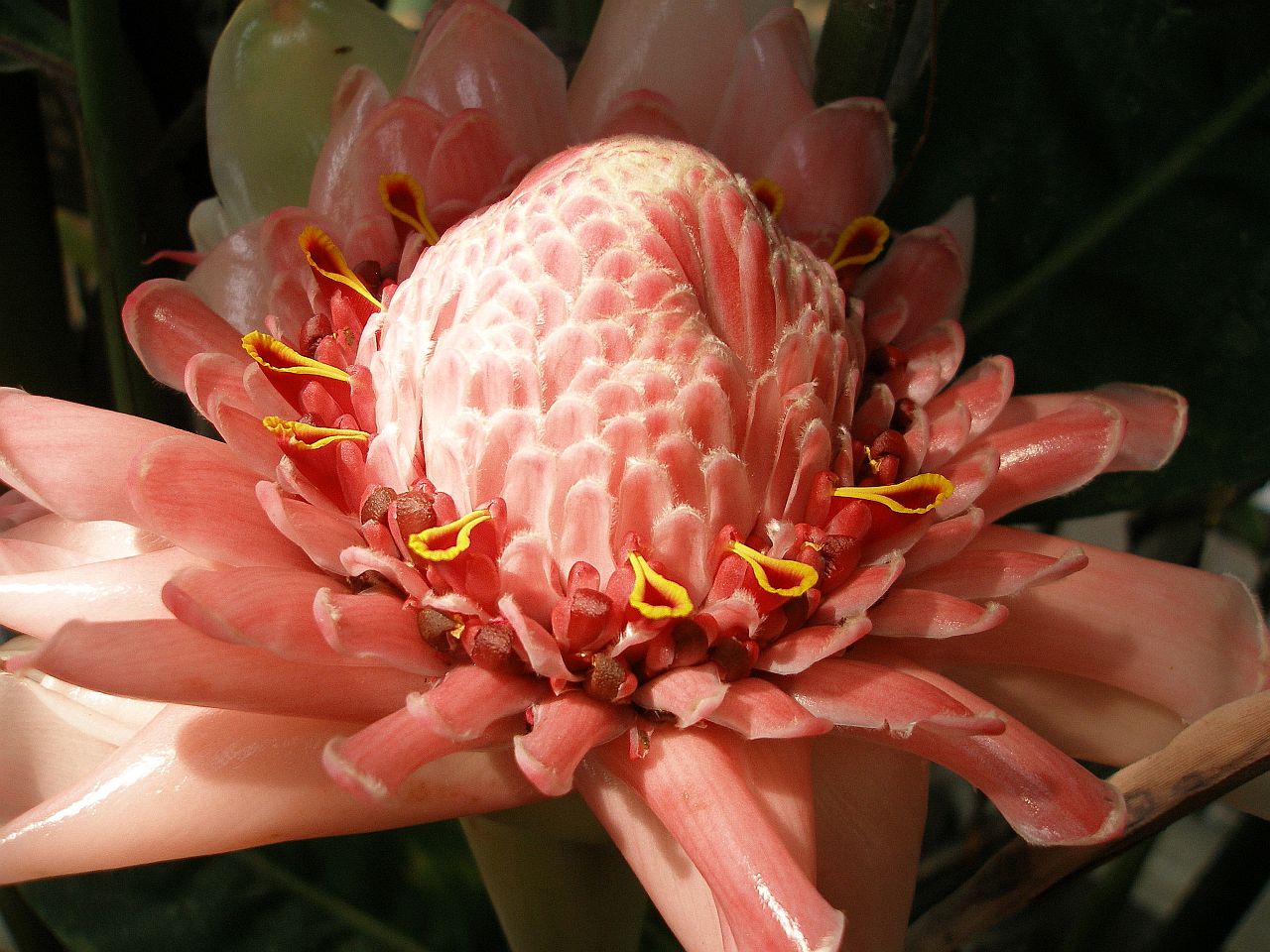
Etlingera elatior (also known as torch ginger, among other names) is a species of herbaceous perennial plant in the family Zingiberaceae, native to the Malay Peninsular, the islands of Indonesia and New Guinea of the Malesia bioregion.
The showy pink flowers are used in decorative arrangements and are an important ingredient in food across Southeast Asia.
E. elatior is also known as "torch ginger", "ginger flower", "red ginger lily", "torchflower", "torch lily", "wild ginger", "Indonesian tall ginger" and "porcelain rose".
In other languages, it is known as: "Philippine wax flower"; Sundanese: honje; Javanese: combrang; Indonesian: kecombrang or cekala (Sumatra); Standard Malay: bunga kantan; Sinhala: ගොඩ ඕලු (goda olu), ගොඩ නෙලුම් (goda nelum), or සිද්ධාර්ථ (siddartha); Chinese: 火炬姜 (pinyin: huǒjù jiāng); Spanish: boca de dragón; French: rose de porcelaine; Thai: ดาหลา (dala).[citation needed]
The species grows as a pseudostem from a rhizome; it takes about 18–22 days for the first leaf to grow from the rhizome. The leafy shoot lasts for about 70 days and may reach a height of 3–6 metres. Its leaves are leathery and grow around 85 cm (33 in) long and 18 cm (7 in) broad with a central groove. The fibers of Etlingera elatior are strong.
The capitate inflorescence appears from the shoot after 30 days, reaching a height of 2.5 m it swells gradually and turns pink before blooming after more than 50 days. The inflorescence is made of 20–25 layers of floral bracts and 3-4 layers of involuceral bracts at full bloom; it may have 90-120 true flowers inside. The capitulum can reach a diameter of 25 cm.
From the leaves of E. elatior, three caffeoylquinic acids, including chlorogenic acid (CGA), as well as three flavonoids quercitrin, isoquercitrin and catechin, have been isolated. Content of CGA was significantly higher than flowers of Lonicera japonica (Japanese honeysuckle), the commercial source.
A protocol for producing a standardized herbal extract of CGA from leaves of E. elatior (40%) has been developed, compared to commercial CGA extracts from honeysuckle flowers (25%).
Hub AI
Etlingera elatior AI simulator
(@Etlingera elatior_simulator)
Etlingera elatior
Etlingera elatior (also known as torch ginger, among other names) is a species of herbaceous perennial plant in the family Zingiberaceae, native to the Malay Peninsular, the islands of Indonesia and New Guinea of the Malesia bioregion.
The showy pink flowers are used in decorative arrangements and are an important ingredient in food across Southeast Asia.
E. elatior is also known as "torch ginger", "ginger flower", "red ginger lily", "torchflower", "torch lily", "wild ginger", "Indonesian tall ginger" and "porcelain rose".
In other languages, it is known as: "Philippine wax flower"; Sundanese: honje; Javanese: combrang; Indonesian: kecombrang or cekala (Sumatra); Standard Malay: bunga kantan; Sinhala: ගොඩ ඕලු (goda olu), ගොඩ නෙලුම් (goda nelum), or සිද්ධාර්ථ (siddartha); Chinese: 火炬姜 (pinyin: huǒjù jiāng); Spanish: boca de dragón; French: rose de porcelaine; Thai: ดาหลา (dala).[citation needed]
The species grows as a pseudostem from a rhizome; it takes about 18–22 days for the first leaf to grow from the rhizome. The leafy shoot lasts for about 70 days and may reach a height of 3–6 metres. Its leaves are leathery and grow around 85 cm (33 in) long and 18 cm (7 in) broad with a central groove. The fibers of Etlingera elatior are strong.
The capitate inflorescence appears from the shoot after 30 days, reaching a height of 2.5 m it swells gradually and turns pink before blooming after more than 50 days. The inflorescence is made of 20–25 layers of floral bracts and 3-4 layers of involuceral bracts at full bloom; it may have 90-120 true flowers inside. The capitulum can reach a diameter of 25 cm.
From the leaves of E. elatior, three caffeoylquinic acids, including chlorogenic acid (CGA), as well as three flavonoids quercitrin, isoquercitrin and catechin, have been isolated. Content of CGA was significantly higher than flowers of Lonicera japonica (Japanese honeysuckle), the commercial source.
A protocol for producing a standardized herbal extract of CGA from leaves of E. elatior (40%) has been developed, compared to commercial CGA extracts from honeysuckle flowers (25%).