


Community hub
Recent from talks
Contribute something to knowledge base
Content stats: 0 posts, 0 articles, 1 media, 0 notes
Members stats: 0 subscribers, 0 contributors, 0 moderators, 0 supporters
Subscribers
Supporters
Contributors
Moderators
Hub AI
Anterior cruciate ligament injury AI simulator
(@Anterior cruciate ligament injury_simulator)
Hub AI
Anterior cruciate ligament injury AI simulator
(@Anterior cruciate ligament injury_simulator)
Anterior cruciate ligament injury
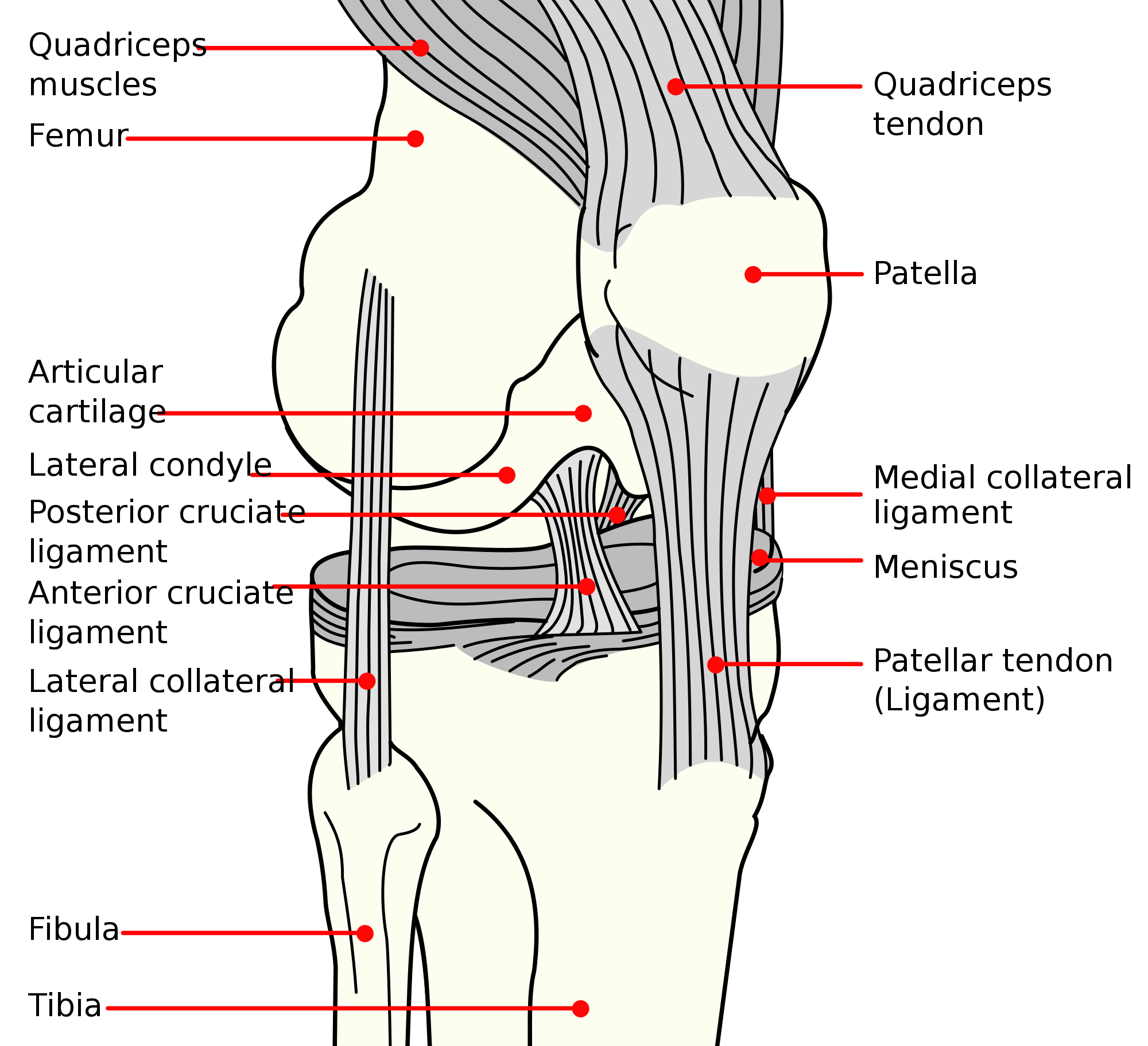
An anterior cruciate ligament injury occurs when the anterior cruciate ligament (ACL) is either stretched, partially torn, or completely torn. The most common injury is a complete tear. Symptoms include pain, an audible cracking sound during injury, instability of the knee, and joint swelling. Swelling generally appears within a couple of hours. In approximately 50% of cases, other structures of the knee such as surrounding ligaments, cartilage, or meniscus are damaged.
The underlying mechanism often involves a rapid change in direction, sudden stop, landing after a jump, or direct contact to the knee. It is more common in athletes, particularly those who participate in alpine skiing, football (soccer), netball, American football, or basketball. Diagnosis is typically made by physical examination and is sometimes supported and confirmed by magnetic resonance imaging (MRI). Physical examination will often show tenderness around the knee joint, reduced range of motion of the knee, and increased looseness of the joint.
Prevention is by neuromuscular training and core strengthening. Treatment recommendations depend on desired level of activity. In those with low levels of future activity, nonsurgical management including bracing and physiotherapy may be sufficient. In those with high activity levels, surgical repair via arthroscopic anterior cruciate ligament reconstruction is often recommended. This involves replacement with a tendon taken from another area of the body or from a cadaver. Following surgery rehabilitation involves slowly expanding the range of motion of the joint, and strengthening the muscles around the knee. Surgery, if recommended, is generally not performed until the initial inflammation from the injury has resolved. It should also be taken into precaution to build up as much strength in the muscle that the tendon is being taken from to reduce risk of injury[clarification needed].
About 200,000 people are affected per year in the United States. In some sports, women have a higher risk of ACL injury, while in others, both sexes are equally affected. While adults with a complete tear have a higher rate of later knee osteoarthritis, treatment strategy does not appear to change this risk. ACL tears can also occur in some animals, including dogs.
When an individual has an ACL injury, they are likely to hear a "pop" in their knee followed by pain and swelling. They may also experience instability in the knee once they resume walking and other activities, as the ligament can no longer stabilize the knee joint and keep the tibia from sliding forward.
Reduced range of motion of the knee and tenderness along the joint line are also common signs of an acute ACL injury. The pain and swelling may resolve on its own; however, the knee will remain unstable and returning to sport without treatment may result in further damage to the knee.
Tearing occurs when the tibia moves too far forwards or the femur moves too far backwards. Causes may include:
These movements cause the tibia to shift away from the femur rapidly, placing strain on the knee joint and potentially leading to rupture of the ACL. About 80% of ACL injuries occur without direct trauma. Risk factors include female anatomy, specific sports, poor conditioning, fatigue, and playing on a turf field.
Anterior cruciate ligament injury
An anterior cruciate ligament injury occurs when the anterior cruciate ligament (ACL) is either stretched, partially torn, or completely torn. The most common injury is a complete tear. Symptoms include pain, an audible cracking sound during injury, instability of the knee, and joint swelling. Swelling generally appears within a couple of hours. In approximately 50% of cases, other structures of the knee such as surrounding ligaments, cartilage, or meniscus are damaged.
The underlying mechanism often involves a rapid change in direction, sudden stop, landing after a jump, or direct contact to the knee. It is more common in athletes, particularly those who participate in alpine skiing, football (soccer), netball, American football, or basketball. Diagnosis is typically made by physical examination and is sometimes supported and confirmed by magnetic resonance imaging (MRI). Physical examination will often show tenderness around the knee joint, reduced range of motion of the knee, and increased looseness of the joint.
Prevention is by neuromuscular training and core strengthening. Treatment recommendations depend on desired level of activity. In those with low levels of future activity, nonsurgical management including bracing and physiotherapy may be sufficient. In those with high activity levels, surgical repair via arthroscopic anterior cruciate ligament reconstruction is often recommended. This involves replacement with a tendon taken from another area of the body or from a cadaver. Following surgery rehabilitation involves slowly expanding the range of motion of the joint, and strengthening the muscles around the knee. Surgery, if recommended, is generally not performed until the initial inflammation from the injury has resolved. It should also be taken into precaution to build up as much strength in the muscle that the tendon is being taken from to reduce risk of injury[clarification needed].
About 200,000 people are affected per year in the United States. In some sports, women have a higher risk of ACL injury, while in others, both sexes are equally affected. While adults with a complete tear have a higher rate of later knee osteoarthritis, treatment strategy does not appear to change this risk. ACL tears can also occur in some animals, including dogs.
When an individual has an ACL injury, they are likely to hear a "pop" in their knee followed by pain and swelling. They may also experience instability in the knee once they resume walking and other activities, as the ligament can no longer stabilize the knee joint and keep the tibia from sliding forward.
Reduced range of motion of the knee and tenderness along the joint line are also common signs of an acute ACL injury. The pain and swelling may resolve on its own; however, the knee will remain unstable and returning to sport without treatment may result in further damage to the knee.
Tearing occurs when the tibia moves too far forwards or the femur moves too far backwards. Causes may include:
These movements cause the tibia to shift away from the femur rapidly, placing strain on the knee joint and potentially leading to rupture of the ACL. About 80% of ACL injuries occur without direct trauma. Risk factors include female anatomy, specific sports, poor conditioning, fatigue, and playing on a turf field.
Recent media
Recent media