
Recent from talks
Tornado warning
Knowledge base stats:
Talk channels stats:
Members stats:
Tornado warning
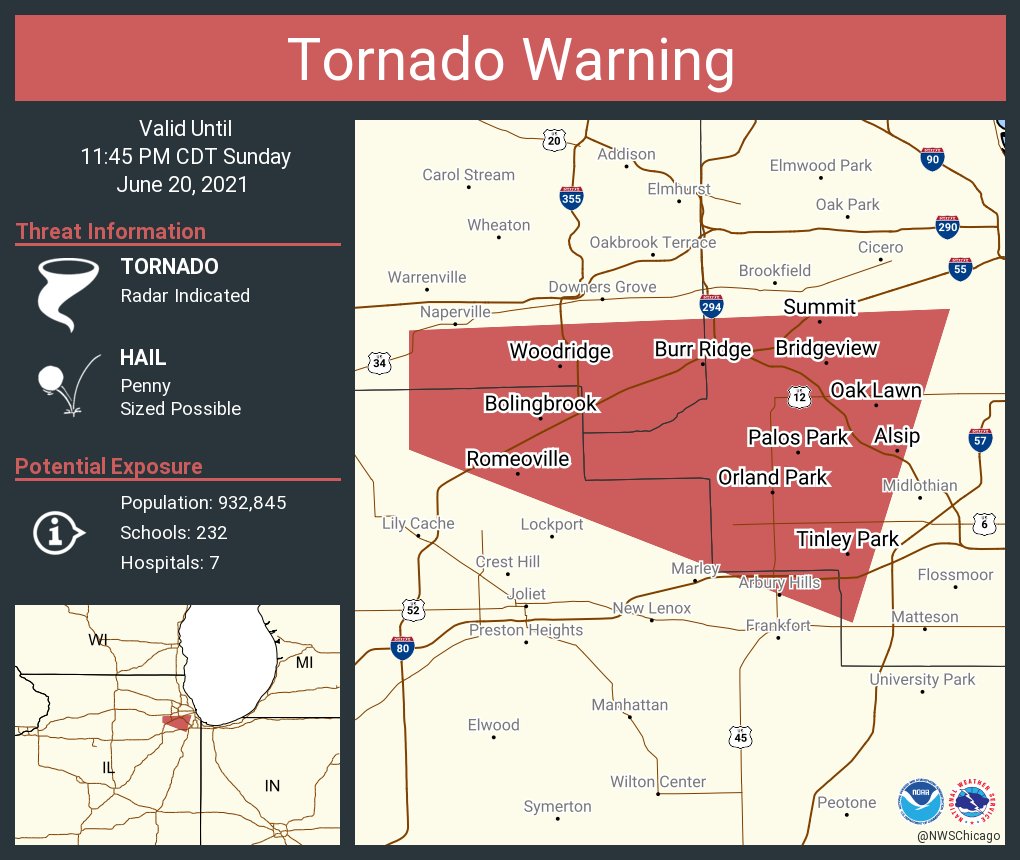
A tornado warning (SAME code: TOR) is a public warning that is issued by weather forecasting agencies to an area in the path of a tornado, or a severe thunderstorm capable of producing one, and advises individuals in that area to take cover. Modern weather surveillance technology such as Doppler weather radar can detect rotation in a thunderstorm, allowing for early warning before a tornado develops. They are also commonly issued based on reported visual sighting of a tornado, funnel cloud, or wall cloud, typically from weather spotters or the public, but also law enforcement or local emergency management. When radar is unavailable or insufficient, such ground truth is crucial. In particular, a tornado can develop in a gap of radar coverage, of which there are several known in the United States.
A warning should not be confused with a tornado watch, issued in the United States by the Storm Prediction Center (SPC) and in other countries by applicable regional forecasting agencies or national severe weather guidance centers, which only indicates that conditions are favorable for the formation of tornadoes. Although a tornado warning is generally a higher alert level than a tornado watch, in the U.S., it can be surpassed by a higher-level alert—structured as wording that can be added to the official warning product—to warn the public of intense tornadoes affecting a densely populated area.
A tornado watch is not required for a warning to be issued; tornado warnings are occasionally issued when a tornado watch is not active (i.e. when a severe thunderstorm watch is active, or when no watches are in effect), if a severe thunderstorm develops and has a confirmed tornado or strong rotation.
In April 1899, the Chicago Tribune wrote to the United States Weather Bureau via a news article posing the question on why tornado warnings are not sent out via telegraphs or even the telephone to warn the local population in the path. Cleveland Abbe responded by saying "it is certain that if any such arrangement were possible, the Weather Bureau would have done this many years ago" along with "we must remember that the destructive areas of tornadoes, and even of thunderstorms, are so small that the chance of being injured is exceedingly slight" and that "we do not attempt to prevent that which is inevitable". They also wrote that the chance of being injured by a tornado is "one in ten thousand years".
In June 1899, U.S. Weather Bureau Oklahoma section director J. I. Widmeyer published that long-range forecasters in Oklahoma were sounding "unnecessary tornado alarms" due to "ignorant predictions" to residents in Oklahoma and that they were causing "frightened men, women, and children" to take shelter, despite no tornadoes occurring. Cleveland Abbe added on to the publication by Widmeyer saying, "it is unnecessary to resort to the caves and cellars, or to stop our ordinary avocations for fear of a tornado, until we see the cloud in the distance, or are positively certain that one is about to pass near us".
In April 1908, the U.S. Weather Bureau published several replies regarding a question posed to the Weather Bureau on: How can we protect against tornadoes?.
In 1938, the Weather Bureau rescinded its ban on the usage of the word "tornado" in weather products disseminated to emergency management personnel. The Bureau would develop a network of volunteer storm spotters in the early 1940s during World War II, to provide warning of tornadoes to workers in munitions plants and strategic factories. The ban on issuing tornado warnings to the general public would not be revoked until Chief of Bureau Francis W. Reichelderfer officially lifted the ban in a Circular Letter issued on July 12, 1950, to all first order stations: "Weather Bureau employees should avoid statements that can be interpreted as a negation of the Bureau's willingness or ability to make tornado forecasts", and that a "good probability of verification" exist when issuing such forecasts due to the difficulty in accurately predicting tornadic activity. The American Meteorological Society agreed to have Miller and Fawbush present their methodology for forecasting tornadoes during the organization's 1950 meeting in St. Louis; after garnering press coverage for their successful prediction of past tornadoes, AMS representatives decided to open the presentation to the public.
The first official tornado forecast was made by United States Air Force Capt. (later Col.) Robert C. Miller and Major Ernest Fawbush, on March 25, 1948. The first such forecast came after the events that occurred five days earlier on March 20, 1948; Miller – a California native who became stationed at Tinker Air Force Base three weeks earlier – was assigned to work the late shift as a forecaster for the base's Air Weather Service office that evening, analyzing U.S. Weather Bureau surface maps and upper-air charts that failed to note atmospheric instability and moisture content present over Oklahoma that would be suitable for producing thunderstorm activity, erroneously forecasting dry conditions for that night. Thunderstorms soon developed southwest of Oklahoma City, and at 9:30 p.m., forecasters from Will Rogers Airport sent a warning to Tinker that the storm encroaching the city was producing wind gusts of 92 miles per hour (148 km/h) and a "Tornado South on Ground Moving NE!" Base personnel received an alert written by the staff sergeant on duty with Miller; the twister struck Tinker several minutes later around 10:00 p.m., damaging several military aircraft (with total damage estimated at $10 million) that could not be secured in time before it crossed the base grounds.
Hub AI
Tornado warning AI simulator
(@Tornado warning_simulator)
Tornado warning
A tornado warning (SAME code: TOR) is a public warning that is issued by weather forecasting agencies to an area in the path of a tornado, or a severe thunderstorm capable of producing one, and advises individuals in that area to take cover. Modern weather surveillance technology such as Doppler weather radar can detect rotation in a thunderstorm, allowing for early warning before a tornado develops. They are also commonly issued based on reported visual sighting of a tornado, funnel cloud, or wall cloud, typically from weather spotters or the public, but also law enforcement or local emergency management. When radar is unavailable or insufficient, such ground truth is crucial. In particular, a tornado can develop in a gap of radar coverage, of which there are several known in the United States.
A warning should not be confused with a tornado watch, issued in the United States by the Storm Prediction Center (SPC) and in other countries by applicable regional forecasting agencies or national severe weather guidance centers, which only indicates that conditions are favorable for the formation of tornadoes. Although a tornado warning is generally a higher alert level than a tornado watch, in the U.S., it can be surpassed by a higher-level alert—structured as wording that can be added to the official warning product—to warn the public of intense tornadoes affecting a densely populated area.
A tornado watch is not required for a warning to be issued; tornado warnings are occasionally issued when a tornado watch is not active (i.e. when a severe thunderstorm watch is active, or when no watches are in effect), if a severe thunderstorm develops and has a confirmed tornado or strong rotation.
In April 1899, the Chicago Tribune wrote to the United States Weather Bureau via a news article posing the question on why tornado warnings are not sent out via telegraphs or even the telephone to warn the local population in the path. Cleveland Abbe responded by saying "it is certain that if any such arrangement were possible, the Weather Bureau would have done this many years ago" along with "we must remember that the destructive areas of tornadoes, and even of thunderstorms, are so small that the chance of being injured is exceedingly slight" and that "we do not attempt to prevent that which is inevitable". They also wrote that the chance of being injured by a tornado is "one in ten thousand years".
In June 1899, U.S. Weather Bureau Oklahoma section director J. I. Widmeyer published that long-range forecasters in Oklahoma were sounding "unnecessary tornado alarms" due to "ignorant predictions" to residents in Oklahoma and that they were causing "frightened men, women, and children" to take shelter, despite no tornadoes occurring. Cleveland Abbe added on to the publication by Widmeyer saying, "it is unnecessary to resort to the caves and cellars, or to stop our ordinary avocations for fear of a tornado, until we see the cloud in the distance, or are positively certain that one is about to pass near us".
In April 1908, the U.S. Weather Bureau published several replies regarding a question posed to the Weather Bureau on: How can we protect against tornadoes?.
In 1938, the Weather Bureau rescinded its ban on the usage of the word "tornado" in weather products disseminated to emergency management personnel. The Bureau would develop a network of volunteer storm spotters in the early 1940s during World War II, to provide warning of tornadoes to workers in munitions plants and strategic factories. The ban on issuing tornado warnings to the general public would not be revoked until Chief of Bureau Francis W. Reichelderfer officially lifted the ban in a Circular Letter issued on July 12, 1950, to all first order stations: "Weather Bureau employees should avoid statements that can be interpreted as a negation of the Bureau's willingness or ability to make tornado forecasts", and that a "good probability of verification" exist when issuing such forecasts due to the difficulty in accurately predicting tornadic activity. The American Meteorological Society agreed to have Miller and Fawbush present their methodology for forecasting tornadoes during the organization's 1950 meeting in St. Louis; after garnering press coverage for their successful prediction of past tornadoes, AMS representatives decided to open the presentation to the public.
The first official tornado forecast was made by United States Air Force Capt. (later Col.) Robert C. Miller and Major Ernest Fawbush, on March 25, 1948. The first such forecast came after the events that occurred five days earlier on March 20, 1948; Miller – a California native who became stationed at Tinker Air Force Base three weeks earlier – was assigned to work the late shift as a forecaster for the base's Air Weather Service office that evening, analyzing U.S. Weather Bureau surface maps and upper-air charts that failed to note atmospheric instability and moisture content present over Oklahoma that would be suitable for producing thunderstorm activity, erroneously forecasting dry conditions for that night. Thunderstorms soon developed southwest of Oklahoma City, and at 9:30 p.m., forecasters from Will Rogers Airport sent a warning to Tinker that the storm encroaching the city was producing wind gusts of 92 miles per hour (148 km/h) and a "Tornado South on Ground Moving NE!" Base personnel received an alert written by the staff sergeant on duty with Miller; the twister struck Tinker several minutes later around 10:00 p.m., damaging several military aircraft (with total damage estimated at $10 million) that could not be secured in time before it crossed the base grounds.
Recent media