Hubbry Logo
Toyota 2000GTToyota 2000GTMain
Open search
Toyota 2000GT
Community hub
Toyota 2000GT
logo
8 pages, 0 posts
0 subscribers
Be the first to start a discussion here.
Toyota 2000GT
Toyota 2000GT
from Wikipedia

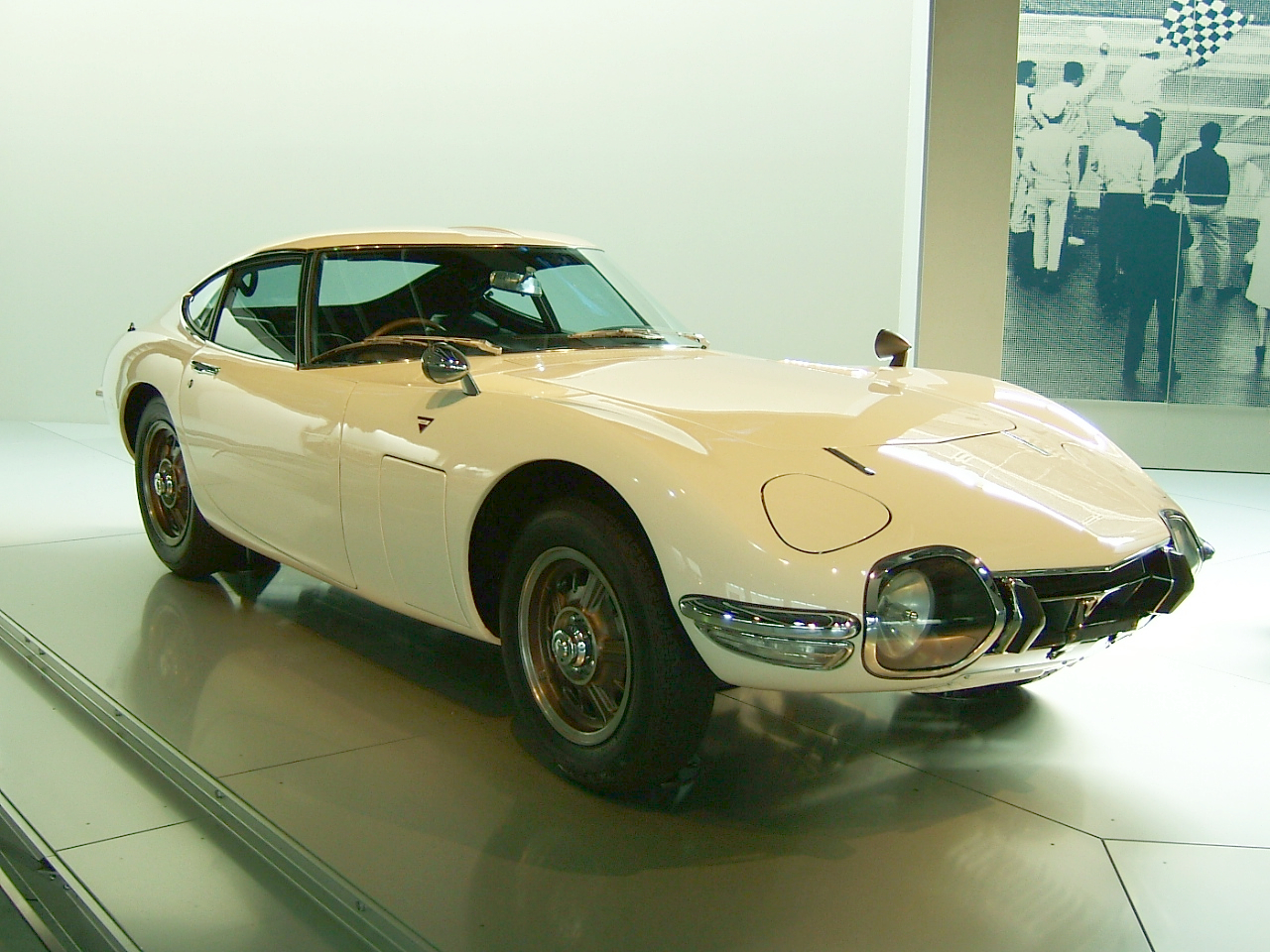
Toyota 2000GT
1967–1969 Toyota 2000GT
Overview
ManufacturerToyota Motor Corporation and Yamaha Motor Corporation (joint project)
Model codeF10
Production1967–1970 (351 produced)
AssemblyJapan: Iwata, Shizuoka (Yamaha Motors)
Designer
Body and chassis
ClassSports car/grand tourer
Body style
LayoutFront mid-engine, rear-wheel-drive
Powertrain
Engine
Power output
  • 150 PS (148 hp; 110 kW) (3M)
  • 140 PS (138 hp; 103 kW) (2M-B)
Transmission
Dimensions
Wheelbase2,330 mm (91.7 in)[2]
Length4,175 mm (164.4 in)[2]
Width1,600 mm (63.0 in)[2]
Height
  • 1,104 mm (43.5 in) (roadster)[3]
  • 1,160 mm (45.7 in)[2]
  • 1,170 mm (46.1 in) (1969–1970)[3]
Curb weight1,120 kg (2,469 lb)[2]

The Toyota 2000GT is a limited-production front mid-engine, rear-wheel-drive, two-door, two-seat sports car/grand tourer designed by Toyota in collaboration with Yamaha. First displayed to the public at the Tokyo Motor Show in 1965, the 2000GT was manufactured under contract by Yamaha between 1967 and 1970. A halo car for the automaker, in Japan it was exclusive to Toyota's Japanese retail sales channel called Toyota Store.

The 2000GT revolutionized the automotive world's view of Japan, then viewed as a producer of imitative and stodgily practical vehicles. As a sleek, high-performance fastback coupé, it demonstrated its auto makers could produce a sports car to rival the better marques of Europe. Reviewing a pre-production 2000GT in 1967, Road & Track magazine summed up the car as "one of the most exciting and enjoyable cars we've driven", and compared it favorably to the Porsche 911. Today, the 2000GT is seen as the first seriously collectible Japanese car and by some as its first supercar, while others claim the later Honda NSX holds that title.[4][5] Examples of the 2000GT have sold at auction for as much as US$1,200,000 in 2013.[6]

Background

[edit]

Automobile ownership in Japan during the late 1950s and early 1960s began to pick up, and Toyota noticed that most international manufacturers had a top level sports car or grand touring coupe, that would draw customers into showrooms and dealerships and drive sales of other more affordable models. Ford had recently introduced the Thunderbird, Chrysler had the C-300 while GM's Chevrolet Division had the Corvette. In Europe, Mercedes-Benz had the 300SL, BMW briefly offered the 507, Porsche had the 356, Jaguar had the E-Type, Aston Martin had the DB4, Ferrari had the 250 GT Coupé, and Maserati had the 3500 GT. In Japan, Nissan offered the Datsun Sports, while Honda introduced the S500 and Prince offered the Skyline Sport Coupé. Toyota had already began production of the Sports 800, but the engine was far too small to be considered a world class sports car, and decided they needed to offer a proper 6-cylinder coupe.

Most of the 2000GT's design was done by Yamaha Motor Corporation, who also contributed contract assistance for other Japanese manufacturers, including Nissan. In 1959, Yamaha established the Technical Research Institute to develop their own sports car, and had built the YX30 sports car with a 4-cylinder engine displacing 1600cc, having drawn inspiration from the British MGA B-Series 1600 DOHC engine.[7][8] Due to various problems, Yamaha senior management decided to close the research facility in 1962, but enthusiasm of developing a sports car led to them partnering with an established auto manufacturer. A prototype called the "A550X" was built, but Nissan cancelled the project and introduced the slow selling Nissan Silvia coupe in 1965.[9][10] Yamaha then proposed the design to Toyota, for whom they also did contract work, then perceived as the most conservative of the Japanese car manufacturers. Wishing to improve their image, Toyota accepted the proposal, but employed a design from their own designer Satoru Nozaki.[11][12]

Styling

[edit]
Toyota 2000GT from rear

The 2000GT incorporated many classic 1960s Gran Turismo design elements. Nozaki's styling was inspired by the E-type Jaguar.[13] Its smoothly flowing bodywork featured pop-up headlights above large plexiglass covered driving lamps flanking the grille similar to those on the Toyota Sports 800. Bumpers were minimal, and the car was extremely low, just 116 cm (45.7 in) to the highest point of the roof. Despite a custom open-top version built for the James Bond film You Only Live Twice, a factory-produced convertible was never offered.

Toyota 2000GT dashboard

The interior offered comfortable, if cramped, accommodation and luxury touches such as a walnut or rosewood veneer dashboard inlays provided by Yamaha's musical instrument woodworking facilities, and an auto-signal seeking radio tuner.[14] Road & Track was impressed, considering the interior suited to a "luxurious GT" and calling the 2000GT an impressive car "in which to sit or ride - or simply admire." An electric clock and a stopwatch were installed in the dashboard below the radio and above the climate controls.[14]

Toyota 2000GT facelift

In August 1969, the front was modified slightly, making the driving lamps smaller and changing the shape of the turn signals. The rear turn signals were enlarged at the same time, and some alterations were made to modernise the interior. The last few vehicles were fitted with air conditioning and had automatic transmission as an option. These cars had an additional scoop fitted underneath the grille to supply air to the A/C unit.

Drivetrain

[edit]
The 3M DOHC 2.0 liter inline six was the 2000GT's main engine
Only nine special models were fitted with the larger 2M SOHC 2.3 liter inline six

The engine was a longitudinally mounted 1,988 cc (2.0 L; 121.3 cu in) straight-6 (the 3M) sourced from the Toyota Crown (S50) sedan.[14] It was transformed by Yamaha into a sports car engine by coupling three 2-barrel Mikuni-Solex 40 PHH carburetors[15][16] to a new DOHC head that produced 150 PS (148 bhp; 110 kW) at 6,600 rpm and 175 N⋅m (129 lb⋅ft) at 5,000 rpm.

Nine special MF-12 models were also built with the larger but lower power output SOHC 2.3 L 2M-B engine, which produced 140 PS (138 bhp; 103 kW) at 5,800 rpm and 201 N⋅m (148 lb⋅ft) at 3,800 rpm of torque.

Fitted with a five-speed manual transmission, the rear wheel drive car was available with three different final drives. A 4.375 ratio axle car was claimed to be capable of reaching 135 mph (217 km/h) and achieve 7.59 L/100 km (31 mpg‑US; 37 mpg‑imp).[1]

Both a limited slip differential and all-around power-assisted disc brake, a first for a Japanese car, were standard. The suspension was coil springs attached to double wishbones at all four wheels installed on a backbone chassis and rode on 15-inch Magnesium alloy wheels.[14] It was also the first Toyota to offer rack and pinion steering as Toyota wanted to establish that this was a world-class sports car. The dashboard-mounted emergency brake gripped the rear discs directly should the primary braking system fail.

Production

[edit]

Only 337 regular production units of the 2000GT were built, figures comparable to contemporary elite Italian supercars, and according to Toyota, all 337 were sold.[3][14] The first prototype was built in August 1965, only 11 months after the project had begun. Taking two years for production vehicles to finally emerge, a total of 233 MF10s, 109 MF10Ls, and nine MF12Ls[citation needed] were built at the Yamaha factory in Iwata, Shizuoka according to Toyota and Yamaha data, starting in May 1967 until August 1970. In America, a 1968 2000GT listed for about US$7,150[17] ($66,197 in 2025 dollars [18]), a moderately higher price than competitors like the $5,539 Jaguar E-Type[19] or the $6,790 Porsche 911S,[20] though much lower than exotics like the $19,700 Ferrari 365 GTB/4.[21] Toyota did not sell very many of the cars, which led to its cancellation in 1970, while it did inspire the company to introduce performance oriented "sporty" coupes that followed in the 1970s.

As a "halo car" for Toyota, it is believed that no profit was made on the 2000GT despite its high price. About 60 units reached North America and the others were similarly thinly spread worldwide. Most 2000GTs were painted either Solar Red or Pegasus White, while other colors were offered such as Thunder Silver metallic, Bellatrix Yellow, Atlantis Green, and Twilight Turquoise metallic.

Yamaha and Toyota also collaborated on another more affordable production car, again using a Toyota engine block while Yamaha developed the DOHC cylinder head, and introduced the Toyota 1600GT, using a 1967 Corona 2-door hardtop coupe. When production of the 2000GT ended, and Toyota had established a reputation of making performance oriented cars, the Celica was exclusively introduced at Toyota Corolla Store locations as the top model, again offering a 2.0L DOHC engine with a manual transmission but more affordably priced. Toyota also introduced sport coupes at each of their sales distribution networks, using the same technology in a 2-door coupe with an OHC 4-cylinder engine and a fun-to-drive approach to each car. May 1967 was also the same time the Mazda Cosmo was also introduced.

Lessons learned by Toyota and Yamaha led to the development of the Toyota 7, which was designed primarily for use in FIA Group 7 competition. It was Toyota's first purpose-built racing car.

Recognizing that the limited number of original cars may need maintenance to keep the vehicles in drivable condition, Toyota has begun reproducing new parts from original sources, and has made them available to registered owners through the GR Heritage Parts Program.[22]

Racing

[edit]

Toyota entered the 2000GT in competition at home, coming third in the 1966 Japanese Grand Prix at Fuji. The 2000GT took its first win in the inaugural Suzuka 1000 Kilometres in 1966, and went on to win the 24 Hours of Fuji and the Fuji 1000 Kilometres in 1967. In addition, the car set thirteen FIA world records for speed and endurance in a 72-hour test at the Yatabe High Speed Test Track in 1966. Unfortunately, the record car was destroyed in a pace car accident and eventually scrapped. These records shortly prompted Porsche to prepare a 911R especially to beat this record.

Carroll Shelby also entered a pair of 2000GTs to compete in the 1968 SCCA production car races in the CP category. Initially Shelby built three cars, including one spare. Although it performed well, it was the only season the car competed in the US. Toyota took back one of the cars and rebuilt it into a replica of their record car, which still resides in Japan. The two remaining Shelby cars remain in the United States.

In 2022, one of the Toyota-Shelby 2000GTs sold at auction for US $2.5 million.[23]

2000GT Open-Top, the "Bond Model"

[edit]
2000GT used in the James Bond film You Only Live Twice

The 2000GT made its most famous screen appearance in the 1967 James Bond movie You Only Live Twice, most of which was filmed in Japan. Two one-off topless models—fitted only with tonneau covers to simulate functioning convertible roofs—were made specially for the film.[14] It is claimed that a targa had been considered to accommodate the burly 1.88 m (6 ft 2 in) tall Sean Connery. This retained the original car's fastback profile but eliminated rear side windows. Purportedly, Connery's head stuck out of the top and a roofless version was fabricated in less than two weeks for the movie.[24] The car was only driven by "Bond girl" Aki (Akiko Wakabayashi) in the film.[25]

Bond actor Daniel Craig voted the 2000GT as his favourite Bond car of all time.[26]

References

[edit]
Revisions and contributorsEdit on WikipediaRead on Wikipedia
from Grokipedia
The 2000GT is a limited-production manufactured by in collaboration with Yamaha from 1967 to 1970, featuring a hand-built body on a , a 2.0-liter DOHC inline-six producing 150 horsepower, and a top speed exceeding 130 mph, with only 351 units ever produced. Unveiled as a concept at the 1965 Tokyo Motor Show, it represented 's ambition to enter the global sports car market, boasting advanced features like four-wheel disc brakes, independent double-wishbone suspension, and a five-speed for its era. Developed under project leader Jiro Kawano, the 2000GT's engine was derived from the SOHC unit in the but redesigned by Yamaha into a high-revving DOHC configuration with hemispherical combustion chambers, delivering 148-150 at 6,600 rpm and enabling acceleration from 0-60 mph in about 8 seconds. Its low-slung, aerodynamic design—measuring 4,175 mm in length with a 2,330 mm and 1,120 kg curb weight—earned it acclaim as Japan's first , a halo vehicle that elevated Toyota's international reputation beyond economy s. The 2000GT achieved motorsport success, including victories in the 1967 Fuji 24-Hour Endurance Race and setting three world speed records plus 13 international records in 1966 trials, while its cultural impact peaked with two specially modified open-top roadsters featured in the 1967 film You Only Live Twice, marking the first Japanese car in a Bond movie and boosting global awareness. Production was handled exclusively by Yamaha's skilled craftsmen, emphasizing precision assembly that contributed to the model's rarity and enduring collector value today.

Development

Background

Following , Motor Corporation concentrated on rebuilding its operations amid Japan's economic recovery, primarily producing reliable economy cars for domestic use while gradually expanding exports. The Tokyo Olympics marked a significant milestone, showcasing Japan's resurgence in technology and manufacturing to the world and motivating the automotive industry to develop sophisticated vehicles that could symbolize national ingenuity and compete internationally. Eiji Toyoda, serving as 's vice president at the time, envisioned a high-performance to challenge established European sports cars like the , positioning as a capable producer of premium automobiles beyond its reputation. In the mid-1960s, amid Japan's aggressive export expansion targets—aiming to elevate its global market share— recognized the strategic value of a halo vehicle to enhance brand prestige and demonstrate advanced engineering capabilities. Initial concept sketches, led by designer Satoru Nozaki, laid the groundwork for the project, prompting in early 1965 to partner with Yamaha Motor Co. for specialized body fabrication, drawing on Yamaha's precision craftsmanship from motorcycle production. This collaboration resulted in the completion of the first prototype by August 1965, setting the stage for the model's public debut.

Design process

The development of the Toyota 2000GT, led by project chief Jiro Kawano, spanned from 1964 to 1967, marked by a strategic engineering collaboration between and Yamaha Motor Co. to produce a high-performance that would elevate Japan's automotive reputation. On September 8, 1965, the companies formalized their partnership, with Yamaha leveraging its precision manufacturing expertise—honed from and production—to handle , body fabrication, and detailing, while oversaw the overall vehicle architecture and integration. This alliance addressed key technical challenges, such as achieving high build quality through hand-assembly techniques at Yamaha's Iwata factory, ensuring smooth curves and structural integrity without mass-production tooling. A pivotal aspect of the design process was the exterior styling under Toyota designer Satoru Nozaki, who created the 2000GT's iconic low-slung coupe profile. Nozaki's design emphasized aerodynamic efficiency and proportional balance, drawing on European influences like the while incorporating Japanese craftsmanship for a sleeker roofline and pop-up headlights, all achieved through and iterative sketching within an eight-month timeline from concept to prototype. This phase overcame challenges in scaling the design for production feasibility, ensuring the body's hand-built construction maintained dimensional accuracy despite the absence of advanced computer-aided tools. The engineering built on internal prototypes, evolving into a rigid X-frame backbone with a separate body mount to enhance torsional stiffness and handling precision. It incorporated fully independent double-wishbone suspension with coil springs at all four corners for superior roadholding, paired with four-wheel disc brakes sourced from the British supplier Girling to provide reliable under high-performance conditions. These components addressed early prototyping hurdles, such as integrating a mid-front placement to optimize , ultimately achieving a near-ideal 49/51 front-to-rear balance through ballast adjustments and suspension tuning. Key prototyping milestones included the completion of the first running prototype in August 1965, powered by a modified 2.0-liter inline-six and showcased as a white at the October 1965 Tokyo Motor Show, where it garnered significant attention. Subsequent iterations in 1966 focused on refining integration and body fitment, culminating in the first production-ready model in February 1967 after extensive on-road testing to resolve vibration issues and ensure durability. These steps highlighted the collaborative problem-solving required to transition from concept to a vehicle capable of competing with European grand tourers.

Design and specifications

Exterior and interior styling

The Toyota 2000GT's exterior emphasized aerodynamic efficiency and sleek proportions, incorporating a tail that truncated abruptly to minimize drag while maintaining a silhouette. Pop-up headlights integrated seamlessly into the low nose, flanked by fixed plexiglass-covered driving lamps, contributing to the car's smooth frontal profile. A distinctive glass-covered rear deck provided visibility into the trunk area and enhanced the overall flowing lines, evoking contemporary European grand tourers. The body's overall dimensions measured 4,175 mm in length, 1,600 mm in width, and 1,160 mm in height, creating a compact, low-slung stance with a of 2,330 mm. Aerodynamic considerations were paramount, with smooth contours, flush surfaces, and minimal protrusions yielding a of 0.28, which supported high-speed stability and efficiency. The steel provided rigidity, while the hand-built aluminum body panels, including the hood, , and trunk lid, reduced weight without compromising structural integrity. This resulted in a curb weight of approximately 1,120 kg, balancing performance and handling. Inside, the cabin prioritized driver-focused with leather-trimmed bucket seats offering supportive bolstering for spirited driving. A handcrafted wooden , veneered in rosewood by Yamaha artisans, provided a premium tactile feel, complemented by analog gauges clustered in a for clear visibility of speed, rpm, and vital metrics. However, the low roofline at just 1,160 mm overall height rendered the space challenging for drivers taller than 1.85 meters and emphasized the car's sporty, intimate character.

Drivetrain and performance

The Toyota 2000GT was powered by the engine, a 2.0-liter inline-six with double overhead camshaft (DOHC) configuration and hemispherical combustion chambers designed in collaboration with Yamaha for enhanced airflow and efficiency. This engine produced 148 horsepower at 6,600 rpm and 129 lb-ft of torque at 5,000 rpm, delivering smooth power delivery suitable for grand touring. Power was transmitted through a five-speed manual gearbox paired with , with a standard 4.375:1 final drive ratio (optional ratios available) that balanced acceleration and highway cruising. The driveline included a , contributing to predictable handling under load. The chassis employed independent double-wishbone suspension at both front and rear axles, with coil springs and telescopic dampers for composed ride quality and cornering stability. Braking was handled by 10.9-inch ventilated disc brakes on all four wheels, providing strong stopping power without fade during spirited driving. In performance testing, the 2000GT achieved 0-60 mph in 7.8 seconds, a top speed of 135 mph, and highway economy of approximately 20 mpg, reflecting its era's balance of sportiness and usability.

Production

Manufacturing

The 2000GT was manufactured through a close collaboration between Toyota Motor Corporation and Yamaha Motor Co., Ltd., with primary assembly occurring at Yamaha's Iwata factory in from 1967 to 1970. Under a cooperation agreement signed in September 1965, Yamaha handled the prototyping and low-volume production of the vehicle, leveraging its expertise in precision craftsmanship from motorcycle and manufacturing. The production process relied on hand-assembly techniques suited to the car's limited run, where small teams of skilled artisans built each vehicle individually in a manner closer to custom fabrication than automated . Body components such as the roof, fenders, and doors were hand-formed from , while the hood and trunk lid utilized fiberglass-reinforced plastic (FRP) molding for lightweight strength. Interior wooden elements, including the rim, gearshift knob, and instrument panel veneers, were meticulously shaped using Yamaha's specialized methods—adapted from and guitar production—to achieve seamless joints and resistance to environmental stress without cracking. The exterior received hand-sprayed paint applications for a flawless finish, and magnesium-alloy disc wheels were cast on-site to precise tolerances. This labor-intensive approach ensured exceptional panel alignment and overall fit, highlighting the role of experienced craftsmen in every stage. Once the bodies and major assemblies were completed at Iwata, they were shipped to Toyota's facilities for final integration of mechanical components, including the , and comprehensive quality checks. Toyota engineers conducted stringent inspections to verify mechanical tolerances, paint durability, and rust-proofing measures, addressing early issues such as water ingress around seals and wiper functionality through iterative improvements. These efforts embodied the philosophy of continuous refinement central to Japanese automotive manufacturing, prioritizing reliability and precision in a low-volume context. Key components were sourced strategically within the to blend Toyota's with specialized inputs. The 2.0-liter DOHC inline-six (3M-B) drew from Toyota's existing 2M block used in the Corona sedan, enhanced by a custom Yamaha-designed aluminum for high-revving performance. Select parts, including certain suspension and braking elements, incorporated European-sourced technologies to meet international grand touring standards, though the majority of the vehicle remained Japanese-built.

Output and distribution

The Toyota 2000GT entered production in 1967 and continued until 1970, during which time a total of 337 units were manufactured. Of these, 233 vehicles were intended for the domestic Japanese market, while 104 were prepared for export markets. Export distribution focused primarily on the , where around 60 units were sold, followed by approximately 30 units in and a handful in . In the , the 2000GT retailed for about $7,200, a figure equivalent to roughly $69,000 in 2025 dollars when adjusted for . Despite its impressive engineering, the model's elevated pricing relative to competitors like the or constrained overall sales volume. Nonetheless, the car garnered significant acclaim upon its public debut as a production model at the 1967 Tokyo Motor Show, where it drew crowds and established Toyota's credibility in high-performance vehicles. Production ceased in 1970 amid tightening global emissions standards that complicated compliance for the handbuilt , alongside Toyota's pivot to more accessible models such as the Celica introduced that year.

Racing

Competition history

The Toyota 2000GT's competition history began in Japan under the auspices of the Toyota Motor Sports Club (TMSC), the company's dedicated racing arm, where it demonstrated strong potential in grand touring classes despite its relatively modest power output. In its debut major event, the third at in May 1966, a factory-prepared 2000GT finished third overall, piloted by TMSC drivers in a field dominated by prototype sports cars like the and R381. This result highlighted the car's balanced handling on twisty circuits, allowing it to punch above its weight against more powerful prototypes, though it trailed the winners by a lap due to the event's multi-class format. Earlier in 1967, the 2000GT achieved back-to-back victories at Fuji Speedway, securing a 1-2 finish in the inaugural Fuji 24-Hour Endurance Race in April and first place in the GT category of the Fuji 1000 km endurance race in July, with drivers Shihomi Hosoya and Yoshio Otsubo completing 248 laps without major incidents and outpacing rivals including Porsche 906 models. The car's reliability shone in these outings, completing the demanding distances ahead of several higher-powered entries, though its 2.0-liter inline-six engine, producing around 150 horsepower in standard form, required careful management to maintain pace. This win, along with a class victory in the inaugural Suzuka 1000 km in 1966 by drivers Sachio Fukuzawa and Tomohiko Tsutsumi, established the 2000GT as a podium contender in Japan's burgeoning sports car scene, often finishing on the rostrum in GT classes against established European marques like Porsche. Internationally, the 2000GT saw limited factory-backed entries due to resource constraints despite satisfying FIA Group 3 GT homologation with over 100 units produced. In the United States, Toyota partnered with Brock Racing Enterprises (BRE) and Carroll Shelby for the 1968 SCCA C-Production National Championship, where the car achieved four outright wins and multiple podiums against competitors like the Porsche 911 and Triumph TR250, driven by entrants such as Scooter Patrick and Dave Jordan. However, the program was hampered by overheating issues in high-temperature conditions and the engine's underpowered nature relative to turbocharged or larger-displacement rivals, leading to retirements and preventing a title challenge despite the car's agile chassis excelling on technical tracks. Overall, the 2000GT's racing record—concentrated in a handful of high-profile Japanese events and a single U.S. season—emphasized its role as a technological showcase for , with just over a dozen competitive outings yielding several class wins and podiums, though constrained by production priorities and mechanical limitations.

Racing modifications

To prepare the Toyota 2000GT for competitive use in events like the FIA GT series, engineers implemented significant engine tuning on the 2.0-liter inline-six, raising output to approximately 200-220 hp. This was achieved through a higher of 10.5:1, replacement of the stock Mikuni-Solex carburetors with three Weber 45 DCOE units for better fuel delivery, and a free-flowing to improve breathing and reduce backpressure. Chassis enhancements focused on improving handling and stability, with the fully independent double-wishbone suspension uprated using stiffer springs and dampers to reduce body roll, thicker adjustable anti-roll bars for tunable cornering balance, and lightweight wheels to lower unsprung weight. These changes enabled superior roadholding, allowing the cars to achieve lateral acceleration approaching 0.9g in testing. Aerodynamic modifications were essential for high-speed stability, including the addition of front and rear spoilers to generate , enlarged vents in the hood and fenders for improved engine cooling and brake airflow, and a lowered of up to 1.5 inches to minimize lift. These alterations helped maintain composure at speeds exceeding 140 mph on circuits. For FIA GT competition, the 2000GT's total production of 351 units satisfied Group 3 requirements (needing at least 100 examples), but racing teams prepared modified versions akin to Group 4 specials, which demanded a minimum of 50 units. These included widened fenders to accommodate larger tires (up to 15-inch wide rears with 225/50 section rubber) for enhanced grip without exceeding displacement limits.

Variants

Open-top "Bond" model

The open-top Toyota 2000GT, often referred to as the "Bond" model, was a pair of custom roadsters commissioned by film producer in early 1966 for the James Bond production You Only Live Twice. Built by at the Toyopet Service Centre in Tsunashima, these two units—along with a static prop—represented the only official convertible variants of the 2000GT, created to address the limited headroom of the standard coupe for the 6-foot-2-inch actor . Unlike the closed-roof , the roadsters featured a roofless with no side windows or hood, white exterior , black , and wire wheels for enhanced visual appeal in filming. The chassis was adapted from the 's backbone frame with structural reinforcements to maintain rigidity without the roof, while retaining the 2.0-liter DOHC inline-six engine, five-speed , and rear-wheel-drive layout. One roadster included production-specific modifications such as Sony-supplied gadgets: a CCTV screen, VCR, concealed cameras, two-way radios, voice-controlled , and an audio system integrated into the . In the film, the roadsters starred in three key Tokyo-based sequences, primarily piloted by Japanese agent Aki (Akiko Wakabayashi) to transport and rescue (), including a drive to meet contact Dikko Henderson and evasion maneuvers during pursuits. Toyota test drivers operated the pedals and gearshift during shoots to ensure precise handling, highlighting the car's agility in urban chase scenes despite its low-slung profile. The open-top configuration not only facilitated Connery's fit but also emphasized the vehicle's exotic styling on screen. Following in 1966, the primary film roadster vanished from records after use, while the backup served promotional duties, including a debut at the 1967 Geneva Motor Show. One of the pair was reportedly wrecked in the 1970s and may have entered private sale, whereas the surviving example was located in in 1977, underwent restoration, and now resides in Toyota's Automobile Museum in .

Other special editions

Nine special MF-12 models were built with the larger SOHC 2.3 L 2M-B inline-six , producing 140 PS (103 kW) at 5,800 rpm, paired with a five-speed . These variants offered slightly more than the standard 2.0 L DOHC models but lower peak power, and were produced alongside the regular lineup from to 1970. In the and beyond, enthusiasts pursued custom conversions of the 2000GT, often focusing on enhanced performance through swaps to address the original 2.0-liter inline-six's limitations. One notable example involved replacing the stock with a 7M 3.0-liter inline-six , boosting output significantly while retaining the car's compact for improved dynamics. These aftermarket modifications, typically performed by shops, extended the model's usability into modern contexts without altering its iconic silhouette, though such projects remained rare due to the car's limited production run of 351 units. Modern replicas have emerged to recreate the 2000GT's allure for contemporary audiences, often using more accessible donor platforms. Japanese firm Auto offers the 3000GT, a hand-built with a body and options for 2.0-liter or larger engines, available in or convertible forms since around 2016 to commemorate the original's legacy. Similarly, builders like Roadster Garage and have developed kits based on the Miata chassis post-2007, employing panels for the bodywork to achieve a near 50:50 while leveraging the Miata's handling traits. These replicas, priced around €70,000 or equivalent, provide an affordable entry into the 2000GT experience without sourcing scarce originals.

Legacy

Cultural significance

The Toyota 2000GT achieved widespread international recognition through its prominent role in the 1967 James Bond film You Only Live Twice, where it was driven by the Japanese agent Aki to transport and rescue Bond. This appearance, which included specially modified open-top versions to accommodate actor Sean Connery's height, introduced the model to a global audience and significantly enhanced Toyota's visibility in Western markets at a time when Japanese cars were primarily associated with affordability rather than sophistication. The film's exposure helped shift perceptions, positioning the 2000GT as a symbol of emerging Japanese excellence in automotive design and engineering. Contemporary media coverage further amplified the 2000GT's prestige, with automotive publications like delivering glowing assessments in their 1967 road test, commending its refined handling, luxurious interior, and competitive performance against European rivals such as the Porsche 911. The model has since been profiled in documentaries on Japanese automotive history, such as those exploring its development and record-setting endurance runs, underscoring its pivotal role in challenging stereotypes about post-war Japanese manufacturing. The 2000GT's cultural impact extended to influencing Toyota's future sports car development, serving as a foundational influence for later models like the MR2 and Supra by proving the feasibility of high-performance grand tourers from a brand known for economy vehicles. It played a key part in elevating Japan's overall automotive reputation, transitioning the industry from perceptions of reliable but unexciting cars to innovative performers capable of rivaling global leaders. In broader pop culture, the 2000GT endures as an icon of 1960s innovation, frequently appearing in video games such as the Gran Turismo series, where it represents early Japanese automotive ambition. Its legacy also includes nods in films and enthusiast media, reinforcing its status as a trailblazing symbol of cultural and technological crossover.

Collectibility and restorations

The Toyota 2000GT's extreme rarity—stemming from its limited production run of just 351 units between 1967 and 1970—has elevated it to one of the most sought-after collectibles in the classic car market, with fewer than the original total believed to survive due to age and attrition. Auction values reflect this scarcity, routinely exceeding $1 million for well-documented examples in the mid-2020s, with a low-mileage 1968 model fetching $850,000 at Bring a Trailer in 2021 and standard coupes trading in the $1.0 to $1.2 million range. The pinnacle came in 2022 when a race-prepared 1967 Shelby-Toyota 2000GT sold for $2.535 million at Gooding & Company's Amelia Island auction, establishing it as the most expensive Japanese car ever sold at public auction. Restoring a surviving 2000GT demands expertise to address prevalent structural vulnerabilities, including accumulation in the fenders and frame sections that trap , as well as on the aluminum body panels exposed after paint stripping. These issues often necessitate extensive and to preserve originality, with specialists like Maine Line Exotics—veteran restorers since —employing period-correct techniques for engine rebuilds, suspension overhauls, and bodywork. Toyota supports such efforts through its GR Heritage Parts program, which reproduces discontinued components like transmissions and differentials. In contemporary settings, the 2000GT maintains strong relevance among enthusiasts, securing multiple Best in Class honors at the Pebble Beach Concours d'Elegance since 2000, including a First in Class win for a preserved 1967 example that later achieved auction prominence. Toyota has nodded to its legacy in the 2020s GR Supra, drawing design inspiration from the 2000GT's sleek profile and double-bubble roofline to evoke the grand tourer's aerodynamic poise. Buyers must exercise caution regarding post-1980 replicas, such as those crafted by Rocky Auto in , which replicate the 2000GT's and even incorporate modern upgrades like a 2JZ but do not qualify as originals. Authentication of genuine vehicles relies on verifying the number prefix "MF10," a hallmark of production, alongside matching serials and historical documentation from archives.

References

Add your contribution
Related Hubs
User Avatar
No comments yet.