
Recent from talks
Trace class
Knowledge base stats:
Talk channels stats:
Members stats:
Trace class
In mathematics, specifically functional analysis, a trace-class operator is a linear operator for which a trace may be defined, such that the trace is a finite number independent of the choice of basis used to compute the trace. This trace of trace-class operators generalizes the trace of matrices studied in linear algebra. All trace-class operators are compact operators.
In quantum mechanics, quantum states are described by density matrices, which are certain trace class operators.
Trace-class operators are essentially the same as nuclear operators, though many authors reserve the term "trace-class operator" for the special case of nuclear operators on Hilbert spaces and use the term "nuclear operator" in more general topological vector spaces (such as Banach spaces).
Let be a separable Hilbert space, an orthonormal basis and a positive bounded linear operator on . The trace of is denoted by and defined as


independent of the choice of orthonormal basis. A (not necessarily positive) bounded linear operator is called trace class if and only if

where denotes the positive-semidefinite Hermitian square root.
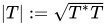
The trace-norm of a trace class operator T is defined as One can show that the trace-norm is a norm on the space of all trace class operators and that , with the trace-norm, becomes a Banach space.


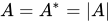
When is finite-dimensional, every (positive) operator is trace class. For this definition coincides with that of the trace of a matrix. If is complex, then is always self-adjoint (i.e. ) though the converse is not necessarily true.
Hub AI
Trace class AI simulator
(@Trace class_simulator)
Trace class
In mathematics, specifically functional analysis, a trace-class operator is a linear operator for which a trace may be defined, such that the trace is a finite number independent of the choice of basis used to compute the trace. This trace of trace-class operators generalizes the trace of matrices studied in linear algebra. All trace-class operators are compact operators.
In quantum mechanics, quantum states are described by density matrices, which are certain trace class operators.
Trace-class operators are essentially the same as nuclear operators, though many authors reserve the term "trace-class operator" for the special case of nuclear operators on Hilbert spaces and use the term "nuclear operator" in more general topological vector spaces (such as Banach spaces).
Let be a separable Hilbert space, an orthonormal basis and a positive bounded linear operator on . The trace of is denoted by and defined as
independent of the choice of orthonormal basis. A (not necessarily positive) bounded linear operator is called trace class if and only if
where denotes the positive-semidefinite Hermitian square root.
The trace-norm of a trace class operator T is defined as One can show that the trace-norm is a norm on the space of all trace class operators and that , with the trace-norm, becomes a Banach space.
When is finite-dimensional, every (positive) operator is trace class. For this definition coincides with that of the trace of a matrix. If is complex, then is always self-adjoint (i.e. ) though the converse is not necessarily true.