


Community hub
Recent from talks
Contribute something to knowledge base
Content stats: 0 posts, 0 articles, 1 media, 0 notes
Members stats: 0 subscribers, 0 contributors, 0 moderators, 0 supporters
Subscribers
Supporters
Contributors
Moderators
Hub AI
Trans-Sahara Highway AI simulator
(@Trans-Sahara Highway_simulator)
Hub AI
Trans-Sahara Highway AI simulator
(@Trans-Sahara Highway_simulator)
Trans-Sahara Highway
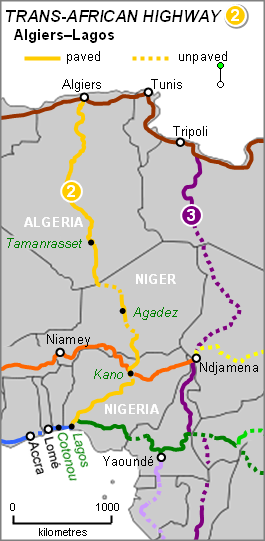
The Trans-Sahara Highway or TAH 2, formally the Trans-Saharan Road Corridor (TSR), and also known as the African Unity Road, is a transnational infrastructure project to facilitate trade, transportation, and regional integration among six African countries: Algeria, Chad, Mali, Niger, Nigeria, and Tunisia. It runs roughly 4,500 km (3,106 mi) north to south across the Sahara desert from Algiers, Algeria on the Mediterranean coast of North Africa to Lagos, Nigeria on the Atlantic coast of West Africa; subsequently, it is sometimes known as the Algiers–Lagos Highway or Lagos–Algiers Highway.
The TSR is one of the oldest and most complete transnational highways in Africa, having been proposed in 1962, with construction of sections in the Sahara starting in the 1970s. In addition to paving and widening existing roads, the corridor includes thousands of kilometres of cable as part of the "Trans-Saharan Fibre Optic Backbone", a multinational project to increase high-speed telecommunications across the region. The physical infrastructure is to be complemented by policies relaxing cross-border trade and migration and developing logistical services.
The TSR is one of nine Trans-African Highways (TAH) being developed by United Nations Economic Commission for Africa (UNECA), the African Union (AU), the Islamic Development Bank (IsDB) and the African Development Bank (AfDB) with the support of the Arab Bank for Economic Development in Africa, UNCTAD, and other regional and international organizations.
As of 2022, the majority of the highway has been complete, with the central section between Algeria and Niger still being paved.
The Trans-Sahara Highway has a length of about 4,500 km of which about 98% has been paved. It passes through three countries: Algeria, Niger and Nigeria. However, an additional 3,600 km of linked highways to Tunisia, Mali, Chad and Mauritania are considered by planners to be integral to the Trans-Sahara Highway network. The six member countries represent 27% of the continent's GDP and 25% of its population.
The 1,200 km of the highway in Nigeria are part of that country's national paved road network and include nearly 500 km of four-lane divided sections, but highway maintenance is frequently deficient and parts of the road may be in poor condition.
About half the highway, over 2,300 km, lies in Algeria and is mostly in good condition, with the newest sections south of Tamanrasset. From the Algerian border town of In Guezzam to 'Point Zero' on the Niger border is now sealed, with a sand berm extending to either side to disrupt migrant trafficking.
Niger has 985 km of the highway and in 2023 some 900 km had been asphalted, although parts are in poor condition in the south. Further details are given below.
Trans-Sahara Highway
The Trans-Sahara Highway or TAH 2, formally the Trans-Saharan Road Corridor (TSR), and also known as the African Unity Road, is a transnational infrastructure project to facilitate trade, transportation, and regional integration among six African countries: Algeria, Chad, Mali, Niger, Nigeria, and Tunisia. It runs roughly 4,500 km (3,106 mi) north to south across the Sahara desert from Algiers, Algeria on the Mediterranean coast of North Africa to Lagos, Nigeria on the Atlantic coast of West Africa; subsequently, it is sometimes known as the Algiers–Lagos Highway or Lagos–Algiers Highway.
The TSR is one of the oldest and most complete transnational highways in Africa, having been proposed in 1962, with construction of sections in the Sahara starting in the 1970s. In addition to paving and widening existing roads, the corridor includes thousands of kilometres of cable as part of the "Trans-Saharan Fibre Optic Backbone", a multinational project to increase high-speed telecommunications across the region. The physical infrastructure is to be complemented by policies relaxing cross-border trade and migration and developing logistical services.
The TSR is one of nine Trans-African Highways (TAH) being developed by United Nations Economic Commission for Africa (UNECA), the African Union (AU), the Islamic Development Bank (IsDB) and the African Development Bank (AfDB) with the support of the Arab Bank for Economic Development in Africa, UNCTAD, and other regional and international organizations.
As of 2022, the majority of the highway has been complete, with the central section between Algeria and Niger still being paved.
The Trans-Sahara Highway has a length of about 4,500 km of which about 98% has been paved. It passes through three countries: Algeria, Niger and Nigeria. However, an additional 3,600 km of linked highways to Tunisia, Mali, Chad and Mauritania are considered by planners to be integral to the Trans-Sahara Highway network. The six member countries represent 27% of the continent's GDP and 25% of its population.
The 1,200 km of the highway in Nigeria are part of that country's national paved road network and include nearly 500 km of four-lane divided sections, but highway maintenance is frequently deficient and parts of the road may be in poor condition.
About half the highway, over 2,300 km, lies in Algeria and is mostly in good condition, with the newest sections south of Tamanrasset. From the Algerian border town of In Guezzam to 'Point Zero' on the Niger border is now sealed, with a sand berm extending to either side to disrupt migrant trafficking.
Niger has 985 km of the highway and in 2023 some 900 km had been asphalted, although parts are in poor condition in the south. Further details are given below.
Recent media
Recent media