
Recent from talks
Transition to the New Order
Knowledge base stats:
Talk channels stats:
Members stats:
Transition to the New Order
Indonesia's transition to the New Order in the mid-1960s ousted the country's first president, Sukarno, after 22 years in the position. One of the most tumultuous periods in the country's modern history, it was also the commencement of Suharto's 32-year presidency.
Described as the great dhalang ("puppet master" or "puppeteer"), Sukarno drew power from balancing the opposing and increasingly antagonistic forces of the Army and Indonesian Communist Party (PKI). By 1965, the PKI extensively penetrated all levels of government and gained influence at the expense of the army.
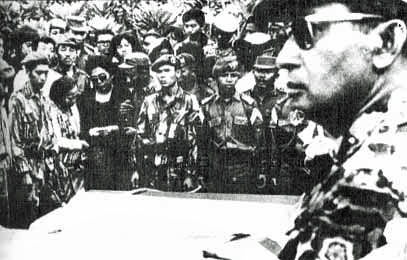
On 30 September 1965, six of the military's most senior officers were tortured and killed (generally labelled an "attempted coup") by the so-called 30 September Movement, a battalion of soldiers from the Tjakrabirawa Regiment (Presidential Guard). Within a few hours, Major General Suharto mobilised forces under his command and took control of Jakarta. Anti-communists, initially following the army's lead, went on a violent purge of communists throughout the country, which killed an estimated half a million people and led to the banning and dissolution of the PKI, which was officially blamed for the attempted coup and crisis.
The politically weakened Sukarno was forced to transfer key political and military powers to General Suharto, who had become head of the armed forces. In March 1967, the Indonesian parliament (MPRS) named General Suharto acting president. He was formally elected president one year later. Sukarno lived under house arrest until his death in 1970.
The nationalist leader Sukarno had declared Indonesian independence in 1945 and was appointed president. After an internal national revolution and struggle against the former Dutch colonial government, Sukarno had managed to hold together the diverse country; however, his administration had not been able to provide a viable economic system to lift its citizens out of severe poverty. He stressed socialist policies domestically and an avidly anti-imperialist international policy, underpinned by an authoritarian style of rule dependent upon his charismatic personality. Pursuing an independent Indonesian foreign policy, Sukarno developed friendly ties with the Eastern Bloc and the People's Republic of China but courted friendly relations with the United States at the same time in his efforts to maximise Indonesian bargaining power in its foreign policy. Sukarno was also a pioneering figure in developing the Non-Aligned Movement by playing a lead role in hosting the Bandung Conference in 1955. In Indonesia's domestic politics, Sukarno also carefully balanced Indonesia's various political parties, including the PKI.
From the late 1950s, political conflict and economic deterioration worsened. By the mid-1960s, the cash-strapped government had to scrap critical public sector subsidies, estimates put annual inflation at 500–1,000%, export revenues were shrinking, infrastructure crumbling, and factories were operating at minimal capacity with negligible investment. Severe poverty and hunger were widespread, and Sukarno led his country in a military confrontation with Malaysia while stepping up revolutionary and anti-western rhetoric.
Described as the great dhalang ("puppet master"), President Sukarno's position came to depend on balancing the opposing and increasingly hostile forces of the army and the PKI. His anti-imperial ideology saw Indonesia increasingly dependent on the Soviet Union and China. By 1965, at the height of the Cold War, the PKI penetrated all levels of government extensively. With the support of Sukarno and the air force, the party gained increasing influence at the expense of the army, thus ensuring the army's enmity. By late 1965, the army was divided between a left-wing faction allied with the PKI and a right-wing faction that was being courted by the United States.
The same policies, however, won Sukarno few friends and many enemies in the Western world, especially including the United States and the United Kingdom, whose investors were increasingly angered by Sukarno's nationalisation of mineral, agricultural, and energy assets.[citation needed] In need of Indonesian allies in the Cold War against the Soviet Union, the United States cultivated a number of ties with officers of the military through exchanges and arms deals. That fostered a split in the military's ranks, with the United States and others backing a right-wing faction against a left-wing faction overlapping with the PKI.
Hub AI
Transition to the New Order AI simulator
(@Transition to the New Order_simulator)
Transition to the New Order
Indonesia's transition to the New Order in the mid-1960s ousted the country's first president, Sukarno, after 22 years in the position. One of the most tumultuous periods in the country's modern history, it was also the commencement of Suharto's 32-year presidency.
Described as the great dhalang ("puppet master" or "puppeteer"), Sukarno drew power from balancing the opposing and increasingly antagonistic forces of the Army and Indonesian Communist Party (PKI). By 1965, the PKI extensively penetrated all levels of government and gained influence at the expense of the army.
On 30 September 1965, six of the military's most senior officers were tortured and killed (generally labelled an "attempted coup") by the so-called 30 September Movement, a battalion of soldiers from the Tjakrabirawa Regiment (Presidential Guard). Within a few hours, Major General Suharto mobilised forces under his command and took control of Jakarta. Anti-communists, initially following the army's lead, went on a violent purge of communists throughout the country, which killed an estimated half a million people and led to the banning and dissolution of the PKI, which was officially blamed for the attempted coup and crisis.
The politically weakened Sukarno was forced to transfer key political and military powers to General Suharto, who had become head of the armed forces. In March 1967, the Indonesian parliament (MPRS) named General Suharto acting president. He was formally elected president one year later. Sukarno lived under house arrest until his death in 1970.
The nationalist leader Sukarno had declared Indonesian independence in 1945 and was appointed president. After an internal national revolution and struggle against the former Dutch colonial government, Sukarno had managed to hold together the diverse country; however, his administration had not been able to provide a viable economic system to lift its citizens out of severe poverty. He stressed socialist policies domestically and an avidly anti-imperialist international policy, underpinned by an authoritarian style of rule dependent upon his charismatic personality. Pursuing an independent Indonesian foreign policy, Sukarno developed friendly ties with the Eastern Bloc and the People's Republic of China but courted friendly relations with the United States at the same time in his efforts to maximise Indonesian bargaining power in its foreign policy. Sukarno was also a pioneering figure in developing the Non-Aligned Movement by playing a lead role in hosting the Bandung Conference in 1955. In Indonesia's domestic politics, Sukarno also carefully balanced Indonesia's various political parties, including the PKI.
From the late 1950s, political conflict and economic deterioration worsened. By the mid-1960s, the cash-strapped government had to scrap critical public sector subsidies, estimates put annual inflation at 500–1,000%, export revenues were shrinking, infrastructure crumbling, and factories were operating at minimal capacity with negligible investment. Severe poverty and hunger were widespread, and Sukarno led his country in a military confrontation with Malaysia while stepping up revolutionary and anti-western rhetoric.
Described as the great dhalang ("puppet master"), President Sukarno's position came to depend on balancing the opposing and increasingly hostile forces of the army and the PKI. His anti-imperial ideology saw Indonesia increasingly dependent on the Soviet Union and China. By 1965, at the height of the Cold War, the PKI penetrated all levels of government extensively. With the support of Sukarno and the air force, the party gained increasing influence at the expense of the army, thus ensuring the army's enmity. By late 1965, the army was divided between a left-wing faction allied with the PKI and a right-wing faction that was being courted by the United States.
The same policies, however, won Sukarno few friends and many enemies in the Western world, especially including the United States and the United Kingdom, whose investors were increasingly angered by Sukarno's nationalisation of mineral, agricultural, and energy assets.[citation needed] In need of Indonesian allies in the Cold War against the Soviet Union, the United States cultivated a number of ties with officers of the military through exchanges and arms deals. That fostered a split in the military's ranks, with the United States and others backing a right-wing faction against a left-wing faction overlapping with the PKI.
Recent media