
Recent from talks
History of Indonesia
Knowledge base stats:
Talk channels stats:
Members stats:
History of Indonesia
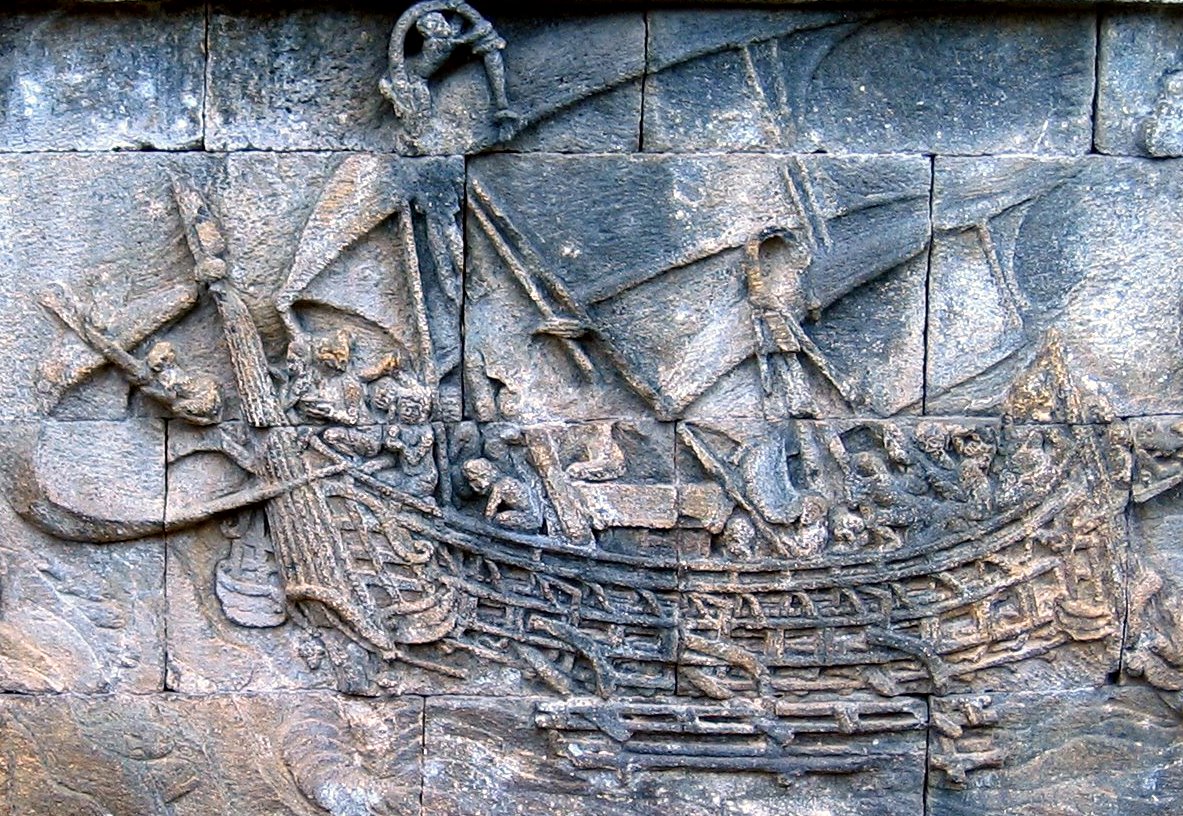
The history of Indonesia has been shaped by its geographic position, natural resources, a series of human migrations and contacts, wars and conquests, as well as by trade, economics and politics. Indonesia is an archipelagic country of 17,000 to 18,000 islands stretching along the equator in Southeast Asia and Oceania. The country's strategic sea-lane position fostered inter-island and international trade; trade has since fundamentally shaped Indonesian history. The area of Indonesia is populated by peoples of various migrations, creating a diversity of cultures, ethnicities, and languages. The archipelago's landforms and climate significantly influenced agriculture and trade, and the formation of states. The boundaries of the state of Indonesia match the 20th-century borders of the Dutch East Indies.
Fossilised remains of Homo erectus, popularly known as "Java Man", and their tools suggest the Indonesian archipelago was inhabited at least 1.5 million years ago. Austronesian people, who form the majority of the modern population, are thought to have originally been from Taiwan and arrived in Indonesia around 2000 BCE. From the 7th century CE, the powerful Srivijaya naval kingdom flourished, bringing Hindu and Buddhist influences with it. The agricultural Buddhist Sailendra and Hindu Mataram dynasties subsequently thrived in inland Java. The last significant non-Muslim kingdom, the Hindu Majapahit kingdom, flourished from the late 13th century, and its influence stretched over much of Indonesia. The earliest evidence of Islamised populations in Indonesia dates to the 13th century in northern Sumatra; other Indonesian areas gradually adopted Islam, which became the dominant religion in Java and Sumatra by the end of the 16th century. Europeans such as the Portuguese arrived in Indonesia from the 16th century seeking to monopolise the sources of valuable nutmeg, cloves, and cubeb pepper in Maluku. In 1602, the Dutch established the Dutch East India Company (Verenigde Oostindische Compagnie or VOC) and became the dominant European power by 1610. Following bankruptcy, the VOC was formally dissolved in 1800, and the government of the Netherlands established the Dutch East Indies under government control. By the early 20th century, Dutch dominance extended to the current boundaries. The Japanese invasion and occupation in 1942–1945 during WWII ended Dutch rule, and encouraged the previously suppressed Indonesian independence movement. Two days after the surrender of Japan in August 1945, nationalist leader Sukarno declared independence and became president. The Netherlands tried to reestablish its rule, but a bitter armed and diplomatic struggle ended in December 1949, when in the face of international pressure the Dutch formally recognised Indonesian independence.
An attempted coup in 1965 led to a violent army-led anti-communist purge in which over half a million people were killed. General Suharto politically outmanoeuvred President Sukarno, and became president in March 1968. His New Order administration was marked by widespread corruption, nepotism, human rights abuses, and the centralization of power, with political dissent brutally suppressed and the media tightly controlled. Economic policies disproportionately benefited elites, while poverty and inequality persisted for much of his rule. In the late 1990s, Indonesia was the country hardest hit by the East Asian financial crisis, which led to popular protests and Suharto's resignation on 21 May 1998. The Reformasi era following Suharto's resignation has led to a strengthening of democratic processes, including a regional autonomy program, the secession of East Timor, and the first direct presidential election in 2004. Political instability, social unrest, corruption, natural disasters, and terrorism remained problems in the 2000s, but the economy has performed strongly since 2007. Although relations between different religious and ethnic groups are largely harmonious, acute sectarian discontent and violence remain problems in some areas.
In 2007, an analysis of cut marks on two bovid bones found in Sangiran, showed them to have been made 1.5 to 1.6 million years ago by clamshell tools. This is the oldest evidence for the presence of early humans in Indonesia. Fossilised remains of Homo erectus in Indonesia, popularly known as the "Java Man" were first discovered by the Dutch anatomist Eugène Dubois at Trinil in 1891, and are at least 700,000 years old. Other H. erectus fossils of a similar age were found at Sangiran in the 1930s by the anthropologist Gustav Heinrich Ralph von Koenigswald, who in the same time period also uncovered fossils at Ngandong alongside more advanced tools, re-dated in 2011 to between 550,000 and 143,000 years old. In 1977 another H. erectus skull was discovered at Sambungmacan. In 2010, stone tools were discovered on Flores, dating from 1 million years ago. These are the earliest remains implying human seafaring technology. The earliest evidence of artistic activity ever found, in the form of diagonal etchings made with the use of a shark's tooth, was detected in 2014 on a 500,000-year-old fossil of a clam found in Java in the 1890s, associated with H. erectus.
In 2003, on the island of Flores, fossils of a 1.1 m (3 ft 7 in) tall hominid dated between 74,000 and 13,000 years old were discovered, much to the surprise of the scientific community. This newly discovered hominid was named the "Flores Man", or Homo floresiensis. A phylogenetic analysis published in 2017 suggests that H. floresiensis was descended from the same ancestor as Homo habilis. H. floresiensis would thus represent a previously unknown and very early migration out of Africa. The Homo floresiensis skeletal material is dated from 60,000 to 100,000 years ago; stone tools recovered alongside the skeletal remains were from archaeological horizons ranging from 50,000 to 190,000 years ago.
The Indonesian archipelago was formed during the thaw after the Last Glacial Maximum. Early humans travelled by sea and spread from mainland Asia eastward to New Guinea and Australia. Homo sapiens reached the region by around 45,000 years ago. In 2011, evidence was uncovered in neighbouring East Timor, showing that 42,000 years ago, these early settlers had high-level maritime skills, and by implication the technology needed to make ocean crossings to reach Australia and other islands, as they were catching and consuming large numbers of big deep sea fish such as tuna.
In November 2018, scientists reported the discovery of the then-oldest known figurative art painting, over 40,000 (perhaps as old as 52,000) years old, of an unknown animal, in the cave of Lubang Jeriji Saléh on the Indonesian island of Borneo. The discovery of the cave paintings is important within human cultural history, as it adds to the view that cave art was created simultaneously in Indonesia and Europe. Francesco d'Errico, an expert in prehistoric art at the University of Bordeaux, described the investigation as a "major archaeological discovery". On 11 December 2019, a team of researchers led by Dr. Maxime Aubert announced the discovery of the oldest hunting scenes in prehistoric art in the world which is more than 44,000 years old from the limestone cave of Leang Bulu' Sipong 4. Archaeologists determined the age of the depiction of hunting a pig and buffalo thanks to the calcite 'popcorn', different isotope levels of radioactive uranium and thorium.
An elaborate 4.5 m long rock art panel in a limestone cave at Leang Bulu' in Sulawesi is currently considered the earliest figurative artwork in the world. It portrays several figures hunting wild pigs and dwarf bovids. This rock art was dated to at least 43,900 years ago on the basis of uranium-series analysis of overlying speleothems. A painted hand stencil from Leang Timpuseng, which has a minimum age of 39,900 years, is now the oldest known hand stencil in the world. Discoveries in 2021 revealed that another cave, Leang Tedongnge, has cave art with a minimum age of 45,500 years old, which makes it the earliest known representational work of art in the world. On July 3, 2024, the journal Nature published research findings indicating that the cave paintings which depict anthropomorphic figures interacting with a pig and measure 36 by 15 inches (91 by 38 cm) in Leang Karampuang are approximately 51,200 years old, establishing them as the oldest known paintings in the world.
Hub AI
History of Indonesia AI simulator
(@History of Indonesia_simulator)
History of Indonesia
The history of Indonesia has been shaped by its geographic position, natural resources, a series of human migrations and contacts, wars and conquests, as well as by trade, economics and politics. Indonesia is an archipelagic country of 17,000 to 18,000 islands stretching along the equator in Southeast Asia and Oceania. The country's strategic sea-lane position fostered inter-island and international trade; trade has since fundamentally shaped Indonesian history. The area of Indonesia is populated by peoples of various migrations, creating a diversity of cultures, ethnicities, and languages. The archipelago's landforms and climate significantly influenced agriculture and trade, and the formation of states. The boundaries of the state of Indonesia match the 20th-century borders of the Dutch East Indies.
Fossilised remains of Homo erectus, popularly known as "Java Man", and their tools suggest the Indonesian archipelago was inhabited at least 1.5 million years ago. Austronesian people, who form the majority of the modern population, are thought to have originally been from Taiwan and arrived in Indonesia around 2000 BCE. From the 7th century CE, the powerful Srivijaya naval kingdom flourished, bringing Hindu and Buddhist influences with it. The agricultural Buddhist Sailendra and Hindu Mataram dynasties subsequently thrived in inland Java. The last significant non-Muslim kingdom, the Hindu Majapahit kingdom, flourished from the late 13th century, and its influence stretched over much of Indonesia. The earliest evidence of Islamised populations in Indonesia dates to the 13th century in northern Sumatra; other Indonesian areas gradually adopted Islam, which became the dominant religion in Java and Sumatra by the end of the 16th century. Europeans such as the Portuguese arrived in Indonesia from the 16th century seeking to monopolise the sources of valuable nutmeg, cloves, and cubeb pepper in Maluku. In 1602, the Dutch established the Dutch East India Company (Verenigde Oostindische Compagnie or VOC) and became the dominant European power by 1610. Following bankruptcy, the VOC was formally dissolved in 1800, and the government of the Netherlands established the Dutch East Indies under government control. By the early 20th century, Dutch dominance extended to the current boundaries. The Japanese invasion and occupation in 1942–1945 during WWII ended Dutch rule, and encouraged the previously suppressed Indonesian independence movement. Two days after the surrender of Japan in August 1945, nationalist leader Sukarno declared independence and became president. The Netherlands tried to reestablish its rule, but a bitter armed and diplomatic struggle ended in December 1949, when in the face of international pressure the Dutch formally recognised Indonesian independence.
An attempted coup in 1965 led to a violent army-led anti-communist purge in which over half a million people were killed. General Suharto politically outmanoeuvred President Sukarno, and became president in March 1968. His New Order administration was marked by widespread corruption, nepotism, human rights abuses, and the centralization of power, with political dissent brutally suppressed and the media tightly controlled. Economic policies disproportionately benefited elites, while poverty and inequality persisted for much of his rule. In the late 1990s, Indonesia was the country hardest hit by the East Asian financial crisis, which led to popular protests and Suharto's resignation on 21 May 1998. The Reformasi era following Suharto's resignation has led to a strengthening of democratic processes, including a regional autonomy program, the secession of East Timor, and the first direct presidential election in 2004. Political instability, social unrest, corruption, natural disasters, and terrorism remained problems in the 2000s, but the economy has performed strongly since 2007. Although relations between different religious and ethnic groups are largely harmonious, acute sectarian discontent and violence remain problems in some areas.
In 2007, an analysis of cut marks on two bovid bones found in Sangiran, showed them to have been made 1.5 to 1.6 million years ago by clamshell tools. This is the oldest evidence for the presence of early humans in Indonesia. Fossilised remains of Homo erectus in Indonesia, popularly known as the "Java Man" were first discovered by the Dutch anatomist Eugène Dubois at Trinil in 1891, and are at least 700,000 years old. Other H. erectus fossils of a similar age were found at Sangiran in the 1930s by the anthropologist Gustav Heinrich Ralph von Koenigswald, who in the same time period also uncovered fossils at Ngandong alongside more advanced tools, re-dated in 2011 to between 550,000 and 143,000 years old. In 1977 another H. erectus skull was discovered at Sambungmacan. In 2010, stone tools were discovered on Flores, dating from 1 million years ago. These are the earliest remains implying human seafaring technology. The earliest evidence of artistic activity ever found, in the form of diagonal etchings made with the use of a shark's tooth, was detected in 2014 on a 500,000-year-old fossil of a clam found in Java in the 1890s, associated with H. erectus.
In 2003, on the island of Flores, fossils of a 1.1 m (3 ft 7 in) tall hominid dated between 74,000 and 13,000 years old were discovered, much to the surprise of the scientific community. This newly discovered hominid was named the "Flores Man", or Homo floresiensis. A phylogenetic analysis published in 2017 suggests that H. floresiensis was descended from the same ancestor as Homo habilis. H. floresiensis would thus represent a previously unknown and very early migration out of Africa. The Homo floresiensis skeletal material is dated from 60,000 to 100,000 years ago; stone tools recovered alongside the skeletal remains were from archaeological horizons ranging from 50,000 to 190,000 years ago.
The Indonesian archipelago was formed during the thaw after the Last Glacial Maximum. Early humans travelled by sea and spread from mainland Asia eastward to New Guinea and Australia. Homo sapiens reached the region by around 45,000 years ago. In 2011, evidence was uncovered in neighbouring East Timor, showing that 42,000 years ago, these early settlers had high-level maritime skills, and by implication the technology needed to make ocean crossings to reach Australia and other islands, as they were catching and consuming large numbers of big deep sea fish such as tuna.
In November 2018, scientists reported the discovery of the then-oldest known figurative art painting, over 40,000 (perhaps as old as 52,000) years old, of an unknown animal, in the cave of Lubang Jeriji Saléh on the Indonesian island of Borneo. The discovery of the cave paintings is important within human cultural history, as it adds to the view that cave art was created simultaneously in Indonesia and Europe. Francesco d'Errico, an expert in prehistoric art at the University of Bordeaux, described the investigation as a "major archaeological discovery". On 11 December 2019, a team of researchers led by Dr. Maxime Aubert announced the discovery of the oldest hunting scenes in prehistoric art in the world which is more than 44,000 years old from the limestone cave of Leang Bulu' Sipong 4. Archaeologists determined the age of the depiction of hunting a pig and buffalo thanks to the calcite 'popcorn', different isotope levels of radioactive uranium and thorium.
An elaborate 4.5 m long rock art panel in a limestone cave at Leang Bulu' in Sulawesi is currently considered the earliest figurative artwork in the world. It portrays several figures hunting wild pigs and dwarf bovids. This rock art was dated to at least 43,900 years ago on the basis of uranium-series analysis of overlying speleothems. A painted hand stencil from Leang Timpuseng, which has a minimum age of 39,900 years, is now the oldest known hand stencil in the world. Discoveries in 2021 revealed that another cave, Leang Tedongnge, has cave art with a minimum age of 45,500 years old, which makes it the earliest known representational work of art in the world. On July 3, 2024, the journal Nature published research findings indicating that the cave paintings which depict anthropomorphic figures interacting with a pig and measure 36 by 15 inches (91 by 38 cm) in Leang Karampuang are approximately 51,200 years old, establishing them as the oldest known paintings in the world.
Recent media