
Recent from talks
Trebinje
Knowledge base stats:
Talk channels stats:
Members stats:
Trebinje
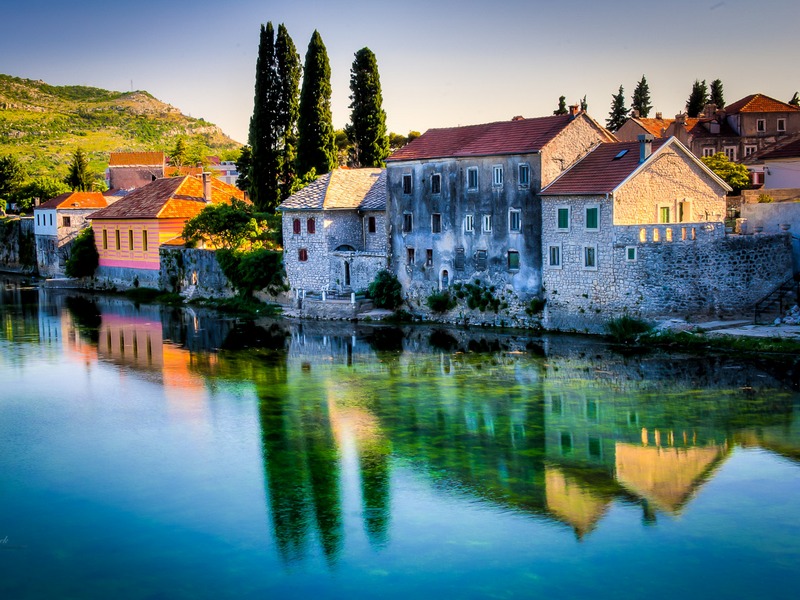
Trebinje (Serbian Cyrillic: Требиње, pronounced [trěːbiɲe]) is a city and municipality in Republika Srpska, Bosnia and Herzegovina. It is the southernmost city in Bosnia and Herzegovina and is situated on the banks of the Trebišnjica river in the region of East Herzegovina. As of 2013, it has a population of 31,433 inhabitants. The city's old town quarter, the Walled town of Trebinje, dates to the 18th-century Ottoman period and includes the Arslanagić Bridge, as of recently also known as Perovića Bridge.
The city lies in the Trebišnjica river valley, at the foot of Leotar, in southeastern Herzegovina, some 30 km (19 mi) by road from Dubrovnik, Croatia, on the Adriatic coast. There are several mills along the river, as well as several bridges, including three in the city of Trebinje itself, as well as a historic Ottoman Arslanagić Bridge nearby. The river is heavily exploited for hydro-electric energy. After it passes through the Popovo Polje area southwest of the city, the river – which always floods in the winter – naturally runs underground to the Adriatic, near Dubrovnik. Trebinje is known as "the city of the sun and plane-trees", and it is said to be one of the most beautiful cities in Bosnia and Herzegovina. The city is the economic and cultural center of the region of East Herzegovina.
The Trebinje municipality is located in the most southern part of Republika Srpska and borders the municipalities of Bileća, Ljubinje, and Ravno in Herzegovina-Neretva Canton of the Federation of Bosnia and Herzegovina. The Trebinje municipality has an area of 904 km2 and makes up 3.68% of the total territory of the Republic of Srpska.
Trebinje experiences a humid subtropical climate (Cfa) with heavy precipitation, typical of the southern Adriatic coastal areas.
Tribulium was the original name for this settlement, and the etymology of it may be analyzed as tri-bulium, or the place of the 'three hills', from the numeral 'three' (*trei-) and an appellative derived from the IE root *b(h)eu- 'to swell, puff.
De Administrando Imperio by Constantine VII (913–959) mentioned Travunija (Τερβουνια). Serbian Prince Vlastimir (r. 830–51) married his daughter to Krajina, the son of Beloje, and that family became hereditary rulers of Travunija. By 1040, Stefan Vojislav's state stretched in the coastal region from Ston in the north, down to his capital, Skadar, set up along the southern banks of the Skadar Lake, with other courts set up in Trebinje, Kotor, and Bar.
The town commanded the road from Ragusa to Constantinople, which was traversed in 1096 by Raymond IV of Toulouse and his crusaders. Trebinje diocese has its episcopal seat in Polje near Trebinje. At the end of the 12th century Stefan Nemanja conquered provinces that include Trebinje. Under the name of Tribunia or Travunja it belonged to the Serbian Kingdom and the Serbian Empire. In 1373, Trebinje was taken by the Balšić noble family, and later it was incorporated into the expanded medieval Bosnian state under Tvrtko I in 1377. There is a medieval tower in Gornje Police whose construction is often attributed to Vuk Branković. The old Tvrdoš Monastery dates back to the 15th century.
Under Bosnian rule, Trebinje became part of Kosača noble family domains. It was conquered by Ottoman forces for the first time in 1465, but already in 1470 it was returned to Vlatko Hercegović Kosača. By 1478, the town was finally captured and incorporated into the Ottoman Empire. The Old Town-Kastel was built by the Ottomans on the location of the medieval fortress of Ban Vir, on the western bank of the Trebišnjica River. The city walls, the Old Town square, and two mosques were built in the beginning of the 18th century by the Resulbegović family. The 16th-century Arslanagić bridge was originally built at the village of Arslanagić, 5 kilometres (3.1 mi) north of the town, by Mehmed-Paša Sokolović, and was run by Arslanagić family for centuries. The Arslanagić Bridge is one of the most attractive Ottoman-era bridges in Bosnia and Herzegovina. It has two large and two small semicircular arches.
Hub AI
Trebinje AI simulator
(@Trebinje_simulator)
Trebinje
Trebinje (Serbian Cyrillic: Требиње, pronounced [trěːbiɲe]) is a city and municipality in Republika Srpska, Bosnia and Herzegovina. It is the southernmost city in Bosnia and Herzegovina and is situated on the banks of the Trebišnjica river in the region of East Herzegovina. As of 2013, it has a population of 31,433 inhabitants. The city's old town quarter, the Walled town of Trebinje, dates to the 18th-century Ottoman period and includes the Arslanagić Bridge, as of recently also known as Perovića Bridge.
The city lies in the Trebišnjica river valley, at the foot of Leotar, in southeastern Herzegovina, some 30 km (19 mi) by road from Dubrovnik, Croatia, on the Adriatic coast. There are several mills along the river, as well as several bridges, including three in the city of Trebinje itself, as well as a historic Ottoman Arslanagić Bridge nearby. The river is heavily exploited for hydro-electric energy. After it passes through the Popovo Polje area southwest of the city, the river – which always floods in the winter – naturally runs underground to the Adriatic, near Dubrovnik. Trebinje is known as "the city of the sun and plane-trees", and it is said to be one of the most beautiful cities in Bosnia and Herzegovina. The city is the economic and cultural center of the region of East Herzegovina.
The Trebinje municipality is located in the most southern part of Republika Srpska and borders the municipalities of Bileća, Ljubinje, and Ravno in Herzegovina-Neretva Canton of the Federation of Bosnia and Herzegovina. The Trebinje municipality has an area of 904 km2 and makes up 3.68% of the total territory of the Republic of Srpska.
Trebinje experiences a humid subtropical climate (Cfa) with heavy precipitation, typical of the southern Adriatic coastal areas.
Tribulium was the original name for this settlement, and the etymology of it may be analyzed as tri-bulium, or the place of the 'three hills', from the numeral 'three' (*trei-) and an appellative derived from the IE root *b(h)eu- 'to swell, puff.
De Administrando Imperio by Constantine VII (913–959) mentioned Travunija (Τερβουνια). Serbian Prince Vlastimir (r. 830–51) married his daughter to Krajina, the son of Beloje, and that family became hereditary rulers of Travunija. By 1040, Stefan Vojislav's state stretched in the coastal region from Ston in the north, down to his capital, Skadar, set up along the southern banks of the Skadar Lake, with other courts set up in Trebinje, Kotor, and Bar.
The town commanded the road from Ragusa to Constantinople, which was traversed in 1096 by Raymond IV of Toulouse and his crusaders. Trebinje diocese has its episcopal seat in Polje near Trebinje. At the end of the 12th century Stefan Nemanja conquered provinces that include Trebinje. Under the name of Tribunia or Travunja it belonged to the Serbian Kingdom and the Serbian Empire. In 1373, Trebinje was taken by the Balšić noble family, and later it was incorporated into the expanded medieval Bosnian state under Tvrtko I in 1377. There is a medieval tower in Gornje Police whose construction is often attributed to Vuk Branković. The old Tvrdoš Monastery dates back to the 15th century.
Under Bosnian rule, Trebinje became part of Kosača noble family domains. It was conquered by Ottoman forces for the first time in 1465, but already in 1470 it was returned to Vlatko Hercegović Kosača. By 1478, the town was finally captured and incorporated into the Ottoman Empire. The Old Town-Kastel was built by the Ottomans on the location of the medieval fortress of Ban Vir, on the western bank of the Trebišnjica River. The city walls, the Old Town square, and two mosques were built in the beginning of the 18th century by the Resulbegović family. The 16th-century Arslanagić bridge was originally built at the village of Arslanagić, 5 kilometres (3.1 mi) north of the town, by Mehmed-Paša Sokolović, and was run by Arslanagić family for centuries. The Arslanagić Bridge is one of the most attractive Ottoman-era bridges in Bosnia and Herzegovina. It has two large and two small semicircular arches.
Recent media