
Recent from talks
Tree-kangaroo
Knowledge base stats:
Talk channels stats:
Members stats:
Tree-kangaroo
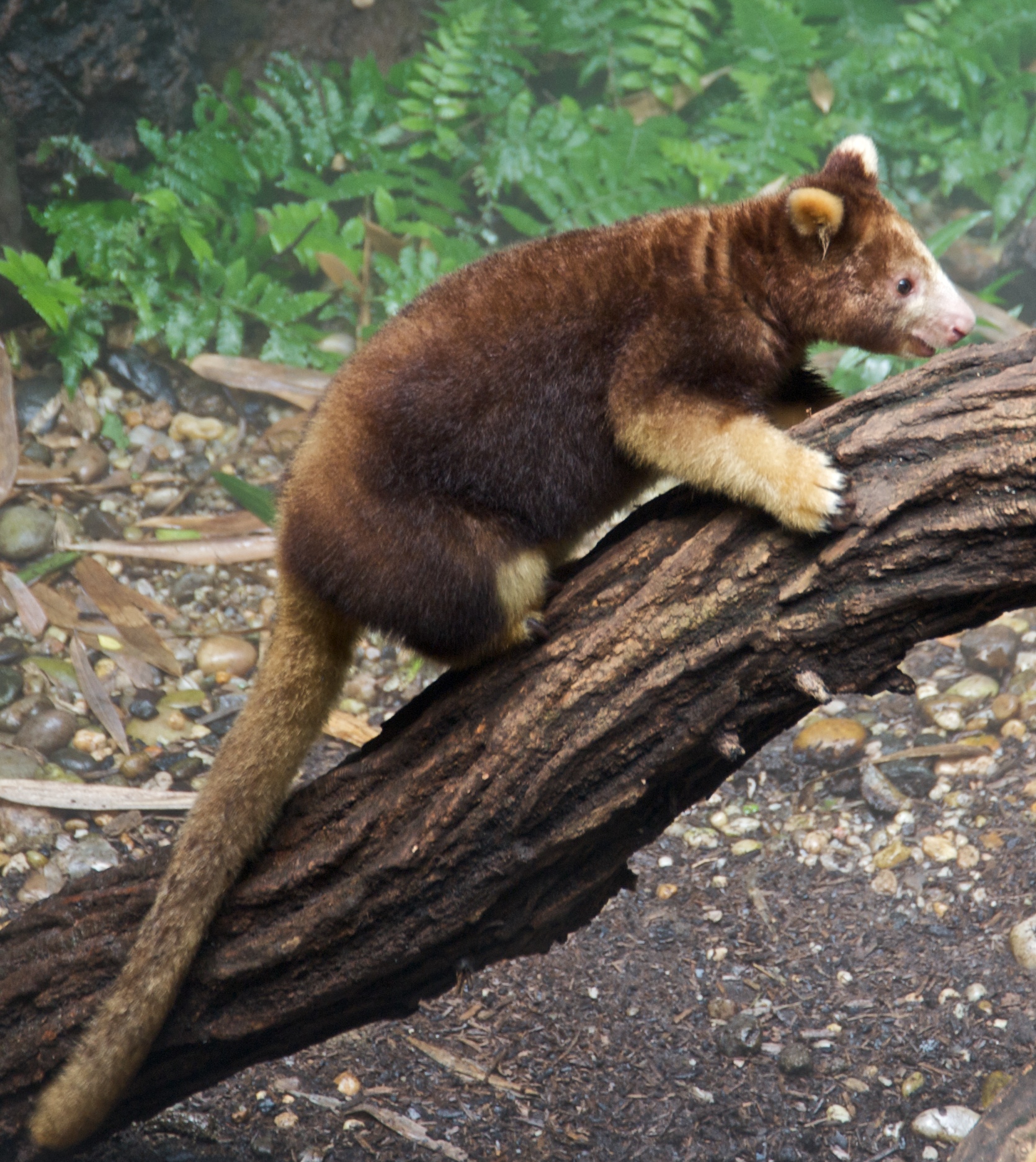
Tree-kangaroos are marsupials of the genus Dendrolagus, adapted for arboreal locomotion. They inhabit the tropical rainforests of New Guinea and far northeastern Queensland, Australia along with some of the islands in the region. All tree-kangaroos are considered threatened due to hunting and habitat destruction. They are the only true arboreal macropods.
The evolutionary history of tree-kangaroos possibly begins with a rainforest floor-dwelling pademelon-like ancestor. This ancestor possibly evolved from an arboreal possum-like ancestor as is suspected of all macropodid marsupials in Australia and New Guinea. During the late Eocene, the Australian/New Guinean continent began a period of drying that caused a retreat in the area of rainforest, which forced the ancestral pademelons to begin living in a drier, rockier environment. After some generations of adaptation to the new environment, the pademelons may have evolved into rock-wallabies (Petrogale spp.), which developed a generalist feeding strategy due to their dependence on a diverse assortment of vegetation refuges. This generalist strategy allowed the rock-wallabies to easily adapt to Malesian rainforest types that were introduced to Australia from Asia during the mid-Miocene. The rock-wallabies that migrated into these introduced forests adapted to spend more time climbing trees. One species in particular, the Proserpine rock-wallaby (Petrogale persephone), displays equal preference for climbing trees as for living in rocky outcrops. During the Late Miocene, the semi-arboreal rock-wallabies could have evolved into the now extinct tree-kangaroo genus Bohra. Global cooling during the Pleistocene caused continent-wide drying and rainforest retractions in Australia and New Guinea.
The rainforest contractions isolated populations of Bohra which resulted in the evolution of today's tree-kangaroos (Dendrolagus spp.), as they adapted to lifestyles in geographically small and diverse rainforest fragments, and became further specialized for a canopy-dwelling lifestyle.
These species are assigned to the genus Dendrolagus:
Seri's tree-kangaroo (Dendrolagus stellarum) has been described as a subspecies of Doria's tree-kangaroo (D. dorianus stellarum), but some recent authorities have treated it as a separate species based on its absolute diagnostability[further explanation needed].
The Wondiwoi tree-kangaroo is among the 25 "most wanted lost" species that are the focus of Global Wildlife Conservation's "Search for Lost Species" initiative.
The extinct species D. noibano from the Pleistocene of Chimbu Province, Papua New Guinea is substantially larger than living species. However, it has since been suggested to be a larger extinct form of Doria's tree-kangaroo.
The case for the golden-mantled tree-kangaroo (D. pulcherrimus) is comparable to that of D. stellarum; it was first described as a subspecies of D. goodfellowi, though recent authorities have elevated it to species status based on its absolute diagnostability. A population of the tenkile (Scott's tree-kangaroo) recently discovered from the Bewani Mountains may represent an undescribed subspecies.
Hub AI
Tree-kangaroo AI simulator
(@Tree-kangaroo_simulator)
Tree-kangaroo
Tree-kangaroos are marsupials of the genus Dendrolagus, adapted for arboreal locomotion. They inhabit the tropical rainforests of New Guinea and far northeastern Queensland, Australia along with some of the islands in the region. All tree-kangaroos are considered threatened due to hunting and habitat destruction. They are the only true arboreal macropods.
The evolutionary history of tree-kangaroos possibly begins with a rainforest floor-dwelling pademelon-like ancestor. This ancestor possibly evolved from an arboreal possum-like ancestor as is suspected of all macropodid marsupials in Australia and New Guinea. During the late Eocene, the Australian/New Guinean continent began a period of drying that caused a retreat in the area of rainforest, which forced the ancestral pademelons to begin living in a drier, rockier environment. After some generations of adaptation to the new environment, the pademelons may have evolved into rock-wallabies (Petrogale spp.), which developed a generalist feeding strategy due to their dependence on a diverse assortment of vegetation refuges. This generalist strategy allowed the rock-wallabies to easily adapt to Malesian rainforest types that were introduced to Australia from Asia during the mid-Miocene. The rock-wallabies that migrated into these introduced forests adapted to spend more time climbing trees. One species in particular, the Proserpine rock-wallaby (Petrogale persephone), displays equal preference for climbing trees as for living in rocky outcrops. During the Late Miocene, the semi-arboreal rock-wallabies could have evolved into the now extinct tree-kangaroo genus Bohra. Global cooling during the Pleistocene caused continent-wide drying and rainforest retractions in Australia and New Guinea.
The rainforest contractions isolated populations of Bohra which resulted in the evolution of today's tree-kangaroos (Dendrolagus spp.), as they adapted to lifestyles in geographically small and diverse rainforest fragments, and became further specialized for a canopy-dwelling lifestyle.
These species are assigned to the genus Dendrolagus:
Seri's tree-kangaroo (Dendrolagus stellarum) has been described as a subspecies of Doria's tree-kangaroo (D. dorianus stellarum), but some recent authorities have treated it as a separate species based on its absolute diagnostability[further explanation needed].
The Wondiwoi tree-kangaroo is among the 25 "most wanted lost" species that are the focus of Global Wildlife Conservation's "Search for Lost Species" initiative.
The extinct species D. noibano from the Pleistocene of Chimbu Province, Papua New Guinea is substantially larger than living species. However, it has since been suggested to be a larger extinct form of Doria's tree-kangaroo.
The case for the golden-mantled tree-kangaroo (D. pulcherrimus) is comparable to that of D. stellarum; it was first described as a subspecies of D. goodfellowi, though recent authorities have elevated it to species status based on its absolute diagnostability. A population of the tenkile (Scott's tree-kangaroo) recently discovered from the Bewani Mountains may represent an undescribed subspecies.
Recent media