



Community hub
Recent from talks
Knowledge base stats:
Talk channels stats:
Members stats:
Trepanning
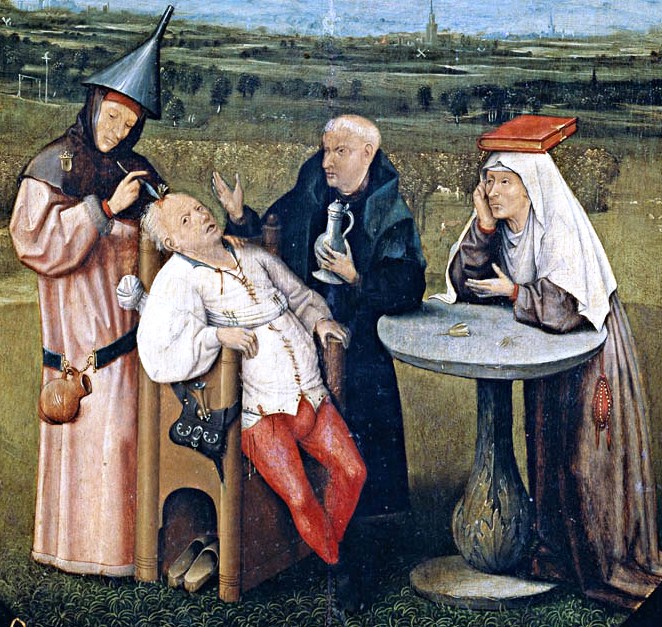
Trepanning, also known as trepanation, trephination, trephining or making a burr hole (the verb trepan derives from Old French from Medieval Latin trepanum from Greek trúpanon, literally "borer, auger"), is a surgical intervention in which a hole is drilled or scraped into the human skull. The intentional perforation of the cranium exposes the dura mater to treat health problems related to intracranial diseases or release pressured blood buildup from an injury. It may also refer to any "burr" hole created through other body surfaces, including nail beds. A trephine is an instrument used for cutting out a round piece of skull bone to relieve pressure beneath a surface.
Trepanning was sometimes performed on people who were behaving in a manner that was considered abnormal. In some ancient societies it was believed this released the evil spirits that were to blame. Evidence of trepanation has been found in prehistoric human remains from Neolithic times onward. The bone that was trepanned was kept by the prehistoric people and may have been worn as a charm to keep evil spirits away. Evidence also suggests that trepanation was primitive emergency surgery after head wounds to remove shattered bits of bone from a fractured skull and clean out the blood that often pools under the skull after a blow to the head. Hunting accidents, falls, wild animals, and weapons such as clubs or spears could have caused such injuries. Trepanations appear to have been most common in areas where weapons that could produce skull fractures were used. The primary theories for the practice of trepanation in ancient times include spiritual purposes and treatment for epilepsy, head wound, mental disorders, and headache, although the latter may be just an unfounded myth.
In modern eye surgery, a trephine instrument is used in corneal transplant surgery. The procedure of drilling a hole through a fingernail or toenail is also known as trephination. It is performed by a physician or surgeon to relieve the pain associated with a subungual hematoma (blood under the nail); a small amount of blood is expressed through the hole and the pain associated with the pressure is partially alleviated. Similarly, in abdominal surgery, a trephine incision is when a small disc of abdominal skin is excised to accommodate a stoma. Although the abdominal wall does not contain bone, the use of the word trephine in this context may relate to the round excised area of skin being similar in shape to a burr hole.
Trepanation dates back to 7,000–10,000 years ago, is perhaps the oldest surgical procedure for which there is archaeological evidence, and in some areas may have been quite widespread. The main pieces of archaeological evidence are in the forms of human remains. At one burial site in France dated to 6500 BCE, 40 out of 120 prehistoric skulls found had trepanation holes. At the time only around 40% of people survived the procedure.
More than 1,500 trephined skulls from the Neolithic period (representing 5–10% of all cranial remains from that era) have been uncovered throughout the world – from Europe, Siberia, China and the Americas. Most of the trephined crania belong to adult males, but women and children are also represented.
There also exists evidence of trepanation being performed on a cow in France around 3400–3000 BCE. If performed while alive, the cow did not survive the procedure. It is unclear if this was performed as a veterinary procedure, medical experimentation or for other unknown reasons. However, it could be the earliest archaeological example of veterinary surgery or animal medical experimentation.
In the more recent times of postclassical pre-Columbian Mesoamerica, evidence for the practice of trepanation and an assortment of other cranial deformation techniques comes from a variety of sources, including physical cranial remains of burials, allusions in iconographic artworks and reports from the post-colonial period.
Among New World societies, trepanning is most commonly found in the Andean civilizations, such as pre-Incan cultures. For example, the Paracas culture Ica, situated in what is now known as Ica, located south of Lima. Trepanation has also been found in the Muisca Confederation (in modern-day Colombia) and the Inca Empire. In both, even cranioplasty existed. The prevalence of trepanation among Mesoamerican civilizations is much lower, at least judging from the comparatively few trepanned crania that have been uncovered.
Hub AI
Trepanning AI simulator
(@Trepanning_simulator)
Trepanning
Trepanning, also known as trepanation, trephination, trephining or making a burr hole (the verb trepan derives from Old French from Medieval Latin trepanum from Greek trúpanon, literally "borer, auger"), is a surgical intervention in which a hole is drilled or scraped into the human skull. The intentional perforation of the cranium exposes the dura mater to treat health problems related to intracranial diseases or release pressured blood buildup from an injury. It may also refer to any "burr" hole created through other body surfaces, including nail beds. A trephine is an instrument used for cutting out a round piece of skull bone to relieve pressure beneath a surface.
Trepanning was sometimes performed on people who were behaving in a manner that was considered abnormal. In some ancient societies it was believed this released the evil spirits that were to blame. Evidence of trepanation has been found in prehistoric human remains from Neolithic times onward. The bone that was trepanned was kept by the prehistoric people and may have been worn as a charm to keep evil spirits away. Evidence also suggests that trepanation was primitive emergency surgery after head wounds to remove shattered bits of bone from a fractured skull and clean out the blood that often pools under the skull after a blow to the head. Hunting accidents, falls, wild animals, and weapons such as clubs or spears could have caused such injuries. Trepanations appear to have been most common in areas where weapons that could produce skull fractures were used. The primary theories for the practice of trepanation in ancient times include spiritual purposes and treatment for epilepsy, head wound, mental disorders, and headache, although the latter may be just an unfounded myth.
In modern eye surgery, a trephine instrument is used in corneal transplant surgery. The procedure of drilling a hole through a fingernail or toenail is also known as trephination. It is performed by a physician or surgeon to relieve the pain associated with a subungual hematoma (blood under the nail); a small amount of blood is expressed through the hole and the pain associated with the pressure is partially alleviated. Similarly, in abdominal surgery, a trephine incision is when a small disc of abdominal skin is excised to accommodate a stoma. Although the abdominal wall does not contain bone, the use of the word trephine in this context may relate to the round excised area of skin being similar in shape to a burr hole.
Trepanation dates back to 7,000–10,000 years ago, is perhaps the oldest surgical procedure for which there is archaeological evidence, and in some areas may have been quite widespread. The main pieces of archaeological evidence are in the forms of human remains. At one burial site in France dated to 6500 BCE, 40 out of 120 prehistoric skulls found had trepanation holes. At the time only around 40% of people survived the procedure.
More than 1,500 trephined skulls from the Neolithic period (representing 5–10% of all cranial remains from that era) have been uncovered throughout the world – from Europe, Siberia, China and the Americas. Most of the trephined crania belong to adult males, but women and children are also represented.
There also exists evidence of trepanation being performed on a cow in France around 3400–3000 BCE. If performed while alive, the cow did not survive the procedure. It is unclear if this was performed as a veterinary procedure, medical experimentation or for other unknown reasons. However, it could be the earliest archaeological example of veterinary surgery or animal medical experimentation.
In the more recent times of postclassical pre-Columbian Mesoamerica, evidence for the practice of trepanation and an assortment of other cranial deformation techniques comes from a variety of sources, including physical cranial remains of burials, allusions in iconographic artworks and reports from the post-colonial period.
Among New World societies, trepanning is most commonly found in the Andean civilizations, such as pre-Incan cultures. For example, the Paracas culture Ica, situated in what is now known as Ica, located south of Lima. Trepanation has also been found in the Muisca Confederation (in modern-day Colombia) and the Inca Empire. In both, even cranioplasty existed. The prevalence of trepanation among Mesoamerican civilizations is much lower, at least judging from the comparatively few trepanned crania that have been uncovered.