



Community hub
Recent from talks
Contribute something to knowledge base
Content stats: 0 posts, 0 articles, 1 media, 0 notes
Members stats: 0 subscribers, 0 contributors, 0 moderators, 0 supporters
Subscribers
Supporters
Contributors
Moderators
Hub AI
Triangular orthobicupola AI simulator
(@Triangular orthobicupola_simulator)
Hub AI
Triangular orthobicupola AI simulator
(@Triangular orthobicupola_simulator)
Triangular orthobicupola
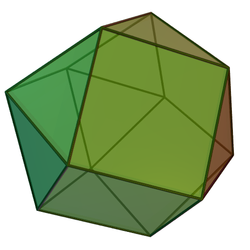
In geometry, the triangular orthobicupola is one of the Johnson solids (J27). As the name suggests, it can be constructed by attaching two triangular cupolas (J3) along their bases. It has an equal number of squares and triangles at each vertex; however, it is not vertex-transitive. It is also called an anticuboctahedron, twisted cuboctahedron or disheptahedron.
The dual polyhedron of a triangular orthobicupola is a trapezo-rhombic dodecahedron. It is a plesiohedron, space-filling polyhedron defined by Voronoi diagram.
The triangular orthobicupola can be found in the coordination structure of crystals with hexagonal closed-packing spheres in chemistry.
The triangular orthobicupola is constructed by attaching two triangular cupolas to their bases. Similar to the cuboctahedron, which would be known as the triangular gyrobicupola, the difference is that the two triangular cupolas that make up the triangular orthobicupola are joined so that pairs of matching sides abut (hence, "ortho"); the cuboctahedron is joined so that triangles abut squares and vice versa. Given a triangular orthobicupola, a 60-degree rotation of one cupola before the joining yields a cuboctahedron. Hence, another name for the triangular orthobicupola is the anticuboctahedron. By such a construction, the triangular orthobicupola is a composite polyhedron.
The triangular orthobicupola is a convex polyhedron with regular polygonal faces (eight equilateral triangles and six squares) and is therefore a Johnson solid, named after American mathematician Norman W. Johnson, who enumerated the 92 such polyhedra (excluding the uniform polyhedra). It is enumerated as the twenty-seventh Johnson solid, .

The surface area and the volume of a triangular orthobicupola are the same as those of a cuboctahedron. Its surface area is the sum of all of its polygonal faces, and its volume is obtained by slicing it off into two triangular cupolas and adding their volume. With edge length , they are:


A triangular orthobicupola has the same symmetry as a triangular prism, the dihedral group of order six, which contains one three-fold axis and three two-fold axes.

A triangular orthobicupola has three different dihedral angles (angles between two polygonal faces):
Triangular orthobicupola
In geometry, the triangular orthobicupola is one of the Johnson solids (J27). As the name suggests, it can be constructed by attaching two triangular cupolas (J3) along their bases. It has an equal number of squares and triangles at each vertex; however, it is not vertex-transitive. It is also called an anticuboctahedron, twisted cuboctahedron or disheptahedron.
The dual polyhedron of a triangular orthobicupola is a trapezo-rhombic dodecahedron. It is a plesiohedron, space-filling polyhedron defined by Voronoi diagram.
The triangular orthobicupola can be found in the coordination structure of crystals with hexagonal closed-packing spheres in chemistry.
The triangular orthobicupola is constructed by attaching two triangular cupolas to their bases. Similar to the cuboctahedron, which would be known as the triangular gyrobicupola, the difference is that the two triangular cupolas that make up the triangular orthobicupola are joined so that pairs of matching sides abut (hence, "ortho"); the cuboctahedron is joined so that triangles abut squares and vice versa. Given a triangular orthobicupola, a 60-degree rotation of one cupola before the joining yields a cuboctahedron. Hence, another name for the triangular orthobicupola is the anticuboctahedron. By such a construction, the triangular orthobicupola is a composite polyhedron.
The triangular orthobicupola is a convex polyhedron with regular polygonal faces (eight equilateral triangles and six squares) and is therefore a Johnson solid, named after American mathematician Norman W. Johnson, who enumerated the 92 such polyhedra (excluding the uniform polyhedra). It is enumerated as the twenty-seventh Johnson solid, .
The surface area and the volume of a triangular orthobicupola are the same as those of a cuboctahedron. Its surface area is the sum of all of its polygonal faces, and its volume is obtained by slicing it off into two triangular cupolas and adding their volume. With edge length , they are:
A triangular orthobicupola has the same symmetry as a triangular prism, the dihedral group of order six, which contains one three-fold axis and three two-fold axes.
A triangular orthobicupola has three different dihedral angles (angles between two polygonal faces):
Recent media
Recent media