Hubbry Logo
Uniform polyhedronUniform polyhedronMain
Open search
Uniform polyhedron
Community hub
Uniform polyhedron
logo
8 pages, 0 posts
0 subscribers
Be the first to start a discussion here.
Uniform polyhedron
Uniform polyhedron
from Wikipedia

In geometry, a uniform polyhedron has regular polygons as faces and is vertex-transitive—there is an isometry mapping any vertex onto any other. It follows that all vertices are congruent. Uniform polyhedra may be regular (if also face- and edge-transitive), quasi-regular (if also edge-transitive but not face-transitive), or semi-regular (if neither edge- nor face-transitive). The faces and vertices don't need to be convex, so many of the uniform polyhedra are also star polyhedra.

There are two infinite classes of uniform polyhedra, together with 75 other polyhedra. They are 2 infinite classes of prisms and antiprisms, the convex polyhedrons as in 5 Platonic solids and 13 Archimedean solids—2 quasiregular and 11 semiregular— the non-convex star polyhedra as in 4 Kepler–Poinsot polyhedra and 53 uniform star polyhedra—14 quasiregular and 39 semiregular. There are also many degenerate uniform polyhedra with pairs of edges that coincide, including one found by John Skilling called the great disnub dirhombidodecahedron, Skilling's figure.[1]

Dual polyhedra to uniform polyhedra are face-transitive (isohedral) and have regular vertex figures, and are generally classified in parallel with their dual (uniform) polyhedron. The dual of a regular polyhedron is regular, while the dual of an Archimedean solid is a Catalan solid.

The concept of uniform polyhedron is a special case of the concept of uniform polytope, which also applies to shapes in higher-dimensional (or lower-dimensional) space.

Definition

[edit]

The Original Sin in the theory of polyhedra goes back to Euclid, and through Kepler, Poinsot, Cauchy and many others continues to afflict all the work on this topic (including that of the present author). It arises from the fact that the traditional usage of the term "regular polyhedra" was, and is, contrary to syntax and to logic: the words seem to imply that we are dealing, among the objects we call "polyhedra", with those special ones that deserve to be called "regular". But at each stage— Euclid, Kepler, Poinsot, Hess, Brückner, ... —the writers failed to define what are the "polyhedra" among which they are finding the "regular" ones.

(Branko Grünbaum 1994)

Coxeter, Longuet-Higgins & Miller (1954) define uniform polyhedra to be vertex-transitive polyhedra with regular faces. They define a polyhedron to be a finite set of polygons such that each side of a polygon is a side of just one other polygon, such that no non-empty proper subset of the polygons has the same property. By a polygon they implicitly mean a polygon in 3-dimensional Euclidean space; these are allowed to be non-convex and intersecting each other.[2]

There are some generalizations of the concept of a uniform polyhedron. If the connectedness assumption is dropped, then we get uniform compounds, which can be split as a union of polyhedra, such as the compound of 5 cubes. If we drop the condition that the realization of the polyhedron is non-degenerate, then we get the so-called degenerate uniform polyhedra. These require a more general definition of polyhedra. Grünbaum (1994) gave a rather complicated definition of a polyhedron, while McMullen & Schulte (2002) gave a simpler and more general definition of a polyhedron: in their terminology, a polyhedron is a 2-dimensional abstract polytope with a non-degenerate 3-dimensional realization. Here an abstract polytope is a poset of its "faces" satisfying various condition, a realization is a function from its vertices to some space, and the realization is called non-degenerate if any two distinct faces of the abstract polytope have distinct realizations. Some of the ways they can be degenerate are as follows:

  • Hidden faces. Some polyhedra have faces that are hidden, in the sense that no points of their interior can be seen from the outside. These are usually not counted as uniform polyhedra.
  • Degenerate compounds. Some polyhedra have multiple edges and their faces are the faces of two or more polyhedra, though these are not compounds in the previous sense since the polyhedra share edges.
  • Double covers. Some non-orientable polyhedra have double covers satisfying the definition of a uniform polyhedron. There double covers have doubled faces, edges and vertices. They are usually not counted as uniform polyhedra.
  • Double faces. There are several polyhedra with doubled faces produced by Wythoff's construction. Most authors do not allow doubled faces and remove them as part of the construction.
  • Double edges. Skilling's figure has the property that it has double edges (as in the degenerate uniform polyhedra) but its faces cannot be written as a union of two uniform polyhedra.

History

[edit]

Regular convex polyhedra

[edit]

Nonregular uniform convex polyhedra

[edit]

Regular star polyhedra

[edit]

Other 53 nonregular star polyhedra

[edit]
  • Of the remaining 53, Edmund Hess (1878) discovered 2, Albert Badoureau (1881) discovered 36 more, and Pitsch (1881) independently discovered 18, of which 3 had not previously been discovered. Together these gave 41 polyhedra.
  • The geometer H.S.M. Coxeter discovered the remaining twelve in collaboration with J. C. P. Miller (1930–1932) but did not publish. M.S. Longuet-Higgins and H.C. Longuet-Higgins independently discovered eleven of these. Lesavre and Mercier rediscovered five of them in 1947.
  • Coxeter, Longuet-Higgins & Miller (1954) published the list of uniform polyhedra.
  • Sopov (1970) proved their conjecture that the list was complete.
  • In 1974, Magnus Wenninger published his book Polyhedron models, which lists all 75 nonprismatic uniform polyhedra, with many previously unpublished names given to them by Norman Johnson.
  • Skilling (1975) independently proved the completeness and showed that if the definition of uniform polyhedron is relaxed to allow edges to coincide then there is just one extra possibility (the great disnub dirhombidodecahedron).
  • In 1987, Edmond Bonan drew all the uniform polyhedra and their duals in 3D with a Turbo Pascal program called Polyca. Most of them were shown during the International Stereoscopic Union Congress held in 1993, at the Congress Theatre, Eastbourne, England; and again in 2005 at the Kursaal of Besançon, France.[5]
  • In 1993, Zvi Har'El (1949–2008)[6] produced a complete kaleidoscopic construction of the uniform polyhedra and duals with a computer program called Kaleido and summarized it in a paper Uniform Solution for Uniform Polyhedra, counting figures 1-80.[7]
  • Also in 1993, R. Mäder ported this Kaleido solution to Mathematica with a slightly different indexing system.[8]
  • In 2002 Peter W. Messer discovered a minimal set of closed-form expressions for determining the main combinatorial and metrical quantities of any uniform polyhedron (and its dual) given only its Wythoff symbol.[9]

Uniform star polyhedra

[edit]
The great dirhombicosidodecahedron, the only non-Wythoffian uniform polyhedron

The 57 nonprismatic nonconvex forms, with exception of the great dirhombicosidodecahedron, are compiled by Wythoff constructions within Schwarz triangles.

Convex forms by Wythoff construction

[edit]
Example forms from the cube and octahedron

The convex uniform polyhedra can be named by Wythoff construction operations on the regular form.

In more detail the convex uniform polyhedron are given below by their Wythoff construction within each symmetry group.

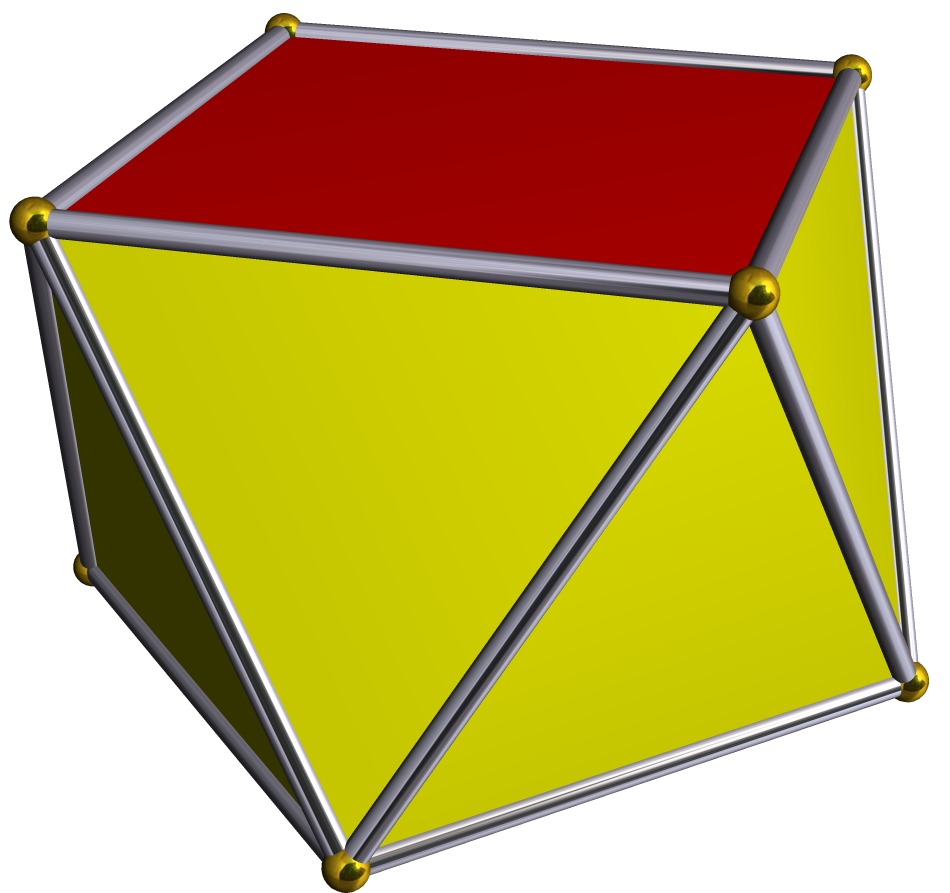
Within the Wythoff construction, there are repetitions created by lower symmetry forms. The cube is a regular polyhedron, and a square prism. The octahedron is a regular polyhedron, and a triangular antiprism. The octahedron is also a rectified tetrahedron. Many polyhedra are repeated from different construction sources, and are colored differently.

The Wythoff construction applies equally to uniform polyhedra and uniform tilings on the surface of a sphere, so images of both are given. The spherical tilings include the set of hosohedra and dihedra which are degenerate polyhedra.

These symmetry groups are formed from the reflectional point groups in three dimensions, each represented by a fundamental triangle (p q r), where p > 1, q > 1, r > 1 and 1/p + 1/q + 1/r < 1.

The remaining nonreflective forms are constructed by alternation operations applied to the polyhedra with an even number of sides.

Along with the prisms and their dihedral symmetry, the spherical Wythoff construction process adds two regular classes which become degenerate as polyhedra : the dihedra and the hosohedra, the first having only two faces, and the second only two vertices. The truncation of the regular hosohedra creates the prisms.

Below the convex uniform polyhedra are indexed 1–18 for the nonprismatic forms as they are presented in the tables by symmetry form.

For the infinite set of prismatic forms, they are indexed in four families:

  1. Hosohedra H2... (only as spherical tilings)
  2. Dihedra D2... (only as spherical tilings)
  3. Prisms P3... (truncated hosohedra)
  4. Antiprisms A3... (snub prisms)

Summary tables

[edit]
Johnson name Parent Truncated Rectified Bitruncated
(tr. dual)
Birectified
(dual)
Cantellated Omnitruncated
(cantitruncated)
Snub
Coxeter diagram


Extended
Schläfli symbol
{p,q} t{p,q} r{p,q} 2t{p,q} 2r{p,q} rr{p,q} tr{p,q} sr{p,q}
t0{p,q} t0,1{p,q} t1{p,q} t1,2{p,q} t2{p,q} t0,2{p,q} t0,1,2{p,q} ht0,1,2{p,q}
Wythoff symbol
(p q 2)
q | p 2 2 q | p 2 | p q 2 p | q p | q 2 p q | 2 p q 2 | | p q 2
Vertex figure pq q.2p.2p (p.q)2 p. 2q.2q qp p. 4.q.4 4.2p.2q 3.3.p. 3.q
Tetrahedral
(3 3 2)

3.3.3

3.6.6

3.3.3.3

3.6.6

3.3.3

3.4.3.4

4.6.6

3.3.3.3.3
Octahedral
(4 3 2)

4.4.4

3.8.8

3.4.3.4

4.6.6

3.3.3.3

3.4.4.4

4.6.8

3.3.3.3.4
Icosahedral
(5 3 2)

5.5.5

3.10.10

3.5.3.5

5.6.6

3.3.3.3.3

3.4.5.4

4.6.10

3.3.3.3.5

And a sampling of dihedral symmetries:

(The sphere is not cut, only the tiling is cut.) (On a sphere, an edge is the arc of the great circle, the shortest way, between its two vertices. Hence, a digon whose vertices are not polar-opposite is flat: it looks like an edge.)

(p 2 2) Parent Truncated Rectified Bitruncated
(tr. dual)
Birectified
(dual)
Cantellated Omnitruncated
(cantitruncated)
Snub
Coxeter diagram
Extended
Schläfli symbol
{p,2} t{p,2} r{p,2} 2t{p,2} 2r{p,2} rr{p,2} tr{p,2} sr{p,2}
t0{p,2} t0,1{p,2} t1{p,2} t1,2{p,2} t2{p,2} t0,2{p,2} t0,1,2{p,2} ht0,1,2{p,2}
Wythoff symbol 2 | p 2 2 2 | p 2 | p 2 2 p | 2 p | 2 2 p 2 | 2 p 2 2 | | p 2 2
Vertex figure p2 2.2p.2p p. 2.p. 2 p. 4.4 2p p. 4.2.4 4.2p.4 3.3.3.p
Dihedral
(2 2 2)

{2,2}

2.4.4

2.2.2.2

4.4.2

2.2

2.4.2.4

4.4.4

3.3.3.2
Dihedral
(3 2 2)

3.3

2.6.6

2.3.2.3

4.4.3

2.2.2

2.4.3.4

4.4.6

3.3.3.3
Dihedral
(4 2 2)

4.4
2.8.8
2.4.2.4

4.4.4

2.2.2.2

2.4.4.4

4.4.8

3.3.3.4
Dihedral
(5 2 2)

5.5
2.10.10
2.5.2.5

4.4.5

2.2.2.2.2

2.4.5.4

4.4.10

3.3.3.5
Dihedral
(6 2 2)

6.6

2.12.12

2.6.2.6

4.4.6

2.2.2.2.2.2

2.4.6.4

4.4.12

3.3.3.6

(3 3 2) Td tetrahedral symmetry

[edit]

The tetrahedral symmetry of the sphere generates 5 uniform polyhedra, and a 6th form by a snub operation.

The tetrahedral symmetry is represented by a fundamental triangle with one vertex with two mirrors, and two vertices with three mirrors, represented by the symbol (3 3 2). It can also be represented by the Coxeter group A2 or [3,3], as well as a Coxeter diagram: .

There are 24 triangles, visible in the faces of the tetrakis hexahedron, and in the alternately colored triangles on a sphere:

# Name Graph
A3
Graph
A2
Picture Tiling Vertex
figure
Coxeter
and Schläfli
symbols
Face counts by position Element counts
Pos. 2

[3]
(4)
Pos. 1

[2]
(6)
Pos. 0

[3]
(4)
Faces Edges Vertices
1 Tetrahedron
{3,3}

{3}
4 6 4
[1] Birectified tetrahedron
(same as tetrahedron)

t2{3,3}={3,3}

{3}
4 6 4
2 Rectified tetrahedron
Tetratetrahedron
(same as octahedron)

t1{3,3}=r{3,3}

{3}

{3}
8 12 6
3 Truncated tetrahedron
t0,1{3,3}=t{3,3}

{6}

{3}
8 18 12
[3] Bitruncated tetrahedron
(same as truncated tetrahedron)

t1,2{3,3}=t{3,3}

{3}

{6}
8 18 12
4 Cantellated tetrahedron
Rhombitetratetrahedron
(same as cuboctahedron)

t0,2{3,3}=rr{3,3}

{3}

{4}

{3}
14 24 12
5 Omnitruncated tetrahedron
Truncated tetratetrahedron
(same as truncated octahedron)

t0,1,2{3,3}=tr{3,3}

{6}

{4}

{6}
14 36 24
6 Snub tetratetrahedron
(same as icosahedron)

sr{3,3}

{3}

2 {3}

{3}
20 30 12

(4 3 2) Oh octahedral symmetry

[edit]

The octahedral symmetry of the sphere generates 7 uniform polyhedra, and a 7 more by alternation. Six of these forms are repeated from the tetrahedral symmetry table above.

The octahedral symmetry is represented by a fundamental triangle (4 3 2) counting the mirrors at each vertex. It can also be represented by the Coxeter group B2 or [4,3], as well as a Coxeter diagram: .

There are 48 triangles, visible in the faces of the disdyakis dodecahedron, and in the alternately colored triangles on a sphere:

# Name Graph
B3
Graph
B2
Picture Tiling Vertex
figure
Coxeter
and Schläfli
symbols
Face counts by position Element counts
Pos. 2

[4]
(6)
Pos. 1

[2]
(12)
Pos. 0

[3]
(8)
Faces Edges Vertices
7 Cube
{4,3}

{4}
6 12 8
[2] Octahedron
{3,4}

{3}
8 12 6
[4] Rectified cube
Rectified octahedron
(Cuboctahedron)

{4,3}

{4}

{3}
14 24 12
8 Truncated cube
t0,1{4,3}=t{4,3}

{8}

{3}
14 36 24
[5] Truncated octahedron
t0,1{3,4}=t{3,4}

{4}

{6}
14 36 24
9 Cantellated cube
Cantellated octahedron
Rhombicuboctahedron

t0,2{4,3}=rr{4,3}

{4}

{4}

{3}
26 48 24
10 Omnitruncated cube
Omnitruncated octahedron
Truncated cuboctahedron

t0,1,2{4,3}=tr{4,3}

{8}

{4}

{6}
26 72 48
[6] Snub octahedron
(same as Icosahedron)

=
s{3,4}=sr{3,3}

{3}

{3}
20 30 12
[1] Half cube
(same as Tetrahedron)

=
h{4,3}={3,3}

1/2 {3}
4 6 4
[2] Cantic cube
(same as Truncated tetrahedron)

=
h2{4,3}=t{3,3}

1/2 {6}

1/2 {3}
8 18 12
[4] (same as Cuboctahedron)
=
rr{3,3}
14 24 12
[5] (same as Truncated octahedron)
=
tr{3,3}
14 36 24
[9] Cantic snub octahedron
(same as Rhombicuboctahedron)

s2{3,4}=rr{3,4}
26 48 24
11 Snub cuboctahedron
sr{4,3}

{4}

2 {3}

{3}
38 60 24

(5 3 2) Ih icosahedral symmetry

[edit]

The icosahedral symmetry of the sphere generates 7 uniform polyhedra, and a 1 more by alternation. Only one is repeated from the tetrahedral and octahedral symmetry table above.

The icosahedral symmetry is represented by a fundamental triangle (5 3 2) counting the mirrors at each vertex. It can also be represented by the Coxeter group G2 or [5,3], as well as a Coxeter diagram: .

There are 120 triangles, visible in the faces of the disdyakis triacontahedron, and in the alternately colored triangles on a sphere:

# Name Graph
(A2)
[6]
Graph
(H3)
[10]
Picture Tiling Vertex
figure
Coxeter
and Schläfli
symbols
Face counts by position Element counts
Pos. 2

[5]
(12)
Pos. 1

[2]
(30)
Pos. 0

[3]
(20)
Faces Edges Vertices
12 Dodecahedron
{5,3}

{5}
12 30 20
[6] Icosahedron
{3,5}

{3}
20 30 12
13 Rectified dodecahedron
Rectified icosahedron
Icosidodecahedron

t1{5,3}=r{5,3}

{5}

{3}
32 60 30
14 Truncated dodecahedron
t0,1{5,3}=t{5,3}

{10}

{3}
32 90 60
15 Truncated icosahedron
t0,1{3,5}=t{3,5}

{5}

{6}
32 90 60
16 Cantellated dodecahedron
Cantellated icosahedron
Rhombicosidodecahedron

t0,2{5,3}=rr{5,3}

{5}

{4}

{3}
62 120 60
17 Omnitruncated dodecahedron
Omnitruncated icosahedron
Truncated icosidodecahedron

t0,1,2{5,3}=tr{5,3}

{10}

{4}

{6}
62 180 120
18 Snub icosidodecahedron
sr{5,3}

{5}

2 {3}

{3}
92 150 60

(p 2 2) Prismatic [p,2], I2(p) family (Dph dihedral symmetry)

[edit]

The dihedral symmetry of the sphere generates two infinite sets of uniform polyhedra, prisms and antiprisms, and two more infinite set of degenerate polyhedra, the hosohedra and dihedra which exist as tilings on the sphere.

The dihedral symmetry is represented by a fundamental triangle (p 2 2) counting the mirrors at each vertex. It can also be represented by the Coxeter group I2(p) or [n,2], as well as a prismatic Coxeter diagram: .

Below are the first five dihedral symmetries: D2 ... D6. The dihedral symmetry Dp has order 4n, represented the faces of a bipyramid, and on the sphere as an equator line on the longitude, and n equally-spaced lines of longitude.

(2 2 2) Dihedral symmetry

[edit]

There are 8 fundamental triangles, visible in the faces of the square bipyramid (Octahedron) and alternately colored triangles on a sphere:

# Name Picture Tiling Vertex
figure
Coxeter
and Schläfli
symbols
Face counts by position Element counts
Pos. 2

[2]
(2)
Pos. 1

[2]
(2)
Pos. 0

[2]
(2)
Faces Edges Vertices
D2
H2
Digonal dihedron,
digonal hosohedron

{2,2}

{2}
2 2 2
D4 Truncated digonal dihedron
(same as square dihedron)

t{2,2}={4,2}

{4}
2 4 4
P4
[7]
Omnitruncated digonal dihedron
(same as cube)

t0,1,2{2,2}=tr{2,2}

{4}

{4}

{4}
6 12 8
A2
[1]
Snub digonal dihedron
(same as tetrahedron)

sr{2,2}

2 {3}
4 6 4

(3 2 2) D3h dihedral symmetry

[edit]

There are 12 fundamental triangles, visible in the faces of the hexagonal bipyramid and alternately colored triangles on a sphere:

# Name Picture Tiling Vertex
figure
Coxeter
and Schläfli
symbols
Face counts by position Element counts
Pos. 2

[3]
(2)
Pos. 1

[2]
(3)
Pos. 0

[2]
(3)
Faces Edges Vertices
D3 Trigonal dihedron
{3,2}

{3}
2 3 3
H3 Trigonal hosohedron
{2,3}

{2}
3 3 2
D6 Truncated trigonal dihedron
(same as hexagonal dihedron)

t{3,2}

{6}
2 6 6
P3 Truncated trigonal hosohedron
(Triangular prism)

t{2,3}

{3}

{4}
5 9 6
P6 Omnitruncated trigonal dihedron
(Hexagonal prism)

t0,1,2{2,3}=tr{2,3}

{6}

{4}

{4}
8 18 12
A3
[2]
Snub trigonal dihedron
(same as Triangular antiprism)
(same as octahedron)

sr{2,3}

{3}

2 {3}
8 12 6
P3 Cantic snub trigonal dihedron
(Triangular prism)

s2{2,3}=t{2,3}
5 9 6

(4 2 2) D4h dihedral symmetry

[edit]

There are 16 fundamental triangles, visible in the faces of the octagonal bipyramid and alternately colored triangles on a sphere:

# Name Picture Tiling Vertex
figure
Coxeter
and Schläfli
symbols
Face counts by position Element counts
Pos. 2

[4]
(2)
Pos. 1

[2]
(4)
Pos. 0

[2]
(4)
Faces Edges Vertices
D4 square dihedron
{4,2}

{4}
2 4 4
H4 square hosohedron
{2,4}

{2}
4 4 2
D8 Truncated square dihedron
(same as octagonal dihedron)

t{4,2}

{8}
2 8 8
P4
[7]
Truncated square hosohedron
(Cube)

t{2,4}

{4}

{4}
6 12 8
D8 Omnitruncated square dihedron
(Octagonal prism)

t0,1,2{2,4}=tr{2,4}

{8}

{4}

{4}
10 24 16
A4 Snub square dihedron
(Square antiprism)

sr{2,4}

{4}

2 {3}
10 16 8
P4
[7]
Cantic snub square dihedron
(Cube)

s2{4,2}=t{2,4}
6 12 8
A2
[1]
Snub square hosohedron
(Digonal antiprism)
(Tetrahedron)

s{2,4}=sr{2,2}
4 6 4

(5 2 2) D5h dihedral symmetry

[edit]

There are 20 fundamental triangles, visible in the faces of the decagonal bipyramid and alternately colored triangles on a sphere:

# Name Picture Tiling Vertex
figure
Coxeter
and Schläfli
symbols
Face counts by position Element counts
Pos. 2

[5]
(2)
Pos. 1

[2]
(5)
Pos. 0

[2]
(5)
Faces Edges Vertices
D5 Pentagonal dihedron
{5,2}

{5}
2 5 5
H5 Pentagonal hosohedron
{2,5}

{2}
5 5 2
D10 Truncated pentagonal dihedron
(same as decagonal dihedron)

t{5,2}

{10}
2 10 10
P5 Truncated pentagonal hosohedron
(same as pentagonal prism)

t{2,5}

{5}

{4}
7 15 10
P10 Omnitruncated pentagonal dihedron
(Decagonal prism)

t0,1,2{2,5}=tr{2,5}

{10}

{4}

{4}
12 30 20
A5 Snub pentagonal dihedron
(Pentagonal antiprism)

sr{2,5}

{5}

2 {3}
12 20 10
P5 Cantic snub pentagonal dihedron
(Pentagonal prism)

s2{5,2}=t{2,5}
7 15 10

(6 2 2) D6h dihedral symmetry

[edit]

There are 24 fundamental triangles, visible in the faces of the dodecagonal bipyramid and alternately colored triangles on a sphere.

# Name Picture Tiling Vertex
figure
Coxeter
and Schläfli
symbols
Face counts by position Element counts
Pos. 2

[6]
(2)
Pos. 1

[2]
(6)
Pos. 0

[2]
(6)
Faces Edges Vertices
D6 Hexagonal dihedron
{6,2}

{6}
2 6 6
H6 Hexagonal hosohedron
{2,6}

{2}
6 6 2
D12 Truncated hexagonal dihedron
(same as dodecagonal dihedron)

t{6,2}

{12}
2 12 12
H6 Truncated hexagonal hosohedron
(same as hexagonal prism)

t{2,6}

{6}

{4}
8 18 12
P12 Omnitruncated hexagonal dihedron
(Dodecagonal prism)

t0,1,2{2,6}=tr{2,6}

{12}

{4}

{4}
14 36 24
A6 Snub hexagonal dihedron
(Hexagonal antiprism)

sr{2,6}

{6}

2 {3}
  14 24 12
P3 Cantic hexagonal dihedron
(Triangular prism)
=
h2{6,2}=t{2,3}
5 9 6
P6 Cantic snub hexagonal dihedron
(Hexagonal prism)

s2{6,2}=t{2,6}
8 18 12
A3
[2]
Snub hexagonal hosohedron
(same as Triangular antiprism)
(same as octahedron)

s{2,6}=sr{2,3}
8 12 6

Wythoff construction operators

[edit]
Operation Symbol Coxeter
diagram
Description
Parent {p,q}
t0{p,q}
Any regular polyhedron or tiling
Rectified (r) r{p,q}
t1{p,q}
The edges are fully truncated into single points. The polyhedron now has the combined faces of the parent and dual. Polyhedra are named by the number of sides of the two regular forms: {p,q} and {q,p}, like cuboctahedron for r{4,3} between a cube and octahedron.
Birectified (2r)
(also dual)
2r{p,q}
t2{p,q}
The birectified (dual) is a further truncation so that the original faces are reduced to points. New faces are formed under each parent vertex. The number of edges is unchanged and are rotated 90 degrees. A birectification can be seen as the dual.
Truncated (t) t{p,q}
t0,1{p,q}
Each original vertex is cut off, with a new face filling the gap. Truncation has a degree of freedom, which has one solution that creates a uniform truncated polyhedron. The polyhedron has its original faces doubled in sides, and contains the faces of the dual.
Bitruncated (2t)
(also truncated dual)
2t{p,q}
t1,2{p,q}
A bitruncation can be seen as the truncation of the dual. A bitruncated cube is a truncated octahedron.
Cantellated (rr)
(Also expanded)
rr{p,q} In addition to vertex truncation, each original edge is beveled with new rectangular faces appearing in their place. A uniform cantellation is halfway between both the parent and dual forms. A cantellated polyhedron is named as a rhombi-r{p,q}, like rhombicuboctahedron for rr{4,3}.
Cantitruncated (tr)
(Also omnitruncated)
tr{p,q}
t0,1,2{p,q}
The truncation and cantellation operations are applied together to create an omnitruncated form which has the parent's faces doubled in sides, the dual's faces doubled in sides, and squares where the original edges existed.
Alternation operations
Operation Symbol Coxeter
diagram
Description
Snub rectified (sr) sr{p,q} The alternated cantitruncated. All the original faces end up with half as many sides, and the squares degenerate into edges. Since the omnitruncated forms have 3 faces/vertex, new triangles are formed. Usually these alternated faceting forms are slightly deformed thereafter in order to end again as uniform polyhedra. The possibility of the latter variation depends on the degree of freedom.
Snub (s) s{p,2q} Alternated truncation
Cantic snub (s2) s2{p,2q}
Alternated cantellation (hrr) hrr{2p,2q} Only possible in uniform tilings (infinite polyhedra), alternation of
For example,
Half (h) h{2p,q} Alternation of , same as
Cantic (h2) h2{2p,q} Same as
Half rectified (hr) hr{2p,2q} Only possible in uniform tilings (infinite polyhedra), alternation of , same as or
For example, = or
Quarter (q) q{2p,2q} Only possible in uniform tilings (infinite polyhedra), same as
For example, = or

See also

[edit]

Notes

[edit]

References

[edit]
[edit]
Revisions and contributorsEdit on WikipediaRead on Wikipedia
from Grokipedia
A uniform polyhedron is a in whose faces are regular polygons (which may be star polygons) and whose vertices are all equivalent under the action of its , making it vertex-transitive. These polyhedra have edges of equal length and vertices that lie on a common , though some may be nonconvex or self-intersecting and thus not enclose a finite . Uniform polyhedra encompass several well-known classes, including the five Platonic solids (, , , , and ), the thirteen Archimedean solids (such as the and ), and the four Kepler–Poinsot polyhedra (regular star polyhedra like the ). Beyond these 22 examples (18 of which are convex), there are 53 additional non-prismatic uniform polyhedra, many of which are nonconvex, bringing the total to 75 finite uniform polyhedra excluding infinite families. Infinite families include uniform prisms and antiprisms for each with three or more sides. The systematic study of uniform polyhedra began in the 19th century with discoveries by mathematicians like Badoureau and Pitsch, who identified 41 nonconvex examples. In 1954, H.S.M. Coxeter, M.S. Longuet-Higgins, and J.C.P. Miller cataloged 75 such polyhedra (conjecturing completeness) using Wythoff's construction based on reflection groups. This list was rigorously proven complete in 1975 by J. Skilling, who confirmed no additional uniform polyhedra exist beyond those enumerated.

Fundamentals

Definition

A uniform polyhedron is a three-dimensional geometric figure bounded by regular polygonal faces, where all edges are of equal length and all vertices are symmetrically equivalent under the polyhedron's . This equivalence means the acts transitively on the vertices, ensuring that each vertex is surrounded by the same arrangement of faces, known as the . The faces may include star polygons (polygrams) in non-convex cases, but they must all be regular and meet edge-to-edge. Vertex-transitivity implies that there exists an of the mapping any vertex to any other, preserving the local configuration of incident faces and edges. This property guarantees that the polyhedron has a high degree of , with all vertices congruent and the vertex figures identical across the structure. Consequently, the polyhedron can be inscribed in a , with all vertices lying on its surface and the geometric center at the sphere's origin. In contrast to regular polyhedra, such as the Platonic solids, where all faces are congruent identical regular polygons, uniform polyhedra permit a variety of regular polygonal face types as long as the arrangement at each vertex remains uniform. For instance, the cube is a regular uniform polyhedron with all square faces, while the is a non-regular convex uniform polyhedron featuring a mix of regular triangles and meeting three triangles and one hexagon at each vertex. Formally, uniform polyhedra realize vertex-transitive (and typically edge-transitive) tilings of by regular polygons, where the tiling's ensures all vertices are indistinguishable and the faces form an isohedral covering in the dual sense.

Key Properties

polyhedra are characterized by having all faces as regular polygons, either convex or polygons (polygrams), with every edge of equal length. This ensures a high degree of , where the arrangement of faces around each vertex is identical. The regularity of the faces contributes to the polyhedron's uniform edge lengths, distinguishing them from more general polyhedra where faces may vary in shape or size. A key feature is the vertex configuration, denoted by a sequence of integers in parentheses representing the number of sides of the regular polygons meeting at each vertex in . For example, the has the vertex configuration (3.4.3.4), indicating alternating triangles and squares around each vertex. This notation encapsulates the local geometry at vertices, highlighting the isogonal nature—meaning all vertices are equivalent under the polyhedron's . Convex uniform polyhedra satisfy the χ = V - E + F = 2. For star polyhedra, the generalized form is d_v V - E + d_f F = 2D, where d_v is the vertex density, d_f the face density, and D the overall density, reflecting their spherical topology adjusted for self-intersections. For star polyhedra, the overall density D measures the degree of self-intersection as the number of times the surface covers the underlying . Face density d_f is the density of the individual regular star polygon faces, and vertex density d_v is the density of the vertex figures. The pentagrammic faces {5/2} of the great stellated dodecahedron, for instance, have a face density of 2. Vertex density d_v is the density of the and contributes to the generalized Euler formula. Uniform polyhedra are isogonal by definition, and their duals are isohedral, meaning face-transitive with all faces equivalent under symmetry.

Historical Development

Ancient and Early Modern Contributions

The earliest known discussions of uniform polyhedra, specifically the five regular convex polyhedra now called Platonic solids, appear in ancient Greek philosophy and mathematics. In his dialogue Timaeus (c. 360 BCE), Plato described these solids—the tetrahedron, cube, octahedron, dodecahedron, and icosahedron—as the fundamental building blocks of the cosmos, associating the first four with the classical elements of fire, earth, air, and water, while assigning the dodecahedron to the universe itself. These five Platonic solids were the only uniform polyhedra recognized in antiquity, with their regularity defined by identical regular polygonal faces and equivalent vertices. Euclid formalized the mathematical foundations of these solids in his Elements (c. 300 BCE), particularly in Books XI–XIII, where he provided rigorous proofs of their , constructions within a , and demonstrations that no other regular convex polyhedra are possible beyond these five. Euclid's approach emphasized their geometric properties, such as the equality of faces, edges, and vertex figures, establishing a systematic basis for uniformity that influenced subsequent polyhedral studies. During the , interest in non-regular uniform polyhedra emerged. In Harmonices Mundi (1619), expanded beyond the Platonic solids by identifying and describing 13 convex uniform polyhedra with regular faces but irregular vertex configurations, including the and , which he illustrated and analyzed in relation to cosmic harmony. Kepler's work marked a key advancement in recognizing semiregular forms as a distinct class. René Descartes contributed further in his unpublished manuscript De solidorum elementis (c. 1630s), where he attempted an early enumeration of polyhedra, deriving a formula relating vertices, faces, and angles—later recognized as a precursor to Euler's formula—and listing several Archimedean solids among convex polyhedra. Descartes' efforts highlighted the challenges of systematic classification but laid groundwork for later enumerations by focusing on general polyhedral properties.

Modern Classifications and Expansions

In the early 19th century, Louis Poinsot extended the study of regular polyhedra by discovering two additional regular star polyhedra—the and great icosahedron—in addition to the two identified by Kepler two centuries earlier, thereby completing the set of four Kepler-Poinsot polyhedra. These non-convex forms maintained regular polygonal faces and vertex figures but introduced intersecting faces, challenging prior notions of regularity confined to convex Platonic solids. Augustin-Louis Cauchy advanced the classification in 1812–1813 by proving the completeness of the four Kepler–Poinsot polyhedra as the only regular star polyhedra and by analyzing vertex figures to ensure consistent arrangement of regular faces around each vertex. This approach shifted focus from mere facial regularity to holistic symmetry, providing a rigorous framework that encompassed both convex and star polyhedra. By 1876, Edmund Hess conducted a systematic of convex polyhedra beyond the Platonic solids, identifying 13 Archimedean solids characterized by regular polygonal faces of more than one type meeting identically at each vertex. Hess's catalog highlighted these semi-regular forms, bridging the gap between the five Platonic solids and more complex configurations. In 1881, Albert Badoureau identified 37 nonconvex uniform polyhedra, and Johann Pitsch discovered additional ones, bringing the total of known nonconvex examples to 41. In the mid-20th century, H.S.M. Coxeter, building on earlier work from in which he and J.C.P. Miller discovered the remaining 12 nonconvex uniform polyhedra, introduced the Wythoff construction as a generative method for uniform polyhedra using reflections in spherical triangles, leading to a comprehensive enumeration in collaboration with M.S. Longuet-Higgins and J.C.P. Miller. Their 1954 catalog listed 75 finite uniform polyhedra, comprising the 5 Platonic solids, 13 Archimedean solids, 4 Kepler-Poinsot polyhedra, and 53 non-prismatic star polyhedra. This enumeration was later proven complete in 1975 by John Skilling. Twentieth-century expansions further incorporated infinite families of uniform and antiprisms, as detailed by Coxeter and , where regular n-gonal bases extend indefinitely along a axis or twist in antiprismatic fashion, maintaining vertex-transitivity for all n ≥ 3. These families generalized finite forms to , emphasizing the boundless nature of uniform structures under prismatic symmetries.

Types of Uniform Polyhedra

Convex Uniform Polyhedra

Convex uniform polyhedra represent the non-intersecting subset of uniform polyhedra, characterized by their realization as bounded convex bodies in three-dimensional Euclidean space. These polyhedra feature regular polygonal faces and identical vertex figures, ensuring vertex-transitivity, while maintaining a density of 1 and positive orientation without self-intersections. They encompass both a finite collection of 18 distinct forms and infinite families parameterized by the number of sides in their bases. The finite convex uniform polyhedra consist of the five Platonic solids and the thirteen Archimedean solids. Platonic solids are the regular polyhedra where all faces are congruent regular polygons and all vertices are equivalent, including the , , , , and . Archimedean solids, in contrast, are vertex-transitive convex polyhedra composed of regular polygonal faces of two or more types, arranged identically at each vertex; examples include the , which has eight triangular and six octagonal faces, and the , featuring twenty triangles and twelve pentagons. These 18 polyhedra were systematically classified as the complete set of finite convex uniforms excluding prismatic families. Beyond the finite cases, convex uniform polyhedra include infinite families of uniform prisms and antiprisms, defined for any integer n3n \geq 3. A uniform prism consists of two parallel regular nn-gonal bases connected by rectangular lateral faces, with triangular lateral faces in the limiting case of n=3n = 3 yielding the . Uniform antiprisms feature two parallel regular nn-gonal bases rotated relative to each other and connected by equilateral triangular lateral faces, providing a twisted variant that generalizes to higher nn; notably, the triangular antiprism coincides with the , one of the Platonic solids. These families extend the convex uniforms indefinitely while preserving the core properties of regularity in faces and vertex equivalence. The convexity of these polyhedra ensures they can be embedded in as solid objects with well-defined interiors, free from the self-intersections that characterize star polyhedra, and their density of 1 reflects the single-layered enclosure of space around any interior point. This structural integrity underpins their applications in , , and , where the balance of and diversity in face types allows for robust tiling and modeling.

Uniform Star Polyhedra

Uniform polyhedra represent the non-convex subset of uniform polyhedra, distinguished by their self-intersecting faces or edges, which allow for regular polygonal or polygonal components arranged uniformly around each vertex. These structures deviate from convex forms by permitting intersections that create more complex geometries, often resulting in densities greater than 1—a measure generalizing the to quantify how many times the polyhedral surface encloses the interior space. For instance, in polyhedra, a line from the center to may intersect the surface multiple times, reflecting the retrogressive or overlapping nature of faces. This self-intersection enables higher topological complexity, such as effective greater than 0, while maintaining vertex-transitivity and regular face edges. The most prominent uniform star polyhedra are the four regular ones, collectively termed the Kepler–Poinsot polyhedra, identified by in 1619 and fully recognized by Louis Poinsot in 1810. These include the ({5/2, 5}), composed of 12 intersecting pentagrams with five meeting at each vertex and a of 3; the ({5, 5/2}), featuring 12 intersecting pentagons and also 3; the great icosahedron ({3, 5/2}), with 20 intersecting triangles and 7; and the great stellated dodecahedron ({5/2, 3}), made of 12 pentagrams with 7. Each exemplifies how fractional Schläfli symbols denote faces, leading to intersections where face planes cross through the interior, yet preserving icosahedral symmetry. In addition to these regular cases, 53 non-regular uniform star polyhedra exist, encompassing quasiregular forms, stellations of Platonic solids, and other non-regular forms with mixed regular and star faces. Examples include the great truncated dodecahedron, which combines decagonal and pentagrammic faces in an intersecting arrangement, and the octahemioctahedron, featuring hemispherical intersections of triangles and hexagons. These non-regular stars often exhibit varied intersection types, such as face-to-face crossings or edge retrogrades, where vertex figures wind oppositely to the faces. The complete enumeration of these 57 finite non-prismatic uniform star polyhedra was established through systematic symmetry analysis in the , contrasting sharply with the 18 convex uniform polyhedra by introducing self-intersections that enhance geometric density and visual depth without violating uniformity.

Construction Methods

Wythoff Construction

The Wythoff construction provides a systematic method for generating polyhedra through the symmetries of a defined by three mirrors meeting at angles π/p\pi/p, π/q\pi/q, and π/r\pi/r, where pp, qq, and rr are rational numbers greater than 1. This approach, utilizing the Wythoff symbol pqr| p \, q \, r|, positions an initial point at the of the corresponding Schwarz in the fundamental domain of the , and repeated reflections across the mirrors produce the complete set of vertices for the . The resulting is vertex-transitive with regular polygonal faces, encompassing both convex and star varieties depending on the parameters. In this construction, the original vertex is placed at coordinates (1,0,0)(1, 0, 0) within the Coxeter group's representation, aligned with one of the symmetry axes, and the full vertex set is obtained by applying the group's reflection operations, which correspond to the mirrors of the . This reflective process ensures that all vertices are equivalent under the , yielding a uniform polyhedron whose faces and vertex figures are determined by the branching angles of the Schwarz triangle. For uniform polyhedra, the parameters pp, qq, and rr are such that 1/p+1/q+1/r>11/p + 1/q + 1/r > 1, leading to and finite polyhedra; fractions in parameters allow for polygons with greater than 1. Infinite Euclidean families like prisms and antiprisms arise when the sum equals 1, while hyperbolic tilings (sum <1) generate infinite non-uniform structures. Representative examples illustrate the notation's application: the Wythoff symbol 5235 | 2 \, 3 generates the , a convex with 20 triangular faces and vertex configuration (3,3,3,3,3)(3,3,3,3,3), while 525/25 | 2 \, 5/2 produces the , a nonconvex featuring 12 pentagrammic faces with density 3 and vertex configuration (5/2,5/2,5/2,5/2,5/2)(5/2,5/2,5/2,5/2,5/2). These constructions highlight how integer parameters with the bar after the first number yield convex forms like Platonic solids, and specific placements with fractions introduce star polygons through intersecting faces. The Wythoff construction is complete for the finite uniform polyhedra, systematically generating all 75 such polyhedra using the appropriate Schwarz triangles and mirror activations, excluding only infinite prismatic families. This method unifies the production of Platonic solids, Archimedean solids, prisms, antiprisms, and nonconvex stars under a single kaleidoscopic framework.

Kaleidoscopic Generation

Kaleidoscopic generation of uniform polyhedra relies on the action of finite Coxeter reflection groups, which are discrete groups generated by reflections across a set of planes that intersect to form a triangular fundamental domain known as a Schwarz triangle. These groups, such as the tetrahedral, octahedral, or icosahedral symmetries, are defined by their Coxeter diagrams, where edges represent the dihedral angles π/mij\pi/m_{ij} between adjacent reflection planes, with mijm_{ij} being positive integers determining the group's structure. The fundamental domain is the spherical triangle bounded by these planes, with vertex angles π/p\pi/p, π/q\pi/q, and π/r\pi/r for the corresponding face types in the uniform polyhedron. To generate the vertices, a point is selected within or on the boundary of the fundamental domain, typically equidistant from a of the reflection planes corresponding to the . The full set of vertices is then obtained by applying the entire —comprising all compositions of reflections—to this point, producing the orbit GxGx where GG is the and xx is the . This transitive action on the vertex set ensures that the resulting polyhedron is vertex-transitive, meaning all vertices are equivalent under the . The kaleidoscopic process guarantees isogonal symmetry for uniform polyhedra, as the regular faces meet at each vertex in the same configuration, with the reflections preserving edge lengths and face regularity across the orbit. For finite uniform polyhedra, the reflection planes tile the , yielding bounded convex or star polyhedra like the Platonic solids. In contrast, infinite families, such as uniform prisms and antiprisms, arise from Euclidean tilings generated by affine Coxeter groups, where the fundamental domain tiles the plane instead of the sphere, leading to unbounded structures with translational symmetries. Vertex coordinates are computed by solving for the seed point's position in the fundamental domain, often using iterative methods that satisfy angle sum conditions around the vertex, such as niαi=πn_i \alpha_i = \pi for face angles and miγi=πd\sum m_i \gamma_i = \pi d for vertex density dd. These solutions employ ring or belt methods, which decompose the into concentric rings or belts of vertices perpendicular to a symmetry axis, allowing exact algebraic positioning via relations like cosa=cosαisinγi\cos a = \cos \alpha_i \sin \gamma_i for side lengths. The full coordinates are then obtained by applying the group generators to propagate the seed across the .

Enumeration and Symmetry

Tetrahedral and Octahedral Symmetries

The group Td, of order 24, is the full of the regular , consisting of rotations ( A4 of order 12) and reflections. This symmetry produces 4 uniform polyhedra, all vertex-transitive with regular faces. These include the convex regular and , as well as two non-convex hemipolyhedra. The Wythoff construction, using the fundamental Schwarz triangle with angles π/2, π/3, π/3, generates these polyhedra by placing a generating point in the triangle and reflecting to form the . The following table lists the uniform polyhedra under Td symmetry, with their Wythoff symbols and vertex configurations:
Wythoff symbolNameVertex configuration
3 | 2 3(3.3.3)
2 3 | 3(3.6.6)
3/2 3 | 3Octahemioctahedron(3.3/2.3/2)
3/2 3 | 2Tetrahemihexahedron(3.4.3/2)
These polyhedra share the property that their vertices lie on a and edges are equal in length, with faces meeting in the same configuration at each vertex. The is a with 4 triangular faces, while the is an with 4 triangles and 4 hexagons. The hemipolyhedra incorporate hemispherical faces (digons) and are non-orientable, with density greater than 1. The group Oh, of order 48, is the full of the regular and , with rotation S4 of order 24. This symmetry generates 20 uniform polyhedra, encompassing convex Archimedean solids and numerous non-convex star polyhedra. The fundamental Schwarz triangle has angles π/2, π/3, π/4, allowing the Wythoff construction to produce a rich variety, including quasi-regular and snub forms. Some polyhedra under Oh also admit Td as a , sharing structural properties like cubic lattice vertices. Representative uniform polyhedra under Oh symmetry are listed in the following table, focusing on key examples with their Wythoff symbols, names, and vertex configurations (full enumeration includes additional star polyhedra like the great cubicuboctahedron and small rhombihexahedron):
Wythoff symbolNameVertex configuration
4 | 2 3Regular octahedron(3.3.3.3)
3 | 2 4(4.4.4)
2 | 3 4(3.4.3.4)
3 4 | 2(3.4.4.4)
| 2 3 4(3.3.3.3.4)
2 3 4 |(4.6.8)
2 3 | 4(3.8.8)
2 4 | 3(4.6.6)
These polyhedra exhibit shared properties such as equal edge lengths and transitive vertices under S4 rotations. The , for instance, is quasi-regular with alternating triangles and squares, serving as the rectification of both the and . The is chiral, with left- and right-handed forms related by reflection, and introduces a of 3. Non-convex examples like the expand include retrograde pentagons or higher-density faces, maintaining the (4.3.2) Coxeter-Dynkin diagram for the symmetry. Quantitative aspects, such as the cuboctahedron's 12 vertices establishing scale for cubic arrangements, highlight their role in space-filling tilings.

Icosahedral and Dihedral Symmetries

Uniform polyhedra exhibiting icosahedral belong to the full icosahedral group IhI_h of order 120, which includes reflections. This generates 51 distinct uniform polyhedra, encompassing both convex Archimedean solids and non-convex star polyhedra, all sharing the same vertex configuration under the group's action. These include the and , quasiregular , truncated and rhombicosidodecahedral forms, as well as stellated variants like the and snub dodecahedron. The icosahedral group is associated with the Coxeter diagram (532)(5\, 3\, 2), reflecting its geometric construction via mirrors. The following table summarizes selected uniform polyhedra under icosahedral symmetry (out of 51 total), including their Wythoff symbols and topological densities (where defined; density measures the winding of faces around a vertex, with 1 indicating convex). For a complete list, see MathWorld.
Wythoff SymbolNameDensity
5235 \mid 2\, 3Icosahedron1
3253 \mid 2\, 5Dodecahedron1
2352 \mid 3\, 5Icosidodecahedron1
2532\, 5 \mid 3Truncated icosahedron1
2352\, 3 \mid 5Truncated dodecahedron1
3523\, 5 \mid 2Rhombicosidodecahedron1
2352\, 3\, 5 \midTruncated icosidodecahedron1
235\mid 2\, 3\, 5Snub dodecahedron1
35233 \mid 5\, 2\, 3Small ditrigonal icosidodecahedron2
52335\, 2\, 3 \mid 3Small icosicosidodecahedron2
5233\mid 5\, 2\, 3\, 3Small snub icosicosidodecahedron2
32553\, 2\, 5 \mid 5Small dodecicosidodecahedron2
52525 \mid 2\, 5\, 2Small stellated dodecahedron3
52255\, 2 \mid 2\, 5Great dodecahedron3
25252 \mid 5\, 2\, 5Dodecadodecahedron3
25252\, 5\, 2 \mid 5Truncated great dodecahedron3
52525\, 2\, 5 \mid 2Rhombidodecadodecahedron3
25252\, 5\, 2\, 5 \midSmall rhombidodecahedron3
2525\mid 2\, 5\, 2\, 5Snub dodecadodecahedron3
35353 \mid 5\, 3\, 5Ditrigonal dodecadodecahedron4
35533\, 5 \mid 5\, 3Great ditrigonal dodecicosidodecahedron4
53355\, 3\, 3 \mid 5Small ditrigonal dodecicosidodecahedron4
53535\, 3\, 5 \mid 3Icosidodecadodecahedron4
53355\, 3\, 3\, 5 \midIcositruncated dodecadodecahedron4
5335\mid 5\, 3\, 3\, 5Snub icosidodecadodecahedron4
Several of these star polyhedra, such as the and its truncations, achieve higher densities due to intersecting faces and are exclusively realized under icosahedral symmetry, without analogs in lower symmetries. Finite dihedral symmetries DnhD_{nh} (order 4n4n) apply to uniform polyhedra with rotational and reflectional symmetry around an axis, typically manifesting in prismatic forms for n3n \geq 3. For each nn, a of uniforms exists, including the regular nn-gonal prism and its truncations, all vertex-transitive under the . These differ from icosahedral cases by lacking full spherical symmetry, focusing instead on cylindrical arrangements. For instance, the D3hD_{3h} exemplifies the simplest case. The table below provides representative uniform polyhedra for n=3n=3 to 66 under dihedral symmetry, highlighting prismatic examples with their Wythoff symbols and densities.
nnWythoff SymbolNameDensity
32322\, 3 \mid 21
42422\, 4 \mid 2Square prism (cube)1
52522\, 5 \mid 21
62622\, 6 \mid 21

Infinite Uniform Families

Prismatic Uniform Polyhedra

Prismatic uniform polyhedra form an infinite family of convex polyhedra known as uniform n-gonal prisms, constructed by connecting two parallel regular n-gonal bases with n square lateral faces, where n ≥ 3. The , a , is included as the square prism (n=4). Each vertex is surrounded by two squares and one n-gon, yielding the vertex configuration (4.4.n). For n=3, the has two equilateral triangular bases and three square sides, while for n=4, it is the itself, with six square faces and vertex configuration (4.4.4). These polyhedra exhibit dihedral symmetry of type D_{nh}, characterized by an n-fold principal axis, n twofold axes to it, and horizontal reflection planes. The Wythoff symbol for a n-gonal prism is 2 n | 2, reflecting its generation from a right-angled spherical with angles π/2, π/n, and π/2 via the kaleidoscopic . All such prisms are convex, as the regular bases and square sides ensure no internal angles exceed 180 degrees. The volume V of a n-gonal prism with side s and h ( between bases) is given by V=ns2h4tan(π/n),V = \frac{n s^2 h}{4 \tan(\pi/n)}, derived from the area of the regular n-gonal base multiplied by the height. For uniform prisms, h = s to ensure square lateral faces.

Antiprismatic Uniform Polyhedra

Antiprismatic uniform polyhedra form an infinite family characterized by their twisted prismatic geometry, where two parallel regular n-gonal bases (for n ≥ 3) are rotated relative to each other by an angle of π/n and connected by 2n equilateral triangular faces. The regular octahedron, a Platonic solid, is included as the uniform triangular antiprism (n=3). This rotation distinguishes them from prismatic uniform polyhedra, resulting in a structure where each vertex meets four equilateral triangles and one n-gon, yielding the vertex configuration (3.3.3.3.n). These polyhedra exhibit dihedral symmetry of type D_{nd}, with order 4n, incorporating n-fold along the axis joining the bases, n twofold rotation axes perpendicular to the principal axis, and additional improper rotations including n dihedral mirror planes. For odd n, the includes an , ensuring the structures remain achiral overall. The Wythoff symbols for these uniform antiprisms are | 2 2 n for the standard density-1 forms, while alternates such as crossed antiprisms (with higher ) are represented by | 2 2 n/2. All faces of uniform antiprisms are regular polygons, satisfying the condition for uniformity with identical vertices under the symmetry group. Chiral variants, known as snub antiprisms, arise from further operations that introduce handedness, lacking reflection symmetry and existing in left- and right-handed enantiomorphs; these are particularly notable for preserving the twisted topology while enhancing triangular face density. The volume of a uniform n-gonal antiprism with edge length aa is given by V=n4cos2π2n1sin3π2n12sin2πna3,V = \frac{n \sqrt{4 \cos^2 \frac{\pi}{2n} - 1} \sin \frac{3\pi}{2n}}{12 \sin^2 \frac{\pi}{n}} \, a^3,
Add your contribution
Related Hubs
User Avatar
No comments yet.