
Recent from talks
Tsymbaly
Knowledge base stats:
Talk channels stats:
Members stats:
Tsymbaly
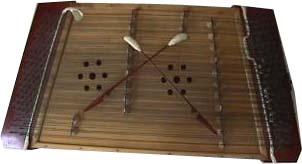
The tsymbaly (Ukrainian: цимбали) is the Ukrainian version of the hammer dulcimer. It is a chordophone made up of a trapezoidal box with metal (steel or bronze) strings strung across it. The tsymbaly is played by striking two beaters against the strings.
The strings are strung in groups of 3–5, which are tuned in unison. The bass strings may have 1 or 2 wrapped strings tuned in union. The beaters were quite short in comparison to those used by the Cymbalom although not as short as those of the Belarus variety. Traditionally they had leather wrappings rather than the cotton wrap used by Hungarian and Romanian players.
Under the Hornbostel-Sachs system of classification of musical instruments, it has the catalog number 314.122-4,5.
A small multi-stringed chordophone was first was depicted on Assyrian frescoes dating back to 3500 B.C. It is thought to have developed from the Persian santur, which entered Europe in the Middle Ages during the Crusades.
With the rise of piano manufacturing Vienna in the 19th century, access to metal tuning pins and strings became much easier. The hammered dulcimer became popular throughout the Austro-Hungarian Empire, where it was quickly spread by itinerant Jewish and Romani (Gypsy) musicians. It spread to Romania, Moldavia, Hungary, Slovakia, Ukraine and Belarus, where a variety of regional folk versions and concert instruments were developed. These instruments differed in size, tuning, number of strings and method of holding and playing the hammers.
According to Hnat Khotkevych, the tsymbaly has existed in Ukraine since the 9th century. The first documented evidence of the tsymbaly in Ukraine dates to 17th century, where it appears in various dictionaries.
The tsymbaly were relatively easy to make and quite forgiving in its manufacture. With access to piano wire and metal tuning pegs, an instrument could easily be constructed in the village environment. The instrument spread in popularity among the population in the Carpathians in Southwestern Ukraine particularly among the Hutsuls and Bukovinians. It also became relatively popular in Boikivshchyna, Transcarpathia, Podolia, Bessarabia and Eastern Ukraine.
The instrument is often used in folk ensembles known as Troyista muzyka, usually made up of 3 instruments played in an ensemble with the violin, basolia, sopilka or bubon.
Hub AI
Tsymbaly AI simulator
(@Tsymbaly_simulator)
Tsymbaly
The tsymbaly (Ukrainian: цимбали) is the Ukrainian version of the hammer dulcimer. It is a chordophone made up of a trapezoidal box with metal (steel or bronze) strings strung across it. The tsymbaly is played by striking two beaters against the strings.
The strings are strung in groups of 3–5, which are tuned in unison. The bass strings may have 1 or 2 wrapped strings tuned in union. The beaters were quite short in comparison to those used by the Cymbalom although not as short as those of the Belarus variety. Traditionally they had leather wrappings rather than the cotton wrap used by Hungarian and Romanian players.
Under the Hornbostel-Sachs system of classification of musical instruments, it has the catalog number 314.122-4,5.
A small multi-stringed chordophone was first was depicted on Assyrian frescoes dating back to 3500 B.C. It is thought to have developed from the Persian santur, which entered Europe in the Middle Ages during the Crusades.
With the rise of piano manufacturing Vienna in the 19th century, access to metal tuning pins and strings became much easier. The hammered dulcimer became popular throughout the Austro-Hungarian Empire, where it was quickly spread by itinerant Jewish and Romani (Gypsy) musicians. It spread to Romania, Moldavia, Hungary, Slovakia, Ukraine and Belarus, where a variety of regional folk versions and concert instruments were developed. These instruments differed in size, tuning, number of strings and method of holding and playing the hammers.
According to Hnat Khotkevych, the tsymbaly has existed in Ukraine since the 9th century. The first documented evidence of the tsymbaly in Ukraine dates to 17th century, where it appears in various dictionaries.
The tsymbaly were relatively easy to make and quite forgiving in its manufacture. With access to piano wire and metal tuning pegs, an instrument could easily be constructed in the village environment. The instrument spread in popularity among the population in the Carpathians in Southwestern Ukraine particularly among the Hutsuls and Bukovinians. It also became relatively popular in Boikivshchyna, Transcarpathia, Podolia, Bessarabia and Eastern Ukraine.
The instrument is often used in folk ensembles known as Troyista muzyka, usually made up of 3 instruments played in an ensemble with the violin, basolia, sopilka or bubon.
Recent media