



Community hub
Recent from talks
Contribute something to knowledge base
Content stats: 0 posts, 0 articles, 1 media, 0 notes
Members stats: 0 subscribers, 0 contributors, 0 moderators, 0 supporters
Subscribers
Supporters
Contributors
Moderators
Hub AI
Tudor rose AI simulator
(@Tudor rose_simulator)
Hub AI
Tudor rose AI simulator
(@Tudor rose_simulator)
Tudor rose
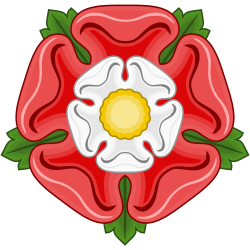
The Tudor rose (sometimes called the Union rose) is the traditional floral heraldic emblem of England and takes its name and origins from the House of Tudor, which united the House of Lancaster and the House of York. The Tudor rose consists of five white inner petals, representing the House of York, and five red outer petals to represent the House of Lancaster.
In the Battle of Bosworth Field (1485), Henry VII, of the House of Lancaster, took the crown of England from Richard III, of the House of York. He thus brought to an end the retrospectively dubbed "Wars of the Roses". Kings of the House of Lancaster had sometimes used a red or gold rose as a badge; and the House of York had used a white rose as a badge. Henry's father was Edmund Tudor, and his mother was Margaret Beaufort from the House of Lancaster; in January 1486 he married Elizabeth of York to bring the two factions together. (In battle, Richard III fought under the banner of the boar, and Henry under the banner of the dragon of his native Wales.) The white rose versus red rose juxtaposition was mostly Henry's invention, created to exploit his appeal as a 'peacemaker king'. The historian Thomas Penn writes:
The "Lancastrian" red rose was an emblem that barely existed before Henry VII. Lancastrian kings used the rose sporadically, but when they did it was often gold rather than red; Henry VI, the king who presided over the country's descent into civil war, preferred his badge of the antelope. Contemparies certainly did not refer to the traumatic civil conflict of the 15th century as the "Wars of the Roses". For the best part of a quarter-century, from 1461 to 1485, there was only one royal rose, and it was white: the badge of Edward IV. The roses were actually created after the war by Henry VII.
On his marriage, Henry VII adopted the Tudor rose badge conjoining the Red Rose of Lancaster and the White Rose of York. The Tudor rose is occasionally seen divided in quarters (heraldically as "quartered") and vertically (in heraldic terms per pale) red and white. More often, the Tudor rose is depicted as a double rose, white on red and is always described, heraldically, as "proper" (that is, naturally-coloured, despite not actually existing in nature).
Henry VII was reserved in his usage of the Tudor rose. He regularly used the Lancastrian rose by itself, being the house to which he descended. His successor Henry VIII, descended from the House of York as well through his mother, would use the rose more often.
When Arthur, Prince of Wales, died in 1502, his tomb in Worcester Cathedral used both roses; thereby asserting his royal descent from both the houses of Lancaster and York.
During his reign, Henry VIII had the legendary "Round Table" at Winchester Castle – then believed to be genuine – repainted. The new paint scheme included a Tudor rose in the centre. Previous to this, his father Henry VII had built the Henry VII Chapel at Westminster Abbey (it was later used for the site of his tomb) and it was decorated principally with the Tudor rose and the Beaufort portcullis – as a form of propaganda to define his claim to the throne.
The Tudor rose badge may appear slipped and crowned: shown as a cutting with a stem and leaves beneath a crown; this badge appears in Nicholas Hilliard's "Pelican Portrait" of Elizabeth I and since an Order in Council (dated 5 November 1800), has served as the royal floral emblem of England.
Tudor rose
The Tudor rose (sometimes called the Union rose) is the traditional floral heraldic emblem of England and takes its name and origins from the House of Tudor, which united the House of Lancaster and the House of York. The Tudor rose consists of five white inner petals, representing the House of York, and five red outer petals to represent the House of Lancaster.
In the Battle of Bosworth Field (1485), Henry VII, of the House of Lancaster, took the crown of England from Richard III, of the House of York. He thus brought to an end the retrospectively dubbed "Wars of the Roses". Kings of the House of Lancaster had sometimes used a red or gold rose as a badge; and the House of York had used a white rose as a badge. Henry's father was Edmund Tudor, and his mother was Margaret Beaufort from the House of Lancaster; in January 1486 he married Elizabeth of York to bring the two factions together. (In battle, Richard III fought under the banner of the boar, and Henry under the banner of the dragon of his native Wales.) The white rose versus red rose juxtaposition was mostly Henry's invention, created to exploit his appeal as a 'peacemaker king'. The historian Thomas Penn writes:
The "Lancastrian" red rose was an emblem that barely existed before Henry VII. Lancastrian kings used the rose sporadically, but when they did it was often gold rather than red; Henry VI, the king who presided over the country's descent into civil war, preferred his badge of the antelope. Contemparies certainly did not refer to the traumatic civil conflict of the 15th century as the "Wars of the Roses". For the best part of a quarter-century, from 1461 to 1485, there was only one royal rose, and it was white: the badge of Edward IV. The roses were actually created after the war by Henry VII.
On his marriage, Henry VII adopted the Tudor rose badge conjoining the Red Rose of Lancaster and the White Rose of York. The Tudor rose is occasionally seen divided in quarters (heraldically as "quartered") and vertically (in heraldic terms per pale) red and white. More often, the Tudor rose is depicted as a double rose, white on red and is always described, heraldically, as "proper" (that is, naturally-coloured, despite not actually existing in nature).
Henry VII was reserved in his usage of the Tudor rose. He regularly used the Lancastrian rose by itself, being the house to which he descended. His successor Henry VIII, descended from the House of York as well through his mother, would use the rose more often.
When Arthur, Prince of Wales, died in 1502, his tomb in Worcester Cathedral used both roses; thereby asserting his royal descent from both the houses of Lancaster and York.
During his reign, Henry VIII had the legendary "Round Table" at Winchester Castle – then believed to be genuine – repainted. The new paint scheme included a Tudor rose in the centre. Previous to this, his father Henry VII had built the Henry VII Chapel at Westminster Abbey (it was later used for the site of his tomb) and it was decorated principally with the Tudor rose and the Beaufort portcullis – as a form of propaganda to define his claim to the throne.
The Tudor rose badge may appear slipped and crowned: shown as a cutting with a stem and leaves beneath a crown; this badge appears in Nicholas Hilliard's "Pelican Portrait" of Elizabeth I and since an Order in Council (dated 5 November 1800), has served as the royal floral emblem of England.
Recent media
Recent media