
Recent from talks
Two Chinas
Knowledge base stats:
Talk channels stats:
Members stats:
Two Chinas
The concept of Two Chinas refers to the political divide between the People's Republic of China (PRC) and the Republic of China (ROC). Founded in 1912, the ROC governed mainland China until the Chinese Communist Party established the PRC in 1949, forcing the ROC to retreat to Taiwan after losing the Chinese Civil War. Both are rival governments claiming to be the sole legitimate authority over all of China (One China), encompassing mainland China and Taiwan, and neither recognises the other’s legitimacy.
Today, they operate as separate entities with different political systems and ideologies. The differences between the two Chinas are stark, with the PRC being a one-party communist state and the ROC a multi-party democracy after transitioning from one-party military rule. Both regions maintain separate diplomatic relations.
In 1912, the Xuantong Emperor abdicated as a result of the Xinhai Revolution, and the Republic of China was established in Nanjing by revolutionaries under Sun Yat-sen. At the same time, the Beiyang government, led by Yuan Shikai, a former Qing dynasty general, existed in Beijing, whose legitimacy was challenged by the Nationalist government under the Kuomintang (KMT).
From 1912 to 1949, China was scarred by warlords, the Japanese invasion and the Chinese Civil War. Throughout this turbulent period, multiple governments existed in China. These include Yuan Shikai's Beiyang government (1912–1928), the Chinese Soviet Republic (1931–1937) established by the Chinese Communist Party (CCP), the puppet states of Manchukuo (1932–1945) and Mengjiang (1939–1945), the Fujian People's Government (1933–1934), Wang Jingwei's Japanese-sponsored puppet government (1940–1945), Ganden Phodrang's Tibet (1912–1951), Khoja Niyaz's Turkic Islamic Republic of East Turkestan (1933–1934), the Soviet-backed East Turkestan Republic (1944–1949), the Tuvan People's Republic (1921–1944), Bogd Khan's Mongolian State in Outer Mongolia (1911–1924) and the Mongolian People's Republic (1924–1992), with the latter recognised by China in 1946.
As the Chinese Civil War ended in 1949, the Chinese communist People's Republic of China (PRC), led by CCP Chairman Mao Zedong, took control of Mainland China. The Republic of China, led by President Chiang Kai-shek, retreated the government of the Republic of China to the island of Taiwan, hence effectively dividing China into two political states, similar to North and South Korea, West and East Germany and North and South Vietnam.
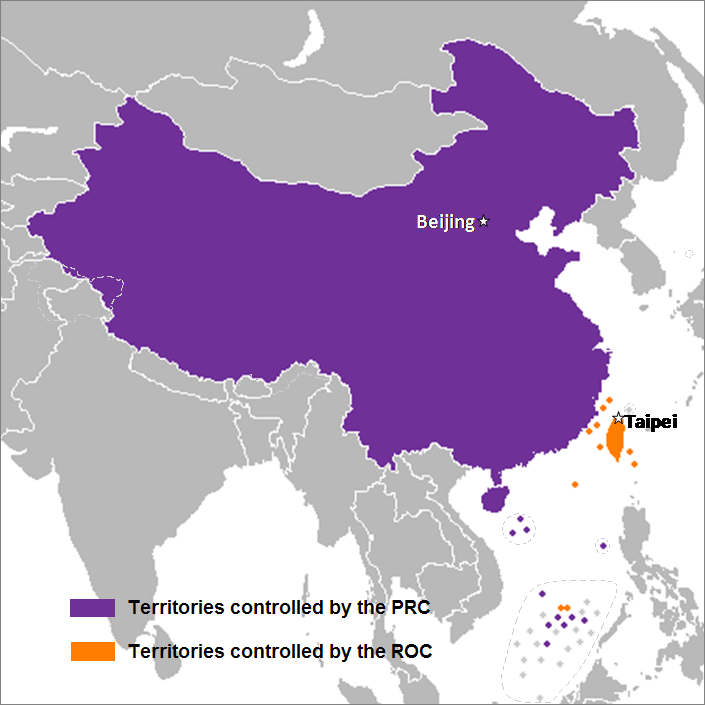
Though fighting continued for the next several years, by the time of the Korean War the lines of control were sharply drawn: the Communist-led People's Republic of China government in Beijing controlled most of mainland China, while the Kuomintang-led Republic of China government, now in Taipei, controlled the island of Taiwan, some surrounding islands, and a number of islands off the coast of Fujian. This stalemate was enforced with the assistance of the United States government that began deterring an invasion of Taiwan after the start of the Korean War.
For many years, both governments contended to be the sole legitimate government of China. With the fighting largely over, the major battleground became diplomatic. Before the 1970s, the Republic of China was still recognised by many countries and the United Nations as the sole legitimate government of "China", which claimed sovereignty over both mainland China and Taiwan. The Republic of China had been a founding member of the United Nations and was one of the five permanent members of the Security Council until 1971, when they were expelled from the UN and China's representation was replaced by the People's Republic of China (PRC) via UN General Assembly Resolution 2758. Before the 1970s, few foreign governments recognised the People's Republic of China. The first governments to recognise it as the government of "China" were Soviet bloc countries, members of the non-aligned movement, and the United Kingdom (1950). The catalyst to change came in 1971, when the United Nations General Assembly expelled representatives of Chiang Kai-shek by refusing to recognise their accreditations as representatives of China. Recognition for the People's Republic of China soon followed from most other governments, including the United States. The Republic of China continued to compete with the People's Republic of China (PRC) to be recognised as the legitimate government of China.
Since the 1990s, however, a rising movement for formal recognition of Taiwanese independence has made the political status of Taiwan the dominant issue, replacing the debate about the legitimate government of China. A view in Taiwan is that the Republic of China and the People's Republic of China are both sovereign, thus forming "two Chinas", or "one China, one Taiwan". Former Republic of China President Chen Shui-bian adamantly supported this status quo, and accordingly largely abandoned the campaign for the Republic of China to be recognised as the sole legitimate government of China. Under President Chen, the ROC government was campaigning for the Republic of China to join the United Nations as representative of its effective territory—Taiwan and nearby islands—only. Chen's successor, President Ma Ying-jeou, ceased that push.[citation needed]
Hub AI
Two Chinas AI simulator
(@Two Chinas_simulator)
Two Chinas
The concept of Two Chinas refers to the political divide between the People's Republic of China (PRC) and the Republic of China (ROC). Founded in 1912, the ROC governed mainland China until the Chinese Communist Party established the PRC in 1949, forcing the ROC to retreat to Taiwan after losing the Chinese Civil War. Both are rival governments claiming to be the sole legitimate authority over all of China (One China), encompassing mainland China and Taiwan, and neither recognises the other’s legitimacy.
Today, they operate as separate entities with different political systems and ideologies. The differences between the two Chinas are stark, with the PRC being a one-party communist state and the ROC a multi-party democracy after transitioning from one-party military rule. Both regions maintain separate diplomatic relations.
In 1912, the Xuantong Emperor abdicated as a result of the Xinhai Revolution, and the Republic of China was established in Nanjing by revolutionaries under Sun Yat-sen. At the same time, the Beiyang government, led by Yuan Shikai, a former Qing dynasty general, existed in Beijing, whose legitimacy was challenged by the Nationalist government under the Kuomintang (KMT).
From 1912 to 1949, China was scarred by warlords, the Japanese invasion and the Chinese Civil War. Throughout this turbulent period, multiple governments existed in China. These include Yuan Shikai's Beiyang government (1912–1928), the Chinese Soviet Republic (1931–1937) established by the Chinese Communist Party (CCP), the puppet states of Manchukuo (1932–1945) and Mengjiang (1939–1945), the Fujian People's Government (1933–1934), Wang Jingwei's Japanese-sponsored puppet government (1940–1945), Ganden Phodrang's Tibet (1912–1951), Khoja Niyaz's Turkic Islamic Republic of East Turkestan (1933–1934), the Soviet-backed East Turkestan Republic (1944–1949), the Tuvan People's Republic (1921–1944), Bogd Khan's Mongolian State in Outer Mongolia (1911–1924) and the Mongolian People's Republic (1924–1992), with the latter recognised by China in 1946.
As the Chinese Civil War ended in 1949, the Chinese communist People's Republic of China (PRC), led by CCP Chairman Mao Zedong, took control of Mainland China. The Republic of China, led by President Chiang Kai-shek, retreated the government of the Republic of China to the island of Taiwan, hence effectively dividing China into two political states, similar to North and South Korea, West and East Germany and North and South Vietnam.
Though fighting continued for the next several years, by the time of the Korean War the lines of control were sharply drawn: the Communist-led People's Republic of China government in Beijing controlled most of mainland China, while the Kuomintang-led Republic of China government, now in Taipei, controlled the island of Taiwan, some surrounding islands, and a number of islands off the coast of Fujian. This stalemate was enforced with the assistance of the United States government that began deterring an invasion of Taiwan after the start of the Korean War.
For many years, both governments contended to be the sole legitimate government of China. With the fighting largely over, the major battleground became diplomatic. Before the 1970s, the Republic of China was still recognised by many countries and the United Nations as the sole legitimate government of "China", which claimed sovereignty over both mainland China and Taiwan. The Republic of China had been a founding member of the United Nations and was one of the five permanent members of the Security Council until 1971, when they were expelled from the UN and China's representation was replaced by the People's Republic of China (PRC) via UN General Assembly Resolution 2758. Before the 1970s, few foreign governments recognised the People's Republic of China. The first governments to recognise it as the government of "China" were Soviet bloc countries, members of the non-aligned movement, and the United Kingdom (1950). The catalyst to change came in 1971, when the United Nations General Assembly expelled representatives of Chiang Kai-shek by refusing to recognise their accreditations as representatives of China. Recognition for the People's Republic of China soon followed from most other governments, including the United States. The Republic of China continued to compete with the People's Republic of China (PRC) to be recognised as the legitimate government of China.
Since the 1990s, however, a rising movement for formal recognition of Taiwanese independence has made the political status of Taiwan the dominant issue, replacing the debate about the legitimate government of China. A view in Taiwan is that the Republic of China and the People's Republic of China are both sovereign, thus forming "two Chinas", or "one China, one Taiwan". Former Republic of China President Chen Shui-bian adamantly supported this status quo, and accordingly largely abandoned the campaign for the Republic of China to be recognised as the sole legitimate government of China. Under President Chen, the ROC government was campaigning for the Republic of China to join the United Nations as representative of its effective territory—Taiwan and nearby islands—only. Chen's successor, President Ma Ying-jeou, ceased that push.[citation needed]
Recent media