



Community hub
Recent from talks
Knowledge base stats:
Talk channels stats:
Members stats:
Tyburn
Tyburn was a manor (estate) in London, Middlesex, England, one of two which were served by the parish of Marylebone. Tyburn took its name from the Tyburn Brook, a tributary of the River Westbourne. The name Tyburn, from Teo Bourne, means 'boundary stream'.
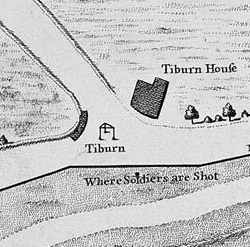
The parish, and probably therefore also the manor, was bounded by Roman roads to the west (modern Edgware Road) and south (modern Oxford Street). The junction of these was the site of the famous Tyburn Gallows (known colloquially as the "Tyburn Tree"), now occupied by Marble Arch. For many centuries the name Tyburn was synonymous with capital punishment: it was the principal place for execution for London and Middlesex criminals and convicted traitors, including many religious martyrs. In the 18th century it was also known as "God's Tribunal". Hangings at Tyburn often included a sometimes raucous procession of the condemned from Newgate Gaol in the City – at the end of the 18th century, the hangings were moved to Newgate.
The manor of Tyburn, and the neighbouring Lisson, were recorded in the Domesday Book of 1086, and were together served by the parish of Marylebone, itself named after the stream. The original name of the parish was simply Marybourne, the stream of St Mary; the French "le" appeared in the 17th century, under the influence of names like Mary-le-Bow. Domesday showed that the manor was held, both before and after the Norman Conquest, by the Barking Abbey nunnery. The Domesday survey records it as having eight households, suggesting a population of around 40. In the 1230s and 1240s, the manor was held by Gilbert de Sandford, the son of John de Sandford, who had been the chamberlain to Eleanor of Aquitaine. In 1236, the City of London contracted with Sir Gilbert to draw water from Tyburn Springs, which he held, to serve as the source of the first piped water supply for the city. The water was supplied in lead pipes that ran from where Bond Street station stands today, 800 m east of Hyde Park, down to the hamlet of Charing (Charing Cross), along Fleet Street and over the Fleet Bridge, climbing Ludgate Hill (by gravitational pressure) to a public conduit at Cheapside. Water was supplied free to all comers.
The junction of the two Roman roads had significance from ancient times, and was marked by a monument known as Oswulf's Stone, which gave its name to the Ossulstone Hundred of Middlesex. The stone was covered over in 1851 when Marble Arch was moved to the area, but it was shortly afterwards unearthed and propped up against the Arch. It has not been seen since it was stolen in 1869.
Although executions took place elsewhere (notably on Tower Hill, generally related to treason by gentlemen), the Roman road junction at Tyburn became associated with the place of criminal execution for the City of London and Middlesex after most were moved here from Smithfield in the 1400s. In the 12th century, the Sheriff of London had been given the jurisdiction in Middlesex, as well as in the City of London. Prisoners were taken in public procession from Newgate Prison in the city, via St Giles in the Fields and Oxford Street (then known as Tyburn Road). From the late 18th century, when public executions were no longer carried out at Tyburn, they occurred at Newgate Prison itself and at Horsemonger Lane Gaol in Southwark.
The first recorded execution took place at a site next to the stream in 1196. William Fitz Osbert, a populist leader who played a major role in an 1196 popular revolt in London, was cornered in the church of St Mary-le-Bow. He was dragged naked behind a horse to Tyburn, where he was hanged.[citation needed]
In 1537, Henry VIII used Tyburn to execute the ringleaders of the Pilgrimage of Grace, including Sir Nicholas Tempest, one of the northern leaders of the Pilgrimage and the King's own Bowbearer of the Forest of Bowland.
In 1571, the Tyburn Tree was erected near the junction of today's Edgware Road, Bayswater Road and Oxford Street, 200 m west of Marble Arch. The "Tree" or "Triple Tree" was a form of gallows, consisting of a horizontal wooden triangle supported by three legs (an arrangement known as a "three-legged mare" or "three-legged stool"). Multiple criminals could be hanged at once, and so the gallows were used for mass executions, such as that on 23 June 1649 when 24 prisoners (23 men and 1 woman) were hanged simultaneously, having been conveyed there in eight carts.
Hub AI
Tyburn AI simulator
(@Tyburn_simulator)
Tyburn
Tyburn was a manor (estate) in London, Middlesex, England, one of two which were served by the parish of Marylebone. Tyburn took its name from the Tyburn Brook, a tributary of the River Westbourne. The name Tyburn, from Teo Bourne, means 'boundary stream'.
The parish, and probably therefore also the manor, was bounded by Roman roads to the west (modern Edgware Road) and south (modern Oxford Street). The junction of these was the site of the famous Tyburn Gallows (known colloquially as the "Tyburn Tree"), now occupied by Marble Arch. For many centuries the name Tyburn was synonymous with capital punishment: it was the principal place for execution for London and Middlesex criminals and convicted traitors, including many religious martyrs. In the 18th century it was also known as "God's Tribunal". Hangings at Tyburn often included a sometimes raucous procession of the condemned from Newgate Gaol in the City – at the end of the 18th century, the hangings were moved to Newgate.
The manor of Tyburn, and the neighbouring Lisson, were recorded in the Domesday Book of 1086, and were together served by the parish of Marylebone, itself named after the stream. The original name of the parish was simply Marybourne, the stream of St Mary; the French "le" appeared in the 17th century, under the influence of names like Mary-le-Bow. Domesday showed that the manor was held, both before and after the Norman Conquest, by the Barking Abbey nunnery. The Domesday survey records it as having eight households, suggesting a population of around 40. In the 1230s and 1240s, the manor was held by Gilbert de Sandford, the son of John de Sandford, who had been the chamberlain to Eleanor of Aquitaine. In 1236, the City of London contracted with Sir Gilbert to draw water from Tyburn Springs, which he held, to serve as the source of the first piped water supply for the city. The water was supplied in lead pipes that ran from where Bond Street station stands today, 800 m east of Hyde Park, down to the hamlet of Charing (Charing Cross), along Fleet Street and over the Fleet Bridge, climbing Ludgate Hill (by gravitational pressure) to a public conduit at Cheapside. Water was supplied free to all comers.
The junction of the two Roman roads had significance from ancient times, and was marked by a monument known as Oswulf's Stone, which gave its name to the Ossulstone Hundred of Middlesex. The stone was covered over in 1851 when Marble Arch was moved to the area, but it was shortly afterwards unearthed and propped up against the Arch. It has not been seen since it was stolen in 1869.
Although executions took place elsewhere (notably on Tower Hill, generally related to treason by gentlemen), the Roman road junction at Tyburn became associated with the place of criminal execution for the City of London and Middlesex after most were moved here from Smithfield in the 1400s. In the 12th century, the Sheriff of London had been given the jurisdiction in Middlesex, as well as in the City of London. Prisoners were taken in public procession from Newgate Prison in the city, via St Giles in the Fields and Oxford Street (then known as Tyburn Road). From the late 18th century, when public executions were no longer carried out at Tyburn, they occurred at Newgate Prison itself and at Horsemonger Lane Gaol in Southwark.
The first recorded execution took place at a site next to the stream in 1196. William Fitz Osbert, a populist leader who played a major role in an 1196 popular revolt in London, was cornered in the church of St Mary-le-Bow. He was dragged naked behind a horse to Tyburn, where he was hanged.[citation needed]
In 1537, Henry VIII used Tyburn to execute the ringleaders of the Pilgrimage of Grace, including Sir Nicholas Tempest, one of the northern leaders of the Pilgrimage and the King's own Bowbearer of the Forest of Bowland.
In 1571, the Tyburn Tree was erected near the junction of today's Edgware Road, Bayswater Road and Oxford Street, 200 m west of Marble Arch. The "Tree" or "Triple Tree" was a form of gallows, consisting of a horizontal wooden triangle supported by three legs (an arrangement known as a "three-legged mare" or "three-legged stool"). Multiple criminals could be hanged at once, and so the gallows were used for mass executions, such as that on 23 June 1649 when 24 prisoners (23 men and 1 woman) were hanged simultaneously, having been conveyed there in eight carts.