


Community hub
Recent from talks
Contribute something
Nothing was collected or created yet.
UA6 experiment
View on Wikipedia | |
| Key SppS Experiments | |
|---|---|
| UA1 | Underground Area 1 |
| UA2 | Underground Area 2 |
| UA4 | Underground Area 4 |
| UA5 | Underground Area 5 |
| SppS pre-accelerators | |
| PS | Proton Synchrotron |
| AA | Antiproton Accumulator |

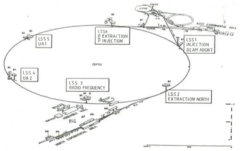
The Underground Area 6 (UA6), also referred to as PHOTONS, experiment was a high-energy physics experiment at the Proton-Antiproton Collider (SppS), a modification of the Super Proton Synchrotron (SPS), at CERN. The experiment ran from 1984 to 1990, with the purpose of studying inclusive electromagnetic final states and lambda production in proton-antiproton and proton-proton interactions.[1][2] Towards the end of its run it focused more on direct-photon and J/ψ production.[3] The experiment is complementary to the UA1, UA2 and CDF experiments.[4]

UA6 is a fixed target experiment in which an internal H2 cluster jet is sent through the collider beams. The luminosity is measured with four silicon detector that count the recoil protons from the scattering.[5] This is followed by a double-arm spectrometer, with each arm consisting of five multiword proportional chambers (PCs) spaced behind and in front of a dipole magnet, an ionisation chamber, a transition radiation detector, and an electromagnetic calorimeter. The spectrometer is placed on the other side of the jet target for pp collisions.[4] The signals for the trigger decisions are provided by the calorimeter and a hodoscope of seven scintillation counters between the first two modules of the calorimeter.[5][6]

Throughout the running of UA6 the detector setup was progressively upgraded, resulting in increased available antiproton luminosity, minimised background interactions, and improved trigger logic.[3]
Preliminary results of the experiment showed clear peaks in the data from the two-photon decays of the π0 and η mesons.[7] Results from the experiment was used to publish cross sections for π0 and η production, direct photon production, elastic scattering, and J/ψ production.[2][8][9][10][5]
See also
[edit]External links
[edit]References
[edit]- ^ "Greybook". greybook.cern.ch. Retrieved 2023-08-04.
- ^ a b Snow, Gregory R. (1991-08-08). "A novel triggering system for the UA6 electromagnetic calorimeter". In Para, Adam; Anderson, D. F.; Derrick, M.; Fisk, H. E.; Sazama, Cynthia (eds.). Calorimetry in High Energy Physics - Proceedings of the International Conference. #N/A. ISBN 978-981-4556-54-5.
- ^ a b "Experimental Studies of Elementary Particle Interactions at High Energy" (PDF). The Rockefeller University. 31 Mar 1992.
- ^ a b Snow, Gregory R. (16 Nov 1988). "Direct Photon Physics From CERN Experiment UA6" (PDF). VIIth Topical Workshop on Proton–Antiproton Collider Physics, Fermilab, Batavia, Ill., USA, 2–24 June 1988.
- ^ a b c Morel, C.; Bernasconi, A.; Breedon, R.E.; Camilleri, L.; Cool, R.L.; Cox, P.T.; Cushman, P.; Dick, L.; Dukes, E.C.; Gabioud, B.; Gaille, F.; Giacomelli, P.; Jeanneret, J.B.; Joseph, C.; Kubischta, W. (Dec 1990). "Measurement of the inclusive J/ψ production cross sections in and pp collisions at √s = 24.3 GeV". Physics Letters B. 252 (3): 505–510. doi:10.1016/0370-2693(90)90579-U.
- ^ Dobinson, Robert W; Pages, J L; Vermeulen, J C (1991). "Transputers in particle physics experiments" (PDF). Particle World. 2 (2): 39–45.
- ^ Dukes, Craig (1986). "PRELIMINARY RESULTS FROM EXPERIMENT UA6 ON INCLUSIVE pi0, eta AND GAMMA PRODUCTION FROM p anti-p COLLISIONS AT S**1/2 = 24-GeV". Strong Interactions and Gauge Theories.
- ^ Camilleri, Leslie (1991). "Comparison of direct γγ production in pp and pp reactions at √s = 24.3 GeV" (PDF). High-energy physics. Proceedings, 25th International Conference, Singapore, August 2-8, 1990. Vol. 2. pp. 1436–1438.
- ^ Duclos, Jean (1989-06-19). "Experiments with internal targets in electron storage rings". Nuclear Physics A. 497: 77–90. Bibcode:1989NuPhA.497...77D. doi:10.1016/0375-9474(89)90456-9. ISSN 0375-9474.
- ^ Breedon, R. E.; Chapin, T. J.; Cool, R. L.; Cox, P. T.; Goulianos, K.; Petersen, P. C.; Rusack, R. W.; Snow, G. R.; Vacghi, A.; White, S. N.; Camilleri, L.; Dick, L.; Jeanneret, J. B.; Kubischra, W.; Von Dardel, G. (1989-01-12). "Precise comparison of antiproton-proton and proton-proton forward elastic scattering at √s = 24.3 GeV". Physics Letters B. 216 (3): 459–465. Bibcode:1989PhLB..216..459B. doi:10.1016/0370-2693(89)91150-7. ISSN 0370-2693.