
Recent from talks
USS Gherardi
Knowledge base stats:
Talk channels stats:
Members stats:
USS Gherardi
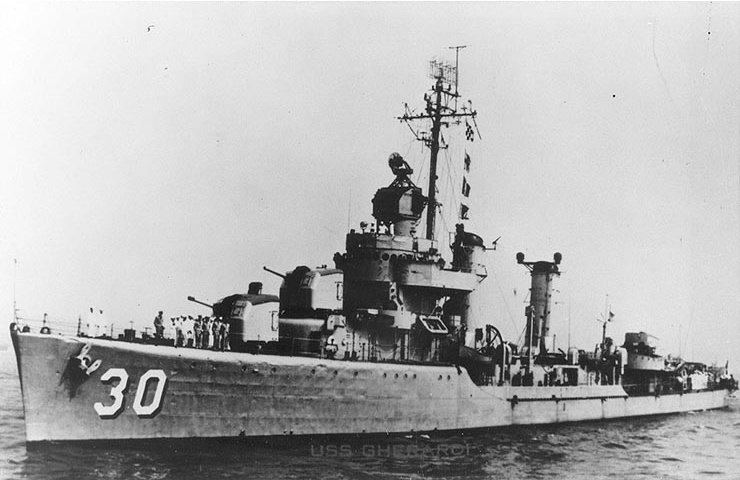
USS Gherardi (DD-637/DMS-30), a Gleaves-class destroyer, is the only ship of the United States Navy to be named for Rear Admiral Bancroft Gherardi.
Gherardi was launched on 12 February 1942 by the Philadelphia Navy Yard, sponsored by Mrs. Christopher Robinson, granddaughter of Rear Admiral Bancroft Gherardi; and commissioned on 15 September 1942.
In December 1942 Gherardi suffered fatalities in a storm. After trials and shakedown training out of Casco Bay, Maine and Newport, Rhode Island Gherardi departed Philadelphia 1 January 1943 making convoy escort voyages to Guantanamo Bay, Cuba, Port Arthur and Galveston, Texas, returning to New York on 7 February 1943. She departed New York on 15 February on what was to be the first of ten transatlantic convoys. Gherardi returned to New York from Casablanca on 14 April 1943. After a voyage to Newfoundland in May she departed Hampton Roads, Virginia on 8 June en route to the Mediterranean to become part of Admiral Kent Hewitt's Western Naval Task Force for the invasion of Sicily. Assigned the duty of protecting troop transports, she helped defeat many bombing attacks and was credited with shooting down one plane, suffering 11 near misses.
Gherardi saw her first surface action when late in July and early August she participated in several offensive sweeps along the northern coast of Sicily, and around the port of Palermo. On the night of 3/4 August the destroyers USS Gherardi and USS Rhind were making a night offensive sweep along the coast, when at 22:15, a few miles off Cape Calava, they picked up a small convoy consisting of one of the German MFP lighters escorted by two Italian motor torpedo boats. At a range of 4,000 yards (3,700 m), the destroyers illuminated the convoy with star shells and opened up with their main batteries. The lighter blew up at 22:25 and one of the escorting boats (MS 66) was sunk; the other (MS 63) fired at least one torpedo, which missed. It was later found that the German lighter had been loaded with land mines.
Gherardi returned to New York 22 August 1943 and commenced a series of fast convoy escort voyages to Northern Ireland and England, touching at Belfast and Derry, Northern Ireland and Swansea, Wales. She returned to New York from her last voyage on 13 February 1944. After intensive training out of Casco Bay, Maine, Gherardi made a voyage to Gibraltar with a large scouting force between 23 March and 22 April 1944. On 8 May 1944 Gherardi departed New York en route to Northern Ireland for rehearsals for the invasion of Normandy. On the morning of D-Day, 6 June 1944 she maneuvered into the fire support area as a unit of Admiral Don P. Moon's Assault Force "U" for Utah Beach. She delivered calls from fire-control parties ashore clearing the way for troops by prompt and accurate fire on railroads, houses, shore batteries and other targets. This drew dangerous return fire and she had one hot duel during the afternoon. Having expended all her ammunition, Gherardi was forced to retire that afternoon to Plymouth, England, to replenish.
Returning to Utah Beach, Gherardi was assigned screening duty. This lasted until 25 June when she joined Admiral Morton Deyo's bombardment Task Force 129 in the support of the First Army assault on Cherbourg, France.
Departing the Normandy area 18 July 1944 Gherardi steamed to Malta where she joined a British–American escort carrier task force which trained for the invasion of Southern France on 15 August. On 9 August 1944 Gherardi rendezvoused with the carrier strike group and maneuvered into the launching areas. For two weeks Gherardi screened the carriers while strike after strike was made in support of the invasion. Southern France now secured, Gherardi departed for the states, reaching New York 16 September. Immediately work started to convert her to a high speed minesweeper.
On 15 November 1944 Gherardi classification changed to DMS-30. After many tests and calibrations she joined Mine Division 60 and steamed to the Pacific, touching at San Diego, Pearl Harbor, and Eniwetok. She reached Ulithi in early March. Departing Ulithi she proceeded to Okinawa where she arrived 25 March 1945. Here Gherardi participated in minesweeping operations prior to the invasion of Okinawa on 1 April under the overall command of Admiral Raymond A. Spruance, Commander Fifth Fleet. After the initial assault she screened the heavier surface fire support units and rendered assistance as needed. For three months of continuous screening duty she fought off many suicide planes. Near the end of the battle for Okinawa the versatile Gherardi participated in day shore bombardment and night illumination of the southern coast of the island, contributing to the advance of the troops.
Hub AI
USS Gherardi AI simulator
(@USS Gherardi_simulator)
USS Gherardi
USS Gherardi (DD-637/DMS-30), a Gleaves-class destroyer, is the only ship of the United States Navy to be named for Rear Admiral Bancroft Gherardi.
Gherardi was launched on 12 February 1942 by the Philadelphia Navy Yard, sponsored by Mrs. Christopher Robinson, granddaughter of Rear Admiral Bancroft Gherardi; and commissioned on 15 September 1942.
In December 1942 Gherardi suffered fatalities in a storm. After trials and shakedown training out of Casco Bay, Maine and Newport, Rhode Island Gherardi departed Philadelphia 1 January 1943 making convoy escort voyages to Guantanamo Bay, Cuba, Port Arthur and Galveston, Texas, returning to New York on 7 February 1943. She departed New York on 15 February on what was to be the first of ten transatlantic convoys. Gherardi returned to New York from Casablanca on 14 April 1943. After a voyage to Newfoundland in May she departed Hampton Roads, Virginia on 8 June en route to the Mediterranean to become part of Admiral Kent Hewitt's Western Naval Task Force for the invasion of Sicily. Assigned the duty of protecting troop transports, she helped defeat many bombing attacks and was credited with shooting down one plane, suffering 11 near misses.
Gherardi saw her first surface action when late in July and early August she participated in several offensive sweeps along the northern coast of Sicily, and around the port of Palermo. On the night of 3/4 August the destroyers USS Gherardi and USS Rhind were making a night offensive sweep along the coast, when at 22:15, a few miles off Cape Calava, they picked up a small convoy consisting of one of the German MFP lighters escorted by two Italian motor torpedo boats. At a range of 4,000 yards (3,700 m), the destroyers illuminated the convoy with star shells and opened up with their main batteries. The lighter blew up at 22:25 and one of the escorting boats (MS 66) was sunk; the other (MS 63) fired at least one torpedo, which missed. It was later found that the German lighter had been loaded with land mines.
Gherardi returned to New York 22 August 1943 and commenced a series of fast convoy escort voyages to Northern Ireland and England, touching at Belfast and Derry, Northern Ireland and Swansea, Wales. She returned to New York from her last voyage on 13 February 1944. After intensive training out of Casco Bay, Maine, Gherardi made a voyage to Gibraltar with a large scouting force between 23 March and 22 April 1944. On 8 May 1944 Gherardi departed New York en route to Northern Ireland for rehearsals for the invasion of Normandy. On the morning of D-Day, 6 June 1944 she maneuvered into the fire support area as a unit of Admiral Don P. Moon's Assault Force "U" for Utah Beach. She delivered calls from fire-control parties ashore clearing the way for troops by prompt and accurate fire on railroads, houses, shore batteries and other targets. This drew dangerous return fire and she had one hot duel during the afternoon. Having expended all her ammunition, Gherardi was forced to retire that afternoon to Plymouth, England, to replenish.
Returning to Utah Beach, Gherardi was assigned screening duty. This lasted until 25 June when she joined Admiral Morton Deyo's bombardment Task Force 129 in the support of the First Army assault on Cherbourg, France.
Departing the Normandy area 18 July 1944 Gherardi steamed to Malta where she joined a British–American escort carrier task force which trained for the invasion of Southern France on 15 August. On 9 August 1944 Gherardi rendezvoused with the carrier strike group and maneuvered into the launching areas. For two weeks Gherardi screened the carriers while strike after strike was made in support of the invasion. Southern France now secured, Gherardi departed for the states, reaching New York 16 September. Immediately work started to convert her to a high speed minesweeper.
On 15 November 1944 Gherardi classification changed to DMS-30. After many tests and calibrations she joined Mine Division 60 and steamed to the Pacific, touching at San Diego, Pearl Harbor, and Eniwetok. She reached Ulithi in early March. Departing Ulithi she proceeded to Okinawa where she arrived 25 March 1945. Here Gherardi participated in minesweeping operations prior to the invasion of Okinawa on 1 April under the overall command of Admiral Raymond A. Spruance, Commander Fifth Fleet. After the initial assault she screened the heavier surface fire support units and rendered assistance as needed. For three months of continuous screening duty she fought off many suicide planes. Near the end of the battle for Okinawa the versatile Gherardi participated in day shore bombardment and night illumination of the southern coast of the island, contributing to the advance of the troops.
Recent media