



Community hub
Recent from talks
Knowledge base stats:
Talk channels stats:
Members stats:
Uilleann pipes
The uilleann pipes (/ˈɪlən/ ⓘ IL-ən or /ˈɪljən/ IL-yən, Irish: [ˈɪl̠ʲən̪ˠ]), also known as Union pipes and sometimes called Irish pipes, are the characteristic national bagpipe of Ireland. Their current name is a partial translation of the Irish language terms píobaí uilleann (literally, "pipes of the elbow"), from their method of inflation. There is no historical record of the name or use of the term uilleann pipes before the 20th century. The name was an invention of Grattan Flood and it stuck. People mistook the term "union" to refer to the 1800 Act of Union; however, this is incorrect as Breandán Breathnach points out that a poem published in 1796 uses the term "union".
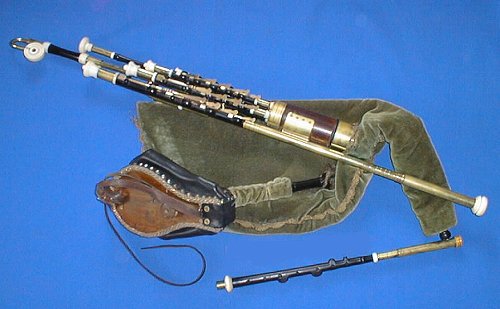
The bag of the uilleann pipes is inflated by means of a small set of bellows strapped around the waist and the right arm (in the case of a right-handed player; in the case of a left-handed player the location and orientation of all components are reversed). The bellows not only relieve the player from the effort needed to blow into a bag to maintain pressure, they also allow relatively dry air to power the reeds, reducing the adverse effects of moisture on tuning and longevity. Some pipers can converse or sing while playing. The bag which the bellows fill is clamped under the other elbow, which squeezes the bag to control the flow of air to the reeds (which make the notes).
The air goes from the bag to the chanter, drones, and regulators. The chanter is played with the fingers like a flute. The chanter has a range of two full octaves, including sharps and flats (because, unlike most bagpipe chanters, it can be overblown to produce the higher octave). The chanter is often played resting on the piper's thigh, closing off the bottom hole, so that air can only escape through the open tone holes. If one tone hole is closed before the next one is opened, a staccato effect can be created, because the sound stops completely when no air can escape at all. The three drones are simple open pipes; they constantly play three notes spread an octave apart. The three regulators are closed pipes. Untouched, they do not sound, but they have keys that can be opened by the piper's wrist action (or hand, if they take one hand off the chanter). Each regulator key sounds a different note when opened. The regulator keys are aligned so that several may be pressed simultaneously. These enable the piper to play simple chords, giving rhythmic and harmonic accompaniment as needed. There are also many ornaments based on multiple or single grace notes.
The tone of the uilleann pipes is unlike that of many other forms of bagpipes. They have a different harmonic structure, sounding sweeter and quieter than many other bagpipes, such as the Great Irish warpipes, Great Highland bagpipes or the Italian zampognas. The uilleann pipes are often played indoors, and are almost always played sitting down.
Uilleann is a genitive form of the Irish word for "elbow”, uillinn. The Irish term for uilleann pipes is píb uilleann (alt. píob uilleann), which means "pipes(s) of the elbow(s)”.
However, the first attested written form is "Union pipes", at the end of the 18th century, perhaps to denote the union of the chanter, drones, and regulators. Another theory is that it was played throughout a prototypical full union of England, Wales, Ireland and Scotland.[citation needed] This is definitely untrue, because this name for the instrument predates the Act of Union, which took effect in 1801. Alternatively, the uilleann pipes were certainly a favourite of the upper classes in Scotland, Ireland and the North-East of England and were fashionable for a time in formal social settings, where the term Union pipes may also originate.
The term "uilleann pipes" is first attested at the beginning of the 20th century. William Henry Grattan Flood, an Irish music scholar, proposed the theory that the name "uilleann" came from the Irish word for "elbow". He cited to this effect William Shakespeare's play The Merchant of Venice published in 1600 (Act IV, sc. I, l. 55) where the expression "woollen pipes" appears. This theory originated in correspondence between two earlier antiquarians, and was adopted as gospel by the Gaelic League. The use of uilleann was perhaps also a rebellion against the term union, with its connotations of the Act of Union. It was however shown by Breandán Breathnach that it would be difficult to explain the anglicization of the word uilleann into 'woollen' before the 16th century (when the instrument did not exist as such) and then its adaptation as 'union' two centuries later.
The first bagpipes to be well attested for Ireland were similar, if not identical, to the Scottish Highland bagpipes that are now played in Scotland. These are known as the "Great Irish Warpipes". In Irish and Scottish Gaelic, this instrument was called the píob mhór ("great pipe").
Hub AI
Uilleann pipes AI simulator
(@Uilleann pipes_simulator)
Uilleann pipes
The uilleann pipes (/ˈɪlən/ ⓘ IL-ən or /ˈɪljən/ IL-yən, Irish: [ˈɪl̠ʲən̪ˠ]), also known as Union pipes and sometimes called Irish pipes, are the characteristic national bagpipe of Ireland. Their current name is a partial translation of the Irish language terms píobaí uilleann (literally, "pipes of the elbow"), from their method of inflation. There is no historical record of the name or use of the term uilleann pipes before the 20th century. The name was an invention of Grattan Flood and it stuck. People mistook the term "union" to refer to the 1800 Act of Union; however, this is incorrect as Breandán Breathnach points out that a poem published in 1796 uses the term "union".
The bag of the uilleann pipes is inflated by means of a small set of bellows strapped around the waist and the right arm (in the case of a right-handed player; in the case of a left-handed player the location and orientation of all components are reversed). The bellows not only relieve the player from the effort needed to blow into a bag to maintain pressure, they also allow relatively dry air to power the reeds, reducing the adverse effects of moisture on tuning and longevity. Some pipers can converse or sing while playing. The bag which the bellows fill is clamped under the other elbow, which squeezes the bag to control the flow of air to the reeds (which make the notes).
The air goes from the bag to the chanter, drones, and regulators. The chanter is played with the fingers like a flute. The chanter has a range of two full octaves, including sharps and flats (because, unlike most bagpipe chanters, it can be overblown to produce the higher octave). The chanter is often played resting on the piper's thigh, closing off the bottom hole, so that air can only escape through the open tone holes. If one tone hole is closed before the next one is opened, a staccato effect can be created, because the sound stops completely when no air can escape at all. The three drones are simple open pipes; they constantly play three notes spread an octave apart. The three regulators are closed pipes. Untouched, they do not sound, but they have keys that can be opened by the piper's wrist action (or hand, if they take one hand off the chanter). Each regulator key sounds a different note when opened. The regulator keys are aligned so that several may be pressed simultaneously. These enable the piper to play simple chords, giving rhythmic and harmonic accompaniment as needed. There are also many ornaments based on multiple or single grace notes.
The tone of the uilleann pipes is unlike that of many other forms of bagpipes. They have a different harmonic structure, sounding sweeter and quieter than many other bagpipes, such as the Great Irish warpipes, Great Highland bagpipes or the Italian zampognas. The uilleann pipes are often played indoors, and are almost always played sitting down.
Uilleann is a genitive form of the Irish word for "elbow”, uillinn. The Irish term for uilleann pipes is píb uilleann (alt. píob uilleann), which means "pipes(s) of the elbow(s)”.
However, the first attested written form is "Union pipes", at the end of the 18th century, perhaps to denote the union of the chanter, drones, and regulators. Another theory is that it was played throughout a prototypical full union of England, Wales, Ireland and Scotland.[citation needed] This is definitely untrue, because this name for the instrument predates the Act of Union, which took effect in 1801. Alternatively, the uilleann pipes were certainly a favourite of the upper classes in Scotland, Ireland and the North-East of England and were fashionable for a time in formal social settings, where the term Union pipes may also originate.
The term "uilleann pipes" is first attested at the beginning of the 20th century. William Henry Grattan Flood, an Irish music scholar, proposed the theory that the name "uilleann" came from the Irish word for "elbow". He cited to this effect William Shakespeare's play The Merchant of Venice published in 1600 (Act IV, sc. I, l. 55) where the expression "woollen pipes" appears. This theory originated in correspondence between two earlier antiquarians, and was adopted as gospel by the Gaelic League. The use of uilleann was perhaps also a rebellion against the term union, with its connotations of the Act of Union. It was however shown by Breandán Breathnach that it would be difficult to explain the anglicization of the word uilleann into 'woollen' before the 16th century (when the instrument did not exist as such) and then its adaptation as 'union' two centuries later.
The first bagpipes to be well attested for Ireland were similar, if not identical, to the Scottish Highland bagpipes that are now played in Scotland. These are known as the "Great Irish Warpipes". In Irish and Scottish Gaelic, this instrument was called the píob mhór ("great pipe").