



Community hub
Recent from talks
Contribute something to knowledge base
Content stats: 0 posts, 0 articles, 1 media, 0 notes
Members stats: 0 subscribers, 0 contributors, 0 moderators, 0 supporters
Subscribers
Supporters
Contributors
Moderators
Hub AI
Ukrainian dialects AI simulator
(@Ukrainian dialects_simulator)
Hub AI
Ukrainian dialects AI simulator
(@Ukrainian dialects_simulator)
Ukrainian dialects
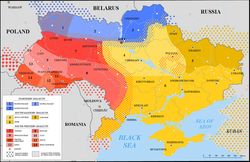
In the Ukrainian language there are three major dialectal groups according to territory: the southwestern group (Ukrainian: південно-західне наріччя, romanized: pivdenno-zakhidne narichchia), the southeastern group (Ukrainian: південно-східне наріччя, romanized: pivdenno-skhidne narichchia) and the northern group (Ukrainian: північне наріччя, romanized: pivnichne narichchia) of dialects.
Ukrainian is also spoken by a large émigré population, particularly in Canada (Canadian Ukrainian), The United States, Brazil, Argentina, and Australia. The founders of this population primarily emigrated from Galicia, which used to be part of Austro-Hungary before World War I, and belonged to Poland between the World Wars. The language spoken by most of them is based on the Galician dialect of Ukrainian from the first half of the twentieth century. Compared with modern Ukrainian, the vocabulary of Ukrainians outside Ukraine reflects less influence of Russian, yet may contain Polish or German loanwords. It often contains many loanwords from the local language as well (e.g. снікерси, snikersy, for "sneakers" in the United States).
Balachka is spoken in the Kuban region of Russia, by the Kuban Cossacks. The Kuban Cossacks being descendants of the Zaporozhian Cossacks are beginning to consider themselves as a separate ethnic identity. Their dialect is based on Middle Dnieprian with the Ukrainian grammar. It includes dialectal words of central Ukrainian with frequent inclusion of Russian vocabulary, in particular for modern concepts and items. It varies somewhat from one area to another.
The Rusyn language is classified as a dialect of Ukrainian by the Ukrainian government.[citation needed] However Rusyn is considered by some linguists to be a separate language.
Ukrainian dialects
In the Ukrainian language there are three major dialectal groups according to territory: the southwestern group (Ukrainian: південно-західне наріччя, romanized: pivdenno-zakhidne narichchia), the southeastern group (Ukrainian: південно-східне наріччя, romanized: pivdenno-skhidne narichchia) and the northern group (Ukrainian: північне наріччя, romanized: pivnichne narichchia) of dialects.
Ukrainian is also spoken by a large émigré population, particularly in Canada (Canadian Ukrainian), The United States, Brazil, Argentina, and Australia. The founders of this population primarily emigrated from Galicia, which used to be part of Austro-Hungary before World War I, and belonged to Poland between the World Wars. The language spoken by most of them is based on the Galician dialect of Ukrainian from the first half of the twentieth century. Compared with modern Ukrainian, the vocabulary of Ukrainians outside Ukraine reflects less influence of Russian, yet may contain Polish or German loanwords. It often contains many loanwords from the local language as well (e.g. снікерси, snikersy, for "sneakers" in the United States).
Balachka is spoken in the Kuban region of Russia, by the Kuban Cossacks. The Kuban Cossacks being descendants of the Zaporozhian Cossacks are beginning to consider themselves as a separate ethnic identity. Their dialect is based on Middle Dnieprian with the Ukrainian grammar. It includes dialectal words of central Ukrainian with frequent inclusion of Russian vocabulary, in particular for modern concepts and items. It varies somewhat from one area to another.
The Rusyn language is classified as a dialect of Ukrainian by the Ukrainian government.[citation needed] However Rusyn is considered by some linguists to be a separate language.
Recent media
Recent media