


Community hub
Recent from talks
Contribute something to knowledge base
Content stats: 0 posts, 0 articles, 1 media, 0 notes
Members stats: 0 subscribers, 0 contributors, 0 moderators, 0 supporters
Subscribers
Supporters
Contributors
Moderators
Hub AI
Ultramarine AI simulator
(@Ultramarine_simulator)
Hub AI
Ultramarine AI simulator
(@Ultramarine_simulator)
Ultramarine
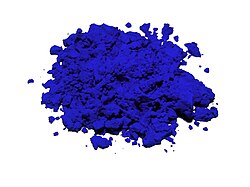
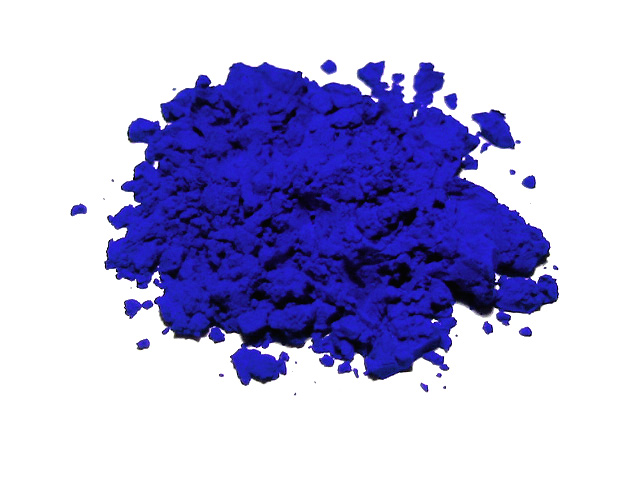
Ultramarine is a deep blue pigment which was originally made by grinding lapis lazuli into a powder. Its lengthy grinding and washing process makes the natural pigment quite valuable—roughly ten times more expensive than the stone it comes from. In the 14th to the 15th Century in Europe it was as expensive as gold.
The name ultramarine comes from the Latin word ultramarinus. The word means 'beyond the sea', as the pigment was imported by Italian traders during the 14th and 15th centuries from mines in Afghanistan. Much of the expansion of ultramarine can be attributed to Venice which historically was the port of entry for lapis lazuli in Europe.
Ultramarine was the finest and most expensive blue used by Renaissance painters. It was often used for the robes of the Virgin Mary and symbolized holiness and humility. It remained an extremely expensive pigment until a synthetic ultramarine was invented in 1826.
Ultramarine is a permanent pigment when under ideal preservation conditions. Otherwise, it is susceptible to discoloration and fading.
The pigment consists primarily of a zeolite-based mineral containing small amounts of polysulfides. It occurs in nature as a proximate component of lapis lazuli containing a blue cubic mineral called lazurite. In the Colour Index International, the pigment of ultramarine is identified as P. Blue 29 77007.
The major component of lazurite is a complex sulfur-containing sodium-silicate (Na8–10Al6Si6O24S2–4), which makes ultramarine the most complex of all mineral pigments. Some chloride is often present in the crystal lattice as well. The blue color of the pigment is due to the S−
3 radical anion, which contains an unpaired electron.
The best samples of ultramarine are a uniform deep blue while other specimens are of paler color.
Particle size distribution has been found to vary among samples of ultramarine from various workshops. Numerous grinding techniques used by painters have resulted in different pigment/medium ratios and particle size distributions. The grinding and purification process results in pigment with particles of various geometries. Different grades of pigment may have been used for different areas in a painting, a characteristic that is sometimes used in art authentication.
Ultramarine
Ultramarine is a deep blue pigment which was originally made by grinding lapis lazuli into a powder. Its lengthy grinding and washing process makes the natural pigment quite valuable—roughly ten times more expensive than the stone it comes from. In the 14th to the 15th Century in Europe it was as expensive as gold.
The name ultramarine comes from the Latin word ultramarinus. The word means 'beyond the sea', as the pigment was imported by Italian traders during the 14th and 15th centuries from mines in Afghanistan. Much of the expansion of ultramarine can be attributed to Venice which historically was the port of entry for lapis lazuli in Europe.
Ultramarine was the finest and most expensive blue used by Renaissance painters. It was often used for the robes of the Virgin Mary and symbolized holiness and humility. It remained an extremely expensive pigment until a synthetic ultramarine was invented in 1826.
Ultramarine is a permanent pigment when under ideal preservation conditions. Otherwise, it is susceptible to discoloration and fading.
The pigment consists primarily of a zeolite-based mineral containing small amounts of polysulfides. It occurs in nature as a proximate component of lapis lazuli containing a blue cubic mineral called lazurite. In the Colour Index International, the pigment of ultramarine is identified as P. Blue 29 77007.
The major component of lazurite is a complex sulfur-containing sodium-silicate (Na8–10Al6Si6O24S2–4), which makes ultramarine the most complex of all mineral pigments. Some chloride is often present in the crystal lattice as well. The blue color of the pigment is due to the S−
3 radical anion, which contains an unpaired electron.
The best samples of ultramarine are a uniform deep blue while other specimens are of paler color.
Particle size distribution has been found to vary among samples of ultramarine from various workshops. Numerous grinding techniques used by painters have resulted in different pigment/medium ratios and particle size distributions. The grinding and purification process results in pigment with particles of various geometries. Different grades of pigment may have been used for different areas in a painting, a characteristic that is sometimes used in art authentication.
Recent media
Recent media