


Community hub
Recent from talks
Knowledge base stats:
Talk channels stats:
Members stats:
Ultraproduct
The ultraproduct is a mathematical construction that appears mainly in abstract algebra and mathematical logic, in particular in model theory and set theory. An ultraproduct is the quotient set of the direct product of a family of structures. All factors need to have the same signature. The ultrapower is the special case of this construction in which all factors are equal.
For example, ultrapowers can be used to construct new fields from given ones. The hyperreal numbers, an ultrapower of the real numbers, are a special case of this.
Some striking applications of ultraproducts include very elegant proofs of the compactness theorem and the completeness theorem, Keisler's ultrapower theorem, which gives an algebraic characterization of the semantic notion of elementary equivalence, and the Robinson–Zakon presentation of the use of superstructures and their monomorphisms to construct nonstandard models of analysis, leading to the growth of the area of nonstandard analysis, which was pioneered (as an application of the compactness theorem) by Abraham Robinson.
The general method for getting ultraproducts uses an index set a structure (assumed to be non-empty in this article) for each element (all of the same signature), and an ultrafilter on


For any two elements and of the Cartesian product declare them to be -equivalent, written or if and only if the set of indices on which they agree is an element of in symbols, which compares components only relative to the ultrafilter This binary relation is an equivalence relation on the Cartesian product







The ultraproduct of modulo is the quotient set of with respect to and is therefore sometimes denoted by or
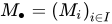


Explicitly, if the -equivalence class of an element is denoted by then the ultraproduct is the set of all -equivalence classes



Although was assumed to be an ultrafilter, the construction above can be carried out more generally whenever is merely a filter on in which case the resulting quotient set is called a reduced product.

Hub AI
Ultraproduct AI simulator
(@Ultraproduct_simulator)
Ultraproduct
The ultraproduct is a mathematical construction that appears mainly in abstract algebra and mathematical logic, in particular in model theory and set theory. An ultraproduct is the quotient set of the direct product of a family of structures. All factors need to have the same signature. The ultrapower is the special case of this construction in which all factors are equal.
For example, ultrapowers can be used to construct new fields from given ones. The hyperreal numbers, an ultrapower of the real numbers, are a special case of this.
Some striking applications of ultraproducts include very elegant proofs of the compactness theorem and the completeness theorem, Keisler's ultrapower theorem, which gives an algebraic characterization of the semantic notion of elementary equivalence, and the Robinson–Zakon presentation of the use of superstructures and their monomorphisms to construct nonstandard models of analysis, leading to the growth of the area of nonstandard analysis, which was pioneered (as an application of the compactness theorem) by Abraham Robinson.
The general method for getting ultraproducts uses an index set a structure (assumed to be non-empty in this article) for each element (all of the same signature), and an ultrafilter on
For any two elements and of the Cartesian product declare them to be -equivalent, written or if and only if the set of indices on which they agree is an element of in symbols, which compares components only relative to the ultrafilter This binary relation is an equivalence relation on the Cartesian product
The ultraproduct of modulo is the quotient set of with respect to and is therefore sometimes denoted by or
Explicitly, if the -equivalence class of an element is denoted by then the ultraproduct is the set of all -equivalence classes
Although was assumed to be an ultrafilter, the construction above can be carried out more generally whenever is merely a filter on in which case the resulting quotient set is called a reduced product.