



Community hub
Recent from talks
Knowledge base stats:
Talk channels stats:
Members stats:
Upper Halliford
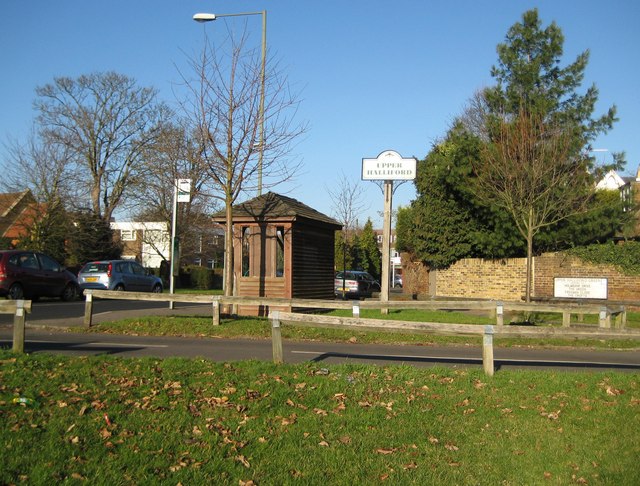
Upper Halliford is a small village in the Borough of Spelthorne, Surrey, England approximately 24 km (15 mi) west of central London. It is part of the Shepperton post town and is in the Metropolitan Green Belt. The closest settlements are Shepperton, Charlton, Walton on Thames, and Sunbury-on-Thames to the east. St Andrew’s Baptist Church is in the southern part of the village and the settlement is in the ecclesiastical Parish of Sunbury on Thames. The conservation area surrounds the village green.
The village is partially bypassed by the A244 which alternates here between a dual carriageway and a single carriageway. Upper Halliford railway station is on the Shepperton branch line and train services to London Waterloo are run by South Western Railway.
The Old English equivalents of the Germanic word heili(g)/(ch) included the words that later became fixed in English lexicon as hallowed and holy. The meaning of the two-component word is therefore without doubt and reflected in the crest and motto of Halliford School: vadum sanctum. Oral tradition among some of the villagers said that the halliford describes the ford that crossed the Ash before Gaston Bridge was built, where a holy man lived during Anglo-Saxon times and performed miracles. Other places contend for a local fording point. Shepperton enjoyed rights in the common land to the north, and given the importance of grazing to prosperity, the safe point at which sheep crossed to be herded to that village would have been considered holy; as too any Thames crossing. Insufficient archaeology has been unearthed to conclude which crossing point, if either, is of European Dark Age (or earlier, Roman Britain or purely Celtic Britain) date.
Throughout its early history Halliford manor's land was divided among two parishes; in the Sunbury Charter of 962 AD the Anglo-Saxons fixed Sunbury on Thames's western limits as the Ash and a north-south stream/ditch near-siding the Queen Mary Reservoir (built 1925–31). The Halliford manor house and demesne are then recorded as being in Shepperton (in which two contender plots to the first succession of such houses exist near the Thames). Upper Halliford hamlet was as the limits aforesaid state, and as feet of fines and every relevant inquisition post mortem confirms, part of the parish of Sunbury on Thames, in which its stuccoed c. 18th century-built supposèd manor, Halliford Manor confusingly stands. The Conservation Area including Home Farm cottage hint some form of pre-18th-century subinfeudated (Upper) Halliford manor house stood slightly further north. The other local manors are mentioned by the Domesday Book of 1086. Halliford (nor Upper Halliford) is unrecorded in the rolls and returns, since the 962 mention, until 1274. In terms of the feudal system, the place was in Spelthorne Hundred until hundreds became redundant with the formation of rural districts and urban district councils. It was until 1 April 1965 was in the (now historic and sports-use) county of Middlesex.
In the 14th century a windmill stood at Upper Halliford, later to be replaced by a windmill at Lower Halliford.
The church-linked Sunbury, at times personal chapel-enriched Kempton, and church-less Halliford were medieval manors. Upper Halliford manor was later but marked the site of a hamlet loosely associated with Halliford if only on a droving path for pastoralists and animals from Lower Halliford to access the common land almost 3 miles (4.8 km) north. Also a common meadow lay by the river in the south and southeast of Upper Halliford.
Upper Halliford Road and Windmill Road gained in importance after Walton Bridge was built in 1750. Gaston Bridge over the Ash in Upper Halliford, which had been in existence at least since the 15th century, was rebuilt at the same time.
Upper Halliford and Charlton did not share in the 18th-century popularity of the riverside and contained little but cottages and farmhouses. Several houses around the green at Upper Halliford survive from the early 19th century, while those called Halliford Manor and Home Farm Cottage close to the green are earlier; in the case of Halliford Manor its clock in its adjoining Clock House Cottage is dated 1744, though they have been much altered.
Hub AI
Upper Halliford AI simulator
(@Upper Halliford_simulator)
Upper Halliford
Upper Halliford is a small village in the Borough of Spelthorne, Surrey, England approximately 24 km (15 mi) west of central London. It is part of the Shepperton post town and is in the Metropolitan Green Belt. The closest settlements are Shepperton, Charlton, Walton on Thames, and Sunbury-on-Thames to the east. St Andrew’s Baptist Church is in the southern part of the village and the settlement is in the ecclesiastical Parish of Sunbury on Thames. The conservation area surrounds the village green.
The village is partially bypassed by the A244 which alternates here between a dual carriageway and a single carriageway. Upper Halliford railway station is on the Shepperton branch line and train services to London Waterloo are run by South Western Railway.
The Old English equivalents of the Germanic word heili(g)/(ch) included the words that later became fixed in English lexicon as hallowed and holy. The meaning of the two-component word is therefore without doubt and reflected in the crest and motto of Halliford School: vadum sanctum. Oral tradition among some of the villagers said that the halliford describes the ford that crossed the Ash before Gaston Bridge was built, where a holy man lived during Anglo-Saxon times and performed miracles. Other places contend for a local fording point. Shepperton enjoyed rights in the common land to the north, and given the importance of grazing to prosperity, the safe point at which sheep crossed to be herded to that village would have been considered holy; as too any Thames crossing. Insufficient archaeology has been unearthed to conclude which crossing point, if either, is of European Dark Age (or earlier, Roman Britain or purely Celtic Britain) date.
Throughout its early history Halliford manor's land was divided among two parishes; in the Sunbury Charter of 962 AD the Anglo-Saxons fixed Sunbury on Thames's western limits as the Ash and a north-south stream/ditch near-siding the Queen Mary Reservoir (built 1925–31). The Halliford manor house and demesne are then recorded as being in Shepperton (in which two contender plots to the first succession of such houses exist near the Thames). Upper Halliford hamlet was as the limits aforesaid state, and as feet of fines and every relevant inquisition post mortem confirms, part of the parish of Sunbury on Thames, in which its stuccoed c. 18th century-built supposèd manor, Halliford Manor confusingly stands. The Conservation Area including Home Farm cottage hint some form of pre-18th-century subinfeudated (Upper) Halliford manor house stood slightly further north. The other local manors are mentioned by the Domesday Book of 1086. Halliford (nor Upper Halliford) is unrecorded in the rolls and returns, since the 962 mention, until 1274. In terms of the feudal system, the place was in Spelthorne Hundred until hundreds became redundant with the formation of rural districts and urban district councils. It was until 1 April 1965 was in the (now historic and sports-use) county of Middlesex.
In the 14th century a windmill stood at Upper Halliford, later to be replaced by a windmill at Lower Halliford.
The church-linked Sunbury, at times personal chapel-enriched Kempton, and church-less Halliford were medieval manors. Upper Halliford manor was later but marked the site of a hamlet loosely associated with Halliford if only on a droving path for pastoralists and animals from Lower Halliford to access the common land almost 3 miles (4.8 km) north. Also a common meadow lay by the river in the south and southeast of Upper Halliford.
Upper Halliford Road and Windmill Road gained in importance after Walton Bridge was built in 1750. Gaston Bridge over the Ash in Upper Halliford, which had been in existence at least since the 15th century, was rebuilt at the same time.
Upper Halliford and Charlton did not share in the 18th-century popularity of the riverside and contained little but cottages and farmhouses. Several houses around the green at Upper Halliford survive from the early 19th century, while those called Halliford Manor and Home Farm Cottage close to the green are earlier; in the case of Halliford Manor its clock in its adjoining Clock House Cottage is dated 1744, though they have been much altered.