
Recent from talks
Upsilon Andromedae c
Knowledge base stats:
Talk channels stats:
Members stats:
Upsilon Andromedae c
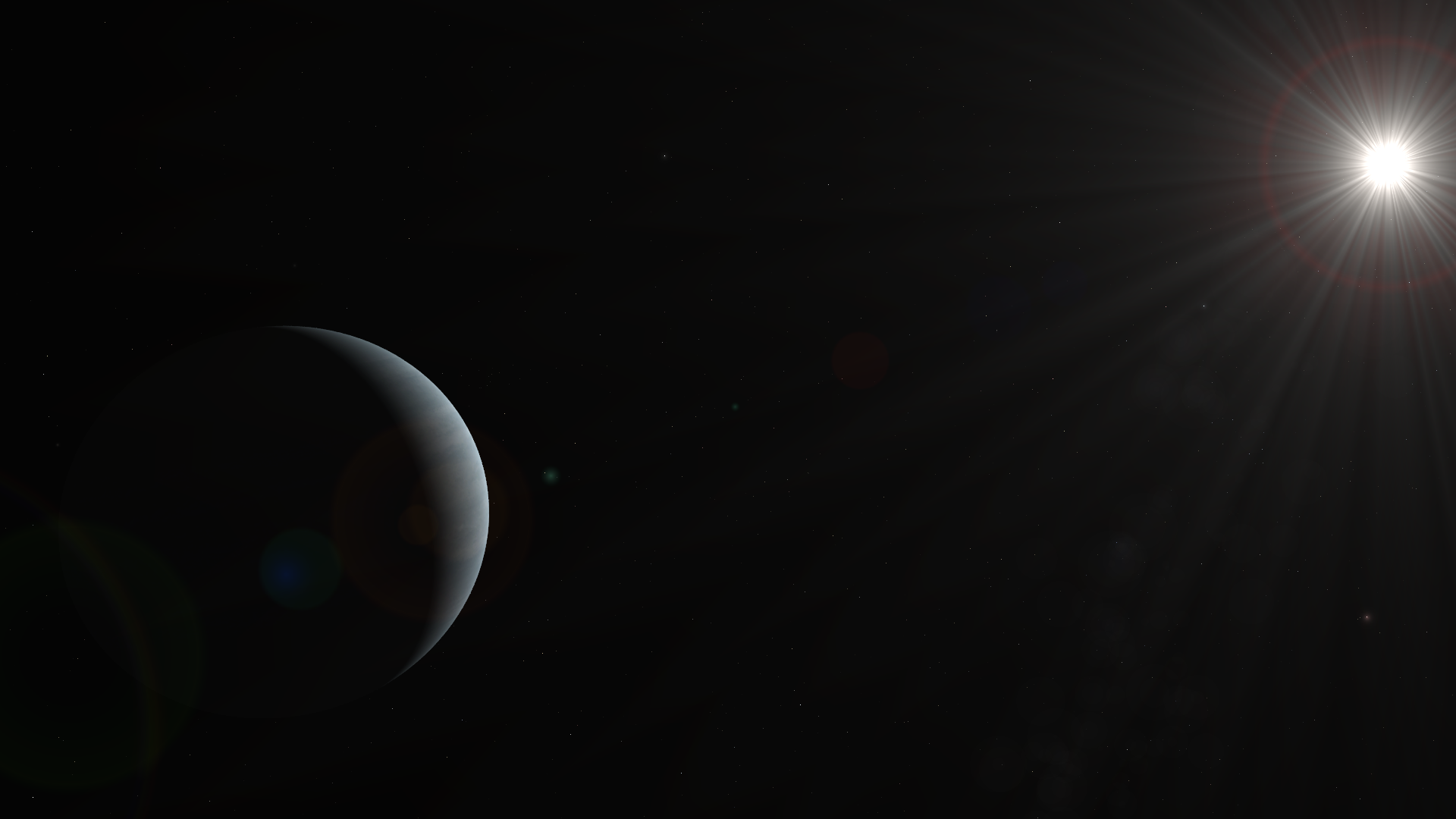
Upsilon Andromedae c (υ Andromedae c, abbreviated Upsilon And c, υ And c), formally named Samh /ˈsɑːm/ (a homophone with the star Salm), is an extrasolar planet orbiting the Sun-like star Upsilon Andromedae A every 241.3 days at an average distance of 0.83 AU (124 million km; 77 million mi). Its discovery in April 1999 by Geoffrey Marcy and R. Paul Butler made this the first multiple-planet system to be discovered around a main-sequence star, and the first multiple-planet system known in a multiple star system. Upsilon Andromedae c is the second-known planet in order of distance from its star.
In July 2014 the International Astronomical Union launched NameExoWorlds, a process for giving proper names to certain exoplanets and their host stars. The process involved public nomination and voting for the new names. In December 2015, the IAU announced the winning name was Samh for this planet. The winning name was submitted by the Vega Astronomy Club of Morocco and honours the 11th-century astronomer Ibn al-Samh of Muslim Spain.
Upsilon Andromedae c was detected by measuring variations in its star's radial velocity as a result of the planet's gravity. This was done by making precise measurements of the Doppler shift of the spectrum of Upsilon Andromedae A. At the time of discovery, Upsilon Andromedae A was already known to host one extrasolar planet, the hot Jupiter Upsilon Andromedae b; however, by 1999 it was clear that the inner planet could not explain the velocity curve.
In 1999, astronomers at both San Francisco State University and the Harvard-Smithsonian Center for Astrophysics independently concluded that a three-planet model best fit the data. The two new planets were designated Upsilon Andromedae c and Upsilon Andromedae d.
The planet orbits a (F-type) star named Upsilon Andromedae A. The star has a mass of 1.27 M☉ and a radius of around 1.48 R☉. It has a temperature of 6,074 K and is 3.12 billion years old. In comparison, the Sun is about 4.6 billion years old. The star is slightly metal-rich, with a metallicity ([Fe/H]) of 0.09, or about 123% of the solar amount. Its luminosity (L☉) is 3.57 times that of the Sun.
The star's apparent magnitude, or how bright it appears from Earth's perspective, is 4.09. Therefore, Upsilon Andromedae can be seen with the naked eye.
Like the majority of long-period extrasolar planets, the orbit of Upsilon Andromedae c is eccentric, more so than any of the major planets in the Solar System (including Pluto). If placed in the Solar System, Upsilon Andromedae c would lie between the orbits of Earth and Venus.
The high orbital eccentricity may be the result of gravitational perturbations from the planet Upsilon Andromedae d. Simulations suggest that the orbit of Upsilon Andromedae c returns to its original circular state roughly once every 9,000 years.
Hub AI
Upsilon Andromedae c AI simulator
(@Upsilon Andromedae c_simulator)
Upsilon Andromedae c
Upsilon Andromedae c (υ Andromedae c, abbreviated Upsilon And c, υ And c), formally named Samh /ˈsɑːm/ (a homophone with the star Salm), is an extrasolar planet orbiting the Sun-like star Upsilon Andromedae A every 241.3 days at an average distance of 0.83 AU (124 million km; 77 million mi). Its discovery in April 1999 by Geoffrey Marcy and R. Paul Butler made this the first multiple-planet system to be discovered around a main-sequence star, and the first multiple-planet system known in a multiple star system. Upsilon Andromedae c is the second-known planet in order of distance from its star.
In July 2014 the International Astronomical Union launched NameExoWorlds, a process for giving proper names to certain exoplanets and their host stars. The process involved public nomination and voting for the new names. In December 2015, the IAU announced the winning name was Samh for this planet. The winning name was submitted by the Vega Astronomy Club of Morocco and honours the 11th-century astronomer Ibn al-Samh of Muslim Spain.
Upsilon Andromedae c was detected by measuring variations in its star's radial velocity as a result of the planet's gravity. This was done by making precise measurements of the Doppler shift of the spectrum of Upsilon Andromedae A. At the time of discovery, Upsilon Andromedae A was already known to host one extrasolar planet, the hot Jupiter Upsilon Andromedae b; however, by 1999 it was clear that the inner planet could not explain the velocity curve.
In 1999, astronomers at both San Francisco State University and the Harvard-Smithsonian Center for Astrophysics independently concluded that a three-planet model best fit the data. The two new planets were designated Upsilon Andromedae c and Upsilon Andromedae d.
The planet orbits a (F-type) star named Upsilon Andromedae A. The star has a mass of 1.27 M☉ and a radius of around 1.48 R☉. It has a temperature of 6,074 K and is 3.12 billion years old. In comparison, the Sun is about 4.6 billion years old. The star is slightly metal-rich, with a metallicity ([Fe/H]) of 0.09, or about 123% of the solar amount. Its luminosity (L☉) is 3.57 times that of the Sun.
The star's apparent magnitude, or how bright it appears from Earth's perspective, is 4.09. Therefore, Upsilon Andromedae can be seen with the naked eye.
Like the majority of long-period extrasolar planets, the orbit of Upsilon Andromedae c is eccentric, more so than any of the major planets in the Solar System (including Pluto). If placed in the Solar System, Upsilon Andromedae c would lie between the orbits of Earth and Venus.
The high orbital eccentricity may be the result of gravitational perturbations from the planet Upsilon Andromedae d. Simulations suggest that the orbit of Upsilon Andromedae c returns to its original circular state roughly once every 9,000 years.
Recent media