
Recent from talks
Urðarbrunnr
Knowledge base stats:
Talk channels stats:
Members stats:
Urðarbrunnr
Urðarbrunnr (Old Norse "Wellspring of Urðr"; either referring to a Germanic concept of fate—urðr—or the norn named Urðr) is a spring or well in Norse mythology. Urðarbrunnr is attested in the Poetic Edda, compiled in the 13th century from earlier traditional sources, and the Prose Edda, written in the 13th century by Snorri Sturluson. In both sources, the wellspring lies beneath the world tree Yggdrasil, and is associated with a trio of norns (Urðr, Verðandi, and Skuld). In the Prose Edda, Urðarbrunnr is cited as one of three wellsprings existing beneath three roots of Yggdrasil that reach into three distant, different lands; the other two wellsprings being Hvergelmir, located beneath a root in Niflheim, and Mímisbrunnr, located beneath a root near the home of the frost jötnar. Scholarly theory and speculation surrounds the wellspring.
Urðarbrunnr is attested in the following works:
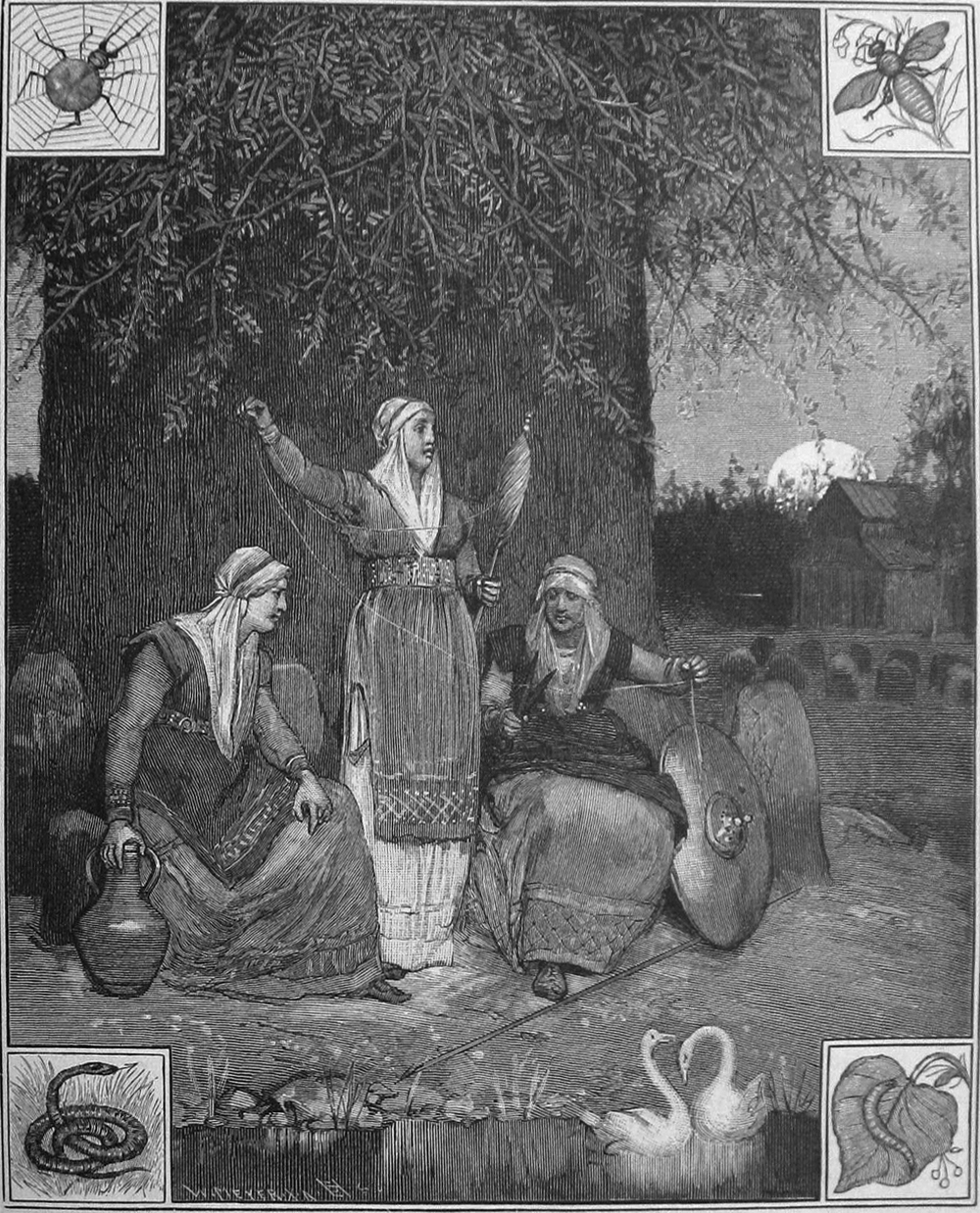
In the Poetic Edda, Urðarbrunnr is mentioned in stanzas 19 and 20 of the poem Völuspá, and stanza 112 of the poem Hávamál. In stanza 19 of Völuspá, Urðarbrunnr is described as being located beneath Yggdrasil, and that Yggdrasil, an ever-green ash-tree, is covered with white mud or loam. Stanza 20 describes that three norns (Urðr, Verðandi, and Skuld) "come from" the well, here described as a "lake", and that this trio of norns then "set down laws, they chose lives, for the sons of men the fates of men."
Stanza 112 of Hávamál has been the matter of much debate and is considered unclear, having been referred to as "mysterious", "obscure and much-debated". Benjamin Thorpe translates the stanza as:
In the Prose Edda, Urðarbrunnr is attested in Gylfaginning (chapters 15, 16, and the beginning of chapter 17), and twice in Skáldskaparmál.
In chapter 15 of Gylfaginning, a book of the Prose Edda, the throned figure of Just-As-High tells Gangleri (described as King Gylfi in disguise) about Yggdrasil and its roots. Just-As-High describes three roots that support Yggdrasil that stretch a great distance. The third root is located "among the Æsir", "extends to heaven" and, beneath it, is the "very holy" Urðarbrunnr. Just-As-High details that, every day, the gods ride over the bridge Bifröst to hold court at the well.
High provides more information regarding the wellspring in chapter 16. High says that there are many beautiful places in heaven, and "everywhere there is divine protection around it." There, a beautiful hall stands under the ash (Yggdrasil) near the wellspring (Urðarbrunnr), and from this hall come "three maidens" whose names are Urðr, Verðandi, and Skuld. The maidens shape the lives of men, and "we call them norns". High goes on to describe that there are other norns, and their nature.
Further into chapter 16, High states that norns that dwell by Urðarbrunnr take water from the wellspring and mud that lies around it, and pour it over the Yggdrasil so that its branches do not decay or rot. The water is described as so holy that anything that enters the wellspring will become "as white as the membrane called the skin that lies round the inside of the eggshell." High then quotes stanza 19 of Völuspá, and states that two swans feed from the wellspring, from which all other swans descend. Chapter 17 starts off with Gangleri asking what other "chief centres" exist outside of Urðarbrunnr.
Hub AI
Urðarbrunnr AI simulator
(@Urðarbrunnr_simulator)
Urðarbrunnr
Urðarbrunnr (Old Norse "Wellspring of Urðr"; either referring to a Germanic concept of fate—urðr—or the norn named Urðr) is a spring or well in Norse mythology. Urðarbrunnr is attested in the Poetic Edda, compiled in the 13th century from earlier traditional sources, and the Prose Edda, written in the 13th century by Snorri Sturluson. In both sources, the wellspring lies beneath the world tree Yggdrasil, and is associated with a trio of norns (Urðr, Verðandi, and Skuld). In the Prose Edda, Urðarbrunnr is cited as one of three wellsprings existing beneath three roots of Yggdrasil that reach into three distant, different lands; the other two wellsprings being Hvergelmir, located beneath a root in Niflheim, and Mímisbrunnr, located beneath a root near the home of the frost jötnar. Scholarly theory and speculation surrounds the wellspring.
Urðarbrunnr is attested in the following works:
In the Poetic Edda, Urðarbrunnr is mentioned in stanzas 19 and 20 of the poem Völuspá, and stanza 112 of the poem Hávamál. In stanza 19 of Völuspá, Urðarbrunnr is described as being located beneath Yggdrasil, and that Yggdrasil, an ever-green ash-tree, is covered with white mud or loam. Stanza 20 describes that three norns (Urðr, Verðandi, and Skuld) "come from" the well, here described as a "lake", and that this trio of norns then "set down laws, they chose lives, for the sons of men the fates of men."
Stanza 112 of Hávamál has been the matter of much debate and is considered unclear, having been referred to as "mysterious", "obscure and much-debated". Benjamin Thorpe translates the stanza as:
In the Prose Edda, Urðarbrunnr is attested in Gylfaginning (chapters 15, 16, and the beginning of chapter 17), and twice in Skáldskaparmál.
In chapter 15 of Gylfaginning, a book of the Prose Edda, the throned figure of Just-As-High tells Gangleri (described as King Gylfi in disguise) about Yggdrasil and its roots. Just-As-High describes three roots that support Yggdrasil that stretch a great distance. The third root is located "among the Æsir", "extends to heaven" and, beneath it, is the "very holy" Urðarbrunnr. Just-As-High details that, every day, the gods ride over the bridge Bifröst to hold court at the well.
High provides more information regarding the wellspring in chapter 16. High says that there are many beautiful places in heaven, and "everywhere there is divine protection around it." There, a beautiful hall stands under the ash (Yggdrasil) near the wellspring (Urðarbrunnr), and from this hall come "three maidens" whose names are Urðr, Verðandi, and Skuld. The maidens shape the lives of men, and "we call them norns". High goes on to describe that there are other norns, and their nature.
Further into chapter 16, High states that norns that dwell by Urðarbrunnr take water from the wellspring and mud that lies around it, and pour it over the Yggdrasil so that its branches do not decay or rot. The water is described as so holy that anything that enters the wellspring will become "as white as the membrane called the skin that lies round the inside of the eggshell." High then quotes stanza 19 of Völuspá, and states that two swans feed from the wellspring, from which all other swans descend. Chapter 17 starts off with Gangleri asking what other "chief centres" exist outside of Urðarbrunnr.
Recent media