
Recent from talks
Uroscopy
Knowledge base stats:
Talk channels stats:
Members stats:
Uroscopy
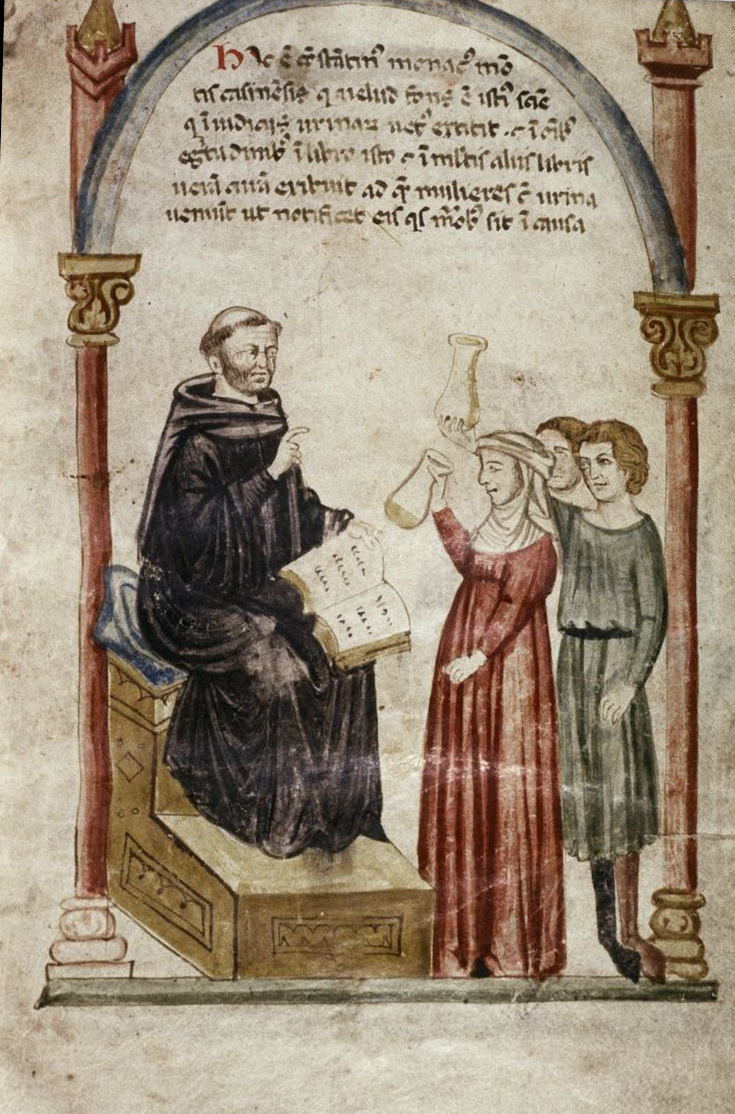
Uroscopy is the historical medical practice of visually examining a patient's urine to diagnose diseases or medical conditions. It is an ancient technique that involves the analyzing the color, odor, and sometimes composition of urine. It was widely used by physicians to assess a patient's health, with different colors or characteristics of urine thought to correspond to specific illnesses.
The first records of uroscopy as a method for determining symptoms of an illness date back to the 4th millennium BC, and became common practice in Classical Greece. After reaching medical predominance during the Byzantine Era & High Middle Ages, the practice eventually was replaced with more accurate methods during the Early Modern Period, with uroscopy being considered inadequate due to the lack of empirical evidence and higher standards of post-Renaissance medicine.
In modern medicine, visual examination of a patient's urine may provide preliminary evidence for a diagnosis, but is generally limited to conditions that specifically affect the urinary system such as urinary tract infections, kidney and bladder issues, and liver failure.
Uroscopy is derived from "Uroscopia," which originates from the Greek word "ouron" meaning "urine," and "skopeo," translating to "behold" or "examine." Records of urinalysis for uroscopy date back as far as 4000 BC, originating with Babylonian and Sumerian physicians. At the outset of the 4th century BC Greek physician Hippocrates hypothesized that urine was a "filtrate" of the four humors, and limited the possible diagnoses resulting from this method to issues dealing with the bladder, kidneys, and urethra. This theory was born from the notion that urine was the liquid residue which moved the humors through the body, and once it had, the urine would exit through the bladder. This implied that because the urine contained a mixture of all four humors, a physician could examine it to accurately decipher the combination of those humors in the body. Another Greek physician, Galen, then refined the idea down to urine being a filtrate of only blood, and not of black bile, yellow bile, or phlegm. Therefore, the development and rapid propagation of uroscopy as the primary procedure for diagnosis hinged on the idea that disease was a result of a humoral imbalance.
From the 4th-7th centuries, several authors including Oreibasios, Aetios of Amida, Magnus of Emesa, and Paulus Aegineta, began teaching the practice of uroscopy. However, it soon became evident that a treatise including all of the basic information about the method was necessary. Byzantine medicine built on these ideas. Since it was rooted in Greco-Roman antiquity, the application and study of uroscopy continued – eventually becoming the primary form of ailment diagnosis.
Byzantine physicians created some of the foundational codifications of uroscopy, with the most well-known example being a 7th-century guide on uroscopic methods, and the first text solely dedicated to the study of urine: Theophilus Protospatharius's De Urines. This work became widely popular and accelerated the rate at which uroscopy spread throughout the Mediterranean. Other notable sources on the practice included Gilles de Corbeil’s Carmen de Urinis and Isaac Israeli ben Solomon’s Liber Urinarum (originally Kitāb al-Bawl). The latter begins with a theory of digestion and explains how changes in urine reflect internal bodily processes. It also includes guidelines for collecting and interpreting urine samples in clinical diagnosis. These works were especially successful due to their engagement with the Articella, a collection of treatises that established a foundation for medical teaching from the 12th -16th centuries. Over time, these Byzantine works inspired further interpretation by other prominent culture's scholars (like Isaac Israeli's urine-hue classification chart), though greater propagation led to a widened application of uroscopy and eventually uroscopic diagnoses of non-urinary related diseases and infections became standard.
Pivotal in the spread of uroscopy, Constantine the African's Latin translations of Byzantine and Arab texts inspired a surge in uroscopic interest specifically in Western Europe throughout the High Middle Ages. However, from about 1375 onward, the translation of uroscopic texts from Latin into English ushered in a time in which anyone could access uroscopic knowledge. This is significant, because at a time when demand for this procedure was unprecedented and constantly growing, the public turned to less qualified physicians in lieu of using university-trained practitioners (both rare and expensive).
For instance, in mid 15th century Essex, a man named John Crophill worked as both a bailiff and a healer. He was most likely self-taught and certainly not university-trained; however, he wrote books, which included two texts on urine, that were accessible to the general public, rather than the educated few.
Hub AI
Uroscopy AI simulator
(@Uroscopy_simulator)
Uroscopy
Uroscopy is the historical medical practice of visually examining a patient's urine to diagnose diseases or medical conditions. It is an ancient technique that involves the analyzing the color, odor, and sometimes composition of urine. It was widely used by physicians to assess a patient's health, with different colors or characteristics of urine thought to correspond to specific illnesses.
The first records of uroscopy as a method for determining symptoms of an illness date back to the 4th millennium BC, and became common practice in Classical Greece. After reaching medical predominance during the Byzantine Era & High Middle Ages, the practice eventually was replaced with more accurate methods during the Early Modern Period, with uroscopy being considered inadequate due to the lack of empirical evidence and higher standards of post-Renaissance medicine.
In modern medicine, visual examination of a patient's urine may provide preliminary evidence for a diagnosis, but is generally limited to conditions that specifically affect the urinary system such as urinary tract infections, kidney and bladder issues, and liver failure.
Uroscopy is derived from "Uroscopia," which originates from the Greek word "ouron" meaning "urine," and "skopeo," translating to "behold" or "examine." Records of urinalysis for uroscopy date back as far as 4000 BC, originating with Babylonian and Sumerian physicians. At the outset of the 4th century BC Greek physician Hippocrates hypothesized that urine was a "filtrate" of the four humors, and limited the possible diagnoses resulting from this method to issues dealing with the bladder, kidneys, and urethra. This theory was born from the notion that urine was the liquid residue which moved the humors through the body, and once it had, the urine would exit through the bladder. This implied that because the urine contained a mixture of all four humors, a physician could examine it to accurately decipher the combination of those humors in the body. Another Greek physician, Galen, then refined the idea down to urine being a filtrate of only blood, and not of black bile, yellow bile, or phlegm. Therefore, the development and rapid propagation of uroscopy as the primary procedure for diagnosis hinged on the idea that disease was a result of a humoral imbalance.
From the 4th-7th centuries, several authors including Oreibasios, Aetios of Amida, Magnus of Emesa, and Paulus Aegineta, began teaching the practice of uroscopy. However, it soon became evident that a treatise including all of the basic information about the method was necessary. Byzantine medicine built on these ideas. Since it was rooted in Greco-Roman antiquity, the application and study of uroscopy continued – eventually becoming the primary form of ailment diagnosis.
Byzantine physicians created some of the foundational codifications of uroscopy, with the most well-known example being a 7th-century guide on uroscopic methods, and the first text solely dedicated to the study of urine: Theophilus Protospatharius's De Urines. This work became widely popular and accelerated the rate at which uroscopy spread throughout the Mediterranean. Other notable sources on the practice included Gilles de Corbeil’s Carmen de Urinis and Isaac Israeli ben Solomon’s Liber Urinarum (originally Kitāb al-Bawl). The latter begins with a theory of digestion and explains how changes in urine reflect internal bodily processes. It also includes guidelines for collecting and interpreting urine samples in clinical diagnosis. These works were especially successful due to their engagement with the Articella, a collection of treatises that established a foundation for medical teaching from the 12th -16th centuries. Over time, these Byzantine works inspired further interpretation by other prominent culture's scholars (like Isaac Israeli's urine-hue classification chart), though greater propagation led to a widened application of uroscopy and eventually uroscopic diagnoses of non-urinary related diseases and infections became standard.
Pivotal in the spread of uroscopy, Constantine the African's Latin translations of Byzantine and Arab texts inspired a surge in uroscopic interest specifically in Western Europe throughout the High Middle Ages. However, from about 1375 onward, the translation of uroscopic texts from Latin into English ushered in a time in which anyone could access uroscopic knowledge. This is significant, because at a time when demand for this procedure was unprecedented and constantly growing, the public turned to less qualified physicians in lieu of using university-trained practitioners (both rare and expensive).
For instance, in mid 15th century Essex, a man named John Crophill worked as both a bailiff and a healer. He was most likely self-taught and certainly not university-trained; however, he wrote books, which included two texts on urine, that were accessible to the general public, rather than the educated few.
Recent media