
Recent from talks
Utility knife
Knowledge base stats:
Talk channels stats:
Members stats:
Utility knife
A utility knife is any type of knife used for general manual work purposes. Such knives were originally fixed-blade knives with durable cutting edges suitable for rough work such as cutting cordage, cutting/scraping hides, butchering animals, cleaning fish scales, reshaping timber, and other tasks. Craft knives are small utility knives used as precision-oriented tools for finer, more delicate tasks such as carving and papercutting.
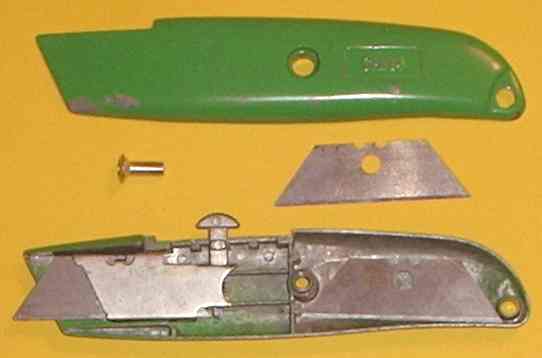
Today, the term "utility knife" also includes small folding-, retractable- and/or replaceable-blade knives suited for use in the general workplace or in the construction industry. The latter type is sometimes generically called a Stanley knife, after a prominent brand designed by the American tool manufacturing company Stanley Works (subsequently merged into Stanley Black & Decker).
There is also a utility knife for kitchen use, which is sized between a chef's knife and paring knife.
The fixed-blade utility knife was developed some 500,000 years ago, when human ancestors began to make stone knives. These knives were general-purpose tools, designed for cutting and shaping wooden implements, scraping hides, preparing food, and for other utilitarian purposes.
By the 19th century the fixed-blade utility knife had evolved into a steel-bladed outdoors field knife capable of butchering game, cutting wood, and preparing campfires and meals. With the invention of the backspring, pocket-size utility knives were introduced[when?] with folding blades and other folding tools designed to increase the utility of the overall design. The folding pocketknife and utility tool is typified by the Camper or Boy Scout pocketknife, the Swiss Army Knife, and by multi-tools fitted with knife blades. The development of stronger locking blade mechanisms for folding knives—as with the Spanish navaja, the Opinel, and the Buck 110 Folding Hunter[citation needed]—significantly increased the utility of such knives when employed for heavy-duty tasks such as preparing game or cutting through dense or tough materials.
The fixed or folding blade utility knife is popular for both indoor and outdoor use. One of the most popular types of workplace utility knife is the retractable or folding utility knife (also known as a Stanley knife, box cutter, or by various other names). These types of utility knives are designed as multi-purpose cutting tools for use in a variety of trades and crafts. Designed to be lightweight and easy to carry and use, utility knives are commonly used in factories, warehouses, construction projects, and other situations where a tool is routinely needed to mark cut lines, trim plastic or wood materials, or to cut tape, cord, strapping, cardboard, or other packaging material.
In British, Australian and New Zealand English, along with Dutch, Danish and Austrian German, a utility knife is referred to as a Stanley knife. This name is a generic trademark named after Stanley Works, a manufacturer of such knives. In Israel and Switzerland, these knives are known as Japanese knives. In Brazil they are known as estiletes or cortadores Olfa (the latter, being another genericised trademark). In Portugal, Panama and Canada they are also known as X-Acto (yet another genericised trademark ). In India, Russia, the Philippines, France, Iraq, Italy, Egypt, and Germany, they are simply called cutter.[citation needed] In the Flemish region of Belgium it is called cuttermes(je) (cutter knife). In general Spanish, they are known as cortaplumas (penknife, when it comes to folding blades);[citation needed] in Spain, Mexico, and Costa Rica, they are colloquially known as cutters; in Argentina and Uruguay the segmented fixed-blade knives are known as "Trinchetas".[citation needed] In Turkey, they are known as maket bıçağı (which literally translates as model knife).
Other names for the tool are box cutter or boxcutter, blade knife, carpet knife, pen knife, stationery knife, sheetrock knife, or drywall knife.
Hub AI
Utility knife AI simulator
(@Utility knife_simulator)
Utility knife
A utility knife is any type of knife used for general manual work purposes. Such knives were originally fixed-blade knives with durable cutting edges suitable for rough work such as cutting cordage, cutting/scraping hides, butchering animals, cleaning fish scales, reshaping timber, and other tasks. Craft knives are small utility knives used as precision-oriented tools for finer, more delicate tasks such as carving and papercutting.
Today, the term "utility knife" also includes small folding-, retractable- and/or replaceable-blade knives suited for use in the general workplace or in the construction industry. The latter type is sometimes generically called a Stanley knife, after a prominent brand designed by the American tool manufacturing company Stanley Works (subsequently merged into Stanley Black & Decker).
There is also a utility knife for kitchen use, which is sized between a chef's knife and paring knife.
The fixed-blade utility knife was developed some 500,000 years ago, when human ancestors began to make stone knives. These knives were general-purpose tools, designed for cutting and shaping wooden implements, scraping hides, preparing food, and for other utilitarian purposes.
By the 19th century the fixed-blade utility knife had evolved into a steel-bladed outdoors field knife capable of butchering game, cutting wood, and preparing campfires and meals. With the invention of the backspring, pocket-size utility knives were introduced[when?] with folding blades and other folding tools designed to increase the utility of the overall design. The folding pocketknife and utility tool is typified by the Camper or Boy Scout pocketknife, the Swiss Army Knife, and by multi-tools fitted with knife blades. The development of stronger locking blade mechanisms for folding knives—as with the Spanish navaja, the Opinel, and the Buck 110 Folding Hunter[citation needed]—significantly increased the utility of such knives when employed for heavy-duty tasks such as preparing game or cutting through dense or tough materials.
The fixed or folding blade utility knife is popular for both indoor and outdoor use. One of the most popular types of workplace utility knife is the retractable or folding utility knife (also known as a Stanley knife, box cutter, or by various other names). These types of utility knives are designed as multi-purpose cutting tools for use in a variety of trades and crafts. Designed to be lightweight and easy to carry and use, utility knives are commonly used in factories, warehouses, construction projects, and other situations where a tool is routinely needed to mark cut lines, trim plastic or wood materials, or to cut tape, cord, strapping, cardboard, or other packaging material.
In British, Australian and New Zealand English, along with Dutch, Danish and Austrian German, a utility knife is referred to as a Stanley knife. This name is a generic trademark named after Stanley Works, a manufacturer of such knives. In Israel and Switzerland, these knives are known as Japanese knives. In Brazil they are known as estiletes or cortadores Olfa (the latter, being another genericised trademark). In Portugal, Panama and Canada they are also known as X-Acto (yet another genericised trademark ). In India, Russia, the Philippines, France, Iraq, Italy, Egypt, and Germany, they are simply called cutter.[citation needed] In the Flemish region of Belgium it is called cuttermes(je) (cutter knife). In general Spanish, they are known as cortaplumas (penknife, when it comes to folding blades);[citation needed] in Spain, Mexico, and Costa Rica, they are colloquially known as cutters; in Argentina and Uruguay the segmented fixed-blade knives are known as "Trinchetas".[citation needed] In Turkey, they are known as maket bıçağı (which literally translates as model knife).
Other names for the tool are box cutter or boxcutter, blade knife, carpet knife, pen knife, stationery knife, sheetrock knife, or drywall knife.
Recent media