Hubbry Logo
NavajaNavajaMain
Open search
Navaja
Community hub
Navaja
logo
8 pages, 0 posts
0 subscribers
Be the first to start a discussion here.
Contribute something
Navaja
Navaja
from Wikipedia
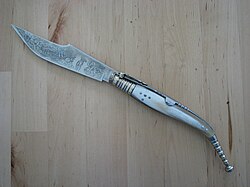
A contemporary navaja of traditional design, with a 12-inch (300 mm) blade

The navaja is a traditional Spanish folding-blade fighting and utility knife.[1]

Etymology

[edit]

The etymology of the word navaja is derived from the Latin novacula, meaning razor, and the Andalusian knife known as the navaja is thought to have derived from the navaja de afeitar, or straight razor used for shaving.

A popular slang term for the navaja in the 19th century was herramienta, which translates as "(iron) tool".[1]

In Spain, the term navaja is often used to generally describe all folding-blade knives[2][3] and epitomized the concept of a defensive knife to be carried at all times on the person.[1]

Most of the larger navajas of the early 19 centuries were clearly intended as fighting knives, and were popularly referred to as santólios, a contraction of the Spanish term for "holy oil".[1]

The name was a reference to the oils or unguents applied to the dying as part of the Catholic last sacrament, as it was believed that a man encountering such a knife in a violent confrontation would invariably require administration of the last rites.[1]

History

[edit]

While folding-blade knives existed in Spain even in pre-Roman times,[4] the earliest Spanish knives recognizable as navajas date from around the late 1600s.

One of the oldest folding knife patterns still in production, the first true navajas originated in the Andalusian region of southern Spain.[1]

Design

[edit]

The navaja used a variety of blade and handle styles over the years, with certain regions of Spain favoring distinct patterns. The classical Andalusian blade style is today popularly known as the navaja bandolera.

Many blade patterns bear a striking resemblance to that of the Bowie knife, and some historians believe the navaja's blade served as inspiration for the latter.[5] Like the straight razor, the navaja's blade folds into the handle when not in use.

The classic Andalusian navaja of the craftsman era utilized forged carbon steel blades predominantly sourced from Spanish communities with a long history of swordmaking and cutlery manufacture, such as Albacete, Santa Cruz de Mudela, and Toledo.[6]

The traditional navaja was typically fitted with a handle made of wood, horn, bone, or pierced copper or brass[7] that was reinforced with a steel or brass liner, although examples can also be found with expensive materials such inlaid silver, ivory, and even gold.

From the mid-19th century, many 'Spanish' navajas were actually imported from France; most of these imported French patterns lack a locking device for the blade. Many examples of this period were fitted with metal bolsters and butt caps for additional strength and protection; these are often carved, filed, or engraved with decorations.

Navajas with blades over 200mm (23 inches) [citation needed] were mostly oversized showpieces (navajas de muestra or navajas de exposición), and were made to display the abilities of the knifemaker, not for actual use.

Early models

[edit]

Like the navaja de afeitar, the earliest navajas worked on the principle of the simple peasant's knife, with no backspring to hold the blade in place once opened.[1]

These early navajas were primarily designed as utility or work knives, and could easily be carried either openly or concealed on one's person.

One of the more common early varieties of this type of knife was the navaja cortaplumas, used by clerical workers, draftsmen, and notaries to sharpen ink quill tips.

With the development of reliable spring steel in Spain, the navaja could be fitted with a tempered steel, externally mounted backspring, making the design much more useful.[1]

The new spring-back navaja proved very popular throughout Spain and was later exported to or manufactured in other countries as well, particularly France[8] and the island of Corsica.[9]

Improvements

[edit]
A priest executed by garotte by French forces under Napoleon for carrying a navaja

During the first part of the 18th century, the blade heel and backspring of the navaja were cleverly altered to provide a locking device for the blade.[10]

Pulling open the blade from the handle, the lock allowed the blade to rotate into the fully open position, where it locked into position.

The locking mechanism itself consisted of pinion teeth (piñones or dientes) cut into the blade heel (talón de la hoja) that are engaged by a lug attached to either the backspring or a separate spring-loaded metal latch as the knife is opened.[11] The last pinion tooth serves to keep the blade locked in its fully opened position.[11]

Around 1850, a metal pull ring was incorporated into the lock to facilitate blade closure.[11] Pulling the metal ring cammed the backspring upward, freeing the blade from its lock and allowing the blade to fold back into the handle. The pull ring was eventually discarded in favor of a low-profile metal lever.

Aside from the early navaja cortaplumas, the design is thought to have been first adopted by the working classes - mule drivers, teamsters, artisans, and sailors[1] as well as by the majos, the "gentlemen of the lower class"[12] of Andalusia.[13]

Navaja dating to c. 1790; it has a yataghan style blade, a stag-horn handle and the pull-ring for disengaging the blade-locking mechanism is clearly visible

Modern models

[edit]

The typical navaja manufactured today blends traditional styling with modern materials.

Most are smaller in blade length and overall size than the navaja carried during the classical era. The majority feature stainless steel blades, stainless metal bolsters and butt caps, and horn or wood handles.

Many different blade patterns are available, with hand-made (artesanal) versions commanding the highest prices.

While the ratcheting carraca can still be found on some knives, most examples now use a simplified locking mechanism consisting of a lug attached to the backspring that engages a single slot machined into the blade's heel.

Variants

[edit]

"Navaja de muelles"

[edit]

The ratcheting-tooth lock-blade navaja was commonly referred to as a navaja de muelles or navaja de siete muelles.

The metal-to-metal contact produces a distinctive clicking or ratcheting sound when the blade is opened, and the navaja de muelles was popularly termed the carraca in consequence.[11]

With its locking blade, the navaja de muelles was now a versatile fighting knife, able to safely deliver thrusts as well as slashes (cuts).

The navaja de muelles developed later proved sufficiently formidable as an offensive arm that it was specifically named by the Marqués de la Mina, the Spanish military governor of Catalonia, in his edict of 29 May 1750 prohibiting the carrying of armas blancas, or edged weapons.[14]

Despite official disapproval, the navaja de muelles became popular throughout Spain as a fighting and general utility knife, and was the primary personal arm of the Spanish guerrilleros who opposed Napoleon during his invasion and subsequent occupation of Spain in the Peninsular War of 1808–1814.[15]

"Navaja bandolera"

[edit]

The navaja bandolera is a variation of what is termed a "clip point" blade, a design featuring a concave unsharpened false edge near the blade tip. Compared to its slim, almost feminine handle, the exaggerated belly and recurved blade of the classical navaja is particularly large and menacing.

"Navaja sevillana"

[edit]

The large-bladed fighting navaja or santólio was eventually refined into a pattern named the navaja sevillana, after the region in which it saw much use.[1]

The navaja sevillana was a fighting knife characterized by a ratcheted locking mechanism, a long and slender blade with a prominent clip, a needle-sharp point, and a finely honed, razor-sharp cutting edge.[1]

Usage

[edit]

Civilian use

[edit]

In Spain the carrying of a navaja did not necessarily identify its owner as a criminal.[1]

During the first part of the 19th century, the navaja was carried by Spanish men—and not a few women—of all classes and backgrounds, including the upper classes, the clergy, and the aristocracy.[1]

Evidence of this rests in museum collections of ornate antique examples, all featuring a standard of costly materials and laborious craftsmanship that could only have been commissioned by the upper classes.[1]

The imposition of laws restricting the carrying of swords and other offensive weapons in Spain and in the Kingdom of Naples in southern Italy only served to increase the popularity of concealable knives such as the navaja in a culture devoted to edged weapons.[16]

Towards the end of the 19th century, use of the navaja began to decline in Spain. However, for the working classes and those living in the provinces, who were loath to give up cherished customs, the navaja remained a habitual item of personal wear for many years afterwards.[17]

Criminal world

[edit]

The rise in popularity of the navaja occurred at a time of increased restrictions upon the wearing of swords and other bladed weapons by persons outside the Spanish nobility.[18]

Its association with barateros, pícaros, jácaros and rufos (gamblers, rogues, ruffians, and thugs) comes from its frequent use as a weapon of the underworld, where it was often used to enforce the collection of gambling debts or to rob innocent victims.[1][19][20]

By 1903 the navaja had become a weapon of stealth, always concealed and "never worn or used ostentatiously."[1][17]

With the advent of mass-produced, low-priced handguns and an increasingly effective national police force, the Guardia Civil, the lock-blade navaja had become the weapon of choice of the lawless and the disreputable.[17]

While most of Spain at that time was about as safe as Victorian London, travel alone after dark was never advisable given occasional encounters with brigands and thieves.[17]

The ominous click-clack of a navaja de muelles was a sound dreaded by lone travellers attempting to negotiate lonely rural highways or the Byzantine back streets of medieval Spanish cities after dark.[17]

The knife's popularity among lawless elements in Spain is attested to in James Loriega's book Sevillian Steel.[20] Loriega writes,

Navajas crossed the hands and drew the blood of soldiers and sailors, rogues and ruffians, and diplomats and aristocrats both in and out of Spain's borders. The use of the navaja fostered a mystique, not only from Seville's back streets, but also from the seedy waterfronts of Barcelona, and the cosmopolitan promenades of Madrid. Regardless of their original intent, the navaja represented the ultimate means for resolving disagreements, misunderstandings, and problems that arose in dockside bars, darkened alleys, and an untold number of places not found in any guidebook; places where there is little reliance on legal recourses; places where you either catch a glimpse of steel and live - or miss it, and never know why you died.[20]

As collectibles

[edit]

The appeal of navaja's distinctive design and cultural symbol proved irresistible to foreign visitors to Spain.[7]

Demand for the navaja as a collectible and as a tourist's souvenir is not a new one; as early as 1858, navajas were being widely offered in street markets in novelty lengths as short as three inches and as long as three feet.[7]

As fighting knives

[edit]
Painting by the French artist Joseph Saint-Germier "La Navaja", 1888. The painting depicts a fight to the death using specific Spanish Navajа knives.

The navaja was first adopted as a fighting knife by the peoples of Andalusia in southern Spain, including the Spanish Romani people of the day, the Gitanos.[1][21]

In this part of Spain, knife fighting was regularly taught as a skill, often passed down from father to son as a rite of passage to adulthood.[1][7]

Among navaja aficionados, the barateros of Málaga and Seville were cited as the most skilled practitioners of fighting with the navaja:[22]

The skill displayed by the Spanish desperado in handling his knife is wonderful. This weapon, to which all are so partial, is a wicked-looking affair, from one to two feet long, and called a navaja from its resemblance to a razor. The blade is of the finest Toledo steel...[22]

In 18th and 19th century Spain esgrimas de navaja (fencing, or knife-fighting schools) could be found in the major cities and throughout Andalusia, particularly in Cordoba, Málaga, and Seville.[1][7][21]

As time went on, these schools began to depart from teaching traditional sword-fighting and fencing techniques in favor of simplified attacks and defenses based largely on the concept of deception, distraction, and counterstrike.[18]

As one English author noted,

Defence with the navaja has been reduced to a science, which has its regular school of instruction. The teachers give lessons with wooden knives, and the most noted among them have their private strokes, which are kept secret for cases of emergency. The arts of the most accomplished swordsman are worthless, when opposed to those of an expert with the navaja. With his cloak or jacket wrapped about his left arm, his formidable weapon glittering in his right hand, and his lithe body poised for a spring, he is an interesting study for the spectator, as well as for his antagonist. The thumb is pressed tightly along the back of the blade, that every advantage may be taken of the flexibility of the wrist, in a struggle where the space of an inch is often a matter of life and death. The postures and guards are changed with bewildering rapidity, and, should the right hand be disabled, the cloak and knife are shifted in the twinkling of an eye, and the duel proceeds, until one or both the combatants are killed.[22]

The firmly established knife fighting tradition with the navaja in Andalusian Spain would later spread to other Spanish-speaking countries, from Argentina[23][24] to Puerto Rico[25] to the Philippines as part of el legado andalusí (the Andalusian legacy, or tradition).[1]

Used as a fighting knife, the navaja typically featured a blade length of 400 mm (15 inches) or longer,[1][26] and knives with 300 mm (12-inch) to 500 mm (19-inch) blades were common.[26]

During the 18th and most of the 19th century, large navajas were traditionally worn pushed into a belt or sash, with the distinctively curved, fish-shaped handle left exposed to ease removal.

An exception to the predominance of large-bladed sevillanas was the salvavirgo ("chastity knife"), a small knife carried by Andalusian women in a bodice or leg garter as a weapon of self-defense.[20]

After more than two centuries of popular and continuous use, demand for the navaja as a large fighting or utility knife began to ebb in the early 20th century.

Reduced in size and length (navaja corta), the design still enjoys some popularity as a pocketknife and utility blade, and both mass-produced and individually hand-built knives of varying craftsmanship and material quality continue to be sold in Spain, primarily to tourists, collectors, and edged weapon enthusiasts.

The decline in popularity of the large fighting navaja sevillana may have been accelerated by the passage of stringent laws in Spain and in the rest of the European Union proscribing the possession and/or carrying of armas blancas.[27]

See also

[edit]

Citations

[edit]
  1. ^ a b c d e f g h i j k l m n o p q r s t u de Rementeria y Fica, Mariano, Manual of the Baratero (transl. and annot. by James Loriega), Boulder, CO: Paladin Press, ISBN 978-1-58160-471-9 (2005)
  2. ^ Cuyás, Arturo (ed.), Appletons' New Spanish-English and English-Spanish Dictionary, New York: D. Appleton & Co, (1912), p. 390
  3. ^ Haraty, Eileen M. (ed.), Merriam-Webster's Spanish-English Dictionary, New York: Merriam-Webster, Inc., ISBN 0-87779-165-1 (1998), pp. 190, 499
  4. ^ De Fontcuberta, Eduardo A., Bandolero Blades Archived 2013-03-04 at the Wayback Machine, Tactical-Life.com, Tactical Knives (September 2010), retrieved 13 August 2011
  5. ^ Price, Ransom, Navaja: Bowie's Spanish Ancestor, retrieved 30 July 2011
  6. ^ de Rementeria y Fica, Manual of the Baratero, p. 2: "Their sharp edges are such that they are greatly admired for neither breaking nor bending after having pierced two solid peso coins or a board two inches thick."
  7. ^ a b c d e Gautier, Théophile, A Romantic in Spain, (orig. publ. as Voyage en Espagne, Charpentier, 1858) Interlink Books, ISBN 1-56656-392-5 (2001), p. 158
  8. ^ 19th century Corsican Navaja, retrieved 22 August 2011
  9. ^ Mañé y Flaquer, Juan, Historia del Bandolerismo y de la Camorra en la Italia Meridional, Barcelona: Salvador Manero (1864), pp. 540-541
  10. ^ Shackleford, Steve, Blade's Guide to Knives & Their Values, Iola, WI: Krause Publications, ISBN 1-4402-0387-3, ISBN 978-1-4402-0387-9 (2009), p. 297
  11. ^ a b c d Albacete Artesanía - Navajas, retrieved 11 August 2011
  12. ^ Mérimée, Prosper, Letters from Spain No. III: An Execution, Dublin, EI: William Curry, Jun. & Co., Dublin University Magazine, Vol. IV, (1834), p. 184
  13. ^ Gautier, Théophile, A Romantic in Spain, (orig. publ. as Voyage en Espagne, Charpentier, 1858) Interlink Books, ISBN 1-56656-392-5 (2001), p. 172
  14. ^ Vicente Algueró, Felipe J. de, El Marqués de la Mina: de militar profesional a Ilustrado Periférico, Primer Congrés d'Història Moderna de Catalunya, Vol. 2, Barcelona: Universidad de Barcelona, Departament d'Història Moderna, ISBN 84-7528-154-0 (1984), p. 97
  15. ^ Rodríguez-Solís, Enrique, Los Guerrilleros de 1808: Historia Popular de la Guerra de la Independencia (2nd ed.), Barcelona: La Enciclopedia Democrática (1895), p. 209
  16. ^ Mañé y Flaquer, Juan, Historia del Bandolerismo y de la Camorra en la Italia Meridional, Barcelona: Salvador Manero (1864), pp. 540-541: "In Naples as well as in Spain the masses always prostrated themselves in admiration before the supremacy of the ignoble and treacherous navaja, not only as the result of arms control laws imposed on the people, but also due to an aversion to the use of other weapons they viewed as the effeminate custom of other peoples."
  17. ^ a b c d e Gallichan, Walter M., The Story of Seville, London: J.M. Dent & Co., pp. 214-218
  18. ^ a b Castle, Egerton, Schools and Masters of Fence: from the Middle Ages to the Eighteenth Century, London: George Bell & Sons (1885), pp. 8, 174
  19. ^ Scott, Samuel P., Through Spain: A Narrative of Travel and Adventure in the Peninsula, Philadelphia, PA: J. B. Lippincott & Co. (1886), pp. 130-132
  20. ^ a b c d Loriega, James, Sevillian Steel: The Traditional Knife-Fighting Arts Of Spain, Boulder, CO: Paladin Press, ISBN 1-58160-039-9 (1999)
  21. ^ a b Davillier, Jean Charles, Spain, London: Scribner, Welford and Armstrong Ltd. (1876)
  22. ^ a b c Scott, Samuel P., Through Spain: A Narrative of Travel and Adventure in the Peninsula, Philadelphia, PA: J. B. Lippincott & Co. (1886), pp. 131-134
  23. ^ Gautier, Théophile, A Romantic in Spain, p. 158: "The navaja is the Spaniards' favourite weapon...they wield it with incredible dexterity, making a shield of their cloak, which they roll round the left arm."
  24. ^ de Rementeria y Fica, Manual of the Baratero, pp 5-6, 9, 12: The esgrima de criolla ("Creole fencing school") method of knife fighting employed by the gaucho and his facón in Argentina, Brazil, and Uruguay, using clothing to protect the weaponless arm, is derived directly from el legado andalusí or el legado Andaluz (the Andalusian legacy or tradition).
  25. ^ Loriega, James, Manual of the Baratero: The Art of Handling the Navaja, the Knife, and the Scissors of the Gypsies, Paladin Press, ISBN 1581604718, 9781581604719 (2005), pp. ix, 5
  26. ^ a b Peterson, Harold L., Daggers and Fighting Knives of the Western World, Mineola, NY: Dover Publications, ISBN 0-486-41743-3 (2001), p. 68
  27. ^ Reglamentación española de armas, retrieved 31 July 2011

General and cited references

[edit]
Revisions and contributorsEdit on WikipediaRead on Wikipedia
from Grokipedia
The navaja is a traditional Spanish folding knife that originated in the Andalusian region of southern , featuring a long, slender clip-point typically measuring 15 to 25 centimeters, a curved handle often crafted from wood or animal horn, and a distinctive lock mechanism that allows incremental blade deployment with audible clicks. Developed as one of the earliest patterns of locking knives in the late amid restrictions on carrying larger weapons like swords by commoners, the navaja served dual purposes as a practical utility tool for peasants and a concealed weapon for and personal . Its design evolved from friction folders without locks to incorporate the ratchet by the , enhancing safety and control during use, and it became emblematic of Spanish knife-making craftsmanship, particularly in centers like . The navaja gained notoriety in the 19th century for its association with duels, street fights, and regional , fostering a body of lore around knife-fighting techniques such as juego de navaja, though empirical accounts of its tactical efficacy remain tied to anecdotal historical records rather than systematic study. Despite regulatory bans in during the early 20th century, the navaja persists in modern production and collector circles, valued for its historical authenticity and mechanical ingenuity, with replicas and originals prized in and edged-tool communities worldwide.

Origins

Etymology

The term navaja derives from the Latin novācula, denoting a or small shaving , as attested in classical sources describing tools for and minor cutting tasks. In the transition to within the , novācula underwent phonetic simplification to forms like navacula, eventually yielding navaja in by the medieval period, where it retained connotations of a sharp, portable blade. This linguistic evolution marked a semantic shift from straight-edged razors—common in Roman and early medieval grooming practices—to concealable folding implements, reflecting adaptations in tools amid regional Iberian customs. By the , Andalusian dialect records in trade inventories and legal texts employed navaja to specify such hinged blades, distinguishing them from fixed daggers or non-folding cutters in artisanal and mercantile contexts.

Historical Emergence

The navaja emerged in during the early as a concealable folding , serving as a practical alternative to larger bladed weapons amid royal edicts restricting and carry among commoners to maintain public order. These restrictions, enforced variably from the late onward, prohibited peasants and urban laborers from bearing offensive arms openly, pushing demand toward compact, pocket-sized tools that could evade scrutiny while providing utility and defense. Originating primarily in , the navaja reflected adaptations by craftsmen in regions like and , where local forges produced simple slipjoint folders with single-edged blades suited for everyday tasks and personal protection. Socio-economic pressures in amplified the navaja's adoption, as rural bandolerismo—organized banditry plaguing highways and countrysides—and urban impoverishment from heightened risks of robbery and violence for travelers and laborers. Affordable to produce from basic and horn or , the navaja filled a niche for among those unable to afford or legally possess swords, evolving from earlier razor-like folders into a versatile implement. Its concealability aligned with the era's class-based weapon controls, allowing commoners to maintain some measure of security without direct defiance of authority. Archaeological evidence confirms the navaja's presence by the early 17th century, with multiple examples recovered from the 1622 Nuestra Señora de Atocha and Santa Margarita galleon wrecks off Florida, indicating widespread maritime use predating industrialized production. These artifacts feature basic folding mechanisms and blades around 6-8 inches, underscoring the knife's role in shipboard life among sailors and passengers from diverse Spanish regions. Such finds predate the navaja's later refinements, establishing its foundational form as a response to both legal constraints and practical needs in a turbulent period.

Historical Development

Pre-19th Century Evolution

The navaja developed in 17th-century amid legal restrictions on edged weapons for commoners, transitioning from rudimentary folding to more structured utility tools. These early forms consisted of simple folders with blades secured open primarily through user grip on the tang, minimizing mechanical parts to enhance durability for everyday agrarian and artisanal tasks. By the 18th century, production in Andalusian centers such as and incorporated refinements from regional traditions, including curved handles crafted from wood, bone, or horn to improve during prolonged use. Blades, initially forged from , began incorporating higher-carbon steel variants, as evidenced by metallurgical analysis of period artifacts showing reduced inclusions and improved attributable to emerging in refined ores and techniques. Surviving specimens circa 1790 illustrate the introduction of basic spring mechanisms for retention, enabling manual opening via nail nicks or thumb pressure while favoring robust, low-failure designs over intricate automatics; this approach ensured consistent performance in variable conditions like moisture or dirt encountered in fieldwork, where unintended closure posed greater risk than deployment speed.

19th Century Peak and Decline

In the mid-19th century, the navaja emerged as a defining implement of Spanish vernacular combat and utility, particularly among rural and working-class populations in Andalusia, where it symbolized dexterity and self-reliance. Known wielders, termed navajeros, employed the knife in duels and skirmishes, often wrapping a cloak around the left arm for defense while executing precise slashes and thrusts. This era saw formalized instruction through manuals like the Manual del Baratero, attributed to Francisco García de la Peña around the 1840s, which detailed gypsy-influenced techniques for manipulating the navaja alongside smaller blades and shears. Stylized baratero knife fighting reached a notable tradition in Seville, underscoring the navaja's role beyond mere utility into ritualized conflict resolution. Artisanal hubs like produced increasingly refined models with ratcheting locks and ornate bolsters, fostering exports that highlighted Spanish metalworking prowess amid growing European demand for folding knives. Yet contemporary accounts, such as those by British traveler , portrayed the navaja as the "favorite weapon of the Spaniards," especially peasants, who wielded it with "incredible dexterity" in countryside affrays—observations reflecting its practical prevalence rather than glorified inevitability. The navaja's preeminence began eroding after the , coinciding with Bourbon restoration efforts to centralize policing and suppress , which curtailed rural lawlessness where knives thrived. Industrialization drew populations to cities, diminishing agrarian tool dependencies, while cheaper revolvers and rifles—proliferating post-Crimean War influences—rendered edged weapons secondary in escalating disputes. By century's end, official responses intensified; knife fighting's ubiquity prompted regulatory crackdowns, signaling reduced everyday reliance. Romanticized literary depictions often amplified the navaja's association with Andalusian as a cultural hallmark, yet such portrayals symptomized underlying frailties more than propelled them, with patterns and armament shifts evidencing pragmatic over moral panics. Artisan exports endured as a , preserving the navaja's legacy in craftsmanship amid its combative fade.

Design and Features

Blade and Opening Mechanism

The navaja's features a single-edged clip-point profile, designed for both piercing and slicing tasks, with lengths typically ranging from 3 to 6 inches in historical specimens to balance portability and utility. Forged from high-carbon steel and differentially hardened, the maintains edge retention suitable for repeated cutting in agrarian and artisanal applications, as evidenced by preserved examples from the 18th and 19th centuries. Deployment relies on a manual mechanism, where notches along the blade's tang sequentially engage a spring-loaded pawl or pin within the handle's frame, generating characteristic clicking sounds during progressive opening. This system enables rapid one-handed extension through a snap, overcoming detents without reliance on external actuators, as demonstrated in operational analyses of models. Unlike modern automatic knives, the navaja's design eschews compressed springs for blade ejection, instead using user-generated momentum amplified by the ratchet's incremental resistance, which early non-locking variants lacked entirely. Subsequent iterations incorporated a primary locking notch alongside the ratchet for blade stabilization when fully extended, preventing inadvertent closure under lateral stress while preserving the mechanism's simplicity for field reliability. The tensioned pin's robust construction, often or , resisted jamming from environmental contaminants like dust or residue, a causal advantage in the rural contexts of origin where prioritized durability over complexity.

Handle Construction and Materials

Navaja handles were constructed with curved scales contoured to provide an ergonomic, pistol-like grip that enhanced control and comfort for prolonged handling. These scales were typically fashioned from natural materials such as bovine horn, including varieties, or , chosen for their availability, workability, and aesthetic appeal in Spanish craftsmanship traditions. To reinforce structural integrity and balance, handles often incorporated or iron bolsters at the end and a matching pommel at the butt, preventing scale separation under stress while distributing weight evenly for better maneuverability. Internal or liners further supported the organic scales, allowing for a slim profile conducive to carry. Surviving 18th- and 19th-century specimens demonstrate builds, with many examples weighing between 50 and 150 grams, enabling all-day utility without encumbrance. Regional variations emphasized portability and grip security, such as denser woods in Mediterranean areas for resilience against environmental wear, while horn scales offered a smoother, more contoured fit prized in Andalusian models for finesse-oriented tasks. Metal components frequently bore intricate engravings or piercings, signaling owner status through artisanal detail rather than mere functionality. However, organic materials like horn and proved prone to cracking under lateral impacts, limiting in high-force applications despite their prevalence.

Early Models and Iterative Improvements

The earliest navajas, dating to the early , were rudimentary folding knives recovered from Spanish galleon wrecks such as those from the 1622 fleet, featuring simple blade mechanisms suited for shipboard utility and basic without advanced locking features. These initial models relied on basic slip-joint designs, where spring tension alone held the in place, prone to accidental closure during use by sailors and laborers. By the late , refinements introduced a notched backspring system for incremental locking, allowing the to secure at multiple positions via engagement with tang notches, alongside a metal pull ring for controlled deployment, enhancing reliability for everyday handling. Further iterative improvements in the early focused on and , including the addition of metal ferrules or bolsters at the handle ends to reinforce pivot connections and prevent slippage under stress, as seen in surviving examples lacking such features in earlier variants. Forges in , a key production hub, incorporated these enhancements, often marked by guild stamps indicating standardized amid rising demand from working-class users like agricultural workers and combatants, whose practical feedback—prioritizing robust, concealable tools over ornamental designs—drove adaptations rather than centralized elite directives. In the mid-, backsprings received additional retaining rings to maintain tension and facilitate smoother folding, reducing wear and improving one-handed operation for field use. These evolutions reflected empirical responses to real-world stresses, such as impacts from labor or skirmishes, yielding progressively safer mechanisms without overcomplicating the core slip-joint heritage.

Variants

The navaja de muelles represents a mechanically advanced variant of the traditional Spanish folding knife, characterized by an internal backspring system that provides assisted opening and secure locking of the . This emerged in the late , incorporating a robust spring mechanism—often a single heavy backspring rather than multiple independent ones—to tension the against the scales, allowing for partial assistance in deployment without fully action. The addition of a metal pull ring around this period facilitated one-handed release of the lock, enhancing usability in confined urban environments where the navaja was commonly carried. Distinguished by its heavier construction compared to non-spring models, the navaja de muelles prioritized durability and reliability, with reinforced handle frames and thicker springs to withstand repeated stress from daily pocket carry and incidental impacts. Artifacts from this era, such as specimens dated circa 1820, exhibit these features in collections associated with Andalusian craftsmanship hubs like , where the variant gained traction among city dwellers for its balance of compactness and mechanical assurance. The spring's V-notched integration by the further refined one-handed operation, bending to disengage the lock while maintaining tension for snap-open action. Historically niche within the broader navaja tradition, the de muelles subtype appealed to 19th-century urban users in for its expedited blade access, a practical edge over purely manual folders in scenarios demanding swift readiness, as noted in period descriptions of its formidable deployment speed. However, the added mechanical complexity introduced potential vulnerabilities, with empirical observations from collectors highlighting occasional jamming risks from spring fatigue or debris accumulation if not meticulously maintained, underscoring the for assisted functionality. Surviving examples from 1820–1850, often featuring ornate bolsters and etched blades, remain prized in specialized archives for illustrating this evolution toward semi-assisted portability. The navaja bandolera, also referred to as the Jerezana, emerged as a distinctive subtype of the navaja folding knife in southern , closely linked to the bandoleros—highwaymen operating in during the late 18th and 19th centuries. These outlaws, driven by economic hardship and feudal inequalities, inhabited rugged mountain regions such as the Sierra de Ronda, where central authority was weak and self-reliance was paramount. The knife's design reflected the demands of rural, often mounted, lifestyles, featuring a curved and pointed optimized for slashing and thrusting in open terrains. Blades on bandolera models typically extended up to 8 inches (20 cm) in length, larger than urban variants to accommodate versatile use in ambushes or defenses against mounted adversaries. The mechanism included a ratchet system producing a characteristic rattling "carraca" sound upon deployment, which bandoleros exploited for psychological during confrontations. Robust hilt construction, often with bolsters, enhanced durability for parrying blows in fights, a common tactic in the era's irregular skirmishes. Documented in Spanish folk ballads known as romances, the navaja bandolera symbolized the bandolero's defiance and prowess, with frequently portraying it as a tool of and vendetta in lawless enclaves. While serving legitimate utility functions like cutting rope or game in remote areas, its primary notoriety stemmed from misuse in robberies targeting travelers and officials, as evidenced by historical accounts of bandit raids peaking in the early to mid-19th century before suppression by forces like the Guardia Civil around the . This duality underscores its role in enabling persistence amid high-risk environments, though quantitative data remains scarce in period records. The Navaja Sevillana, a distinctive ornate variant of the Spanish navaja folding knife, originated in the workshops of during the , where local cutlers emphasized decorative finesse alongside basic functionality. Blades were typically shorter, measuring approximately 11-12 cm in length, and featured fine etchings or chiseled relief patterns that highlighted the artisan's skill in steel ornamentation. Handles commonly incorporated inlays of mother-of-pearl () or silver, often combined with horn or bone, creating a luxurious aesthetic emblematic of Andalusian craftsmanship pride. Produced empirically through handed-down techniques in Seville's specialized knife-making guilds, the Sevillana form blended utility with artistry, as evidenced by surviving examples from mid-century workshops featuring unique mechanisms like guitar-shaped springs in aristocratic models. These knives were exported from as high-value souvenirs amid rising 19th-century European fascination with Spanish exotica, particularly following the Peninsular War's conclusion in , which facilitated renewed and . Their decorative elements, while enhancing collectible appeal— with specimens fetching significant prices at —introduced fragility risks from delicate inlays prone to cracking under stress, rendering them less ideal for rigorous compared to plainer utility variants, according to analyses of period artifacts and user-worn examples.

Other Regional Forms

In , a northern Spanish region bordering , navaja variants adapted local folding knife traditions, featuring lanceolate-shaped blades—tapering to a point like a —and handles reinforced with bolsters alongside , wood, or horn scales for enhanced durability in everyday tasks. These "navajas catalanas" or "gavinet" types emphasize compact, ambidextrous designs with manual locking mechanisms, measuring around 7-8 inches overall, suited to regional practices such as light utility work rather than extended combat. Basque adaptations, while sharing the navaja's folding heritage, prioritize robust functionality for and , with sturdier handles and potentially subtler blade curvatures to facilitate tasks like gutting or rope-cutting in rugged terrain. like Aitor exemplify this, producing reinforced models that diverge from southern elongation toward northern practicality, though historical records note fewer fighting-oriented examples compared to Andalusian forms. Northern Spanish navajas often incorporated shorter blades, typically under 11 cm, aligning with possession laws permitting such folding knives without automatic features for non-prohibited carry, a pragmatic response to uniform regulations rather than southern extravagance. These modifications underscore organic regional evolution driven by utility and compliance, evidencing decentralized artisan responses over imposed standardization.

Practical Applications

Civilian and Utility Use

The navaja functioned primarily as a versatile among Spanish peasants and rural workers, particularly in during the 18th and 19th centuries. Its folding mechanism and sturdy construction made it suitable for everyday agrarian tasks, including cutting to secure loads or bind crops, slicing and cheese for field meals, and performing minor leatherwork such as repairing harnesses or trimming hides. This design emphasized portability, allowing laborers to carry the tool discreetly in clothing without encumbrance, thereby supporting personal autonomy in remote farming activities where fixed blades proved impractical. Historical records indicate the navaja's integration into household and farm routines as a multi-purpose implement, distinct from specialized agricultural tools like sickles. For instance, variants with curved blades akin to the tranchete facilitated pruning vines or harvesting grapes, reflecting adaptations for regional viticulture prevalent in southern Spain by the 19th century. Archaeological evidence from shipwrecks, such as sheaths associated with 16th- to 17th-century navajas, supports its role in practical cutting of lines and materials, a function that extended to land-based labor. Spanish authorities viewed it as a domestic tool rather than a prohibited arm, permitting open carry among civilians due to its low incidence of misuse in non-violent contexts. The navaja's ergonomic features, including a secure lock and ergonomic handle, favored broad utility over narrow specialization, enabling efficient one-handed operation for tasks requiring precision slicing or prying. This countered perceptions of it solely as a combative instrument, as its prevalence in inventories of peasant effects underscores routine tool status amid agrarian economies reliant on manual labor.

Self-Defense and Combat Techniques

The Manual del Baratero, an anonymous 1849 treatise published in Madrid, provides the primary historical documentation of navaja self-defense techniques, outlining systematic instruction for wielding the folding knife in personal combat. The manual divides training into characteristics of the weapon, basic handling, offensive strikes, and defensive maneuvers, emphasizing a forward grip akin to sword esgrima with adaptations for the navaja's compact form. Techniques prioritize fluid footwork—such as circular steps and weight shifts—to maintain distance in confined spaces, alongside rapid blade deployment via the notched opener for one-handed activation. Strikes focus on slashes to extremities and torso to induce hemorrhage from arterial damage, rather than deep thrusts that risk blade entrapment or overextension; this approach leverages the navaja's 6- to 12-inch blade for efficient blood loss incapacitation without committing the user's balance. In close-quarters scenarios, such as urban alleys or tavern brawls common in 19th-century , the navaja's concealability and quick snap-open mechanism conferred tactical advantages over longer blades like swords or bayonets, which proved unwieldy in grapples or crowds. Historical accounts, including an eyewitness description of Spanish knife fencing, highlight its in duels among civilians, where practitioners used cloaks or jackets as improvised shields to deflect incoming attacks while countering with evasive slashes. Dedicated schools, or "academias de navaja," taught these methods with wooden replicas to minimize training injuries, underscoring the weapon's role in empowering lower-class individuals against superior-armed adversaries like mounted constables or bandits. However, the navaja's combat utility hinged critically on user proficiency; the Manual del Baratero stresses repetitive drills for hand-to-hand passes and parries, warning that novices faced severe disadvantages due to the weapon's short reach and reliance on precise timing. Unskilled wielders often sustained deep lacerations or punctures, as the absence of crossguards exposed hands to enemy blades during clashes, a vulnerability mitigated only through ingrained from formal instruction. This skill dependency limited its democratizing potential, as access to expert tutors—typically in Andalusian or academies—remained uneven, rendering the navaja a double-edged tool for self-protection.

Criminal Associations and Misuse

In 19th-century , the navaja became linked to interpersonal among the working classes, particularly through its use by barateros extortionists who wielded the knife to intimidate and debtors in casinos and taverns. These individuals exploited disputes over card games or bets, employing the navaja's sharp, fish-shaped blade for precise, often fatal strikes to the abdomen, as documented by British traveler Henry George O'Shea in his 1889 observations of Andalusian gambling dens. Similarly, American writer Samuel Parsons Scott reported in 1886 on the barateros' proficiency in navaja techniques, derived from informal training in rural areas, which enabled them to enforce with minimal resistance in under-policed locales. Such misuse frequently arose in contexts of economic , where weak state authority left individuals reliant on personal armament for resolving conflicts or securing meager gains. The navaja's role extended to spontaneous brawls and duels among commoners, supplanting restricted swords as the accessible weapon for settling honor disputes or bar fights, with blades often inscribed with threats like "Where I touch all is finished" to amplify . Italian traveler noted in 1880 that these encounters followed rudimentary taught by local masters, yet resulted in high lethality due to the knife's concealability and the participants' familiarity with its handling. While accounts from the era, including those by , decried the practice as barbarous, empirical patterns indicate it functioned primarily as a tool of exigency in regions plagued by and sparse governance, rather than evidencing organized criminal syndicates or inherent malevolence in the weapon. Misrepresentations framing the navaja solely as a catalyst for societal decay overlook its symptomatic emergence in environments where alternatives for protection or enforcement were absent. Contemporary viewpoints diverged on the implications: some reformers, influenced by perspectives, attributed escalating urban altercations to the navaja's ubiquity, advocating curbs as a deterrent to ; conversely, defenders among the populace viewed restrictions as endangering the vulnerable against predation in lawless districts, prioritizing causal factors like destitution over the implement itself. testimonies from Andalusian courts in the mid-1800s, as referenced in historical analyses, reveal knives like the navaja implicated in a notable share of recorded homicides from petty thefts and vendettas, yet underscore how inadequate policing amplified reliance on such arms for immediate redress. This duality highlights the navaja's dual-edged legacy in misuse, tied inexorably to structural failings rather than isolated moral failings.

Cultural and Symbolic Role

In Andalusian Folklore and Flamenco

The navaja features prominently in Andalusian folklore as a symbol of masculine honor and resilience, particularly in 19th-century narratives depicting ritualized duels among barateros (professional knife fighters) and gypsy communities, where it represented defiance against authority and personal vendettas rooted in codes of conduct. These tales, often disseminated through oral ballads and romances (traditional Spanish poetic narratives), portrayed the knife not merely as a but as an extension of the wielder's valor, countering its practical criminal connotations with romantic ideals of Andalusian . Federico García Lorca's (1928), drawing from gypsy lore in and , evoked similar motifs of fatal confrontations and fatalistic passion, embedding the navaja's archetype in literary depictions of regional strife without explicit criminal glorification. In traditions, emerging from 18th- and 19th-century gitano enclaves in , the navaja symbolizes the raw underlying cante jondo (deep song) themes of betrayal, rivalry, and existential struggle, though it rarely appears as a literal stage prop in performances, which favor elements like shawls and for rhythmic expression. Historical theater productions from the 1800s, including zarzuelas and folk reenactments in and , incorporated the navaja as a prop for bandit or duelist characters, dramatizing honor clashes to evoke audience empathy for the underclass's tenacity amid poverty and marginalization. This artistic framing elevated the knife's cultural status, transforming its image from tool of outlaws to emblem of artisanal heritage and unyielding spirit, as detailed in accounts of Sevillian knife lore. Contemporary preservation of this occurs through artisan workshops and cuchillería expositions, such as those in reviving 19th-century forging techniques, where over 40 master craftsmen annually demonstrate navaja assembly to honor regional identity against modernization's erosion. These events, attended by thousands, underscore the navaja's role in sustaining Andalusian , blending empirical craft demonstrations with sessions on historical duels to affirm its non-criminal, symbolic legacy.

As a Craftsmanship Icon and Collectible

The navaja holds significant appeal among collectors for its embodiment of Spanish artisanal mastery, with authenticated 19th-century specimens commanding premium prices in markets and . For example, a 19th-century Spanish navaja folding sold for $900 at Compendium in October 2022, exceeding its $200–$300 estimate, reflecting demand for well-preserved examples featuring traditional or horn handles and etched . Similarly, a large 19th-century navaja achieved €750 at Finarte's June 2023 of rare arms, surpassing its €500–700 estimate due to its single-edged and fuller details. These sales underscore the navaja's status as a tangible link to regional heritage, drawing enthusiasts who value its mechanical ingenuity, such as the strong spine spring and lock mechanisms. In contemporary contexts, the navaja inspires hobbyists through the revival of historic engraving techniques in centers like , Spain's historic hub. Artisans there, including those at Simón Cuchillerías, produce limited-edition replicas using methods that mimic 20th-century styles, often numbering pieces and signing them to appeal to collectors seeking authentic craftsmanship interpretations. This practice sustains interest in the navaja's decorative elements, such as floral motifs and maker stamps, verifiable through local artisan networks and forums where engravers share techniques rooted in traditional guilds. The navaja's collectibility bolsters regional economies by promoting to cutlery museums and workshops in Castile-La Mancha, where it symbolizes enduring trades. However, proliferation of fakes poses challenges, as reproductions with inconsistent markings or materials dilute market authenticity; collectors mitigate this via expert appraisals and provenance checks, as discussed in knife enthusiast communities examining for age indicators like and hardware wear. Such issues highlight the need for rigorous verification to preserve the navaja's value as a heritage icon.

Historical Restrictions in Spain

In the 17th century, Spanish edicts restricting commoners from carrying swords and large offensive weapons fostered the rise of the as a compact folding suitable for everyday utility while evading outright bans on extended blades. These measures aimed to curb armed disturbances among the lower classes during periods of political instability, though enforcement often spared and military figures who retained exemptions for status symbols and defense. By the , municipal and royal prohibitions extended to urban areas, banning the open carry of blades deemed weapons to preserve order in growing cities prone to brawls and vendettas. The navaja persisted due to its classification as a tool rather than an , allowing widespread possession among laborers and artisans, yet authorities periodically targeted oversized variants amid fears of escalation in street conflicts. Into the 19th century, amid the (1833–1876) and associated rural uprisings, decrees reinforced blade controls, prompting adaptations like the punta cortada (blunted tip) design to conform to rules curbing stabbing potential while maintaining cutting utility. Such regulations, selectively applied to non-elites, underscored state priorities for centralized authority over peripheral unrest but failed to suppress navaja proliferation, as folding mechanisms enabled discreet compliance or circumvention. Historical accounts indicate these edicts reflected class-based rather than uniform safety imperatives, with urban patrols confiscating blades from while overlooking privileged carriers.

Modern Regulations and Controversies

In , modern regulations on navajas fall under the Real Decreto 137/1993 on firearms and related regulations, as amended, which classify folding knives with blades exceeding 11 cm as prohibited arms unless used for specific professional or sporting purposes. Assisted-opening or automatic mechanisms, common in some contemporary reproductions, render navajas illegal for possession and carry outside controlled contexts, aligning with Directive 91/477/EEC on control of weapons acquisition and possession, though implementation remains national. Antiques or non-functional replicas are generally exempt from carry bans if certified as collectibles and not modified for use, but public exhibition without justification can lead to fines or confiscation. Carrying any knife, including traditional manual navajas with blades under 11 cm, is prohibited for under Article 149 of the Spanish Penal Code, which deems preventive armament illegitimate and subject to interpretation by law enforcement; justifications must demonstrate utility needs, such as rural work or , with urban carry presumptively suspect. These rules, reinforced in the 2015 4/2015 on Protection of Citizen Security, prioritize deterrence of public disturbances over individual preparedness, exempting only licensed collectors or exhibitors at events. Debates surrounding these restrictions highlight tensions between urban safety imperatives and rural practicalities, where advocates for relaxed carry in agrarian regions cite navajas' historical role in fieldwork and low documented misuse by civilians—knife-involved homicides constitute under 40% of Spain's total murders annually, with overall rates remaining below European averages at 0.6 per 1,000 inhabitants in 2023. Pro-ban positions, often advanced by municipal authorities in cities like , reference localized spikes, such as a 38% rise in knife incidents reported in early 2025, arguing that accessibility correlates with opportunistic violence despite national statistics showing no proportional surge in rural areas. Critics, including knife rights proponents and legal scholars, contend that of restrained civilian use—evidenced by police reports attributing less than 1% of overall offenses to lawful knives—undermines blanket prohibitions, which they view as driven by perceptual fears rather than causal on disarmament's efficacy in curbing aggression. jurisprudence, requiring post-hoc proportionality assessments under rulings like STS 1565/2023, further complicates reform efforts, as preemptive carry invites prosecution even in justified scenarios, fueling arguments that such policies erode personal agency without commensurate reductions in crime perpetration by non-compliant actors.

References

Add your contribution
Related Hubs
Contribute something
User Avatar
No comments yet.