Hubbry Logo
EMS VCS 3EMS VCS 3Main
Open search
EMS VCS 3
Community hub
EMS VCS 3
logo
8 pages, 0 posts
0 subscribers
Be the first to start a discussion here.
EMS VCS 3
EMS VCS 3
from Wikipedia

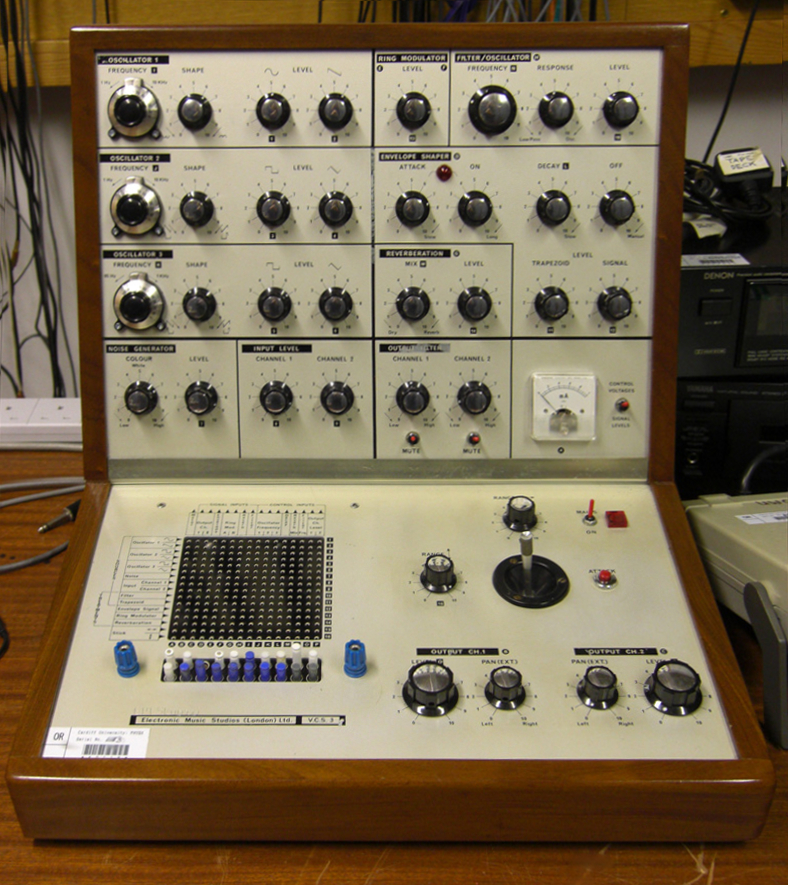
User's eye view of the "VCS 3";[# 1] top left, three main oscillators; bottom left, patch panel; bottom right, joystick. External keyboard not shown.
Note: it has printed logo: "V.C.S. 3".

The VCS 3 (or VCS3; an initialism for Voltage Controlled Studio, version #3) is a portable analogue synthesizer with a flexible modular voice architecture introduced by Electronic Music Studios (EMS) in 1969.[# 1]

EMS released the product under various names. Logos printed at the console's front left (see photos) say "V.C.S. 3" on the most widely sold version; "The Putney (VCS 3)" on the earlier version; and "The Synthi (VCS 3) II" on the later version "Synthi VCS 3 II".[# 2]

History

[edit]
VCS 3 variations
Synthi VCS 3 with logo:
"The Putney (VCS 3)"
Synthi VCS 3 II with logo:
"The Synthi (VCS 3) II"

The VCS 3 was created in 1969 by Peter Zinovieff's EMS company. The electronics were designed largely by David Cockerell, and its distinctive appearance was the work of composer Tristram Cary. It was one of the first portable commercially available synthesizers, in the sense that it was housed entirely in a small wooden case, unlike synths from American manufacturers such as Moog Music, ARP and Buchla, which had large cabinets and could take up entire rooms.

The VCS 3 cost just under £330 in 1969. Some people found it unsatisfactory as a melodic instrument due to its inherent tuning instability.[1] This arose from the instrument's reliance on the then current method of exponential conversion of voltage to oscillator frequency—an approach that other companies also implemented with fewer tuning issues. However, the VCS 3 was renowned as an extremely powerful generator of electronic effects and processor of external sounds for its cost.[according to whom?]

The first album recorded using only the VCS 3 was The Unusual Classical Synthesizer on Westminster Gold.[2]

The VCS 3 was popular among progressive rock bands, and was used on recordings by artists including Franco Battiato, The Moody Blues, The Alan Parsons Project, Jean-Michel Jarre, Todd Rundgren, Hawkwind, Curved Air, Brian Eno (with Roxy Music and as a solo artist or collaborator), King Crimson, The Who, Gong, and Pink Floyd. Two VCS 3s and a Sequencer 256 were featured in the 1978 film The Shout.[3]

The routing matrix on the VCS 3

Description

[edit]

The VCS 3 has three oscillators (the first two normal voltage-controlled oscillators; the third a low-frequency oscillator), a noise generator, two input amplifiers, a ring modulator, 24 dB/octave low-pass voltage-controlled filter,[citation needed] a trapezoid envelope generator, a joystick controller, a voltage-controlled spring reverb unit, and two voltage controlled output amplifiers. Unlike most modular synthesiser systems, which used cables to link components, the VCS 3 uses a distinctive patchboard matrix where pins are inserted to connect its components.

Keyboards controller

[edit]
DK1 keyboard controller (front)
connected to VCS 3 (rear)

Although the VCS 3 is often used for generating sound effects due to lack of a built-in keyboard, external keyboard controllers were available for melodic play. The DK1, produced in 1969, is an early velocity-sensitive monophonic keyboard for VCS 3 with an extra VCO and VCA.[# 3] In 1972 it was extended for duophonic play as DK2.[# 4] Also in 1972, the Synthi AKS was released, as well as a digital sequencer with a touch-sensitive flat keyboard, the KS sequencer,[# 5] and its mechanical keyboard version, DKS.[# 6]

[edit]

The VCS 3's basic design was reused by EMS in many other of their own products,[citation needed] most notably the EMS Synthi 100 (1971),[# 7] the Synthi A (1971),[# 8] and AKS (1972, essentially a VCS 3 in a plastic briefcase). The AKS also has a sequencer built into the keyboard's lid.[# 9]

A former agent of EMS in the United States, Ionic Industries, released a portable-keyboard VCS 3 clone in 1973. The Ionic Performer, whose circuitry is based on the VCS 3's, replaced the patchboard matrix with over 100 push-buttons, and added a built-in keyboard and effects units.[4]

Synthi A

[edit]
EMS SynthiA (top) as used on stage by a progressive rock band; underneath are an EMS DK keyboard controller, Solina String Ensemble, Optigan, and an M400 Mellotron
EMS Synthi A

The EMS Synthi A has the same electronics as the VCS 3, but was rehoused in a Spartanite briefcase. Instead of routing signals using patch cables, like Moog products, it uses a patch matrix with resistive pins. The 2700 ohm resistors soldered inside each pin vary in tolerance, indicated by different colours: red pins have 1% tolerance, white have 5%, and green pins are attenuating pins with a resistance of 68,000 ohms.

The later Synthi AKS incorporated an early digital 256 event KS (Keyboard Sequencer) sequencer in the lid, with input provided by a capacitance-sensitive Buchla-style keyboard.

Perhaps its most prominent use is in the introduction to The Alan Parsons Project's I Robot. (1977). VCS 3 synthesisers were also used alongside a traditional chamber music ensemble for the soundtrack to the BBC's Life On Earth nature documentary series, composed by Edward Williams.[5]

Along with Klaus Schulze and Tangerine Dream, other frequent users of the instrument include Cabaret Voltaire, Tim Blake & Miquette Giraudy of Gong, Richard Pinhas of Heldon, Merzbow, Thomas Lehn, Cor Fuhler and Alva Noto.

Development

[edit]

The original VCS No.1 was a hand-built rack-mount unit with two oscillators, one filter and one envelope, designed by Cockerell before the formation of EMS. When a benefactor, Don Banks, asked Zinovieff for a synthesiser, Zinovieff and Cockerell decided to work together on an instrument that was small and portable but powerful and flexible.

Notable users

[edit]

References

[edit]

Bibliography

[edit]

Further reading

[edit]
[edit]
Revisions and contributorsEdit on WikipediaRead on Wikipedia
from Grokipedia
The EMS VCS 3, commonly known as the VCS3 or , is a portable introduced by (EMS) in 1969, marking it as the first commercially available portable synthesizer on the market. It features a compact wooden case housing a modular synthesis architecture, including three voltage-controlled oscillators (VCOs), a noise generator, a self-oscillating (VCF), an envelope shaper, a ring modulator, and a voltage-controlled spring reverb, all interconnected via a distinctive 16x16 pin matrix patching system that eliminates the need for traditional patch cords. The instrument also includes a for real-time control, an integral amplifier, and built-in stereo speakers, though it lacks a keyboard in its original form, emphasizing hands-on experimentation over preset performance. Developed by EMS—a founded in 1969 by composer in , , with key contributions from engineer David Cockerell—the VCS 3 originated as an affordable tool to support Zinovieff's computer-controlled studio experiments, initially priced at around £330. Its design evolved from earlier EMS systems using multiple oscillators, prioritizing portability and accessibility for musicians and educators, and it predated more famous synthesizers like the by a year. Technically, the VCOs offer frequency ranges from 0.6 Hz to 16.7 kHz for the primary pair and 0.015 Hz to 500 Hz for the low-frequency oscillator, paired with a with a slope of 12 dB/ for the first octave and 18 dB/ thereafter that enables a wide palette of tones from subtle sweeps to aggressive distortions. The VCS 3 gained prominence in the 1970s British music scene, influencing progressive rock and electronic genres through its adoption by artists such as Pink Floyd—featured prominently in the pulsating sequences of "On the Run" from The Dark Side of the Moon—as well as The Who, Roxy Music's Brian Eno, and Tangerine Dream. Hundreds of units were sold, often to educational institutions and studios, fostering innovative sound design despite its quirks, like inconsistent tuning and manual patching demands. Production by the original EMS ceased in 1979 amid financial challenges, although small-scale production continued later under revived EMS efforts, but reconditioned models remain highly sought after, with prices often exceeding £20,000 as of 2025, and the instrument's legacy endures in modern revivals and tributes by acts including Oasis and Radiohead.

Overview

Design Philosophy

Electronic Music Studios (EMS) was founded in 1969 by Peter Zinovieff, along with engineers David Cockerell and composer Tristram Cary, with the explicit aim of developing synthesizers that could extend electronic music creation beyond the confines of academic institutions and large-scale studios. Prior to this, electronic music tools were often custom-built, expensive, and immobile, limiting access to well-funded researchers or composers; EMS sought to address this by prioritizing commercial viability and user-friendliness for a broader audience, including educators, performers, and independent artists. Central to the VCS 3's design was an emphasis on portability and affordability, distinguishing it sharply from contemporaries like the room-filling, high-cost modular systems from Moog, which could exceed several thousand pounds and require dedicated installation. The VCS 3 weighed approximately 10 kg and was priced at £330 upon release, making it feasible for individual ownership and transport to performances or classrooms without compromising core functionality. This approach reflected a commitment to democratizing synthesis, allowing musicians to experiment in diverse settings rather than being tethered to fixed equipment. The synthesizer's modular voice architecture centered on a 16x16 matrix patchboard, which enabled highly flexible signal routing by simply inserting pins to connect modules, eliminating the need for cumbersome fixed wiring or patch cables common in earlier designs. David Cockerell handled the core electronics, ensuring reliable voltage-controlled components, while Tristram Cary contributed to the musical and the instrument's distinctive wooden for durability and portability. This pin-based system fostered intuitive reconfiguration, empowering users to craft bespoke sound paths on the fly. At its philosophical core, the VCS 3 was conceived to liberate composers and performers from traditional instrumental constraints, promoting experimental and non-traditional that could yield abstract textures, sci-fi effects, and compositions outside conventional studio environments. By integrating modular flexibility into a compact form, EMS envisioned the instrument as both an educational tool for exploring electronic principles and a creative powerhouse for innovative music-making, influencing genres from to ambient experimentation.

Key Features

The EMS VCS 3 features three voltage-controlled oscillators (VCOs) as its primary sound sources, each offering distinct options and frequency ranges suitable for both audio and modulation duties. Oscillator 1 provides sine and sawtooth (impulse) waveforms, while Oscillators 2 and 3 offer and square (pulse-width modulable) waveforms; all three can be tuned across a wide range, with Oscillators 1 and 2 spanning from subsonic frequencies below 1 Hz up to approximately 10 kHz, and Oscillator 3 covering 0.025 Hz to around 500 Hz, enabling versatile tonal and control applications. Complementing the VCOs is a noise generator equipped with level and color controls, allowing selection between low-frequency emphasized (pink-like) noise for atmospheric textures and balanced or high-frequency (white) noise for percussive elements, which can be patched into the signal path for added sonic complexity. The voltage-controlled filter (VCF) is a low-pass design with an 18 dB/octave slope beyond the initial cutoff knee (where it starts at 12 dB/octave), facilitating precise tone sculpting through and adjustments, and capable of at high resonance levels to function as an additional oscillator. Modulation is handled by a envelope shaper that generates controllable and filter envelopes, featuring adjustable attack (2 ms to 1 s), hold/sustain (up to 5 s), decay (3 ms to 60 s), and release/off times (with auto-repeat up to 60 Hz), along with level controls for the envelope output and manual triggering. A ring modulator combines input signals for metallic or bell-like timbres, with simple level control, while the mixer section blends up to six audio sources (including VCOs, , external inputs, and delayed signals) into stereo outputs with independent channel levels, panning, and optional bass/treble filtering. At the heart of the VCS 3's modular flexibility is a 16x16 pin matrix patchboard, where banana-style pins of varying resistance (white for standard 2.7 kΩ connections, red for precise 2% tolerance, and green for ) are inserted to route signals between any of the 32 points (16 inputs and 16 outputs), supporting intricate and experimental modulation paths without traditional cables. A built-in X-Y provides real-time control over two parameters, such as pitch and filter cutoff, with a ±2 V range for dynamic performance expression. Additionally, four quarter-inch audio inputs (two and two ) allow external sounds to be processed through the synthesizer's modules via the patch matrix.

History and Development

Origins

, a British composer and electronic music pioneer, established a private studio in , , during the mid-1960s, where he experimented with computer-generated music using two DEC PDP-8 —one of the first instances of a home-based setup. By 1967-1968, in collaboration with engineer David Cockerell, Zinovieff developed an early precursor to the : a 60-channel analog filter and oscillator bank controlled by a , marking a significant step in voltage-controlled synthesis technology. Dissatisfied with the limitations of American synthesizers like the Moog Modular—particularly their lack of portability and alignment with British experimental needs—Zinovieff co-founded (EMS) in with Tristram Cary and Cockerell to pursue innovative, domestically developed electronic instruments. Initial prototype work on the VCS 3 began in 1968-1969. Its compact design aligned with the needs of organizations like the for portable equipment to facilitate on-location and experimentation, contrasting with the bulky studio-bound systems of the era. The VCS 3 made an early appearance at the Computer Arts Society's Event One exhibition, held on March 29-30, 1969, at the Royal College of Art in , where EMS showcased live electronic performances and related technology. Its official public launch occurred later in 1969 with a promotional event organized by PR consultant Julian Bray, featuring a Thames boat trip from Westminster to Zinovieff’s garden in for a champagne reception with the musical press. EMS's early development and demonstration were funded primarily through Zinovieff's personal resources, supplemented by initial sales to institutions such as the , which helped sustain the project amid limited commercial backing.

Production Timeline

The EMS VCS 3 was officially released in November 1969, priced at just under £330, with initial manufacturing carried out in small batches at ' facility in . This marked the synthesizer's entry into the commercial market as the world's first portable analog instrument of its kind, enabling broader accessibility beyond large studio installations. In 1973, EMS introduced the VCS 3 Mark II, which incorporated minor enhancements including a stronger for improved reliability, slightly better oscillator stability, a revised matrix layout, updated circuitry, and the addition of a Prestopatch socket allowing for basic patch memory via 16x16 plugs. Priced at £374 upon release, the Mark II represented a subtle evolution aimed at addressing early user feedback on performance consistency while maintaining the core design. Production of the VCS 3 remained limited throughout the 1970s, with EMS gradually shifting emphasis toward larger, more complex systems like the Synthi 100 by 1976 amid mounting operational challenges and a focus on custom installations for institutions. The saw to international markets, including the through specialized dealers, which facilitated its uptake among musicians seeking innovative tools. Financial pressures intensified for EMS in the late , culminating in the company's in 1979 following unpaid debts from a major European distributor and broader economic strains in the analog synthesizer sector. Despite the closure, VCS 3 units persisted in circulation via second-hand markets, sustaining interest among musicians and collectors. Following the bankruptcy, original EMS engineer Robin Wood continued providing occasional repairs and maintenance for VCS 3 and related equipment into the 1980s, supporting users from educational institutions and studios as parts remained available through legacy channels. This informal aftercare helped preserve the instrument's functionality during a period of transition in electronic .

Technical Components

Sound Generation Modules

The EMS VCS 3 features three voltage-controlled oscillators (VCOs) as its primary sound sources, with VCOs 1 and 2 capable of frequencies from below 1 Hz to over 10 kHz, while VCO 3 operates primarily in the low-frequency range from approximately 0.025 Hz to 500 Hz, suitable for modulation duties such as LFO. VCO 1 provides sine and sawtooth waveforms, while VCOs 2 and 3 provide triangle and pulse waveforms, each with shape controls allowing further variation such as to square or ramp. Synchronization is possible between the oscillators, allowing VCO 1 or 2 to hard-sync VCO 3 for complex timbres through phase-locked frequency relationships. The oscillators adhere to an EMS-specific control voltage sensitivity of approximately 0.32 V/octave for VCOs 1 and 2, and 0.26 V/octave for VCO 3. Complementing the oscillators is a noise generator providing variable spectral content, with a level control for amplitude adjustment up to 3 V peak-to-peak and a color control that continuously varies the noise from (flat spectrum) to bass-emphasized pink-like noise through low-pass filtering. This module feeds directly into the main mixer alongside the oscillator outputs, enabling percussive or atmospheric elements in the . The (VCF) is a diode ladder design functioning as a low-pass unit with a range of 5 Hz to 10 kHz, featuring a of 12 dB/ in the first octave above , steepening to 18 dB/ thereafter for a characteristic "knee" response. is adjustable via a response knob, allowing above 10 kHz when fully engaged, at which point the VCF can serve as an additional source. While primarily low-pass, the filter's interaction with the noise color control effectively permits high-frequency emphasis in signals, though dedicated high-pass functionality is absent in the core module. A balanced ring modulator, implemented with transformerless integrated circuits, processes carrier and modulator inputs to produce sum and difference frequencies, suppressing originals for metallic, bell-like, or frequency-shifted tones when balanced precisely. This module accepts signals from oscillators, noise, or external sources, enhancing the VCS 3's capacity for inharmonic spectra. The shaper is a generator producing a four-stage contour—Attack, On (sustain), Decay, and Off (release)—with the Attack time ranging from 2 ms to 1 s, On time from 0 to 2.5 s, Decay from 10 ms to 15 s, and Off from 50 ms to 10 s, plus a level control for output amplitude. This [envelope](/page/ capitalized) modulates the voltage-controlled (VCA) for amplitude shaping or serves as a control voltage for other parameters like filter , with triggering via input or manual button. Signal flow begins with two pre-amplifiers for external or line-level inputs, alongside internal sources to a four-channel mixer before treatments like the filter, ring modulator, and VCA. Post-VCA, the signal passes through a standard dual spring reverb unit and a final output with level control, delivering up to 10 V into 50 ohms for high-level outputs or 2 V into 600 ohms for line-level. This modular path allows flexible interactions, such as enveloping filtered noise or ring-modulated oscillators, defining the VCS 3's raw, experimental sonic palette.

Control Systems

The EMS VCS 3's revolves around a modular patching approach that emphasizes flexibility and user intervention for sound shaping. At its core is the pin-based patch matrix, a grid where small resistive pins are inserted at intersections to route signals, and audio between the synthesizer's modules. This design, inspired by telephone switchboards, avoids traditional patch cords and supports normalized paths for common signal flows, such as direct oscillator-to-filter connections, allowing quick setups without permanent wiring. The matrix provides 256 possible connection points in a 16x16 configuration, enabling complex modulation networks while maintaining the instrument's portable form factor. Complementing the matrix is the onboard joystick controller, which offers two-axis manual control for dynamic performance. The X-axis typically handles pitch bend, with adjustable range to produce variations from subtle glides to full shifts, while the Y-axis is often assigned to filter cutoff or waveshaping for timbral alterations. The features spring-loaded return to center and can be patched via the matrix to any parameter, providing immediate, expressive interaction during live play. Independent range controls for each axis allow customization, from precise micro-adjustments to broad sweeps. Performance-oriented controls include individual multi-turn sliders for fine-tuning the three oscillators' frequencies, a master volume fader, and an output selector switch for line or levels to accommodate various recording setups. These analog sliders offer tactile, real-time adjustments, with the oscillator controls spanning wide frequency ranges for both audio and low-frequency applications. External CV inputs on the front panel accept voltage control for all major parameters, adhering to the EMS-specific scaling of 0.32 volts per octave for oscillators 1 and 2 (0.26 V/oct for oscillator 3), which differs from the more common 1 V/oct standard and requires compatible controllers or attenuators for integration with other systems. Unlike later synthesizers, the VCS 3 has no built-in sequencer or preset memory, relying entirely on manual patching to configure and store sounds—users recreate setups by noting pin positions or photographing . This fosters experimentation but introduces limitations, including strict (single-note output only, with no polyphonic capabilities) and vulnerability to patch errors, such as accidental dislodged pins or unintended signal interactions due to unbuffered routing. These traits underscore the instrument's emphasis on performative, hands-on control over automated sequencing.

Variants and Accessories

Keyboard Controllers

The EMS VCS 3, lacking an integrated keyboard, relied on optional external controllers for melodic input, with the DK1 serving as the primary accessory introduced in 1969. This 3- (37-note) wooden keyboard featured velocity-sensitive keys that generated a monophonic control voltage (CV) at 1V/ for pitch, along with a dynamic voltage proportional to key velocity and a gate signal for triggering envelopes. It included a built-in sawtooth oscillator with controls for frequency, spread, level, and , allowing it to function as an additional sound source. The DK1 connected to the VCS 3 via an eight-way multi-pin cable that supplied power, CV, dynamic voltage, and gate, plugging into dedicated input channels on the synthesizer's panel to bypass the for more precise pitch control. Despite its innovations, the DK1 had notable limitations, including the absence of aftertouch, a modulation wheel, or polyphonic capabilities, restricting it to monophonic operation and basic expressive control through alone. Its non-standard CV scaling—such as 0.32V/octave sensitivity on certain VCS 3 inputs—often required careful adjustment for accurate tracking across the full range, and the wooden keybed could suffer from mechanical wear over time. Essential for live performances where the base VCS 3's proved inadequate for intricate melodies, the DK1 was frequently paired with the in stage setups by musicians seeking portable, hands-on control. In the early , EMS released the DK2 as an updated variant around , featuring a mechanical wooden keybed designed for improved stability and potential to independently control two oscillators. Like the DK1, it transmitted 1V/octave CV and via a similar multi-pin cable to the VCS 3's dedicated , maintaining compatibility for precise pitch input over the . However, the mode was flawed, as pressing a second key would drag down the first note's pitch, effectively limiting practical use to monophonic play in most VCS 3 configurations. The DK2 shared the same core limitations—no aftertouch or modulation wheel—and integrated seamlessly with the VCS 3's patchboard, enabling users to route keyboard CV to multiple oscillators for expanded tonal possibilities. The EMS Synthi A, introduced in 1971, served as a portable iteration of the VCS 3, housed within a compact attaché case for enhanced mobility while retaining the core modular architecture. It featured a pin matrix patching system, an integrated for performance control, and compatibility with the DK1 keyboard mounted in the case lid. Priced at approximately £198 upon release, the Synthi A targeted musicians and studios seeking a self-contained alternative to larger studio setups. Building on the Synthi A, the Synthi AKS debuted in 1972, incorporating a built-in 256-step digital sequencer for generating rhythmic patterns and a 30-note touch-sensitive directly into the design. This addition expanded its utility for live and compositional applications, with the sequencer enabling monophonic sequences up to 256 steps. Production was limited, with estimates suggesting around 30 units manufactured, reflecting EMS's focus on specialized, low-volume instruments. Retailing for about £420, the AKS became a staple for experimental artists due to its integrated portability and sequencing capabilities. The VCS 3 Mark II, released around 1973, refined the original model with a more robust for improved reliability and oscillator stability, while maintaining the identical core circuitry. It also introduced an optional spring reverb unit, enhancing sonic versatility without altering the fundamental signal path. These upgrades addressed early user complaints about power inconsistencies, though overall sales remained modest. In 1975, EMS launched the Synthi E as a desktop-oriented educational variant, simplifying the VCS 3's controls and patching for classroom use in schools and colleges. Designed with a reduced feature set—including fewer oscillators and a straightforward pin matrix—it included accompanying teaching materials to facilitate learning subtractive synthesis principles. Approximately 200 units were produced, emphasizing over professional complexity. The VCS 3 architecture influenced larger-scale systems, notably the Synthi 100 introduced in 1971, a massive comprising up to 100 interconnected modules in a room-filling frame. Featuring 12 voltage-controlled oscillators, multiple filters, and a digital sequencer, it expanded the VCS 3's modular ethos into broadcast and institutional environments, with only about 30 units built at a cost of £6,500 each. By the late 1970s, production of these analog models waned as EMS shifted toward digital technologies amid financial challenges, culminating in the company's sale in 1979.

Cultural Impact

Notable Users

of utilized the EMS VCS 3 to create the sequencer-like patterns in "On the Run" from the 1973 album The Dark Side of the Moon, employing external clocking to drive rhythmic pulses. The synthesizer's flexible patching allowed for the track's iconic, airport-announcement-inspired sequences, recorded at . Brian Eno incorporated the VCS 3 during his time with on their 1972 debut album and 1973's , manipulating sounds for textures and effects. In his solo ambient work, such as (1975), Eno extended its use through the related variant, highlighting the instrument's experimental flexibility in generating looping and generative compositions. Dave Brock of Hawkwind integrated the VCS 3 for droning space-rock elements on the 1973 live album Space Ritual, contributing to the band's psychedelic soundscapes with filtered noise and oscillating tones. The synthesizer's acid-like effects enhanced the improvisational freak-outs central to their performances. Pete Townshend of The Who employed the VCS 3 for sound effects on the 1971 album Who's Next, routing a Lowrey organ through its gated filter to produce the swirling wind-like sounds in "Baba O'Riley." This setup added atmospheric depth to the track's opening violin-like arpeggios. Jean-Michel Jarre adopted the VCS 3 as his first , employing it on early works like the 1972 soundtrack Les Granges Brûlées and 1974's Deserted Palace, where it shaped ethereal and experimental electronic motifs. Many users paired the VCS 3 with tape delays for live , creating echoing, evolving soundscapes that amplified its pin-matrix patching for real-time modulation. This combination was particularly valued in studio setups for generating infinite, feedback-driven drones without traditional sequencing.

Musical Influence

The EMS VCS 3 pioneered portable synthesis by introducing the world's first commercially available portable in 1969, enabling musicians to perform electronic sounds live on stage without the need for bulky studio equipment. This portability revolutionized live electronic performances, particularly influencing and bands in the , where it facilitated improvisational and experimental sonic explorations during concerts. The synthesizer's innovative pin-based patchboard system encouraged unconventional , allowing users to create abstract timbres and complex textures through flexible routing that bypassed traditional keyboard control. This approach significantly impacted ambient and genres, as seen in Brian Eno's adoption of the VCS 3 to develop for generative composition, emphasizing chance and unpredictability in electronic soundscapes. Intended initially for educational purposes, the VCS 3 was adopted in universities and workshops across the during the , making modular synthesis accessible to students and educators beyond professional elites and fostering a new generation of electronic composers. Its relatively affordable of around £300 democratized advanced synthesis techniques, promoting hands-on experimentation in academic settings. The VCS 3 appeared in notable media productions, including creations for radio dramas and sound effects in the , where it generated otherworldly tones for shows like . Its technical legacy extended to inspiring subtractive synthesis workflows in subsequent instruments, such as the , by demonstrating compact, voltage-controlled modulation in a user-friendly format that influenced semi-modular designs. By boosting the scene, the VCS 3 positioned EMS as a key European competitor to American brands like Moog and ARP, encouraging a vibrant domestic market and inspiring DIY modifications among users to expand its capabilities with custom filters and oscillators. This fostered innovation in the British electronic music community, contributing to the growth of independent synth builders and experimental circuits in the .

Modern Legacy

Hardware Restorations and Clones

Restoration of original EMS VCS 3 units involves addressing age-related degradation, such as failure due to drying out over decades and sticky potentiometers from dust accumulation and oxidized contacts. These issues can lead to intermittent signal noise, unstable voltages, and complete power loss, requiring full teardowns for component replacement with modern equivalents to ensure reliability. In 2025, synthesizer technician Keith Robert Murray documented a comprehensive restoration in a video series, including disassembly of the VCS 3 and associated DK-1 keyboard, where he replaced faulty capacitors, cleaned pots with specialized solvents, and recalibrated the matrix pinboard for accurate patching. A notable example is the 2025 inspection of Pete Townshend's original VCS 3 unit, which revealed a blown original fuse due to age and power issues from the voltage selector being set to 115V, underscoring the challenges of maintaining 50-year-old hardware. To resolve the power instability, the fuse was replaced with a 1A unit, and the voltage selector was adjusted to 240V using an , preserving the analog circuitry. Clones and replicas of the VCS 3 have emerged to replicate its unique matrix-based patching and sound character, with modular adaptations allowing integration into contemporary systems. Since the 2000s, CGS modules by designer Ken Stone have offered faithful recreations of key VCS 3 components like oscillators and filters, available as DIY kits for custom builds. In 2024, Feedback Modules released the VCZIII A and B oscillators, direct clones of the VCS 3's voltage-controlled oscillators, emphasizing the original's warm, gritty tone at a fraction of costs. Similarly, the Cloney Project provides partial PCB kits and assembly guides for building near-exact hardware replicas, focusing on the VCS 3's semi-modular architecture. Modern production efforts include hand-built recreations by technician Robin Wood of EMS, who continues to assemble VCS 3 units using original schematics and upgraded components as of 2025, with historical waiting lists due to limited output. DIY upgrade kits are available for existing VCS 3 and Synthi units, including modifications for enhanced gate triggering, trapezoid generator polarity inversion, and integration to improve stability and compatibility. In 2023, Behringer announced a VCS3 clone that entered beta testing, but as of October 2025, preorders were cancelled due to discontinued development, leaving the market reliant on independent clones and restorations. By 2025, restored and cloned VCS 3 hardware is frequently adapted for Eurorack formats, enabling hybrid setups where original modules interface with modular synthesizers for expanded patching options. Rush guitarist Alex Lifeson incorporates a restored VCS 3 into his hybrid rig, blending its analog textures with Eurorack elements for live and studio performances. Restored original VCS 3 units typically command prices exceeding $10,000, reflecting scarcity and expert refurbishment labor. Clones and replicas range from $2,000 to $5,000, depending on kit completeness and builder modifications, making the design accessible to contemporary musicians.

Software Emulations

The development of software emulations for the EMS VCS 3 has enabled musicians to recreate the synthesizer's distinctive modular architecture digitally, preserving its pin-matrix patching and analog-inspired sound generation without the need for vintage hardware. These emulations typically employ circuit-level modeling to simulate components such as voltage-controlled oscillators (VCOs), low-pass filters, and noise generators, offering enhanced stability and integration with modern workstations (DAWs). By 2025, several notable emulations have emerged, focusing on faithful reproduction while adding contemporary features like control and preset morphing. The iVCS3, developed by apeSoft in association with EMS, stands as the official licensed emulation of the VCS 3, initially released for in 2012 and updated to include macOS AUv3 support as a free upgrade in August 2025. It replicates the original patchboard using a touch-based interface, allowing users to insert virtual pins for routing signals between modules, and includes over 50 factory presets with additional banks available via in-app purchases, such as the free JEC EMS-50 pack commemorating the VCS 3's 50th anniversary. Key enhancements include preset morphing via a snapshot pad for seamless transitions between patches, learn functionality for controller mapping, and multiple scenes for live performance switching—features absent in the monophonic hardware original. Reviews in 2025 highlight its portability for iPad-based workflows in DAW environments like , praising the emulation's responsive interface and authentic analog-like timbres for film scoring and . XILS-lab's XILS 3, first released in 2009, provides a comprehensive emulation of the VCS 3 (also known as the Synthi A), with version 2.0 in 2014 introducing refined modeling of the trapezoid envelope shapers and self-oscillating filters for greater sonic accuracy. It incorporates an emulation of the EMS 256 Analog Sequencer as a companion module, enabling polyphonic sequencing up to 16 steps per row across eight rows, and supports pin-matrix patching in a virtual environment compatible with VST, AU, and AAX formats. Priced at approximately $150, the plugin emphasizes circuit-accurate simulation of the VCOs' sawtooth, square, and triangle waveforms, along with noise sources, making it suitable for recreating the VCS 3's gritty, experimental tones in professional production. XILS 4 extends this by combining dual VCS 3 cores for , further broadening its appeal for modern modular-style synthesis. Other emulations integrate VCS 3 elements into broader analog modeling suites. Arturia's Analog Lab, updated throughout the 2020s, incorporates presets and modules from its Synthi V plugin (released in 2016), which models the VCS 3's core alongside the Synthi A's keyboard interface for accessible in a preset-browser format. Cherry Audio's Voltage Modular platform, with packs released in 2023, offers modular bundles featuring pin-matrix routing inspired by the VCS 3, including VCO, filter, and envelope modules for customizable recreations within a Eurorack-style . These emulations achieve through component-level modeling of the VCS 3's VCOs, filters, and noise circuits, often surpassing the original's single-voice limitation by adding and precise tuning stability. However, they cannot fully replicate the analog drift and inconsistencies inherent to the hardware, instead prioritizing deterministic performance for DAW integration and portable use cases like iPad scoring sessions. Adoption has grown among composers for its role in evoking textures in contemporary media, with iVCS3 particularly noted in 2025 for enabling on-the-go experimentation.

References

Add your contribution
Related Hubs
User Avatar
No comments yet.