


Community hub
Recent from talks
Contribute something to knowledge base
Content stats: 0 posts, 0 articles, 1 media, 0 notes
Members stats: 0 subscribers, 0 contributors, 0 moderators, 0 supporters
Subscribers
Supporters
Contributors
Moderators
Hub AI
Hindu mythological wars AI simulator
(@Hindu mythological wars_simulator)
Hub AI
Hindu mythological wars AI simulator
(@Hindu mythological wars_simulator)
Hindu mythological wars
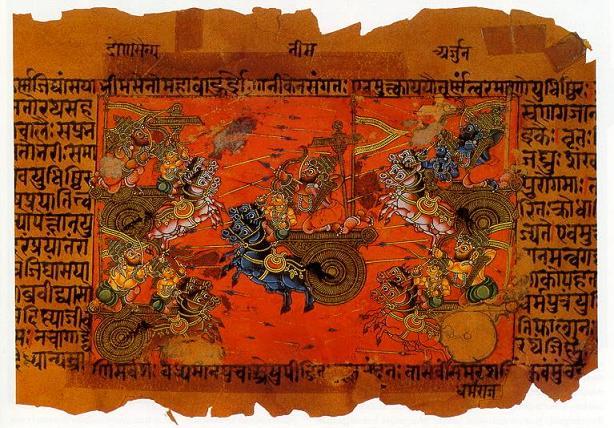
Hindu mythological wars are the wars described in the Hindu texts of ancient India. These wars depicted both mortals of great prowess as well as deities and supernatural beings, often wielding supernatural weapons of great power. Hindu teachings prescribe war as the final option, to be employed only after all peaceful methods are exhausted. Participation in righteous war, or dharmayuddha, was said to be honourable and was a principal duty of the Kshatriya or the warrior varna, and victory in such wars was regarded as a matter of honour.
The central battle in the Vedas is between Indra and Vritra, and the defeat of the demon Vritra leads to the liberation of rivers, cattle and Ushas (dawn/light).
The perennial battle between the devas and asuras is undertaken over the dominion of the three worlds: Svarga, Bhumi, and Patala, (Heaven, Earth, and the underworld). Both races are technically equal, possessors of great religious and martial powers, but the devas are committed to the worship of the Supreme Being and the practice of virtue. The asuras have atheistic and devious tendencies that grow over time. The divide is the greatest in the Kali Yuga, the final age.[better source needed]
In the Varaha kalpa, twelve battles between the devas and the asuras are described in the Brahmanda Purana:
Atirathis:
Maharathis:
Atimaharathis:
Before war, Bhishma mistreated Karna by calling him Artha-rathi because he despised Karna's antagonistic nature towards the Pandavas.
Hindu mythological wars
Hindu mythological wars are the wars described in the Hindu texts of ancient India. These wars depicted both mortals of great prowess as well as deities and supernatural beings, often wielding supernatural weapons of great power. Hindu teachings prescribe war as the final option, to be employed only after all peaceful methods are exhausted. Participation in righteous war, or dharmayuddha, was said to be honourable and was a principal duty of the Kshatriya or the warrior varna, and victory in such wars was regarded as a matter of honour.
The central battle in the Vedas is between Indra and Vritra, and the defeat of the demon Vritra leads to the liberation of rivers, cattle and Ushas (dawn/light).
The perennial battle between the devas and asuras is undertaken over the dominion of the three worlds: Svarga, Bhumi, and Patala, (Heaven, Earth, and the underworld). Both races are technically equal, possessors of great religious and martial powers, but the devas are committed to the worship of the Supreme Being and the practice of virtue. The asuras have atheistic and devious tendencies that grow over time. The divide is the greatest in the Kali Yuga, the final age.[better source needed]
In the Varaha kalpa, twelve battles between the devas and the asuras are described in the Brahmanda Purana:
Atirathis:
Maharathis:
Atimaharathis:
Before war, Bhishma mistreated Karna by calling him Artha-rathi because he despised Karna's antagonistic nature towards the Pandavas.
Recent media
Recent media