



Community hub
Recent from talks
Knowledge base stats:
Talk channels stats:
Members stats:
Vatican City during World War II
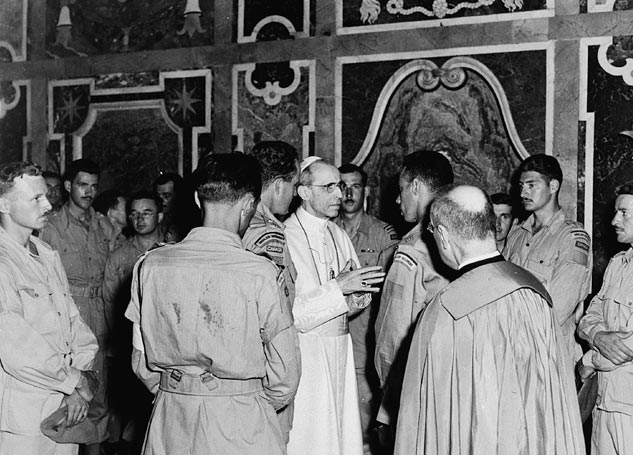
Vatican City pursued a policy of neutrality during World War II under the leadership of Pope Pius XII. Although the city of Rome was occupied by Nazi Germany from September 1943 and the Allies from June 1944, Vatican City itself was not occupied. The Vatican organised extensive humanitarian aid throughout the duration of the conflict.
The Lateran Treaty of 1929 with Italy recognized the sovereignty of Vatican City. It declared Vatican City a neutral country in international relations, and required the Pope to abstain from mediation unless requested by all parties. In 1939, the city state was recognized by thirty-eight nations, with a diplomatic corps of thirteen full ambassadors and twenty-five ministers.
As early as April 1939, Pius XII announced a plan for peace, hoping to mediate a negotiation between the major European powers on the brink of war. The first leader contacted was Benito Mussolini, via Pius XII's usual go-between, Jesuit Father Tacchi Venturi. With Mussolini's approval, the next day Cardinal Secretary of State Luigi Maglione contacted the nuncios in Paris (Valerio Valeri), Warsaw (Filippo Cortesi), and Berlin (Cesare Orsenigo) and the Apostolic Delegate in London (William Godfrey). The proposed Vatican meeting accomplished very little of substance: if there was any coherent position espoused by the Vatican among its various communications, it was that of appeasement. In particular, the Pope attempted to get Poland to accept the secession of the Free City of Danzig to Nazi Germany, a position Polish ambassador Kazimierz Papée (the former High Commissioner of Danzig) and the Polish government could not accept.
In his 24 August 1939 radio message, just a week before war, Pius warned: "The danger is imminent, but there is still time. Nothing is lost with peace; all can be lost with war!"
British historian Owen Chadwick drew four themes from the Vatican mediation attempts: a particular closeness to Mussolini, to the point of sending correspondence of his drafting, from the period May–August 1939; British and Polish disinterest in Vatican proposals, which were suspected of being pro-Italian and pro-German, respectively; major European powers viewed the Pope as "no minor pawn upon their chessboard"; and, above all, Pius XII wanted to ensure compromise between the Western powers to prevent Soviet territorial gains.
With Poland overrun, but France and the Low Countries yet to be attacked, Pius continued to hope for a negotiated peace to prevent the spread of the conflict. The similarly minded US President Franklin D. Roosevelt re-established unofficial American relations with the Vatican after a seventy-year hiatus and dispatched Myron C. Taylor as his personal representative. Despite the early collapse of peace hopes, the Taylor mission continued at the Vatican.
Despite intense behind the scenes actions, Pius XII was resolved not to issue any public pronouncement that took sides in the conflict; this first manifested itself in a refusal to explicitly condemn the German invasion of Poland. Early on, Pius XII believed that the "rapid destruction of Poland meant the end of the war".
Summi Pontificatus ("On the Limitations of the Authority of the State"), issued 20 October 1939, was the first papal encyclical issued by Pope Pius XII, and established some of the themes of his papacy. According to Chadwick, Summi Pontificatus exemplified both "the hesitancy and the care" of the pontiff. During the drafting of the letter, the Second World War commenced with the Nazi–Soviet invasion of Catholic Poland. Though couched in diplomatic language, Pius endorsed Catholic resistance, and stated his disapproval of the war, racism, anti-semitism, the Nazi/Soviet invasion of Poland and the persecutions of the Church.
Hub AI
Vatican City during World War II AI simulator
(@Vatican City during World War II_simulator)
Vatican City during World War II
Vatican City pursued a policy of neutrality during World War II under the leadership of Pope Pius XII. Although the city of Rome was occupied by Nazi Germany from September 1943 and the Allies from June 1944, Vatican City itself was not occupied. The Vatican organised extensive humanitarian aid throughout the duration of the conflict.
The Lateran Treaty of 1929 with Italy recognized the sovereignty of Vatican City. It declared Vatican City a neutral country in international relations, and required the Pope to abstain from mediation unless requested by all parties. In 1939, the city state was recognized by thirty-eight nations, with a diplomatic corps of thirteen full ambassadors and twenty-five ministers.
As early as April 1939, Pius XII announced a plan for peace, hoping to mediate a negotiation between the major European powers on the brink of war. The first leader contacted was Benito Mussolini, via Pius XII's usual go-between, Jesuit Father Tacchi Venturi. With Mussolini's approval, the next day Cardinal Secretary of State Luigi Maglione contacted the nuncios in Paris (Valerio Valeri), Warsaw (Filippo Cortesi), and Berlin (Cesare Orsenigo) and the Apostolic Delegate in London (William Godfrey). The proposed Vatican meeting accomplished very little of substance: if there was any coherent position espoused by the Vatican among its various communications, it was that of appeasement. In particular, the Pope attempted to get Poland to accept the secession of the Free City of Danzig to Nazi Germany, a position Polish ambassador Kazimierz Papée (the former High Commissioner of Danzig) and the Polish government could not accept.
In his 24 August 1939 radio message, just a week before war, Pius warned: "The danger is imminent, but there is still time. Nothing is lost with peace; all can be lost with war!"
British historian Owen Chadwick drew four themes from the Vatican mediation attempts: a particular closeness to Mussolini, to the point of sending correspondence of his drafting, from the period May–August 1939; British and Polish disinterest in Vatican proposals, which were suspected of being pro-Italian and pro-German, respectively; major European powers viewed the Pope as "no minor pawn upon their chessboard"; and, above all, Pius XII wanted to ensure compromise between the Western powers to prevent Soviet territorial gains.
With Poland overrun, but France and the Low Countries yet to be attacked, Pius continued to hope for a negotiated peace to prevent the spread of the conflict. The similarly minded US President Franklin D. Roosevelt re-established unofficial American relations with the Vatican after a seventy-year hiatus and dispatched Myron C. Taylor as his personal representative. Despite the early collapse of peace hopes, the Taylor mission continued at the Vatican.
Despite intense behind the scenes actions, Pius XII was resolved not to issue any public pronouncement that took sides in the conflict; this first manifested itself in a refusal to explicitly condemn the German invasion of Poland. Early on, Pius XII believed that the "rapid destruction of Poland meant the end of the war".
Summi Pontificatus ("On the Limitations of the Authority of the State"), issued 20 October 1939, was the first papal encyclical issued by Pope Pius XII, and established some of the themes of his papacy. According to Chadwick, Summi Pontificatus exemplified both "the hesitancy and the care" of the pontiff. During the drafting of the letter, the Second World War commenced with the Nazi–Soviet invasion of Catholic Poland. Though couched in diplomatic language, Pius endorsed Catholic resistance, and stated his disapproval of the war, racism, anti-semitism, the Nazi/Soviet invasion of Poland and the persecutions of the Church.