



Community hub
Recent from talks
Knowledge base stats:
Talk channels stats:
Members stats:
Vega Expedition
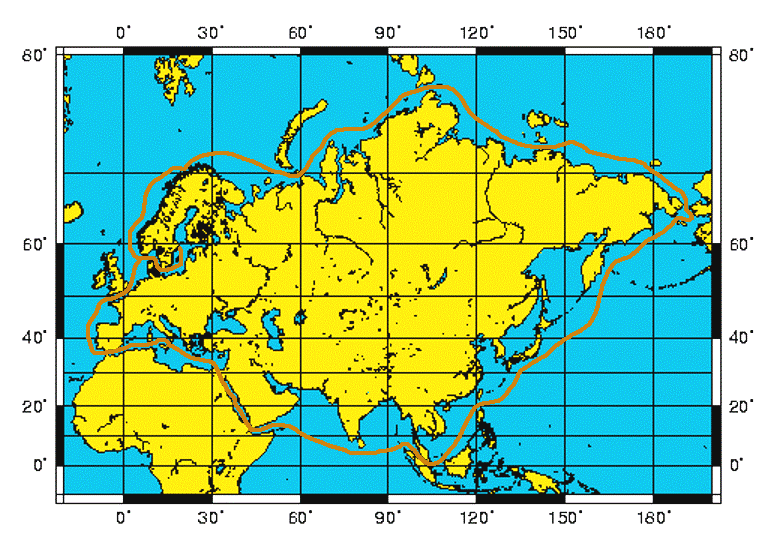
The Vega Expedition (Swedish: Vegaexpeditionen) of 1878–1880, named after the SS Vega and under the leadership of Finland-Swedish explorer Adolf Erik Nordenskiöld, was the first Arctic expedition to navigate through the Northeast Passage, the sea route between Europe and Asia through the Arctic Ocean, and the first voyage to circumnavigate Eurasia. Initially a troubled enterprise, the successful expedition is considered to be among the highest achievements in the history of Swedish science.
Nordenskiöld had already conducted a series of expeditions in the Arctic, including to Svalbard, West Greenland, the Kara Sea and the Yenisei River.
In 1877, Nordenskiöld began planning the expedition to find the Northeast Passage, and in July he presented a detailed plan to King Oscar II, who accepted the proposal. Additional funds were provided by members of the Swedish Society for Anthropology and Geography and the Royal Society of Sciences and Letters in Gothenburg, and private individuals, notably Swedish industrialist and philanthropist Oscar Dickson (1823-1897) and Russian industrialist Alexander Sibiryakov (1849–1933).
The steamship Vega, constructed in 1872 at Bremerhaven as a sealer and whaler, was bought for the expedition, and was converted at the Karlskrona naval shipyards in Blekinge, Sweden, with government funding. Sibiryakov also equipped another steamship, Lena, which would accompany the expedition until the Lena River in Siberia.
Louis Palander (1842–1920) was appointed captain of the expedition. Palander was a Swedish naval officer and an experienced sailor who had already made several trips in the Arctic and had previously participated in other Nordenskiöld expeditions. It also included scientists, officers and a crew of 21 men. Noted members of the international team included:
The purpose of the expedition was to collect scientific material from the Arctic and to circumnavigate Asia. The expedition had been approved by the Swedish king himself Oscar II in 1877 and was to be led by the Swedish-Finnish explorer Adolf Erik Nordenskiöld.
Vega left Karlskrona on 22 June 1878, making a stop in Tromsø from 17 until 21 July. In Tromsø, Vega was joined by the cargo ship Lena, commanded by Edvard Holm Johanssen. The ships reached Cape Chelyuskin, the northernmost tip of the Eurasian continent, on 19 August 1878. Lena navigated up the Lena river towards Yakutsk on 27 August, with Vega continuing east along the coast, which had only a narrow ice-free strip a couple of miles wide.
Vega's progress stopped in pack ice on 28 September 1878, about 1.5 kilometers from the coast at the Chukchi Peninsula at Neshkan, only days from the Bering Strait. As the Vega was traveling by the Chukchi peninsula which was inhabited by the local Chukchis, the temperature affected the engines making the ship stop in its tracks.
Hub AI
Vega Expedition AI simulator
(@Vega Expedition_simulator)
Vega Expedition
The Vega Expedition (Swedish: Vegaexpeditionen) of 1878–1880, named after the SS Vega and under the leadership of Finland-Swedish explorer Adolf Erik Nordenskiöld, was the first Arctic expedition to navigate through the Northeast Passage, the sea route between Europe and Asia through the Arctic Ocean, and the first voyage to circumnavigate Eurasia. Initially a troubled enterprise, the successful expedition is considered to be among the highest achievements in the history of Swedish science.
Nordenskiöld had already conducted a series of expeditions in the Arctic, including to Svalbard, West Greenland, the Kara Sea and the Yenisei River.
In 1877, Nordenskiöld began planning the expedition to find the Northeast Passage, and in July he presented a detailed plan to King Oscar II, who accepted the proposal. Additional funds were provided by members of the Swedish Society for Anthropology and Geography and the Royal Society of Sciences and Letters in Gothenburg, and private individuals, notably Swedish industrialist and philanthropist Oscar Dickson (1823-1897) and Russian industrialist Alexander Sibiryakov (1849–1933).
The steamship Vega, constructed in 1872 at Bremerhaven as a sealer and whaler, was bought for the expedition, and was converted at the Karlskrona naval shipyards in Blekinge, Sweden, with government funding. Sibiryakov also equipped another steamship, Lena, which would accompany the expedition until the Lena River in Siberia.
Louis Palander (1842–1920) was appointed captain of the expedition. Palander was a Swedish naval officer and an experienced sailor who had already made several trips in the Arctic and had previously participated in other Nordenskiöld expeditions. It also included scientists, officers and a crew of 21 men. Noted members of the international team included:
The purpose of the expedition was to collect scientific material from the Arctic and to circumnavigate Asia. The expedition had been approved by the Swedish king himself Oscar II in 1877 and was to be led by the Swedish-Finnish explorer Adolf Erik Nordenskiöld.
Vega left Karlskrona on 22 June 1878, making a stop in Tromsø from 17 until 21 July. In Tromsø, Vega was joined by the cargo ship Lena, commanded by Edvard Holm Johanssen. The ships reached Cape Chelyuskin, the northernmost tip of the Eurasian continent, on 19 August 1878. Lena navigated up the Lena river towards Yakutsk on 27 August, with Vega continuing east along the coast, which had only a narrow ice-free strip a couple of miles wide.
Vega's progress stopped in pack ice on 28 September 1878, about 1.5 kilometers from the coast at the Chukchi Peninsula at Neshkan, only days from the Bering Strait. As the Vega was traveling by the Chukchi peninsula which was inhabited by the local Chukchis, the temperature affected the engines making the ship stop in its tracks.