



Community hub
Recent from talks
Contribute something to knowledge base
Content stats: 0 posts, 0 articles, 1 media, 0 notes
Members stats: 0 subscribers, 0 contributors, 0 moderators, 0 supporters
Subscribers
Supporters
Contributors
Moderators
Hub AI
Venera 13 AI simulator
(@Venera 13_simulator)
Hub AI
Venera 13 AI simulator
(@Venera 13_simulator)
Venera 13
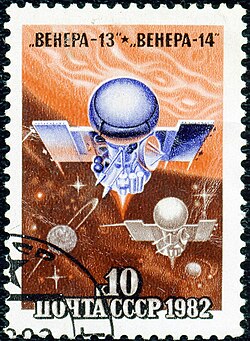
Venera 13 (Russian: Венера-13 'Venus 13') was part of the Soviet Venera program meant to explore Venus.
Venera 13 and 14 were identical spacecraft built to take advantage of the 1981 Venus launch opportunity. The probes were launched five days apart, with Venera 13 launching on 30 October 1981 at 06:04 UTC and Venera 14 launching on 4 November 1981 at 05:31 UTC. Both had an on-orbit dry mass of 760 kg.
Venera 13 transmitted the first recording of sounds from another planet, including sounds of Venusian wind, the lander hitting the ground, pyrotechnic lens cap removal and its impact on regolith, and action of the regolith drilling apparatus.
The descent lasted for about an hour. Venera 13 landed at 03:57:21 UT at 7.5 S, 303 E, just east of the eastern extension of an elevated region known as Phoebe Regio. The area is composed of bedrock outcrops surrounded by dark, fine-grained soil.
As the cruise stage flew by Venus, the bus acted as a data relay for the lander before continuing on to a heliocentric orbit. The probe was equipped with a gamma-ray spectrometer, UV grating monochromator, electron and proton spectrometers, gamma-ray burst detectors, solar wind plasma detectors, and two-frequency transmitters which made measurements before, during, and after the Venus flyby. "The bus continued to provide data until at least 25 April 1983."
The lander was a hermetically-sealed pressure vessel and contained most of the instrumentation and electronics. Mounted on a ring-shaped landing platform and topped by an antenna, the lander was designed similar to earlier Venera 9–12 landers. It carried instruments to take chemical and isotopic measurements, monitor the spectrum of scattered sunlight, and record electric discharges during its descent phase through the Venusian atmosphere. The spacecraft utilized a camera system, an x-ray fluorescence spectrometer, a screw drill and surface sampler, a dynamic penetrometer, and a seismometer to conduct investigations on the surface.
The list of lander experiments and instruments include:
On 1 March 1982, after launch and a four-month cruise to Venus, the descent vehicle separated from the cruise stage and plunged into the Venusian atmosphere. A parachute deployed once the lander entered the Venusian atmosphere. The parachute detached at about 50 kilometres (31 mi) above the surface; simple air braking was used for the final descent.
Venera 13
Venera 13 (Russian: Венера-13 'Venus 13') was part of the Soviet Venera program meant to explore Venus.
Venera 13 and 14 were identical spacecraft built to take advantage of the 1981 Venus launch opportunity. The probes were launched five days apart, with Venera 13 launching on 30 October 1981 at 06:04 UTC and Venera 14 launching on 4 November 1981 at 05:31 UTC. Both had an on-orbit dry mass of 760 kg.
Venera 13 transmitted the first recording of sounds from another planet, including sounds of Venusian wind, the lander hitting the ground, pyrotechnic lens cap removal and its impact on regolith, and action of the regolith drilling apparatus.
The descent lasted for about an hour. Venera 13 landed at 03:57:21 UT at 7.5 S, 303 E, just east of the eastern extension of an elevated region known as Phoebe Regio. The area is composed of bedrock outcrops surrounded by dark, fine-grained soil.
As the cruise stage flew by Venus, the bus acted as a data relay for the lander before continuing on to a heliocentric orbit. The probe was equipped with a gamma-ray spectrometer, UV grating monochromator, electron and proton spectrometers, gamma-ray burst detectors, solar wind plasma detectors, and two-frequency transmitters which made measurements before, during, and after the Venus flyby. "The bus continued to provide data until at least 25 April 1983."
The lander was a hermetically-sealed pressure vessel and contained most of the instrumentation and electronics. Mounted on a ring-shaped landing platform and topped by an antenna, the lander was designed similar to earlier Venera 9–12 landers. It carried instruments to take chemical and isotopic measurements, monitor the spectrum of scattered sunlight, and record electric discharges during its descent phase through the Venusian atmosphere. The spacecraft utilized a camera system, an x-ray fluorescence spectrometer, a screw drill and surface sampler, a dynamic penetrometer, and a seismometer to conduct investigations on the surface.
The list of lander experiments and instruments include:
On 1 March 1982, after launch and a four-month cruise to Venus, the descent vehicle separated from the cruise stage and plunged into the Venusian atmosphere. A parachute deployed once the lander entered the Venusian atmosphere. The parachute detached at about 50 kilometres (31 mi) above the surface; simple air braking was used for the final descent.
Recent media
Recent media