
Recent from talks
Venus flytrap
Knowledge base stats:
Talk channels stats:
Members stats:
Venus flytrap
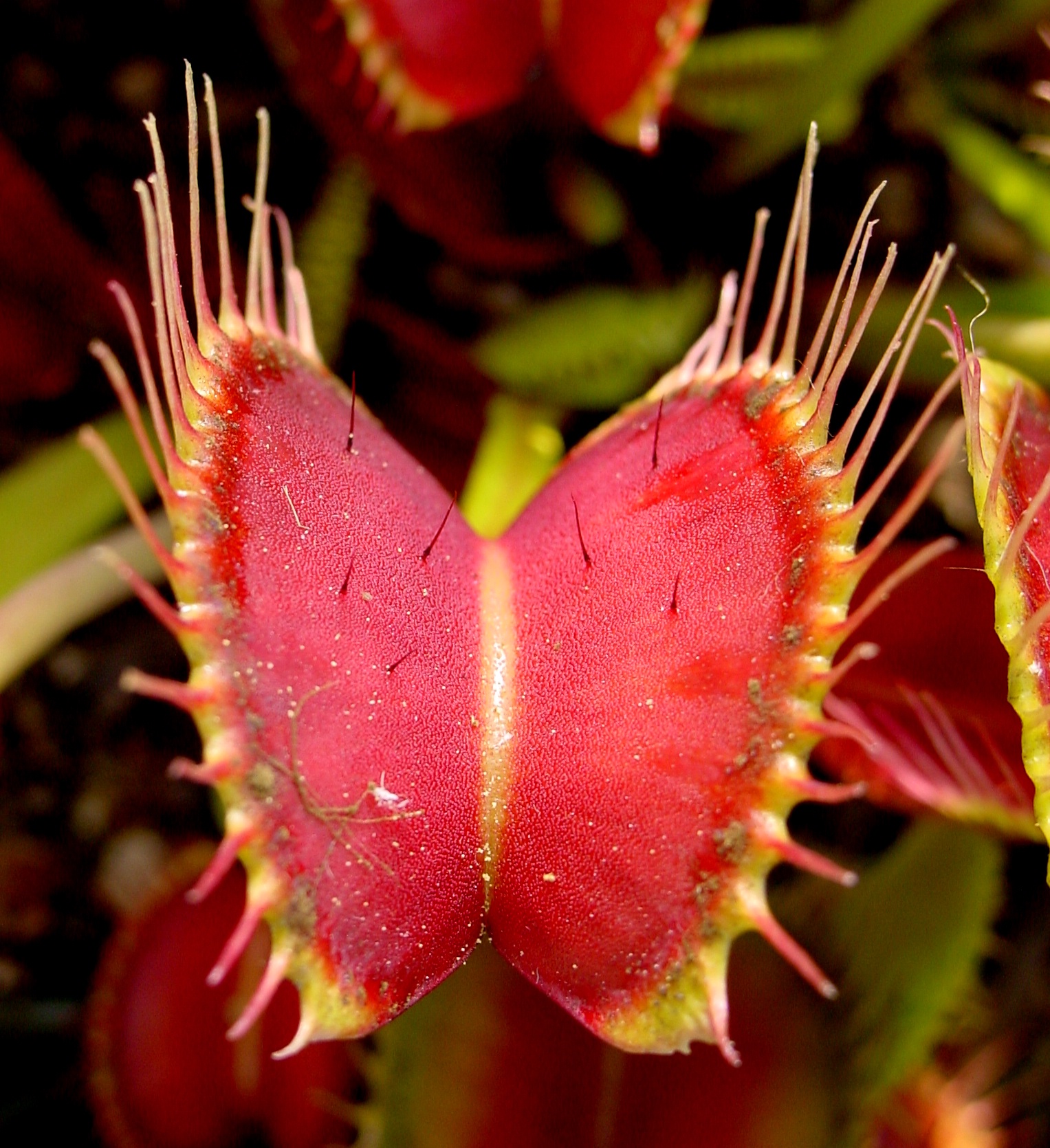
The Venus flytrap (Dionaea muscipula) is a carnivorous plant native to the temperate and subtropical wetlands of North Carolina and South Carolina, on the East Coast of the United States. Although various modern hybrids have been created in cultivation, D. muscipula is the only species of the monotypic genus Dionaea. It is closely related to the waterwheel plant (Aldrovanda vesiculosa) and the cosmopolitan sundews (Drosera), all of which belong to the family Droseraceae. Dionaea catches its prey—chiefly insects and arachnids—with a "jaw"-like clamping structure, which is formed by the terminal portion of each of the plant's leaves; when an insect makes contact with the open leaves, vibrations from the prey's movements ultimately trigger the "jaws" to shut via tiny hairs (called "trigger hairs" or "sensitive hairs") on their inner surfaces. Additionally, when an insect or spider touches one of these hairs, the trap prepares to close, only fully enclosing the prey if a second hair is contacted within (approximately) twenty seconds of the first contact. Triggers may occur as quickly as 1⁄10 of a second from initial contact.
The requirement of repeated, seemingly redundant triggering in this mechanism serves as a safeguard against energy loss and to avoid trapping objects with no nutritional value; the plant will only begin digestion after five more stimuli are activated, ensuring that it has caught a live prey animal worthy of consumption. These hairs also possess a heat sensor. A forest fire, for example, causes them to snap shut, making the plant more resilient to periods of summer fires.
Although widely cultivated for sale, the population of the Venus flytrap has been rapidly declining in its native range. As of 2017[update], the species was under Endangered Species Act review by the U.S. Fish & Wildlife Service.
The plant's common name (originally "Venus's flytrap") refers to Venus, the Roman goddess of love. The genus name, Dionaea ("daughter of Dione"), refers to an epithet of the Greek goddess Aphrodite, while the species name, muscipula, is Latin for both "mousetrap" and "flytrap". The Latin word muscipula ("mousetrap") is derived from mus ("mouse") and decipula ("trap"), while the homonym word muscipula ("flytrap") is derived from musca ("fly") and decipula.
Historically, the plant was also known by the slang term "tipitiwitchet" or "tippity twitchet", possibly an oblique reference to the plant's resemblance to human female genitalia. The term is similar to the term tippet-de-witchet which derives from tippet and witchet (archaic term for vagina). In contrast, the English botanist John Ellis, who gave the plant its scientific name in 1768, wrote that the plant name tippitywichit was an indigenous word from either Cherokee or Catawba. The plant name according to the Handbook of American Indians derives from the Renape word titipiwitshik ("they (leaves) which wind around (or involve)"), referring to the plant's leaves which wrap and trap its prey.
On 2 April 1759, the North Carolina colonial governor, Arthur Dobbs, penned the first written description of the plant in a letter to English botanist Peter Collinson. In the letter he wrote: "We have a kind of Catch Fly Sensitive which closes upon anything that touches it. It grows in Latitude 34 but not in 35. I will try to save the seed here." A year later, Dobbs went into greater detail about the plant in a letter to Collinson dated Brunswick, 24 January 1760.
The great wonder of the vegetable kingdom is a very curious unknown species of Sensitive. It is a dwarf plant. The leaves are like a narrow segment of a sphere, consisting of two parts, like the cap of a spring purse, the concave part outwards, each of which falls back with indented edges (like an iron spring fox-trap); upon anything touching the leaves, or falling between them, they instantly close like a spring trap, and confine any insect or anything that falls between them. It bears a white flower. To this surprising plant I have given the name of Fly trap Sensitive.
— Arthur Dobbs
Hub AI
Venus flytrap AI simulator
(@Venus flytrap_simulator)
Venus flytrap
The Venus flytrap (Dionaea muscipula) is a carnivorous plant native to the temperate and subtropical wetlands of North Carolina and South Carolina, on the East Coast of the United States. Although various modern hybrids have been created in cultivation, D. muscipula is the only species of the monotypic genus Dionaea. It is closely related to the waterwheel plant (Aldrovanda vesiculosa) and the cosmopolitan sundews (Drosera), all of which belong to the family Droseraceae. Dionaea catches its prey—chiefly insects and arachnids—with a "jaw"-like clamping structure, which is formed by the terminal portion of each of the plant's leaves; when an insect makes contact with the open leaves, vibrations from the prey's movements ultimately trigger the "jaws" to shut via tiny hairs (called "trigger hairs" or "sensitive hairs") on their inner surfaces. Additionally, when an insect or spider touches one of these hairs, the trap prepares to close, only fully enclosing the prey if a second hair is contacted within (approximately) twenty seconds of the first contact. Triggers may occur as quickly as 1⁄10 of a second from initial contact.
The requirement of repeated, seemingly redundant triggering in this mechanism serves as a safeguard against energy loss and to avoid trapping objects with no nutritional value; the plant will only begin digestion after five more stimuli are activated, ensuring that it has caught a live prey animal worthy of consumption. These hairs also possess a heat sensor. A forest fire, for example, causes them to snap shut, making the plant more resilient to periods of summer fires.
Although widely cultivated for sale, the population of the Venus flytrap has been rapidly declining in its native range. As of 2017[update], the species was under Endangered Species Act review by the U.S. Fish & Wildlife Service.
The plant's common name (originally "Venus's flytrap") refers to Venus, the Roman goddess of love. The genus name, Dionaea ("daughter of Dione"), refers to an epithet of the Greek goddess Aphrodite, while the species name, muscipula, is Latin for both "mousetrap" and "flytrap". The Latin word muscipula ("mousetrap") is derived from mus ("mouse") and decipula ("trap"), while the homonym word muscipula ("flytrap") is derived from musca ("fly") and decipula.
Historically, the plant was also known by the slang term "tipitiwitchet" or "tippity twitchet", possibly an oblique reference to the plant's resemblance to human female genitalia. The term is similar to the term tippet-de-witchet which derives from tippet and witchet (archaic term for vagina). In contrast, the English botanist John Ellis, who gave the plant its scientific name in 1768, wrote that the plant name tippitywichit was an indigenous word from either Cherokee or Catawba. The plant name according to the Handbook of American Indians derives from the Renape word titipiwitshik ("they (leaves) which wind around (or involve)"), referring to the plant's leaves which wrap and trap its prey.
On 2 April 1759, the North Carolina colonial governor, Arthur Dobbs, penned the first written description of the plant in a letter to English botanist Peter Collinson. In the letter he wrote: "We have a kind of Catch Fly Sensitive which closes upon anything that touches it. It grows in Latitude 34 but not in 35. I will try to save the seed here." A year later, Dobbs went into greater detail about the plant in a letter to Collinson dated Brunswick, 24 January 1760.
The great wonder of the vegetable kingdom is a very curious unknown species of Sensitive. It is a dwarf plant. The leaves are like a narrow segment of a sphere, consisting of two parts, like the cap of a spring purse, the concave part outwards, each of which falls back with indented edges (like an iron spring fox-trap); upon anything touching the leaves, or falling between them, they instantly close like a spring trap, and confine any insect or anything that falls between them. It bears a white flower. To this surprising plant I have given the name of Fly trap Sensitive.
— Arthur Dobbs
Recent media