Recent from talks
Nothing was collected or created yet.
Vertex distance
View on Wikipedia
Vertex distance is the distance between the back surface of a corrective lens, i.e. glasses (spectacles) or contact lenses, and the front of the cornea. Increasing or decreasing the vertex distance changes the optical properties of the system, by moving the focal point forward or backward, effectively changing the power of the lens relative to the eye. Since most refractions (the measurement that determines the power of a corrective lens) are performed at a vertex distance of 12–14 mm, the power of the correction may need to be modified from the initial prescription so that light reaches the patient's eye with the same effective power that it did through the phoropter or trial frame.[1]
Vertex distance is important when converting between contact lens and glasses prescriptions and becomes significant if the glasses prescription is beyond ±4.00 diopters (often abbreviated D). The formula for vertex correction is , where Fc is the power corrected for vertex distance, F is the original lens power, and x is the change in vertex distance in meters.
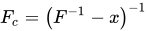
The effect can also be noticed by moving the glasses further away from the eyes. For a short-sighted person, this weakens the effective strength of the lens, which may make it easier to read text up close. More plus power or less minus power as you move the glasses further away from the eye.
Derivation
[edit]The vertex distance formula calculates what power lens (Fc) is needed to focus light on the same location if the lens has been moved by a distance x. To focus light to the same image location:
where fc is the corrected focal length for the new lens, f is the focal length of the original lens, and x is the distance that the lens was moved. The value for x can be positive or negative depending on the sign convention. Lens power in diopters is the mathematical inverse of focal length in meters.
Substituting for lens power arrives at
After simplifying the final equation is found:
Examples
[edit]Example 1: example prescription adjustment from glasses to contacts
[edit]A phoropter measurement of a patient reads −8.00 D sphere and −5.25 D cylinder with an axis of 85° for one eye (the notation for which is typically written as −8 −5.25×85). The phoropter measurement is made at a common vertex distance of 12 mm from the eye. The equivalent prescription at the patient's cornea (say, for a contact lens) can be calculated as follows (this example assumes a negative cylinder sign convention):
Power 1 is the spherical value, and power 2 is the steeper power of the astigmatic axis:
The axis value does not change with vertex distance, so the equivalent prescription for a contact lens (vertex distance, 0 mm) is −7.30 D of sphere, −4.13 D of cylinder with 85° of axis (−7.30 −4.13×85 or about −7.25 −4.25×85).
Example 2: example prescription adjustment from contacts to glasses
[edit]A patient has −8 D sphere contacts. What is the equivalent prescription for glasses?
Therefore −8 D contacts correspond to −8.75 D or −9 D glasses.
Example 3: sample plots
[edit]

The following plots show the difference in spherical power at a 0 mm vertex distance (at the eye) and a 12 mm vertex distance (standard eyeglasses distance). 0 mm is used as the reference starting power and is one-to-one. The second plot shows the difference between the 0 mm and 12 mm vertex distance powers. Above around 4D of spherical power, the difference versus the corrected power becomes more than 0.25 D and is clinically significant.
References
[edit]- ^ Brooks, Clifford (1992). Understanding Lens Surfacing. Elsevier Science & Technology Books. pp. 241–245. ISBN 0-7506-9177-8.
Vertex distance
View on GrokipediaFundamentals
Definition and Measurement
Vertex distance refers to the physical separation between the posterior surface of a spectacle lens and the anterior surface of the cornea.[1][4][2] This distance is crucial in optometry as it influences the effective optical power of the lens when positioned in front of the eye.[2] In adults, vertex distance typically ranges from 10 to 15 mm, depending on facial anatomy, frame fit, and eyewear design.[1][5] Measurement of vertex distance is performed using specialized tools to ensure accuracy during clinical assessments. The standard method employs a vertexometer, also known as a distometer, which quantifies the distance from the back surface of the lens to the corneal apex, often through a closed eyelid to avoid discomfort.[6] Alternatively, a millimeter ruler can be used by aligning it perpendicularly from the lens's posterior surface to the cornea's front, with the patient in a natural head position.[7] Consistent positioning of the patient and equipment is emphasized during refraction to maintain reliability, as variations can affect prescription outcomes.[1] Expressed in millimeters, vertex distance conventionally uses an average value of 12 mm for standard calculations unless a specific measurement is taken.[4] This convention facilitates routine optometric practice while allowing for individualized adjustments. The concept originated in early 20th-century optometry, emerging as standardized refraction techniques developed to account for the impact of lens position on effective power.[8]Clinical Significance
Vertex distance plays a critical role in optometry by influencing the effective power of ophthalmic lenses, as changes in this distance alter the vergence of light rays entering the eye, potentially resulting in over- or under-correction if not accounted for during prescription.[9] For instance, increasing the vertex distance from the corneal plane reduces the effective minus power for myopic corrections and increases the effective plus power for hyperopic ones, leading to discrepancies that can exceed 0.25 D in prescriptions above ±4.00 D, thereby compromising visual clarity.[10] Ignoring vertex distance variations can lead to adverse patient outcomes, including asthenopia, blurred vision, and persistent refractive errors, particularly in high-power prescriptions where even small shifts (e.g., 5 mm) induce clinically meaningful power changes of 0.125 D or more.[10] These effects are pronounced in myopes, where over-correction may cause eye strain, and in hyperopes, where under-correction can result in accommodative fatigue; such errors are especially detrimental in patients with prescriptions exceeding ±4.00 D, as they amplify the risk of suboptimal visual acuity and comfort.[9] The clinical relevance of vertex distance varies across patient groups, with children typically exhibiting shorter distances (often due to less pronounced nasal bridges) compared to adults, which necessitates tailored adjustments to avoid magnification distortions and ensure accurate correction in progressive conditions like myopia management.[11] In pediatric populations, where myopia progression is common, precise vertex distance consideration helps prevent under-correction that could exacerbate axial elongation, while in adults with hyperopia, longer distances may require compensation to maintain clear near vision without inducing strain.[9] During subjective refraction, vertex distance is routinely checked—particularly for high prescriptions—to align the phoropter or trial frame position with the intended spectacle plane, ensuring that the final prescription is position-specific and minimizes discrepancies between refraction and wear.[12] This step is essential for prescription accuracy, as variations (typically 10-15 mm, but up to 34 mm in some measured cases) can introduce errors up to 1.81 D in extreme cases, directly affecting long-term visual outcomes.[9]Theoretical Basis
Derivation of the Vertex Power Formula
The vertex power formula arises from the principles of vergence in paraxial optics, which describe how the curvature of wavefronts changes as light propagates through space or encounters optical elements. Consider a thin lens of power (in diopters) positioned at a distance (in meters) anterior to the corneal vertex, correcting for a distant object. The incident vergence on the lens is zero, so the vergence immediately posterior to the lens is . As light travels the distance toward the cornea, the vergence propagates according to the formula for vergence change over distance: the vergence at a point meters after an initial vergence is given by Here, and , yielding the effective power at the corneal vertex: This effective power represents the vergence incident on the cornea, equivalent to the power of a contact lens placed directly on the cornea.[13] To derive the compensation formula, suppose the original power is measured at a reference vertex distance (often assumed as zero for contact lenses), and a new lens power is required at a different distance to produce the same effective power at the cornea. Setting , the equation becomes Solving for : However, in standard optometric convention for converting spectacle power (at positive ) to contact lens power (at ), the formula adjusts as , reflecting the direction of distance change (moving the lens closer to the eye). This ensures the same corrective vergence at the cornea. For the reverse conversion, the signs and roles reverse accordingly.[13][14] The derivation relies on key assumptions: the thin lens approximation, where lens thickness is negligible; paraxial ray optics, limiting rays to small angles near the optical axis; and propagation in air (refractive index ≈1). Distances must be converted to meters for consistency with dioptric units (e.g., typical vertex distance of 12 mm = 0.012 m), as power in diopters is defined as the reciprocal of focal length in meters.[13] This formula approximates the behavior in a thick lens model, where principal planes and lens thickness affect the effective power via the back vertex power calculation. For small vertex distances (typically 10–15 mm) and moderate lens powers (< ±10 D), the thin lens approximation is sufficient for clinical accuracy, as the principal plane shift in real lenses is minimal relative to . More precise thick lens computations use the general lensmaker's equation adjusted for surface separations, but the simple formula remains the standard for vertex compensation.[13]Factors Influencing Vertex Distance
Vertex distance, the separation between the posterior surface of a spectacle lens and the anterior corneal surface, typically averages around 12 mm but can vary considerably due to anatomical differences in facial structure. Individuals with deep-set eyes often exhibit a shorter vertex distance, as the recessed orbital position brings the cornea closer to the frame, potentially reducing the effective distance by several millimeters. In contrast, prominent brows or a protruding nose can extend the distance by displacing the frame anteriorly, leading to variations of up to 5 mm or more in some cases. These anatomical factors contribute to inter-patient differences ranging from 4.0 mm to 19.5 mm, with a mean of 11.1 mm and standard deviation of ±3.11 mm observed in clinical assessments of head morphology.[15][16][10] Frame and lens design further modulate vertex distance, influencing the lens's position relative to the eye. Wraparound or curved frames, common in sports eyewear, introduce lateral tilt that effectively increases the distance for peripheral gaze, altering light path geometry and necessitating adjustments in lens power calculations. Lens thickness, particularly in high-minus prescriptions where edges are thicker, can shift the back vertex posteriorly, exacerbating variations in effective power. Traditional flat frames maintain more consistent distances, but modern designs like rimless or semi-rimless styles may allow for closer fitting, reducing the distance by 1-2 mm compared to full-rim alternatives.[17][18][19] Environmental and behavioral elements introduce dynamic changes to vertex distance during everyday use. Head movements, such as tilting forward for near tasks, can increase the distance by up to 5 mm, while lifting the head reduces it, affecting optical alignment especially in progressive lenses. Gaze shifts, like downward for reading versus straight-ahead for distance vision, may cause subtle variations through interactions between the eyelids, lashes, and frame, potentially altering the distance by 1-2 mm in patients with prominent features. These fluctuations highlight the need for measurements under typical wearing conditions to capture real-world variability.[10][20] Accounting for these influences requires compensation through individualized assessments rather than standard 12 mm assumptions, ensuring precise spectacle fitting and minimizing refractive errors. Clinical protocols involve measuring eye-to-frame distance with tools like digital pupillometers or calipers, particularly for prescriptions exceeding ±5.00 D, where even 1 mm changes can alter effective power by approximately 0.10 D or more. Personalized frame adjustments, such as bridge modifications for anatomical fit, have been shown to reduce deviations from ideal vertex distance, improving visual quality and comfort.[10][21][22]Practical Applications
Spectacle to Contact Lens Conversion
Converting a spectacle prescription to a contact lens prescription requires adjusting for the reduction in vertex distance from the typical spectacle position (approximately 12 mm from the cornea) to nearly zero for contact lenses, which alters the effective optical power. This adjustment ensures the contact lens provides equivalent refractive correction at the corneal plane, preventing issues such as over- or under-correction that could lead to visual discomfort or suboptimal acuity. The process is essential in clinical optometry to maintain precise vision correction, particularly as the power change is more pronounced with higher ametropias.[23] The step-by-step process begins with measuring the patient's spectacle vertex distance, commonly 12 mm using a vertexometer or ruler from the corneal apex to the posterior spectacle lens surface. The contact lens power is then computed using the vertex power formula:where is the contact lens power in diopters, is the spectacle power in diopters, and is the vertex distance in meters (e.g., 0.012 m for 12 mm). This formula applies to both plus and minus powers, but the effect is inverse: for plus powers (hyperopia), the contact lens power increases, while for minus powers (myopia), it becomes less negative due to the power sign influencing the denominator. The derivation of this formula is covered in the section on the Vertex Power Formula. Results are rounded to the nearest 0.25 D increment, standard for contact lens manufacturing.[23][24] For instance, a spectacle prescription of +6.00 D at 12 mm vertex distance yields D, rounded to +6.50 D. Similarly, for -6.00 D, D, rounded to -5.50 D.[25] This conversion is critical for prescriptions exceeding ±4.00 D, where failing to account for vertex distance can produce an error greater than 0.25 D, resulting in blurred vision, asthenopia, or adaptation difficulties. It is routinely applied for powers ≥ ±6.00 D to ensure accurate fitting and patient comfort.[26] Optometric calculators, such as those available from professional suppliers, and pre-computed vertex conversion tables streamline these adjustments, allowing practitioners to input the spectacle power and distance for immediate results without manual derivation.[27][28]