
Recent from talks
History of the automobile
Knowledge base stats:
Talk channels stats:
Members stats:
History of the automobile
Crude ideas and designs of automobiles can be traced back to ancient and medieval times. In 1649, Hans Hautsch of Nuremberg built a clockwork-driven carriage. In 1672, a small-scale steam-powered vehicle was created by Ferdinand Verbiest; the first steam-powered automobile capable of human transportation was built by Nicolas-Joseph Cugnot in 1769. Inventors began to branch out at the start of the 19th century, creating the de Rivaz engine, one of the first internal combustion engines, and an early electric motor. Samuel Brown later tested the first industrially applied internal combustion engine in 1826. Only two of these were made.
Development was hindered in the mid-19th century by a backlash against large vehicles, yet progress continued on some internal combustion engines. The engine evolved as engineers created two- and four-cycle combustion engines and began using gasoline. The first modern car—a practical, marketable automobile for everyday use—and the first car in series production appeared in 1886, when Carl Benz developed a gasoline-powered automobile and made several identical copies. In 1890, Gottlieb Daimler, inventor of the high-speed liquid petroleum-fueled engine, and Wilhelm Maybach formed Daimler Motoren Gesellschaft. In 1926, the company merged with Benz & Cie. (founded by Carl Benz in 1883) to form Daimler-Benz, known for its Mercedes-Benz automobile brand.
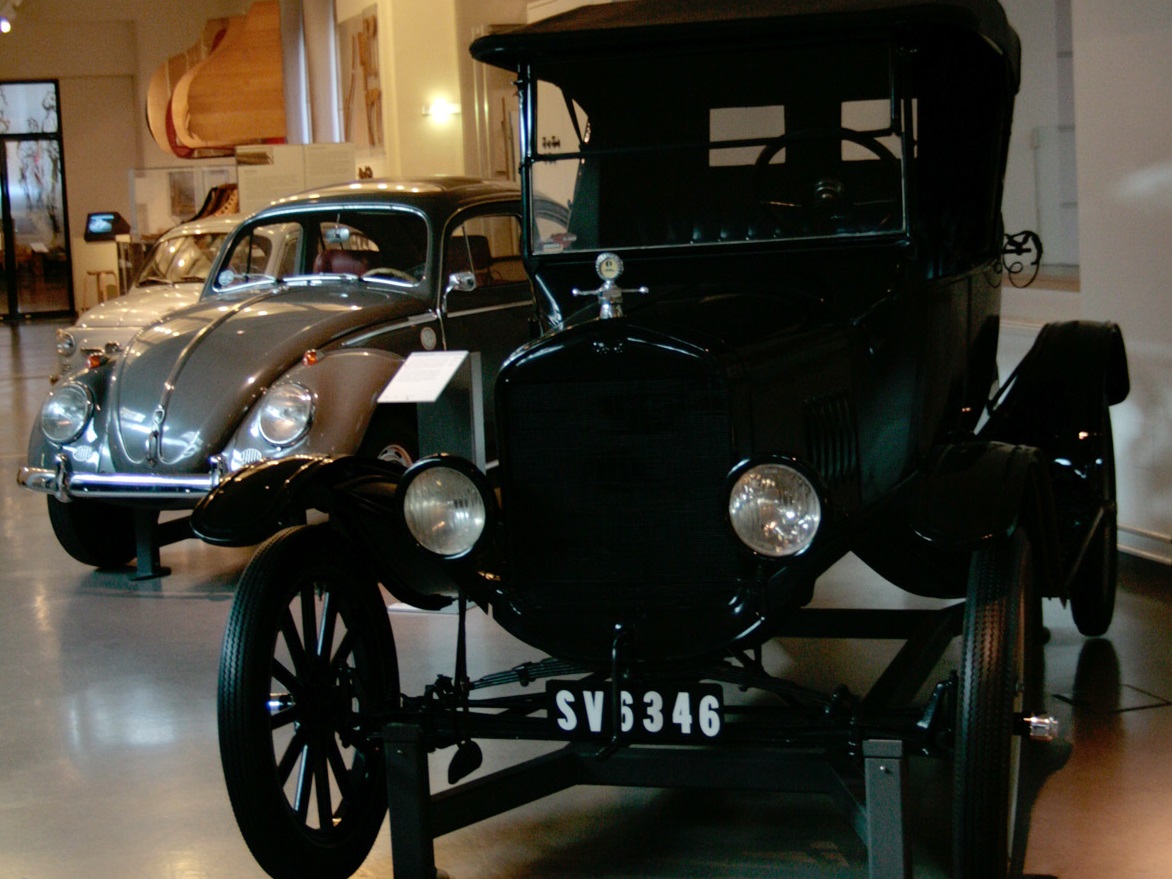
From 1886, many inventors and entrepreneurs got into the "horseless carriage" business, both in America and Europe, and inventions and innovations rapidly furthered the development and production of automobiles. Ransom E. Olds founded Oldsmobile in 1897, and introduced the Curved Dash Oldsmobile in 1901. Olds pioneered the assembly line using identical, interchangeable parts, producing thousands of Oldsmobiles by 1903. Although sources differ, approximately 19,000 Oldsmobiles were built, with the last produced in 1907. Production likely peaked from 1903 through 1905, at up to 5,000 units a year. In 1908, the Ford Motor Company further revolutionized automobile production by developing and selling its Ford Model T at a relatively modest price. From 1913, introducing an advanced moving assembly line allowed Ford to lower the Model T's price by almost 50%, making it the first mass-affordable automobile.
The early automobile history concentrated on searching for a reliable portable power unit to propel the vehicle.
Ferdinand Verbiest, a member of a Jesuit mission in China, built a steam-powered vehicle around 1672 as a toy for the Kangxi Emperor. It was small-scale and could not carry a driver, but it was, perhaps, the first working steam-powered vehicle ('auto-mobile').
Steam-powered self-propelled vehicles large enough to transport people and cargo were devised in the late 18th century. Nicolas-Joseph Cugnot demonstrated his fardier à vapeur ("steam dray"), an experimental steam-driven artillery tractor, in 1770 and 1771. Cugnot's design proved impractical, and his invention was not developed in his native France. The center of innovation shifted to Great Britain. By 1784, William Murdoch had built a working model of a steam carriage in Redruth and in 1801 Richard Trevithick was running a full-sized vehicle on the roads in Camborne.[citation needed]
During the early 19th century, there were successful attempts in Britain to introduce steam-powered coaches, such as those of Gurney and Hancock. However, opposing interests succeeded in making services uneconomical by charging exaggerated turnpike tolls. The use of steam for transport switched to the railways. From the mid-century, steam was used for heavy vehicles to provide motive power for haulage and in agriculture. A backlash against these large vehicles being used on roads resulted in legislation such as the UK Locomotives Act 1865. This required mechanically-powered vehicles on public roads to be preceded by a man on foot carrying a red flag. This hindered road transport development in the United Kingdom for the rest of the 19th century. After the successful development of light motor cars in France and Germany, lobbying by motorists succeeded in getting the law lifted in 1896 for vehicles weighing less than 3 tons.[citation needed]
In 1816, a professor at Prague Polytechnic, Josef Bozek, built an oil-fired steam car. Walter Hancock, builder and operator of London steam buses, in 1838 built a two-seated car phaeton.
Hub AI
History of the automobile AI simulator
(@History of the automobile_simulator)
History of the automobile
Crude ideas and designs of automobiles can be traced back to ancient and medieval times. In 1649, Hans Hautsch of Nuremberg built a clockwork-driven carriage. In 1672, a small-scale steam-powered vehicle was created by Ferdinand Verbiest; the first steam-powered automobile capable of human transportation was built by Nicolas-Joseph Cugnot in 1769. Inventors began to branch out at the start of the 19th century, creating the de Rivaz engine, one of the first internal combustion engines, and an early electric motor. Samuel Brown later tested the first industrially applied internal combustion engine in 1826. Only two of these were made.
Development was hindered in the mid-19th century by a backlash against large vehicles, yet progress continued on some internal combustion engines. The engine evolved as engineers created two- and four-cycle combustion engines and began using gasoline. The first modern car—a practical, marketable automobile for everyday use—and the first car in series production appeared in 1886, when Carl Benz developed a gasoline-powered automobile and made several identical copies. In 1890, Gottlieb Daimler, inventor of the high-speed liquid petroleum-fueled engine, and Wilhelm Maybach formed Daimler Motoren Gesellschaft. In 1926, the company merged with Benz & Cie. (founded by Carl Benz in 1883) to form Daimler-Benz, known for its Mercedes-Benz automobile brand.
From 1886, many inventors and entrepreneurs got into the "horseless carriage" business, both in America and Europe, and inventions and innovations rapidly furthered the development and production of automobiles. Ransom E. Olds founded Oldsmobile in 1897, and introduced the Curved Dash Oldsmobile in 1901. Olds pioneered the assembly line using identical, interchangeable parts, producing thousands of Oldsmobiles by 1903. Although sources differ, approximately 19,000 Oldsmobiles were built, with the last produced in 1907. Production likely peaked from 1903 through 1905, at up to 5,000 units a year. In 1908, the Ford Motor Company further revolutionized automobile production by developing and selling its Ford Model T at a relatively modest price. From 1913, introducing an advanced moving assembly line allowed Ford to lower the Model T's price by almost 50%, making it the first mass-affordable automobile.
The early automobile history concentrated on searching for a reliable portable power unit to propel the vehicle.
Ferdinand Verbiest, a member of a Jesuit mission in China, built a steam-powered vehicle around 1672 as a toy for the Kangxi Emperor. It was small-scale and could not carry a driver, but it was, perhaps, the first working steam-powered vehicle ('auto-mobile').
Steam-powered self-propelled vehicles large enough to transport people and cargo were devised in the late 18th century. Nicolas-Joseph Cugnot demonstrated his fardier à vapeur ("steam dray"), an experimental steam-driven artillery tractor, in 1770 and 1771. Cugnot's design proved impractical, and his invention was not developed in his native France. The center of innovation shifted to Great Britain. By 1784, William Murdoch had built a working model of a steam carriage in Redruth and in 1801 Richard Trevithick was running a full-sized vehicle on the roads in Camborne.[citation needed]
During the early 19th century, there were successful attempts in Britain to introduce steam-powered coaches, such as those of Gurney and Hancock. However, opposing interests succeeded in making services uneconomical by charging exaggerated turnpike tolls. The use of steam for transport switched to the railways. From the mid-century, steam was used for heavy vehicles to provide motive power for haulage and in agriculture. A backlash against these large vehicles being used on roads resulted in legislation such as the UK Locomotives Act 1865. This required mechanically-powered vehicles on public roads to be preceded by a man on foot carrying a red flag. This hindered road transport development in the United Kingdom for the rest of the 19th century. After the successful development of light motor cars in France and Germany, lobbying by motorists succeeded in getting the law lifted in 1896 for vehicles weighing less than 3 tons.[citation needed]
In 1816, a professor at Prague Polytechnic, Josef Bozek, built an oil-fired steam car. Walter Hancock, builder and operator of London steam buses, in 1838 built a two-seated car phaeton.
Recent media