
Recent from talks
Vezo people
Knowledge base stats:
Talk channels stats:
Members stats:
Vezo people
The Vezo is the term the semi-nomadic coastal people of southern Madagascar use to refer to people that have become accustomed to live from sea fishing. The Vezo speak a dialect of the Malagasy language, which is a branch of the Malayo-Polynesian language group derived from the Barito languages, spoken in southern Borneo. They currently populate most of the littoral zone along Madagascar's west coast between Toliara and Mahajanga.
"Vezo" literally means 'the people who fish', but also has been known to mean 'to struggle with the sea'.
Vezo do not identify with a particular Malagasy ethnic group but instead with their way of life. They currently populate most of the littoral zone along Madagascar's west coast between Toliara and Mahajanga. Like most other Malagasy ethnic groups, their origins can directly be traced to that original mix of Austronesian settlers from Asia and the Bantu migrants from mainland East Africa with Arab-Persian and Indian ancestry since the Middle Ages. They have been known to state emphatically that they need have no common origin or shared essence with one another. Their identity is instead contextual and embodied in learned skills such as fishing or swimming and the calluses they produce, rather than in shared origin. Because of their semi-nomadic marine migrations, their population is difficult to determine and has been estimated by counting the dugout canoes called pirogues (lakanas in Malagasy language) around Madagascar. The Vezo tribe is from Southwest Madagascar.
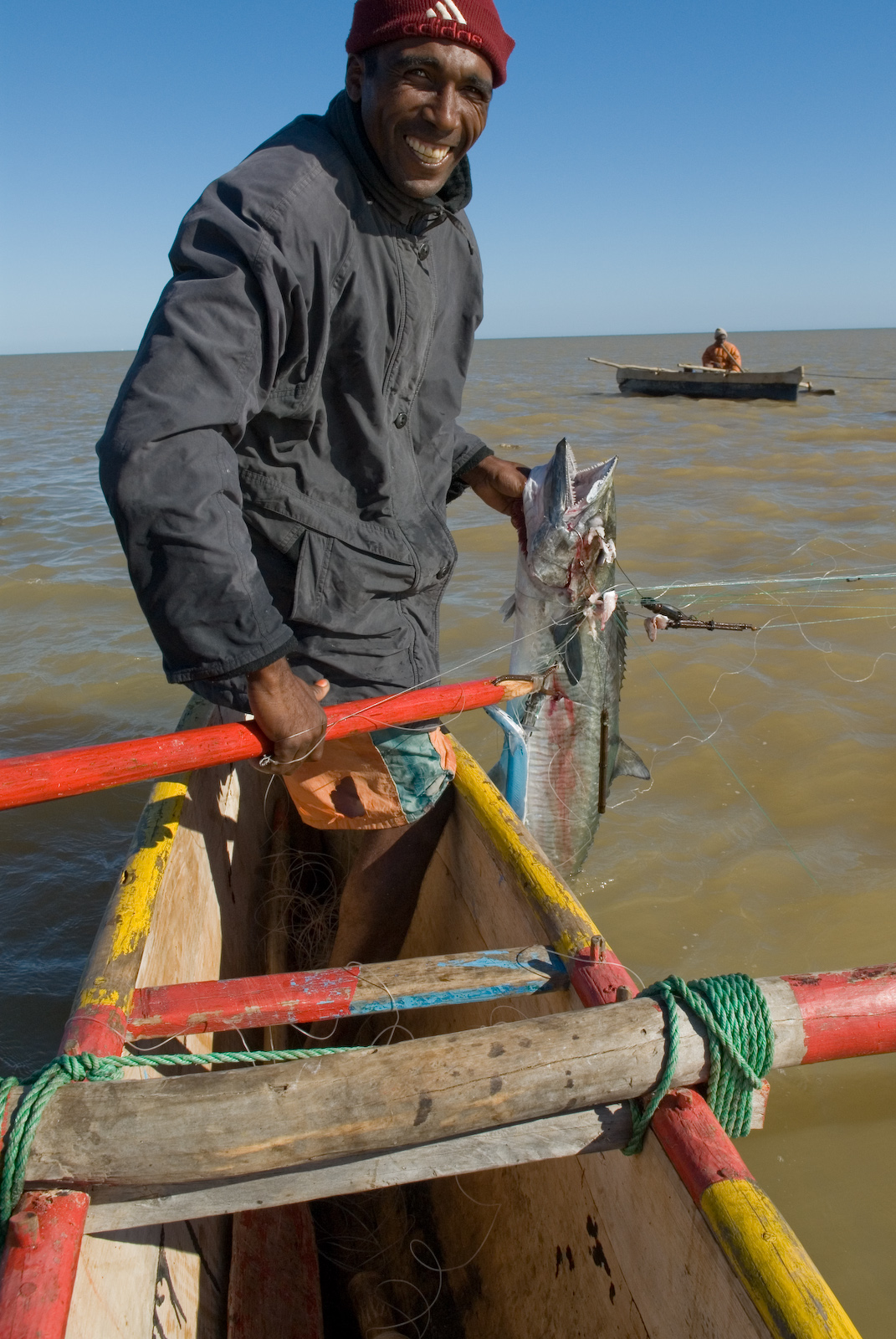
The Vezo are a fishing people who inhabit a coastal belt extending from Intampolo in the south to Morondava in the north of southwest Madagascar. Andavadoaka is a village whose population are of the Vezo tribe. It has a population of 1,200, with over 50% under 15 years of age. Household income is mainly from fishing. Fishermen make use of mangroves for timber, wood, and fishing. The fishers participate in an artisanal fishery reliant on pirogues (canoes, made by hollowing out a large log) powered by sail and paddle, and most fishing occurs 5 km or less from shore. Men predominantly fish with line, nets, and spears. Women glean the reef flats for invertebrates including octopus and sea cucumbers. Fish sales, processing and trade supplement local income, as does tourism and local commerce.
The Vezo traditionally traded with the neighboring agro-foresters, the Masikoro. The Vezo also trade with the Mikea, exchanging fish for honey and tubers. However, increased trade has changed the economy from barter to cash-based.[citation needed] Furthermore, growth in fish export from Madagascar has encouraged fish processing and export companies to the region, such as Murex and Copefrito (now operating in the southwest). Their purchases of marine products have increased fish demand and strengthened the cash economy. Besides gleaning from the reef flats, women are the ones who sell the catches that men bring them. With what they earn, women buy rice, the staple food, as well as other essential foodstuffs and a variety of luxury items. Children go to school in the one village school building, where there are two designated teachers. However, due to the deterioration of public administration in Madagascar, the building and the teachers are hardly ever occupied. Whenever children are in the building, and if the teacher has not run out of chalk, the teaching largely consists in copying letters, numbers, and short sentences from the blackboard onto the child's own A5 size blackboard. Understandably, the many children who do not own a blackboard are allowed to play in the burning heat outside.
Family ties are extremely important among the Vezo and elders are greatly respected in the community. Families often provide for each other with younger members building boats for the elderly to use. Maintaining family ties is important to ensure that one is looked after in old age, or after an accident or ill health. Family relationships are particularly important to Vezo fishers because they determine access to marine resources and fishing gear.
The Vezo have official cultural ceremonies called Fomba. These include Bilo, Tromba, Savatse, Takasy and Soro. All these ceremonies, except Takasy, are practiced (with some variations) by the neighbouring inland Masikoro people.
The circumcision ceremony typically lasts from 4 am until 9 am. The parents ask a wise elder to suggest the best date and time for the ceremony, and identify a nurse or doctor who knows how to perform the circumcision. Family members are invited to attend the ceremony, and one of the uncles holds the child during the ceremony. After the physical cut, there is drinking of alcohol. After the ceremony the child is called savatse.[citation needed]
Hub AI
Vezo people AI simulator
(@Vezo people_simulator)
Vezo people
The Vezo is the term the semi-nomadic coastal people of southern Madagascar use to refer to people that have become accustomed to live from sea fishing. The Vezo speak a dialect of the Malagasy language, which is a branch of the Malayo-Polynesian language group derived from the Barito languages, spoken in southern Borneo. They currently populate most of the littoral zone along Madagascar's west coast between Toliara and Mahajanga.
"Vezo" literally means 'the people who fish', but also has been known to mean 'to struggle with the sea'.
Vezo do not identify with a particular Malagasy ethnic group but instead with their way of life. They currently populate most of the littoral zone along Madagascar's west coast between Toliara and Mahajanga. Like most other Malagasy ethnic groups, their origins can directly be traced to that original mix of Austronesian settlers from Asia and the Bantu migrants from mainland East Africa with Arab-Persian and Indian ancestry since the Middle Ages. They have been known to state emphatically that they need have no common origin or shared essence with one another. Their identity is instead contextual and embodied in learned skills such as fishing or swimming and the calluses they produce, rather than in shared origin. Because of their semi-nomadic marine migrations, their population is difficult to determine and has been estimated by counting the dugout canoes called pirogues (lakanas in Malagasy language) around Madagascar. The Vezo tribe is from Southwest Madagascar.
The Vezo are a fishing people who inhabit a coastal belt extending from Intampolo in the south to Morondava in the north of southwest Madagascar. Andavadoaka is a village whose population are of the Vezo tribe. It has a population of 1,200, with over 50% under 15 years of age. Household income is mainly from fishing. Fishermen make use of mangroves for timber, wood, and fishing. The fishers participate in an artisanal fishery reliant on pirogues (canoes, made by hollowing out a large log) powered by sail and paddle, and most fishing occurs 5 km or less from shore. Men predominantly fish with line, nets, and spears. Women glean the reef flats for invertebrates including octopus and sea cucumbers. Fish sales, processing and trade supplement local income, as does tourism and local commerce.
The Vezo traditionally traded with the neighboring agro-foresters, the Masikoro. The Vezo also trade with the Mikea, exchanging fish for honey and tubers. However, increased trade has changed the economy from barter to cash-based.[citation needed] Furthermore, growth in fish export from Madagascar has encouraged fish processing and export companies to the region, such as Murex and Copefrito (now operating in the southwest). Their purchases of marine products have increased fish demand and strengthened the cash economy. Besides gleaning from the reef flats, women are the ones who sell the catches that men bring them. With what they earn, women buy rice, the staple food, as well as other essential foodstuffs and a variety of luxury items. Children go to school in the one village school building, where there are two designated teachers. However, due to the deterioration of public administration in Madagascar, the building and the teachers are hardly ever occupied. Whenever children are in the building, and if the teacher has not run out of chalk, the teaching largely consists in copying letters, numbers, and short sentences from the blackboard onto the child's own A5 size blackboard. Understandably, the many children who do not own a blackboard are allowed to play in the burning heat outside.
Family ties are extremely important among the Vezo and elders are greatly respected in the community. Families often provide for each other with younger members building boats for the elderly to use. Maintaining family ties is important to ensure that one is looked after in old age, or after an accident or ill health. Family relationships are particularly important to Vezo fishers because they determine access to marine resources and fishing gear.
The Vezo have official cultural ceremonies called Fomba. These include Bilo, Tromba, Savatse, Takasy and Soro. All these ceremonies, except Takasy, are practiced (with some variations) by the neighbouring inland Masikoro people.
The circumcision ceremony typically lasts from 4 am until 9 am. The parents ask a wise elder to suggest the best date and time for the ceremony, and identify a nurse or doctor who knows how to perform the circumcision. Family members are invited to attend the ceremony, and one of the uncles holds the child during the ceremony. After the physical cut, there is drinking of alcohol. After the ceremony the child is called savatse.[citation needed]
Recent media