
Recent from talks
Via Dolorosa
Knowledge base stats:
Talk channels stats:
Members stats:
Via Dolorosa
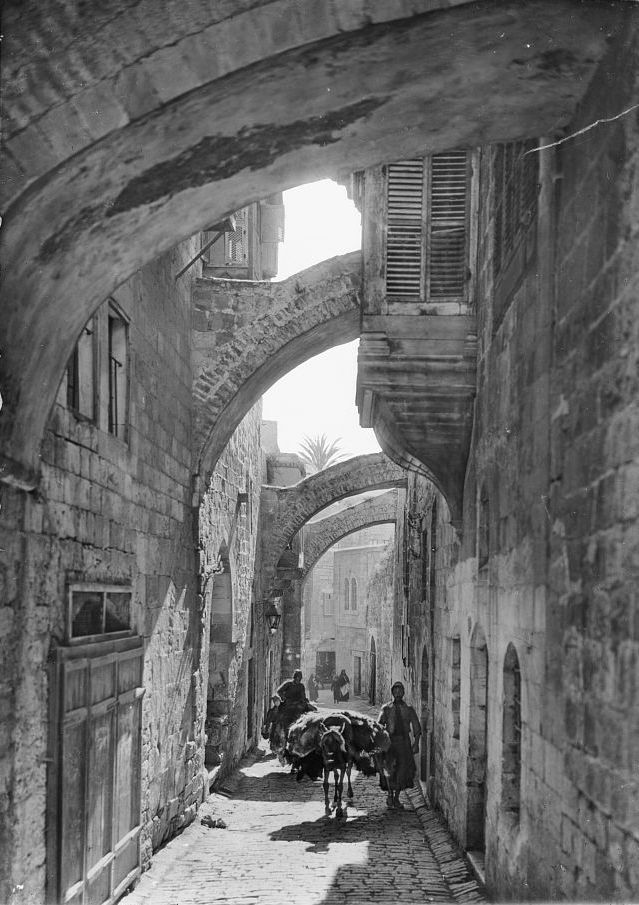
The Via Dolorosa (Latin for 'Sorrowful Way', often translated as 'Way of Suffering'; Arabic: طريق الآلام; Hebrew: ויה דולורוזה), sometimes known as the Via Crucis (Latin for 'Way of Cross'; Arabic: درب الصليب, lit. 'Via Crucis'; Hebrew: ויה קרוסיס) is a processional route in the Old City of Jerusalem. It represents the path that Jesus took, forced by the Roman soldiers, on the way to his crucifixion. The winding route from the former Antonia Fortress to the Church of the Holy Sepulchre—a distance of about 600 metres (2,000 ft)—is a celebrated place of Christian pilgrimage. The current route has been established since the 18th century, replacing various earlier versions. It is today marked by 14 Stations of the Cross, nine of which are outside, in the streets, with the remaining five stations being currently inside the Church of the Holy Sepulchre.
The Via Dolorosa is not one street, but a route consisting of segments of several streets. One of the main segments is the modern remnant of one of the two main east-west routes (Decumanus Maximus) through the Roman city of Aelia Capitolina, as built by Hadrian. Standard Roman city design places the main east-west road through the middle of the city, but the presence of the Temple Mount along much of the eastern side of the city required Hadrian's planners to add an extra east-west road at its north. In addition to the usual central north-south road (Cardo Maximus), which in Jerusalem headed straight up the western hill, a second major north-south road was added down the line of the Tyropoeon Valley; these two cardines converge near the Damascus Gate, close to the Via Dolorosa. If the Via Dolorosa had continued west in a straight line across the two routes, it would have formed a triangular block too narrow to construct standard buildings; the decumanus (now the Via Dolorosa) west of the Cardo was constructed south[dubious – discuss] of its eastern portion, creating the discontinuity in the road still present today.[citation needed]
The first reports of a pilgrimage route corresponding to the Biblical events date from the Byzantine era; during that time, a Holy Thursday procession started from the top of the Mount of Olives, stopped in Gethsemane, entered the Old City at the Lions' Gate, and followed approximately the current route to the Church of the Holy Sepulchre; however, there were no actual stops during the route along the Via Dolorosa itself. By the 8th century, however, the route went via the western hill instead; starting at Gethsemane, it continued to the alleged House of Caiaphas on Mount Zion, then to the Church of Hagia Sophia (viewed as the site of the Praetorium), and finally to the Church of the Holy Sepulchre.
After the split in the Catholic Church, Christians created two separate routes on the western hill and the eastern hill, with each group supporting the route which took pilgrims past the churches they controlled, one arguing that the Roman governor's mansion (Praetorium) was on Mount Zion (where they had churches), the other that it was near the Antonia Fortress (where they had churches).
What the Crusader Kingdom of Jerusalem called Jehoshaphat Street (Via Josaphat) was where present-day Via Dolorosa partly is. (Today's Via Dolorosa extends westward from the western portion of that street.) Near the ruined Antonia Fortress and north of the Templum Domini precinct, Jehoshaphat Street led eastward to the Jehoshaphat Gate (near or at Lions' Gate on Lions' Gate Street), with the Valley of Jehoshaphat (near or in the Kidron Valley) beyond the gate.
In the 14th century, Pope Clement VI achieved some consistency in route with the bull Nuper Carissimae, establishing the Franciscan Custody of the Holy Land, and charging the friars with "the guidance, instruction, and care of Latin pilgrims as well as with the guardianship, maintenance, defense and rituals of the Catholic shrines of the Holy Land". Beginning around 1350, Franciscan friars conducted official tours of the Via Dolorosa, from the Holy Sepulchre to the House of Pilate—opposite the direction travelled by Jesus in the Bible. The route was not reversed until c. 1517, when the Franciscans began to follow the events of Jesus's Passion chronologically—setting out from the House of Pilate and ending with the crucifixion at Golgotha.
From the onset of Franciscan administration, the development of the Via Dolorosa was intimately linked to devotional practices in Europe. The Friars Minor were ardent proponents of devotional meditation as a means to access and understand the Passion. The hours and guides they produced, such as Meditaciones vite Christi (MVC), were widely circulated in Europe.[citation needed]
Necessarily, such devotional literature expanded on the terse accounts of the Via Dolorosa in the Bible; the period of time between just after Jesus's condemnation by Pilate and just before his crucifixion receives no more than a few verses in the canonical gospels. Throughout the 14th century, a number of events, marked by stations on the Via Dolorosa, emerged in devotional literature and on the physical site in Jerusalem.[citation needed]
Hub AI
Via Dolorosa AI simulator
(@Via Dolorosa_simulator)
Via Dolorosa
The Via Dolorosa (Latin for 'Sorrowful Way', often translated as 'Way of Suffering'; Arabic: طريق الآلام; Hebrew: ויה דולורוזה), sometimes known as the Via Crucis (Latin for 'Way of Cross'; Arabic: درب الصليب, lit. 'Via Crucis'; Hebrew: ויה קרוסיס) is a processional route in the Old City of Jerusalem. It represents the path that Jesus took, forced by the Roman soldiers, on the way to his crucifixion. The winding route from the former Antonia Fortress to the Church of the Holy Sepulchre—a distance of about 600 metres (2,000 ft)—is a celebrated place of Christian pilgrimage. The current route has been established since the 18th century, replacing various earlier versions. It is today marked by 14 Stations of the Cross, nine of which are outside, in the streets, with the remaining five stations being currently inside the Church of the Holy Sepulchre.
The Via Dolorosa is not one street, but a route consisting of segments of several streets. One of the main segments is the modern remnant of one of the two main east-west routes (Decumanus Maximus) through the Roman city of Aelia Capitolina, as built by Hadrian. Standard Roman city design places the main east-west road through the middle of the city, but the presence of the Temple Mount along much of the eastern side of the city required Hadrian's planners to add an extra east-west road at its north. In addition to the usual central north-south road (Cardo Maximus), which in Jerusalem headed straight up the western hill, a second major north-south road was added down the line of the Tyropoeon Valley; these two cardines converge near the Damascus Gate, close to the Via Dolorosa. If the Via Dolorosa had continued west in a straight line across the two routes, it would have formed a triangular block too narrow to construct standard buildings; the decumanus (now the Via Dolorosa) west of the Cardo was constructed south[dubious – discuss] of its eastern portion, creating the discontinuity in the road still present today.[citation needed]
The first reports of a pilgrimage route corresponding to the Biblical events date from the Byzantine era; during that time, a Holy Thursday procession started from the top of the Mount of Olives, stopped in Gethsemane, entered the Old City at the Lions' Gate, and followed approximately the current route to the Church of the Holy Sepulchre; however, there were no actual stops during the route along the Via Dolorosa itself. By the 8th century, however, the route went via the western hill instead; starting at Gethsemane, it continued to the alleged House of Caiaphas on Mount Zion, then to the Church of Hagia Sophia (viewed as the site of the Praetorium), and finally to the Church of the Holy Sepulchre.
After the split in the Catholic Church, Christians created two separate routes on the western hill and the eastern hill, with each group supporting the route which took pilgrims past the churches they controlled, one arguing that the Roman governor's mansion (Praetorium) was on Mount Zion (where they had churches), the other that it was near the Antonia Fortress (where they had churches).
What the Crusader Kingdom of Jerusalem called Jehoshaphat Street (Via Josaphat) was where present-day Via Dolorosa partly is. (Today's Via Dolorosa extends westward from the western portion of that street.) Near the ruined Antonia Fortress and north of the Templum Domini precinct, Jehoshaphat Street led eastward to the Jehoshaphat Gate (near or at Lions' Gate on Lions' Gate Street), with the Valley of Jehoshaphat (near or in the Kidron Valley) beyond the gate.
In the 14th century, Pope Clement VI achieved some consistency in route with the bull Nuper Carissimae, establishing the Franciscan Custody of the Holy Land, and charging the friars with "the guidance, instruction, and care of Latin pilgrims as well as with the guardianship, maintenance, defense and rituals of the Catholic shrines of the Holy Land". Beginning around 1350, Franciscan friars conducted official tours of the Via Dolorosa, from the Holy Sepulchre to the House of Pilate—opposite the direction travelled by Jesus in the Bible. The route was not reversed until c. 1517, when the Franciscans began to follow the events of Jesus's Passion chronologically—setting out from the House of Pilate and ending with the crucifixion at Golgotha.
From the onset of Franciscan administration, the development of the Via Dolorosa was intimately linked to devotional practices in Europe. The Friars Minor were ardent proponents of devotional meditation as a means to access and understand the Passion. The hours and guides they produced, such as Meditaciones vite Christi (MVC), were widely circulated in Europe.[citation needed]
Necessarily, such devotional literature expanded on the terse accounts of the Via Dolorosa in the Bible; the period of time between just after Jesus's condemnation by Pilate and just before his crucifixion receives no more than a few verses in the canonical gospels. Throughout the 14th century, a number of events, marked by stations on the Via Dolorosa, emerged in devotional literature and on the physical site in Jerusalem.[citation needed]
Recent media