


Community hub
Recent from talks
Contribute something
Nothing was collected or created yet.
Stations of the Cross
View on Wikipedia
 |
| Part of a series on |
| Devotions to Jesus in the Catholic Church |
|---|
 |
| Devotions |
| Prayers |
 Catholic Church portal Catholic Church portal |
The Stations of the Cross or the Way of the Cross, also known as the Way of Sorrows, the Via Crucis or the Via Dolorosa, are any series of fourteen images depicting Jesus Christ on the day of his crucifixion and accompanying prayers, These stations are derived from the imitations of the Via Dolorosa in Jerusalem which is a traditional processional route symbolizing the path Jesus walked from Lions' Gate to Mount Calvary. The objective of the stations is to help the Christian faithful to make a spiritual pilgrimage through contemplation of the Passion of Christ. It has become one of the most popular devotions and the stations can be found in many Western Christian churches, including those in the Catholic,[1] Lutheran,[2][3] Anglican,[4] and Methodist traditions.[5][6]
Commonly, a series of 14 images will be arranged in numbered order along a path, along which worshippers—individually or in a procession—move in order, stopping at each station to say prayers and engage in reflections associated with that station. These devotions are most common during Lent, especially on Good Friday, and reflect a spirit of reparation for the sufferings and insults that Jesus endured during his passion.[7][8][9] As a physical devotion involving standing, kneeling and genuflections, the Stations of the Cross are tied with the Christian themes of repentance and mortification of the flesh.[1][10]
The style, form, and placement of the stations vary widely. The typical stations are small plaques with reliefs or paintings placed around a church nave. Modern minimalist stations can be simple crosses with a numeral in the centre.[7][11] Occasionally, the faithful might say the stations of the cross without there being any image, such as when the pope leads the stations of the cross around the Colosseum in Rome on Good Friday.[12]
History
[edit]
.jpg)


The Stations of the Cross originated from the pilgrimage to Jerusalem in Roman Judaea and a desire to reproduce the Via Dolorosa. Imitating holy places was not a new concept. For example, the religious complex of Santo Stefano in Bologna, Italy, replicated the Church of the Holy Sepulchre and other religious sites, including the Mount of Olives and the Valley of Josaphat.[13]
Following the siege of 1187, Jerusalem fell to the forces of Saladin, the first sultan of Egypt and Syria. Forty years later, members of the Franciscan religious order were allowed back into the Holy Land. Their founder, Francis of Assisi, held the Passion of Christ in special veneration and is said to have been the first person to receive stigmata.[14] In 1217, Francis also founded the Custody of the Holy Land to guard and promote the devotion to Christian holy places. The Franciscans' efforts were recognized when Pope Clement VI officially proclaimed them the custodians of holy places in 1342.[14] Although several travelers who visited the Holy Land during the 12–14th centuries (e.g. Riccoldo da Monte di Croce, Burchard of Mount Sion, and James of Verona), mention a "Via Sacra", i.e. a settled route that pilgrims followed, there is nothing in their accounts to identify this with the Way of the Cross, as we understand it.[15] The earliest use of the word "stations", as applied to the accustomed halting-places along the Via Sacra at Jerusalem, occurs in the narrative of an English pilgrim, William Wey, who visited the Holy Land in the mid-15th century and described pilgrims following the footsteps of Christ to Golgotha. In 1521, a book called Geystlich Strass (German: "spiritual road") was printed with illustrations of the stations in the Holy Land.[15]
During the 15th and 16th centuries, the Franciscans began to build a series of outdoor shrines in Europe to duplicate their counterparts in the Holy Land. The number of stations at these shrines varied between seven and thirty; seven was common. These were usually placed, often in small buildings, along the approach to a church, as in a set of 1490 by Adam Kraft, leading to the Johanniskirche in Nuremberg.[16] A number of rural examples were established as attractions in their own right, usually on attractive wooded hills. These include the Sacro Monte di Domodossola (1657) and Sacro Monte di Belmonte (1712), and form part of the Sacri Monti of Piedmont and Lombardy World Heritage Site, together with other examples on different devotional themes. The sculptures at these sites are very elaborate and often nearly life-size. Remnants of these sites are often referred to as calvary hills.
In 1686, in answer to their petition, Pope Innocent XI granted to the Franciscans the right to erect stations within their churches. In 1731, Pope Clement XII extended to all churches the right to have the stations, provided that a Franciscan father erected them, with the consent of the local bishop. At the same time the number of stations was fixed at fourteen. In 1857, the bishops of England were allowed to erect the stations by themselves, without the intervention of a Franciscan priest, and in 1862 this right was extended to bishops throughout the church.[17]
Stations
[edit]


The early set of seven scenes was usually numbers 2, 3, 4, 6, 7, 11 and 14 from the list below.[16] From the late 16th century to the present, the standard complement has consisted of 14 pictures or sculptures depicting the following scenes:[18][19][20]
- Jesus is condemned to death
- Jesus takes up his Cross
- Jesus falls the first time
- Jesus meets his Mother
- Simon of Cyrene helps Jesus carry the Cross
- Veronica wipes the face of Jesus
- Jesus falls for the second time
- Jesus meets the women of Jerusalem
- Jesus falls for the third time
- Jesus is stripped of his garments (sometimes called the "Division of Robes")
- Jesus is nailed to the Cross
- Jesus dies on the Cross
- Jesus is taken down from the Cross
- Jesus is laid in the tomb
Although not traditionally part of the Stations, the Resurrection of Jesus is sometimes included as an unofficial fifteenth station.[dubious – discuss][21][22] One very different version, called the Via Lucis ("Way of Light"), comprising the Fourteen Stations of Light or Stations of the Resurrection, starts with Jesus rising from the dead and ends with Pentecost.[23]
Scriptural form
[edit]Out of the fourteen traditional Stations of the Cross, only eight have a clear scriptural foundation. Station 4 appears out of order from scripture; Jesus's mother is present at the crucifixion but is only mentioned after Jesus is nailed to the cross and before he dies (between stations 11 and 12). The scriptures contain no accounts whatsoever of any woman wiping Jesus's face nor of Jesus falling as stated in Stations 3, 6, 7 and 9. Station 13 (Jesus's body being taken down off the cross and laid in the arms of his mother Mary) differs from the gospels' record, which states that Joseph of Arimathea took Jesus down from the cross and buried him.
To provide a version of this devotion more closely aligned with the biblical accounts, Pope John Paul II introduced a new form of devotion, called the Scriptural Way of the Cross, on Good Friday 1991. He celebrated that form many times but not exclusively at the Colosseum in Italy,[24][25] using the following sequence (as published by the United States Catholic Conference of Bishops):[26]
- Jesus prays in the Garden of Gethsemane;
- Jesus is betrayed by Judas and arrested;
- Jesus is condemned by the Sanhedrin;
- Jesus is denied by Peter three times;
- Jesus is judged by Pilate;
- Jesus is scourged and crowned with thorns;
- Jesus takes up his cross;
- Jesus is helped by Simon of Cyrene to carry his cross;
- Jesus meets the women of Jerusalem;
- Jesus is crucified;
- Jesus promises his kingdom to the repentant thief;
- Jesus entrusts Mary and John to each other;
- Jesus dies on the cross; and
- Jesus is laid in the tomb.
In 2007, Pope Benedict XVI approved this set of stations for meditation and public celebration.[27][28]
The New Way of the Cross (Philippines)
[edit]Another set of stations is used by the Catholic Church in the Philippines. Filipinos use this set during Visita Iglesia, which is usually undertaken during Holy Week:
- The Last Supper
- The Agony in Gethsemane
- Jesus Before the Sanhedrin
- Jesus is scourged and crowned with thorns
- Jesus Receives His Cross
- Jesus Falls under the weight of the Cross
- Simon of Cyrene Helps Jesus carry the Cross
- Jesus meets the women of Jerusalem
- Jesus is nailed to the Cross
- The Repentant Thief
- Mary and John at the Foot of the Cross
- Jesus dies on the Cross
- Jesus is laid in His Tomb
- Jesus rises from the Dead
Modern usage
[edit]
In the Roman Catholic Church, the devotion may be conducted personally by the faithful, making their way from one station to another and saying the prayers, or by having an officiating celebrant move from cross to cross while the faithful make the responses. The stations themselves must consist of, at the very least, fourteen wooden crosses—pictures alone do not suffice—and they must be blessed by someone with the authority to erect stations.[29]
Pope John Paul II led an annual public prayer of the Stations of the Cross at the Roman Colosseum on Good Friday. Originally, the pope himself carried the cross from station to station, but in his last years when age and infirmity limited his strength, John Paul presided over the celebration from a stage on the Palatine Hill, while others carried the cross. Just days prior to his death in 2005, Pope John Paul II observed the Stations of the Cross from his private chapel. Each year a different person is invited to write the meditation texts for the Stations. Past composers of the Papal Stations include several non-Catholics. The pope himself wrote the texts for the Great Jubilee in 2000 and used the traditional Stations.
The celebration of the Stations of the Cross is especially common on the Fridays of Lent, especially Good Friday. Community celebrations are usually accompanied by various songs and prayers. Particularly common as musical accompaniment is the Stabat Mater of which a few verses are sung between each station. At the end of each station the Adoramus Te is sometimes sung. The Alleluia is also sung, except during Lent.
Structurally, Mel Gibson's 2004 film, The Passion of the Christ, follows the Stations of the Cross.[30]
Debates
[edit]Place of Christ's resurrection
[edit]Some modern liturgists[31] say the traditional Stations of the Cross are incomplete without a final scene depicting the empty tomb and the resurrection of Jesus because Jesus' rising from the dead was an integral part of his salvific work on Earth. Advocates of the traditional form of the Stations ending with the body of Jesus being placed in the tomb say the Stations are intended as a meditation on the atoning death of Jesus, and not as a complete picture of his life, death, and resurrection. Another point of contention, at least between some ranking liturgists and traditionalists, is (the use of) the "New Way of the Cross" being recited exclusively in the Philippines and by Filipinos abroad.
The Stations of the Resurrection (also known by the Latin name of Via Lucis, Way of Light) are used in some churches at Eastertide to meditate on the Resurrection and Ascension of Jesus Christ.
Music
[edit]Franz Liszt wrote a Via Crucis for choir, soloists and piano or organ or harmonium in 1879. In 1931, French organist Marcel Dupré improvised and transcribed musical meditations based on fourteen poems by Paul Claudel, one for each station. Peter Maxwell Davies's Vesalii Icones (1969), for male dancer, solo cello and instrumental ensemble, brings together the Stations of the Cross and a series of drawings from the anatomical treatise De humani corporis fabrica (1543) by the Belgian physician Andreas van Wesel (Vesalius). In Davies's sequence, the final "station" represents the Resurrection, but of Antichrist, the composer's moral point being the need to distinguish what is false from what is real.[32] David Bowie regarded his 1976 song "Station to Station" as "very much concerned with the stations of the cross".[33] Polish composer Paweł Łukaszewski wrote Via Crucis in 2000 and it was premiered by the Podlaska Opera and Orchestra on March 8, 2002.[34] Stefano Vagnini's 2002 modular oratorio, Via Crucis,[35] is a composition for organ, computer, choir, string orchestra and brass quartet. Italian composer Fabio Mengozzi released his electronic album Via crucis in 2022.[36]
As the Stations of the Cross are prayed during the season of Lent in Catholic churches, each station is traditionally followed by a verse of the Stabat Mater, composed in the 13th century by Franciscan Jacopone da Todi. James Matthew Wilson's poetic sequence, The Stations of the Cross, is written in the same meter as da Todi's poem.[37]
Literature
[edit]Dimitris Lyacos' third part of the Poena Damni trilogy, The First Death, is divided into fourteen sections in order to emphasise the "Via Dolorosa" of its marooned protagonist during his ascent on the mount of the island which constitutes the setting of the work.[38]
Gallery
[edit]-
 1st Station: Jesus is condemned to death
 -
 2nd Station: Jesus takes up his Cross
 -
 3rd Station: Jesus falls for the first time
 -
 4th Station: Jesus meets his Mother
 -
 5th Station: Simon of Cyrene helps Jesus carry the Cross
 -
 6th Station: Veronica wipes the face of Jesus
 -
 7th Station: Jesus falls for the second time
 -
 8th Station: Jesus meets the women of Jerusalem
 -
 9th Station: Jesus falls for the third time
 -
 10th Station: Jesus is stripped of his garments (sometimes called the "Division of Robes")
 -
 11th Station: Jesus is nailed to the Cross
 -
 12th Station: Jesus dies on the cross
 -
 13th Station: Jesus is taken down from the Cross
 -
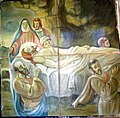 14th Station: Jesus is laid in the tomb


.JPG)
.JPG)
.JPG)


.jpg)
See also
[edit]References
[edit]- ^ a b Byrne, William (16 October 2020). 5 Things with Father Bill: Hope, Humor, and Help for the Soul. Loyola Press. ISBN 978-0-8294-5327-0.
- ^ "Stations of the Cross". Holy Trinity Lutheran Church. Archived from the original on 20 October 2017. Retrieved 20 October 2017.
- ^ "Good Friday: Stations of the Cross Explained". Sinclair Broadcast Group, Inc. (KJZZ14). 15 April 2022.
It has become standard for Catholic churches in the United States to mark the Stations of the Cross on Good Friday. In addition to Catholics, some Protestant churches, especially those belonging to the Episcopal [i.e., Anglican] or Lutheran denominations, also commemorate the Stations of the Cross as of their Lenten activities.
- ^ "Lent" (PDF). Church of England. 236. Archived from the original (PDF) on 5 July 2017. Retrieved 20 October 2017.
- ^ "Stations of the Cross". Trinity UMC. 24 March 2013. Archived from the original on 17 April 2015. Retrieved 17 April 2015.
- ^ Quann, Lynn (4 April 2017). "Stations of the Cross". Epworth United Methodist Church. Archived from the original on 26 March 2023. Retrieved 16 April 2022.
- ^ a b "Stations of the Cross". St. Michael's Episcopal Church. 2012. Archived from the original on 17 February 2015. Retrieved 3 March 2015.
- ^ Ann Ball, 2003 Encyclopedia of Catholic Devotions and Practices ISBN 0-87973-910-X
- ^ The Catholic Prayer Book and Manual of Meditations (1883) by Patrick Francis Moran /The Way of the Cross. Browne and Nolan.
- ^ Ryder, Henry Ignatius Dudley (1920). Sermons and Notes of Sermons. Sands & Company. p. 58.
- ^ Chryssides, George D.; Wilkins, Margaret Z. (11 September 2014). Christians in the Twenty-First Century. Taylor & Francis. p. 51. ISBN 978-1-317-54557-6.
- ^ "Frommer's Events – Event Guide: Good Friday Procession in Rome (Palatine Hill, Italy)". Frommer's. Archived from the original on 7 January 2009. Retrieved 8 April 2008.
- ^ Ousterhout, Robert G. (1981). "The Church of Santo Stefano: A "Jerusalem" in Bologna". Gesta. 2 (20): 311–321. doi:10.2307/766940. ISSN 0016-920X. JSTOR 766940. S2CID 191752841.
- ^ a b Weitzel Gibbons, Mary (1995). Giambologna: Narrator of the Catholic Reformation. University of California Press. pp. 72–73. ISBN 978-0-520-08213-7.
- ^ a b Thurston, Herbert (1914). The Stations of the Cross: an account of their history and devotional purpose. London: Burns & Oates. pp. 20–21, 46. OCLC 843213.
- ^ a b Schiller, Gertrud, Iconography of Christian Art, Vol. II, p. 82, 1972 (English trans from German), Lund Humphries, London, ISBN 0-85331-324-5
- ^ The Catholic Encyclopedia (1907). s.v. "The Way of the Cross".
- ^ "Text of the Stations of the Cross for 2020, led by Pope Francis". Aleteia / Foundation for Evangelization through the Media (FEM). 9 April 2020. Retrieved 19 May 2020.
- ^ "First Station: Jesus is condemned to death". Libreria Editrice Vaticana. Retrieved 19 May 2020.
- ^ Francesca Merlo (10 April 2020). "Way of the Cross: Meditations from a corrections facility". Vatican News. Retrieved 19 May 2020.
- ^ "Fr. William Saunders". Archived from the original on 2009-04-30. Retrieved 2009-04-04.
Because of the intrinsic relationship between the passion and death of our Lord with His resurrection, several of the devotional booklets now include a 15th station, which commemorates the Resurrection.
- ^ Ficcaglia, Jennifer (12 February 2016). "Stations of the Cross Explained". Catholic Courier.
The Way of the Cross traditionally consists of 14 iconic stations that depict the events of Jesus' journey to crucifixion. A 15th station, which is not depicted by an icon, is meant to remember Jesus' resurrection.
- ^ "The Official Web Site for the Archdiocese of Detroit" (PDF). Archived from the original (PDF) on 2010-12-23. Retrieved 2012-02-13.
In some contemporary Stations of the Cross, a fifteenth station has been added to commemorate the Resurrection of the Lord.
- ^ Joseph M Champlin, The Stations of the Cross With Pope John Paul II Liguori Publications, 1994, ISBN 0-89243-679-4
- ^ Pope John Paul II, Meditation and Prayers for the Stations of the Cross at the Colosseum Archived 2013-06-03 at the Wayback Machine, Good Friday, 2000
- ^ "Scriptural Stations of the Cross". www.usccb.org. Retrieved 2019-03-11.
- ^ Office for the Liturgical Celebrations of the Supreme Pontiff (April 6, 2007). "Way of the Cross at the Colosseum". Vatican.va. Archived from the original on July 7, 2013. Retrieved February 18, 2018.
- ^ "Pope Benedict leads Good Friday service". ABC News. April 6, 2007 – via www.abc.net.au.
- ^ "Catholic Encyclopedia: Way of the Cross". Newadvent.org. 1912-10-01. Retrieved 2014-07-03.
- ^ Review Archived 2012-04-30 at the Wayback Machine, United States Conference of Catholic Bishops, 2004
- ^ McBrien, Richard P.; Harold W. Attridge (1995). The HarperCollins encyclopedia of Catholicism. Harper Collins. p. 1222. ISBN 978-0-06-065338-5.
- ^ Peter Maxwell Davies: Composer's note in the published score (Boosey and Hawkes, B & H 20286).
- ^ Cavanagh, David (February 1997). "ChangesFiftyBowie". Q magazine: 52–59.
- ^ "Via Crucis by Paweł Łukaszewski". www.viacrucis.pl.
- ^ Falcon Valley Music Ed., Stefano Vagnini, Via Crucis, Rome, 2002.[not specific enough to verify]
- ^ "Esce il primo disco del compositore e pianista astigiano Fabio Mengozzi, elettronica e magia". La Stampa (in Italian). 18 October 2022.
- ^ "The Stations of the Cross : Clarion Review". www.clarionreview.org. Retrieved 2017-12-16.
- ^ Toti O’Brien (October 2018). "Poena Damni/Poetry Review - Ragazine". Retrieved 2024-01-21.
External links
[edit]
- Scriptural Stations of the Cross from the United States Conference of Catholic Bishops
- The Way Of The Cross: Presentation (historical development; present form, both traditional and scriptural), from the official Vatican website (accessed 19 May 2020)
- Via Crucis celebration texts used by the Vatican on Good Fridays since 1991 from the official Vatican website
- Video: Corine Schleif. Adam Kraft's Seven Falls of Christ. Walking the History of Emotions in Nuremberg. Part 1
- Video: Corine Schleif. Adam Kraft's Seven Falls of Christ. Walking the History of Emotions in Nuremberg. Part 2
- "Way of the Cross" article from The Catholic Encyclopedia


Liturgical year of the Catholic Church | ||||||||||||||||||||
|---|---|---|---|---|---|---|---|---|---|---|---|---|---|---|---|---|---|---|---|---|
| ||||||||||||||||||||
| ||||||||||||||||||||

| Topics |
|  |
|---|---|---|
| Statues | ||
| Related | ||
| International | |
|---|---|
| National | |
| Other | |

Stations of the Cross
View on Grokipedia- Jesus is condemned to death.
- Jesus receives his cross.
- Jesus falls the first time.
- Jesus meets his afflicted mother.
- Simon of Cyrene helps Jesus carry the cross.
- Veronica wipes the face of Jesus.
- Jesus falls the second time.
- Jesus meets the women of Jerusalem.
- Jesus falls the third time.
- Jesus is stripped of his garments.
- Jesus is nailed to the cross.
- Jesus dies on the cross.
- Jesus is taken down from the cross.
- Jesus is laid in the tomb.[1][2]
Origins and History
Early Devotions and Pilgrimage Traditions
The devotion to the Stations of the Cross traces its origins to early Christian pilgrimages to the Holy Land, where believers sought to retrace the path of Jesus' Passion along what became known as the Via Dolorosa. As early as the fourth century, these journeys involved processions from the site of Pilate's Praetorium to the Church of the Holy Sepulchre, with stops at key locations associated with Christ's suffering, such as Golgotha and the tomb.[3] A detailed account survives from the pilgrim Egeria, a Spanish or Gallic noblewoman who traveled to Jerusalem between 381 and 384 AD, describing how the bishop led the faithful in commemorative walks during Lent and Holy Week, reciting Scripture and prayers at each halting point to evoke the events of the Passion.[4] These rituals, documented in Egeria's itinerary, emphasized communal meditation on Christ's journey to the cross, fostering a sense of spiritual participation in his sacrifice despite the physical distance from Jerusalem.[5] By the medieval period, the dangers of travel to the Holy Land—exacerbated by Muslim control after the Crusades—prompted the development of substitute devotions in Europe, particularly under Franciscan influence. In the early thirteenth century, St. Francis of Assisi, after visiting the Holy Land around 1219–1220, integrated meditation on Christ's Passion into Franciscan spirituality, urging friars to imitate Jesus' humility and suffering through practices like the Christmas crib and dramatic reenactments of the Way of the Cross.[6] This emphasis gained institutional support in 1342, when Pope Clement VI appointed the Franciscans as custodians of the Holy Land's sacred sites, including the Church of the Holy Sepulchre and the Via Dolorosa, granting them authority to replicate these pilgrimages elsewhere to extend the devotion to those unable to travel.[7] Franciscan friars thus began erecting outdoor shrines and chapels across Europe in the fourteenth and fifteenth centuries, allowing the faithful to perform a symbolic journey without leaving their localities.[8] To encourage this practice, popes issued indulgences for meditating on Christ's Passion outside Jerusalem, building on earlier privileges for Holy Land visitors. In the fifteenth century, such grants proliferated, with various popes extending partial indulgences for devotional stops at replicated Passion sites, recognizing their equivalence to Jerusalem pilgrimages.[9] A pivotal development came in 1686 under Pope Innocent XI, who awarded a special plenary indulgence to the Franciscans for erecting and praying the Stations in their churches, further popularizing the devotion among the laity.[10] These measures transformed the pilgrimage tradition into an accessible form of personal piety. Early European reproductions exemplified this shift, often featuring fewer than the later standardized fourteen stations and focusing on key moments like the "Seven Falls" of Christ. A notable instance is the set of seven stations carved in Nuremberg in 1468, commissioned following the pilgrimage account of Martin Ketzel, depicting sequential Passion events for public procession and prayer.[11] By the late fifteenth century, this evolved into more elaborate sets, such as the sandstone reliefs carved by Adam Krafft for Nuremberg's city walls around 1490–1491, depicting sequential Passion events for public procession and prayer.[11] These installations, blending architecture, art, and liturgy, preserved the immersive quality of Jerusalem's Via Dolorosa while adapting it to local contexts.Formalization and Standardization
The standardization of the Stations of the Cross into a fixed devotion of fourteen stations occurred in the early 18th century through official decrees of the Catholic Church, building on earlier pilgrimage traditions that sought to replicate the Via Dolorosa in Jerusalem. On January 25, 1731, the Sacred Congregation of Rites issued a decree establishing the precise number and sequence of the fourteen stations, incorporating nine events from the Gospels and five from pious tradition, along with guidelines for associated images and prayers to ensure uniformity in practice.[12] This formalization aimed to regulate the growing popularity of the devotion across Europe, where variations in the number of stations had previously ranged from five to thirty-seven. The Franciscan order played a pivotal role in advocating for and implementing this uniformity, as they held custodianship over the holy sites in the Holy Land since 1342 and had long promoted the devotion through erected shrines. St. Leonard of Port Maurice, a Franciscan friar renowned as the "Apostle of the Stations of the Cross," was instrumental in this effort; between 1731 and 1751, he personally erected over 570 sets of stations throughout Italy, including the notable ones at the Colosseum in Rome. On April 2, 1731, Pope Clement XII issued the brief Exponi nobis, extending the privilege to non-Franciscan churches and allowing friars to bless and erect the stations with episcopal approval, thereby broadening access beyond monastic and pilgrimage contexts.[13][14] Indulgences further incentivized the devotion's adoption, evolving from partial grants in the 17th century to more generous provisions. Pope Clement XII's 1731 decree included plenary indulgences for the faithful who devoutly completed the stations, equivalent in merit to a pilgrimage to Jerusalem, under conditions such as sacramental confession, reception of Holy Communion, detachment from sin, and prayers for the intentions of the Pope. These were codified in the Enchiridion Indulgentiarum and detailed in the 1952 edition of the Raccolta, which specified that the plenary indulgence could be gained once per day by meditating on Christ's Passion while moving from station to station in a properly erected set; alternatives were provided for the ill or those at sea, involving prayers with a blessed crucifix.[15] This 18th-century codification had roots in the Counter-Reformation's emphasis on accessible lay spirituality, transforming the Stations from an elite pilgrimage practice into a widespread devotion that reinforced Catholic identity amid Protestant challenges by focusing on Christ's Passion without requiring travel to the Holy Land. The Franciscans' promotional efforts during this period, including public processions and missions, helped disseminate it across parishes, making it a cornerstone of Lenten observance for ordinary believers.[12][16]The Traditional Stations
Description of the Fourteen Stations
The traditional fourteen Stations of the Cross form a devotional sequence that meditates on pivotal events in Jesus Christ's Passion, drawing from both biblical accounts and longstanding Christian traditions. Standardized by Pope Clement XII in 1731, these stations enable the faithful to spiritually accompany Christ from his condemnation to his entombment, often visualized through images or plaques in churches.[9] Each station typically includes a brief reflection or prayer, as popularized in the 18th-century method composed by St. Alphonsus Liguori, which emphasizes personal repentance and union with Christ's sufferings.[17]-
Jesus is Condemned to Death
Pontius Pilate, under pressure from the crowd, reluctantly sentences Jesus to crucifixion despite declaring him innocent, marking the legal culmination of his trial. This event is rooted in the Gospel narratives of the Passion. In St. Alphonsus Liguori's meditation, devotees reflect: "My adorable Jesus, it was not Pilate, no, it was my sins that condemned Thee to die. I beseech Thee, by the merits of this sorrowful journey, to assist my soul in its journey towards eternity."[9][17] -
Jesus Receives His Cross
Jesus takes up the heavy wooden cross, beginning his journey to Calvary amid mockery and physical torment from his scourging. This station symbolizes the start of his sacrificial path. Liguori's prayer urges: "My most beloved Jesus, I embrace all the tribulations Thou hast destined for me until death. I beseech Thee, by the merits of the pain Thou didst suffer in carrying Thy Cross, to give me the necessary help to carry mine with perfect patience and resignation."[9][17] -
Jesus Falls the First Time
Weakened by torture and blood loss, Jesus stumbles and falls under the cross's weight for the first time, highlighting his human frailty amid divine purpose. This fall is a pious tradition, not explicitly detailed in Scripture. The reflection from Liguori states: "My beloved Jesus, it is not the weight of the Cross, but of my sins which have made Thee suffer so much pain. Ah, by the merits of this first fall, deliver me from the misfortune of falling into mortal sin."[9][17] -
Jesus Meets His Afflicted Mother
Along the way, Jesus encounters his sorrowful mother, Mary, sharing a moment of profound mutual anguish in silent gaze. This poignant meeting stems from medieval devotional traditions emphasizing maternal grief. Liguori meditates: "My most loving Jesus, by the sorrow Thou didst experience in this meeting, grant me the grace of a truly devoted love for Thy most holy Mother."[9][17] -
Simon of Cyrene Helps Jesus Carry the Cross
Roman soldiers compel Simon of Cyrene, a passerby, to assist Jesus in bearing the cross when his strength fails further. This act, drawn from the Gospels, illustrates reluctant aid turning to participation in redemption. The prayer reads: "My most sweet Jesus, I will not refuse the Cross, as the Cyrenian did; I accept it; I embrace it. I accept in particular the death Thou hast destined for me; with all the pains that may accompany it; I unite it to Thy death, and I offer it to Thee. Thou hast died for love of me; I will die for love of Thee, and to please Thee. Help me by Thy grace."[9][17] -
Veronica Wipes the Face of Jesus
A compassionate woman named Veronica approaches and wipes Jesus' bloodied and sweat-streaked face with her veil, upon which his sacred image miraculously imprints itself, as legend holds. This station originates from 13th-century apocryphal tales in Jacobus de Voragine's Golden Legend, where Veronica seeks a portrait of Christ and receives a divine impression instead. Liguori reflects: "My most beloved Jesus, Thy face was beautiful before, but in this journey it has lost all its beauty, and wounds and blood have disfigured it. Alas, my soul also was once beautiful, when it received baptism; but I have disfigured it since with my sins. Thou alone, my Redeemer, canst restore it to its former beauty. Look down upon me in pity; restore me to grace for the sole purpose of beholding Thee face to face forever."[9][17][18] -
Jesus Falls the Second Time
Jesus collapses again under the cross, his wounds reopening and agony intensifying, symbolizing persistent human sinfulness weighing upon him. This second fall is part of the traditional expansions by Franciscan promoters in the late Middle Ages. The meditation is: "My most gentle Jesus, how many times Thou hast pardoned me, and yet I have fallen again and begun again to offend Thee! Oh, by the merits of this new fall, give me the necessary helps to persevere in Thy grace until death. Grant, that in all temptations which assail me, I may always commend myself to Thee."[9][17] -
Jesus Meets the Women of Jerusalem
Jesus addresses a group of mourning women, urging them to weep not for him but for themselves and their children due to impending judgment. Based on the Gospel account, this station underscores prophetic warning amid suffering. Liguori prays: "My Jesus, laden with sorrows, I weep for the offenses I have committed against Thee, because of the pains they have deserved, and still more, because of the displeasure they have caused Thee, Who hast loved me so much. It is Thy love, more than the fear of hell, which causes me to weep for my sins."[9][17] -
Jesus Falls the Third Time
Nearing exhaustion, Jesus falls once more, his body nearly broken, representing the culmination of bodily torment and the depth of redemptive love. This third fall, like the others, emerged in 15th-century European devotions to evoke empathy. The reflection states: "Ah, my outraged Jesus, by the merits of the weakness Thou didst suffer in going to Calvary, give me strength sufficient to conquer all human respect, and all my wicked passions, which have led me to despise Thy friendship."[9][17] -
Jesus is Stripped of His Garments
At Golgotha, soldiers brutally tear away Jesus' clothes, reopening his wounds and exposing him to humiliation before nailing him to the cross. This scriptural moment highlights the loss of dignity in sacrifice. Liguori meditates: "My innocent Jesus, by the torment Thou hast felt, being deprived of Thy garments, help me to strip myself of all vain esteem, of all worldly esteem, of all affection for earthly things, and in like manner to place all my love in Thee, Who art so worthy of my love."[9][17] -
Jesus is Nailed to the Cross
With hammers and nails, executioners fix Jesus' hands and feet to the cross, stretching his limbs in excruciating pain as he forgives his tormentors. Drawn from Gospel descriptions, this station evokes the physical reality of crucifixion. The prayer is: "My Jesus! nailed to the Cross, nail my heart to Thy feet, that it may ever remain there to love Thee, and never more to leave Thee."[9][17] -
Jesus Dies on the Cross
After hours of agony, Jesus commends his spirit to the Father and expires, his death marked by darkness, earthquake, and the temple veil tearing. This central event, biblically attested, signifies atonement for humanity's sins. Liguori reflects: "O my dying Jesus, I kiss devoutly the Cross on which Thou didst die for love of me. I have merited by my sins to die a miserable death; but Thy death is my hope. Ah, by the merits of Thy death, give me grace to die, embracing Thy feet, and burning with love for Thee. I commit my soul into Thy hands."[9][17] -
Jesus is Taken Down from the Cross
Joseph of Arimathea and others reverently remove Jesus' lifeless body, placing it in the arms of his grieving mother in the Pietà pose. This tender scene, supported by Scripture, developed in Renaissance art and devotion. The meditation reads: "O Mother of sorrow, for the love of this Son, accept me for thy servant, and pray to Him for me. And Thou, my Redeemer, since Thou hast died for me, permit me to love Thee; for I wish but Thee, my Jesus, and I repent of ever having offended Thee. Now that I love Thee, I am sorry for having offended Thee. Pardon me, my God. Amen."[9][17] -
Jesus is Laid in the Tomb
Jesus' body is wrapped in linen and laid in a nearby rock-hewn tomb, sealed as witnesses depart, concluding his earthly Passion before the Resurrection. This final station, Gospel-based, invites hope amid desolation. Liguori concludes: "Oh, my buried Jesus, I kiss the stone that encloses Thee. But Thou wilt rise again on the third day. I believe in Thee. Grant me, by Thy grace, to rise gloriously with Thee at the Last Day, to be forever united to Thee in heaven, to praise Thee and love Thee forever. Amen."[9][17]
Scriptural and Traditional Sources
The traditional Stations of the Cross draw upon a mix of direct scriptural accounts from the Gospels and elements rooted in early Christian traditions, medieval piety, and apocryphal literature. Several stations have clear biblical foundations, particularly those depicting key events in Jesus' journey to Calvary and his crucifixion. For instance, the second station, where Jesus receives and carries his cross, is based on John 19:17, which states, "Carrying the cross himself he went out to what is called the place of the Skull (which in Hebrew is Golgotha)."[19] Similarly, the fifth station, involving Simon of Cyrene helping Jesus carry the cross, derives from Luke 23:26: "As they led him away they seized Simon from Cyrene, who was coming in from the country, and placed the cross on him to carry behind Jesus." The eighth station, Jesus meeting the women of Jerusalem, reflects Luke 23:27-31, where mourning women follow him, and he addresses them amid the crowd. The tenth through fourteenth stations—Jesus being stripped of his garments (John 19:23), nailed to the cross (Luke 23:33; John 19:18), dying on the cross (John 19:30), taken down from the cross (John 19:38), and laid in the tomb (Matthew 27:59-60)—are likewise grounded in Gospel narratives, emphasizing the Passion's culmination.[19] In contrast, stations three (Jesus' first fall), four (Jesus meeting his mother), six (Veronica wiping Jesus' face), seven (Jesus' second fall), and nine (Jesus' third fall) lack explicit scriptural support and emerged from post-biblical developments in Christian devotion. These elements arose during the medieval period, influenced by popular piety that sought to humanize and emotionalize the Passion narrative, often incorporating legendary expansions to foster empathy and meditation.[9] The story of Veronica in the sixth station, for example, traces to apocryphal texts such as the fourth-century Acts of Pilate (also known as the Gospel of Nicodemus), which describes a woman healed by touching Jesus' garment, a motif later adapted into the tale of her offering a cloth to wipe his bloodied face during the Via Dolorosa.[20] This narrative gained traction through relics and artistic depictions, blending compassion with miraculous imprinting of Jesus' face on the cloth. The falls and meeting with Mary, meanwhile, reflect imaginative elaborations in medieval sermons and devotional literature, symbolizing human weakness and maternal sorrow without historical attestation in the canonical Gospels.[9] Mystical visions and dramatic traditions further shaped these non-scriptural stations. The fourteenth-century revelations of St. Bridget of Sweden, who experienced detailed visions of Christ's Passion from childhood, profoundly influenced medieval piety by providing vivid, sensory descriptions of Jesus' sufferings, including scourging and crowning with thorns, which informed later meditative practices on the stations.[21] Her writings, circulated widely in Europe, emphasized emotional engagement with the Passion, contributing to the devotional framework that integrated legendary elements. Passion plays, popular in medieval Europe from the twelfth century onward, also played a key role by dramatizing expanded Passion scenes, introducing figures like Veronica and the falls to audiences through theatrical reenactments that mirrored pilgrimage routes.[22] These plays, often performed during Holy Week, helped standardize and popularize the fourteen-station sequence by the fifteenth century. Relics associated with the Passion, such as the Veil of Veronica—believed to bear Jesus' imprinted face—reinforced station six; in 1616, Pope Paul V authenticated its veneration by prohibiting unauthorized copies, underscoring its role in authenticating devotional traditions.[23] Overall, the traditional stations harmonize scriptural fidelity with theological and devotional creativity, prioritizing spiritual immersion over strict historical precision. This synthesis allows the devotion to evoke the Passion's redemptive mystery, drawing believers into a contemplative journey that transcends literal events to foster union with Christ's suffering.[9]Variations and Adaptations
Scriptural Stations of the Cross
The Scriptural Stations of the Cross constitute a revised form of the traditional devotion, introduced by Pope John Paul II on Good Friday 1991 during the public celebration at Rome's Colosseum, consisting of fourteen stations drawn exclusively from Gospel accounts of Christ's Passion to ensure strict biblical fidelity. This version replaces the five non-scriptural stations found in the traditional set—such as Jesus meeting his mother or Veronica wiping his face—with additional events explicitly described in the New Testament, thereby aligning the entire sequence with scriptural sources. The revision reflects post-Vatican II emphases on returning to the Bible in liturgical and devotional practices, promoting a deeper engagement with the Gospels amid broader reforms aimed at scriptural authenticity in popular piety. In 2001, the Congregation for Divine Worship and the Discipline of the Sacraments formally approved this scriptural form as a complementary alternative to the traditional Via Crucis, as outlined in the Directory on Popular Piety and the Liturgy, which highlights its retention of the devotion's essential structure while incorporating direct Gospel texts for prayer and meditation.[24] The rationale, as articulated in the context of Pope John Paul II's implementation, underscores the desire to foster a "journey in the Holy Spirit" that conforms the faithful more closely to Christ's Passion through biblically grounded reflections, particularly suitable for Lenten observance and preparation for the Easter liturgy.[24][25] The fourteen Scriptural Stations, as celebrated by Pope John Paul II and subsequently approved, are as follows:- Jesus in the Garden of Gethsemane (Matthew 26:36-41)
- Jesus, Betrayed by Judas, is Arrested (Mark 14:43-46)
- Jesus is Condemned by the Sanhedrin (Luke 22:66-71)
- Jesus is Denied by Peter (Matthew 26:69-75)
- Jesus is Judged by Pilate (Mark 15:1-5, 15)
- Jesus is Scourged and Crowned with Thorns (John 19:1-3)
- Jesus Bears the Cross (John 19:6, 15-17)
- Jesus is Helped by Simon the Cyrenian to Carry the Cross (Mark 15:21)
- Jesus Meets the Women of Jerusalem (Luke 23:27-31)
- Jesus is Crucified (Luke 23:33-34)
- Jesus Promises His Kingdom to the Good Thief (Luke 23:39-43)
- Jesus Speaks to His Mother and the Disciple (John 19:25-27)
- Jesus Dies on the Cross (Luke 23:44-46)
- Jesus is Placed in the Tomb (Matthew 27:57-60)