



Community hub
Recent from talks
Knowledge base stats:
Talk channels stats:
Members stats:
Vibrio cholerae
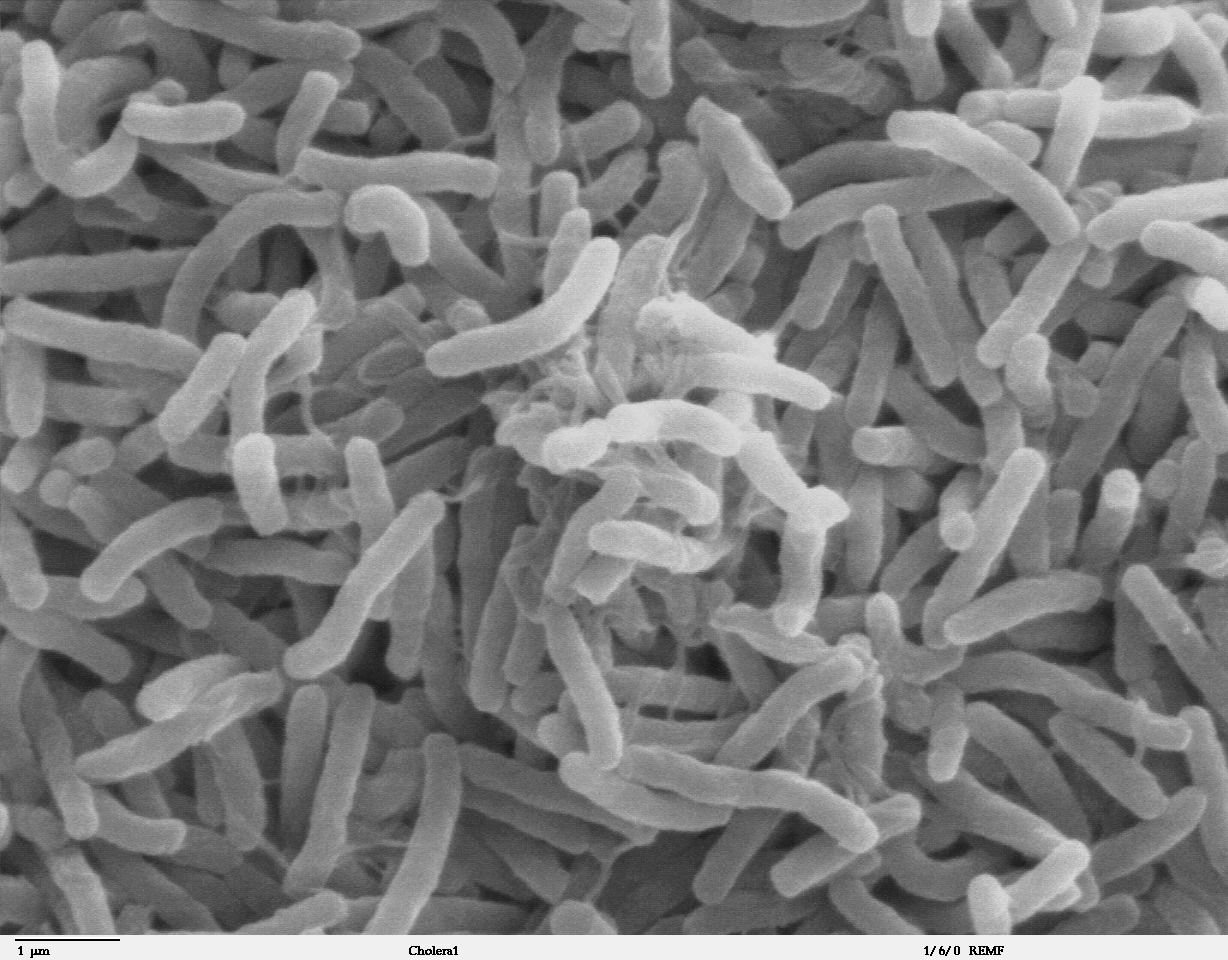
Vibrio cholerae is a species of Gram-negative, facultative anaerobe and comma-shaped bacteria. The bacteria naturally live in brackish or saltwater where they attach themselves easily to the chitin-containing shells of crabs, shrimp, and other shellfish. Some strains of V. cholerae are pathogenic to humans and cause a deadly disease called cholera, which can be derived from the consumption of undercooked or raw marine life species or drinking contaminated water.
V. cholerae was first described by Félix-Archimède Pouchet in 1849 as some kind of protozoa. Filippo Pacini correctly identified it as a bacterium and from him, the scientific name is adopted. The bacterium as the cause of cholera was discovered by Robert Koch in 1884. Sambhu Nath De isolated the cholera toxin and demonstrated the toxin as the cause of cholera in 1959.
The bacterium has a flagellum (a tail like structure) at one pole and several pili throughout its cell surface. It undergoes respiratory and fermentative metabolism. Two serogroups called O1 and O139 are responsible for cholera outbreaks. Infection is mainly through drinking contaminated water or ingestion of food contaminated with faecal matter from an infected person, therefore is linked to sanitation and hygiene. When ingested, it invades the intestinal mucosa which can cause diarrhea and vomiting in a host within several hours to 2–3 days of ingestion. Ringers lactate and Oral rehydration solution combined with antibiotics such as fluoroquinolones and tetracyclines are the common treatment methods in severe cases.
V. cholerae has two circular chromosomes. One chromosomes produces the cholera toxin (CT), a protein that causes profuse, watery diarrhea (known as "rice-water stool"). But the DNA does not directly code for the toxin as the genes for cholera toxin are carried by CTXphi (CTXφ), a temperate bacteriophage (virus). The virus only produces the toxin when inserted into the bacterial DNA. Quorum sensing in V. cholerae is well studied and it activates host immune signaling and prolongs host survival, by limiting the bacterial intake of nutrients, such as tryptophan, which further is converted to serotonin. As such, quorum sensing allows a commensal interaction between host and pathogenic bacteria.
During the third global pandemic of cholera (1846–1860), there was extensive scientific research to understand the etiology of the disease. The miasma theory, which posited that infections spread through contaminated air, was no longer a satisfactory explanation. The English physician John Snow was the first to give convincing evidence in London in 1854 that cholera was spread from drinking water – a contagion, not miasma. Yet he could not identify the pathogens, which made most people still believe in the miasma origin.
V. cholerae was first observed and recognized under microscope by the French zoologist Félix-Archimède Pouchet. In 1849, Pouchet examined the stool samples of four people having cholera. His presentation before the French Academy of Sciences on 23 April was recorded as: "[Pouchet] could verify that there existed in these [cholera patients] dejecta an immense quantity of microscopic infusoria." As summarised in the Gazette medicale de Paris (1849, p 327), in a letter read at the 23 April 1849 meeting of the Paris Academy of Sciences, Pouchet announced that the organisms were infusoria, a name then used for microscopic protists, naming them as the 'Vibrio rugula of Mueller and Shrank', a species of protozoa described by Danish naturalist Otto Friedrich Müller in 1786.
An Italian physician, Filippo Pacini, while investigating cholera outbreak in Florence in the late 1854, identified the causative pathogen as a new type of bacterium. He performed autopsies of corpses and made meticulous microscopic examinations of the tissues and body fluids. From feces and intestinal mucosa, he identified many comma-shaped bacilli. Reporting his discovery before the Società Medico-Fisica Fiorentina (Medico-Physician Society of Florence) on 10 December, and published in the 12 December issue of the Gazzetta Medica Italiana (Medical Gazette of Italy), Pacini stated:
Le poche materie del vomito che ho potuto esaminare nel secondo e terzo caso di cholera ... e di più trovai degli ammassi granulosi appianati, simili a quelli che si formano alla superficie delle acque corrotte, quando sono per svilupparsi dei vibrioni; dei quali di fatto ne trovai alcuni del genere Bacterium, mentre la massima parte, per la loro estrema piccolezza, erano stati eliminati con la decantazione del fluido. [From the few samples of vomit that I was able to examine in the second and third cases of cholera ... and in addition I found smoothed granular masses, similar to those which form on the surface of dirty waters, when they are about to develop vibrios; of which in fact I found some of the genus Bacterium, while the greatest part, because of their extreme smallness, had been eliminated with the removal of the liquid.]
Hub AI
Vibrio cholerae AI simulator
(@Vibrio cholerae_simulator)
Vibrio cholerae
Vibrio cholerae is a species of Gram-negative, facultative anaerobe and comma-shaped bacteria. The bacteria naturally live in brackish or saltwater where they attach themselves easily to the chitin-containing shells of crabs, shrimp, and other shellfish. Some strains of V. cholerae are pathogenic to humans and cause a deadly disease called cholera, which can be derived from the consumption of undercooked or raw marine life species or drinking contaminated water.
V. cholerae was first described by Félix-Archimède Pouchet in 1849 as some kind of protozoa. Filippo Pacini correctly identified it as a bacterium and from him, the scientific name is adopted. The bacterium as the cause of cholera was discovered by Robert Koch in 1884. Sambhu Nath De isolated the cholera toxin and demonstrated the toxin as the cause of cholera in 1959.
The bacterium has a flagellum (a tail like structure) at one pole and several pili throughout its cell surface. It undergoes respiratory and fermentative metabolism. Two serogroups called O1 and O139 are responsible for cholera outbreaks. Infection is mainly through drinking contaminated water or ingestion of food contaminated with faecal matter from an infected person, therefore is linked to sanitation and hygiene. When ingested, it invades the intestinal mucosa which can cause diarrhea and vomiting in a host within several hours to 2–3 days of ingestion. Ringers lactate and Oral rehydration solution combined with antibiotics such as fluoroquinolones and tetracyclines are the common treatment methods in severe cases.
V. cholerae has two circular chromosomes. One chromosomes produces the cholera toxin (CT), a protein that causes profuse, watery diarrhea (known as "rice-water stool"). But the DNA does not directly code for the toxin as the genes for cholera toxin are carried by CTXphi (CTXφ), a temperate bacteriophage (virus). The virus only produces the toxin when inserted into the bacterial DNA. Quorum sensing in V. cholerae is well studied and it activates host immune signaling and prolongs host survival, by limiting the bacterial intake of nutrients, such as tryptophan, which further is converted to serotonin. As such, quorum sensing allows a commensal interaction between host and pathogenic bacteria.
During the third global pandemic of cholera (1846–1860), there was extensive scientific research to understand the etiology of the disease. The miasma theory, which posited that infections spread through contaminated air, was no longer a satisfactory explanation. The English physician John Snow was the first to give convincing evidence in London in 1854 that cholera was spread from drinking water – a contagion, not miasma. Yet he could not identify the pathogens, which made most people still believe in the miasma origin.
V. cholerae was first observed and recognized under microscope by the French zoologist Félix-Archimède Pouchet. In 1849, Pouchet examined the stool samples of four people having cholera. His presentation before the French Academy of Sciences on 23 April was recorded as: "[Pouchet] could verify that there existed in these [cholera patients] dejecta an immense quantity of microscopic infusoria." As summarised in the Gazette medicale de Paris (1849, p 327), in a letter read at the 23 April 1849 meeting of the Paris Academy of Sciences, Pouchet announced that the organisms were infusoria, a name then used for microscopic protists, naming them as the 'Vibrio rugula of Mueller and Shrank', a species of protozoa described by Danish naturalist Otto Friedrich Müller in 1786.
An Italian physician, Filippo Pacini, while investigating cholera outbreak in Florence in the late 1854, identified the causative pathogen as a new type of bacterium. He performed autopsies of corpses and made meticulous microscopic examinations of the tissues and body fluids. From feces and intestinal mucosa, he identified many comma-shaped bacilli. Reporting his discovery before the Società Medico-Fisica Fiorentina (Medico-Physician Society of Florence) on 10 December, and published in the 12 December issue of the Gazzetta Medica Italiana (Medical Gazette of Italy), Pacini stated:
Le poche materie del vomito che ho potuto esaminare nel secondo e terzo caso di cholera ... e di più trovai degli ammassi granulosi appianati, simili a quelli che si formano alla superficie delle acque corrotte, quando sono per svilupparsi dei vibrioni; dei quali di fatto ne trovai alcuni del genere Bacterium, mentre la massima parte, per la loro estrema piccolezza, erano stati eliminati con la decantazione del fluido. [From the few samples of vomit that I was able to examine in the second and third cases of cholera ... and in addition I found smoothed granular masses, similar to those which form on the surface of dirty waters, when they are about to develop vibrios; of which in fact I found some of the genus Bacterium, while the greatest part, because of their extreme smallness, had been eliminated with the removal of the liquid.]