
Recent from talks
Cholera toxin
Knowledge base stats:
Talk channels stats:
Members stats:
Cholera toxin
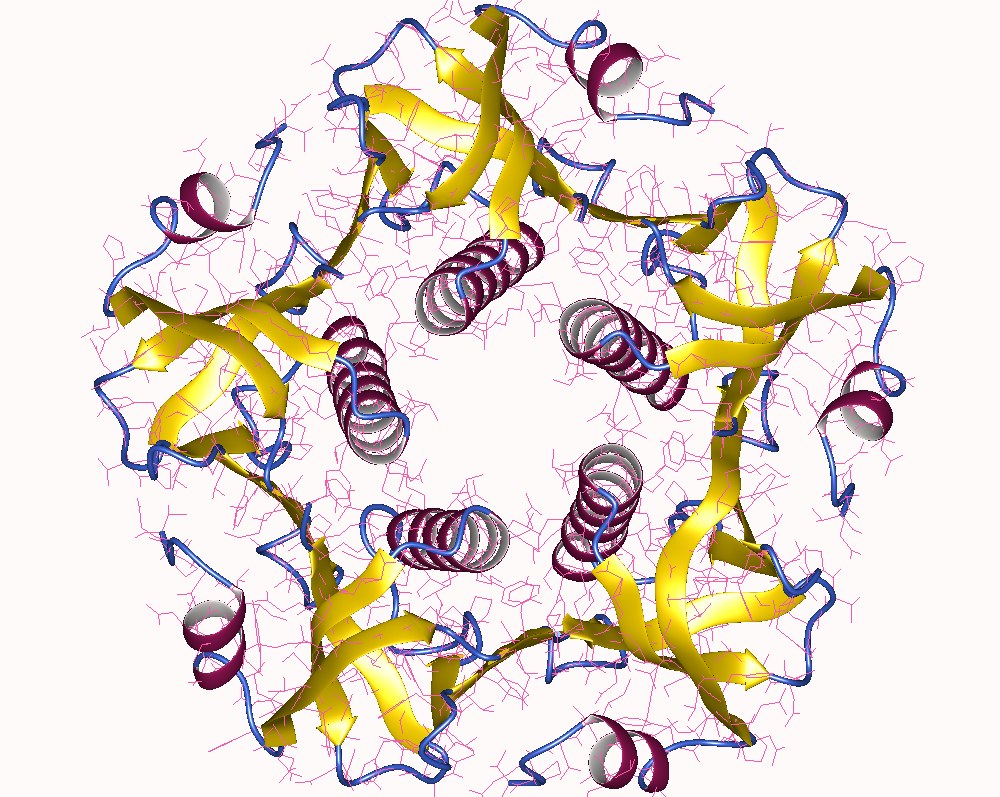
Cholera toxin (also known as choleragen, CTX, CTx and CT) is a potent enterotoxin produced by the bacterium Vibrio cholerae which causes severe watery diarrhea and dehydration that define cholera infections. The toxin is a member of the heat-labile enterotoxin family, and exists as an AB5 multimeric toxin with one enzymatically active A subunit and five receptor-binding B subunits that facilitate host cell entry.
Vibrio cholerae producing cholera toxin are the causative pathogenic agent of the ancient disease cholera, originally found in Asia and Europe. The first modern global pandemic emerged in the Ganges Delta in 1817. Globalization that was developing in the nineteenth century spread it worldwide through the course of seven subsequent pandemics. When cholera arrived in London in 1832, its transmission was poorly understood, with many blaming miasma. A physician, John Snow (1813–1858), was an advocate of water contamination as the cause of its spread—famously ending an outbreak by removing a public water pump handle in central London. His theory however, only gained acceptance years after his death, through the discovery of the bacteria Vibrio cholerae.
The discovery of the cholera toxin has widely been accredited to Robert Koch, a physician and microbiologist. In 1886, Koch hypothesised that Vibrio cholerae produced a substance that caused cholera symptoms. However, the isolation of the bacteria had already been conducted 30 years earlier by Italian anatomist Fillippo Pacini, who had subsequently published his work in his native language.
In 1951, Sambhu Nath De confirmed Koch's hypothesis, through De's research that involved injecting heat-killed V. cholerae into rabbits. From this experiment he determined that an endotoxin is released as the bacteria disintegrate, and that this endotoxin is responsible for the disease symptoms. Then, in 1959, De performed a follow-up experiment, injecting bacteria-free culture filtrate of V. cholerae into the rabbit's small intestines and thereby proving the existence of cholera toxin by the fluid accumulation.
The next decade saw Richard Finkelstein's research team successfully isolating and purifying the cholera toxin (CT). This research identified the holotoxin (AB5) as the primary active agent, whereas the B5 oligomer lacked intrinsic toxicity but played a key role in triggering cholera symptoms. Subsequent biochemical methods confirmed the complex subunit structure of the toxin, leading to our current comprehensive understanding of its mechanisms.
Another significant landmark occurred in 1973 when King and van Heyningen identified the GM1 ganglioside as the CT receptor. Their experiments revealed that the GM1 blocked the toxin's ability to enhance capillary permeability in rabbit skin, preventing fluid accumulation in ligated rabbit intestinal loops. Additionally, they discovered that the receptor obstructed its effect on the adenylyl cyclase pathway in guinea pig intestinal tissue. These findings would come to aid in future pursuits of medical applications of the toxin, through increasingly detailed knowledge of its functional abilities.
Modern sanitation facilities have almost completely removed cholera from industrialized nations, in contrast to economically disadvantaged regions where the disease claims over 100,000 annual deaths. The disease primarily targets people who live in areas with inadequate water sanitation, ongoing conflicts, and restricted healthcare access. A prominent example is the 2010 Haiti earthquake, which caused the worst modern cholera epidemic after a 10-month lag period.
Currently, there are recorded over 200 serogroups of V. cholerae, of which only serogroup O1 and O139 lead to epidemic sickness, whereas serotypes that cause sporadic outbreaks are termed non-O1/non-O139 V. cholerae. Serogroup O1 has two distinctive biotypes, namely El Tor and Classical and has been the reason for all seven pandemics. O1 El Tor (strain16961) extensively replaced the classical biotype during the start of the seventh pandemic in the 1960s. Furthermore, serogroup O139 appeared in 1992, and remains prevalent today.
Hub AI
Cholera toxin AI simulator
(@Cholera toxin_simulator)
Cholera toxin
Cholera toxin (also known as choleragen, CTX, CTx and CT) is a potent enterotoxin produced by the bacterium Vibrio cholerae which causes severe watery diarrhea and dehydration that define cholera infections. The toxin is a member of the heat-labile enterotoxin family, and exists as an AB5 multimeric toxin with one enzymatically active A subunit and five receptor-binding B subunits that facilitate host cell entry.
Vibrio cholerae producing cholera toxin are the causative pathogenic agent of the ancient disease cholera, originally found in Asia and Europe. The first modern global pandemic emerged in the Ganges Delta in 1817. Globalization that was developing in the nineteenth century spread it worldwide through the course of seven subsequent pandemics. When cholera arrived in London in 1832, its transmission was poorly understood, with many blaming miasma. A physician, John Snow (1813–1858), was an advocate of water contamination as the cause of its spread—famously ending an outbreak by removing a public water pump handle in central London. His theory however, only gained acceptance years after his death, through the discovery of the bacteria Vibrio cholerae.
The discovery of the cholera toxin has widely been accredited to Robert Koch, a physician and microbiologist. In 1886, Koch hypothesised that Vibrio cholerae produced a substance that caused cholera symptoms. However, the isolation of the bacteria had already been conducted 30 years earlier by Italian anatomist Fillippo Pacini, who had subsequently published his work in his native language.
In 1951, Sambhu Nath De confirmed Koch's hypothesis, through De's research that involved injecting heat-killed V. cholerae into rabbits. From this experiment he determined that an endotoxin is released as the bacteria disintegrate, and that this endotoxin is responsible for the disease symptoms. Then, in 1959, De performed a follow-up experiment, injecting bacteria-free culture filtrate of V. cholerae into the rabbit's small intestines and thereby proving the existence of cholera toxin by the fluid accumulation.
The next decade saw Richard Finkelstein's research team successfully isolating and purifying the cholera toxin (CT). This research identified the holotoxin (AB5) as the primary active agent, whereas the B5 oligomer lacked intrinsic toxicity but played a key role in triggering cholera symptoms. Subsequent biochemical methods confirmed the complex subunit structure of the toxin, leading to our current comprehensive understanding of its mechanisms.
Another significant landmark occurred in 1973 when King and van Heyningen identified the GM1 ganglioside as the CT receptor. Their experiments revealed that the GM1 blocked the toxin's ability to enhance capillary permeability in rabbit skin, preventing fluid accumulation in ligated rabbit intestinal loops. Additionally, they discovered that the receptor obstructed its effect on the adenylyl cyclase pathway in guinea pig intestinal tissue. These findings would come to aid in future pursuits of medical applications of the toxin, through increasingly detailed knowledge of its functional abilities.
Modern sanitation facilities have almost completely removed cholera from industrialized nations, in contrast to economically disadvantaged regions where the disease claims over 100,000 annual deaths. The disease primarily targets people who live in areas with inadequate water sanitation, ongoing conflicts, and restricted healthcare access. A prominent example is the 2010 Haiti earthquake, which caused the worst modern cholera epidemic after a 10-month lag period.
Currently, there are recorded over 200 serogroups of V. cholerae, of which only serogroup O1 and O139 lead to epidemic sickness, whereas serotypes that cause sporadic outbreaks are termed non-O1/non-O139 V. cholerae. Serogroup O1 has two distinctive biotypes, namely El Tor and Classical and has been the reason for all seven pandemics. O1 El Tor (strain16961) extensively replaced the classical biotype during the start of the seventh pandemic in the 1960s. Furthermore, serogroup O139 appeared in 1992, and remains prevalent today.
Recent media